
- Protocol
- Published:
- Tianhong Qiao (乔天鸿) ORCID: orcid.org/0009-0009-8578-60331,2,3,
- Chaofan He (何超凡) ORCID: orcid.org/0000-0003-3574-72971,2,3,
- Pengcheng Xia (夏鹏程)4,
- Guofeng Liu (刘国峰)1,2,3,
- Yuan Sun (孙元)1,2,3,
- Miao Sun (孙苗)5,6,
- Yi Wang (王毅)7,
- Yiyu Cheng (程翼宇)7,
- Mengfei Yu (俞梦飞)5,6 &
- …
- Yong He (贺永) ORCID: orcid.org/0000-0002-9099-08311,2,3
Subjects
Abstract
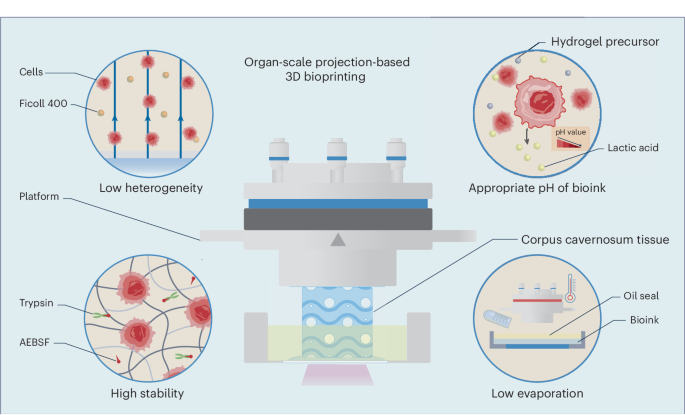
Projection-based three-dimensional bioprinting offers an approach for manufacturing biomimetic tissues with complex spatial structures and bioactivity, presenting potential for creating implantable organs or organoids to test drug response. Nevertheless, the extended printing times required for organ-scale manufacturing represents a challenge. Here we provide step-by-step instructions to manufacture organ-scale structures using bioinks while preserving high bioactivity. This approach incorporates Ficoll 400 to mitigate the heterogeneity of bioink with respect to refractive index and density, while 4-(2-aminoethyl)benzenesulfonyl fluoride and oil-sealing ensure the stability of the bioink components, thereby allowing extended printing times. This procedure also enables high-cell-viability printing via the calibration of the pH value of the bioink. This Protocol is appropriate for users with basic laboratory skills and fundamental knowledge in biotechnology to manufacture organ-scale structures for utilization in a wide variety of experimental designs. The approach is generalizable, as demonstrated by the successful printing of corpora cavernosa structures with a cell density of 10 million per milliliter, measuring 10 mm × 10 mm × 10 mm. After 7 d of culture, the cell viability was measured at 82.5%, highlighting the potential applicability in tissue engineering. All bioink preparation and printing steps are expected to take 5 h, while the development of printed structures requires 7 d of continuous culture.
Key points
-
We provide a versatile process for the fabrication of organ-scale structures with complex spatial architectures and high bioactivity using bioinks. We use Ficoll 400 to reduce bioink heterogeneity, while 4-(2-aminoethyl)benzenesulfonyl fluoride and oil-sealing ensure the components’ stability, enabling extended printing time.
-
This Protocol permits organ-scale printing without the need to modify existing 3D bioprinting equipment. It makes this Protocol an economical, stable and easily scalable 3D bioprinting solution.
This is a preview of subscription content, access via your institution
Access options
Access Nature and 54 other Nature Portfolio journals
Get Nature+, our best-value online-access subscription
$32.99 / 30 days
cancel any time
Subscribe to this journal
Receive 12 print issues and online access
$259.00 per year
only $21.58 per issue
Buy this article
- Purchase on SpringerLink
- Instant access to full article PDF
Prices may be subject to local taxes which are calculated during checkout
Data availability
All remaining data generated or analyzed during this protocol are included in this published article and its supplementary files.
References
-
Zandrini, T., Florczak, S., Levato, R. & Ovsianikov, A. Breaking the resolution limits of 3D bioprinting: future opportunities and present challenges. Trends Biotechnol. 41, 604–614 (2023).
-
Zhu, W. et al. 3D printing of functional biomaterials for tissue engineering. Curr. Opin. Biotechnol. 40, 103–112 (2016).
-
Murphy, S. V. & Atala, A. 3D bioprinting of tissues and organs. Nat. Biotechnol. 32, 773–785 (2014).
-
Yu, C. et al. Photopolymerizable biomaterials and light-based 3D printing strategies for biomedical applications. Chem. Rev. 120, 10695–10743 (2020).
-
Matai, I., Kaur, G., Seyedsalehi, A., McClinton, A. & Laurencin, C. T. Progress in 3D bioprinting technology for tissue/organ regenerative engineering. Biomaterials 226, 119536 (2020).
-
Zhang, Y. S. et al. 3D bioprinting for tissue and organ fabrication. Ann. Biomed. Engin. 45, 148–163 (2016).
-
He, C. et al. 3D printing for tissue/organ regeneration in China. Bio-Des. Manuf. 8, 169–242 (2025).
-
Gardin, J. M. et al. Echocardiographic measurements in normal subjects: evaluation of an adult population without clinically apparent heart disease. J. Clin. Ultrasound 7, 439–447 (1979).
-
Silva, R. M., Pereira, R. B. & Siqueira, M. V. Correlation between clinical evaluation of liver size versus ultrasonography evaluation according to body mass index (BMI) and biotypes. Rev. Med. Chil. 138, 1495–1501 (2010).
-
Frank, K., Linhart, P., Kortsik, C. & Wohlenberg, H. Sonographic determination of spleen size—standard dimensions in the healthy adult. Ultraschall Med. 7, 134–137 (1986).
-
Dinkel, E. et al. Kidney size in childhood sonographical growth charts for kidney length and volume. Pediatr. Radiol. 15, 38–43 (1985).
-
Yu, C. et al. Scanningless and continuous 3D bioprinting of human tissues with decellularized extracellular matrix. Biomaterials 194, 1–13 (2019).
-
Wang, Z., Lee, S. J., Cheng, H.-J., Yoo, J. J. & Atala, A. 3D bioprinted functional and contractile cardiac tissue constructs. Acta Biomaterialia 70, 48–56 (2018).
-
Wang, J. et al. Engineering large-scale self-mineralizing bone organoids with bone matrix-inspired hydroxyapatite hybrid bioinks. Adv. Mater. https://doi.org/10.1002/adma.202309875 (2024).
-
Jorgensen, A. M., Yoo, J. J. & Atala, A. Solid organ bioprinting: strategies to achieve organ function. Chem. Rev. 120, 11093–11127 (2020).
-
Leberfinger, A. N. et al. Bioprinting functional tissues. Acta Biomater. 95, 32–49 (2019).
-
Torrent-Guasp, F. et al. The structure and function of the helical heart and its buttress wrapping. I. The normal macroscopic structure of the heart. Semin. Thorac. Cardiovasc. Surg. 13, 301–319 (2001).
-
Moroni, L. et al. Biofabrication: a guide to technology and terminology. Trends Biotechnol. 36, 384–402 (2018).
-
Gu, Z., Fu, J., Lin, H. & He, Y. Development of 3D bioprinting: from printing methods to biomedical applications. Asian J. Pharm. Sci. 15, 529–557 (2020).
-
You, S. T. et al. High cell density and high-resolution 3D bioprinting for fabricating vascularized tissues. Sci. Adv. 9, eade7923 (2023).
-
He, C.-F., Qiao, T.-H., Wang, G.-H., Sun, Y. & He, Y. High-resolution projection-based 3D bioprinting. Nat. Rev. Bioeng. https://doi.org/10.1038/s44222-024-00218-w (2024).
-
Yu, K. et al. Printability during projection-based 3D bioprinting. Bioact. Mater. 11, 254–267 (2022).
-
Almeida-Pinto, J., Moura, B. S., Gaspar, V. M. & Mano, J. F. Advances in cell-rich inks for biofabricating living architectures. Adv. Mater. https://doi.org/10.1002/adma.202313776 (2024).
-
He, C.-F. et al. Formation theory and printability of photocurable hydrogel for 3D bioprinting. Adv. Funct. Mater. https://doi.org/10.1002/adfm.202301209 (2023).
-
He, C.-F. et al. Printability in multi-material projection-based 3-dimensional bioprinting. Research https://doi.org/10.34133/research.0613 (2025).
-
Sun, Y. et al. Modeling the printability of photocuring and strength adjustable hydrogel bioink during projection-based 3D bioprinting. Biofabrication https://doi.org/10.1088/1758-5090/aba413 (2021).
-
Zhao, L. et al. Single-cell transcriptome atlas of the human corpus cavernosum. Nat. Commun. 13, 4302 (2022).
-
Jahangir, S. et al. Cell-laden 3D printed gelMA/HAp and THA hydrogel bioinks: development of osteochondral tissue-like bioinks. Materials https://doi.org/10.3390/ma16227214 (2023).
-
Lee, J. S. et al. 3D-printable photocurable bioink for cartilage regeneration of tonsil-derived mesenchymal stem cells. Addit. Manuf. https://doi.org/10.1016/j.addma.2020.101136 (2020).
-
Zhang, L. et al. Fabrication of multi-channel nerve guidance conduits containing schwann cells based on multi-material 3D bioprinting. 3D Print. Addit. Manuf. 10, 1046–1054 (2023).
-
Bernal, P. N. et al. Volumetric bioprinting of organoids and optically tuned hydrogels to build liver-like metabolic biofactories. Adv. Mater. 34, e2110054 (2022).
-
Tanadchangsaeng, N. et al. 3D bioprinting of fish skin-based gelatin methacryloyl (GelMA) bio-ink for use as a potential skin substitute. Sci. Rep. https://doi.org/10.1038/s41598-024-73774-1 (2024).
-
Wang, P., Wang, T., Xu, Y., Song, N. & Zhang, X. 3D-bioprinted cell-laden hydrogel with anti-inflammatory and anti-bacterial activities for tracheal cartilage regeneration and restoration. Int. J. Bioprint. https://doi.org/10.36922/ijb.0146 (2023).
-
Tang, H. et al. A bioengineered trachea-like structure improves survival in a rabbit tracheal defect model. Sci. Transl. Med. 15, eabo4272 (2023).
-
Shao, L. et al. Directly coaxial 3D bioprinting of large-scale vascularized tissue constructs. Biofabrication 12, https://doi.org/10.1088/1758-5090/ab7e76 (2020).
-
Xu, L. et al. Bioprinting small diameter blood vessel constructs with an endothelial and smooth muscle cell bilayer in a single step. Biofabrication 12, https://doi.org/10.1088/1758-5090/aba2b6 (2020).
-
Wang, Z. et al. 3D printing-electrospinning hybrid nanofibrous scaffold as LEGO-like bricks for modular assembling skeletal muscle-on-a-chip functional platform. Adv. Fiber Mater. https://doi.org/10.1007/s42765-024-00433-5 (2024).
-
Li, T. et al. Bioprinted anisotropic scaffolds with fast stress relaxation bioink for engineering 3D skeletal muscle and repairing volumetric muscle loss. Acta Biomater. 156, 21–36 (2023).
-
Su, H. et al. Development of digital light processing-based multi-material bioprinting for fabrication of heterogeneous tissue constructs. Biomater. Sci. 11, 6663–6673 (2023).
-
Kumari, S., Mondal, P. & Chatterjee, K. Digital light processing-based 3D bioprinting of kappa-carrageenan hydrogels for engineering cell-loaded tissue scaffolds. Carbohydr. Polym. 290, 119508 (2022).
-
Rajput, M., Mondal, P., Yadav, P. & Chatterjee, K. Light-based 3D bioprinting of bone tissue scaffolds with tunable mechanical properties and architecture from photocurable silk fibroin. Int. J. Biol. Macromol. 202, 644–656 (2022).
-
Wang, M. et al. Molecularly cleavable bioinks facilitate high-performance digital light processing-based bioprinting of functional volumetric soft tissues. Nat. Commun. 13, 3317 (2022).
-
Chen, S., Wang, Y., Lai, J., Tan, S. & Wang, M. Structure and properties of gelatin methacryloyl (GelMA) synthesized in different reaction systems. Biomacromolecules 24, 2928–2941 (2023).
-
Pepelanova, I., Kruppa, K., Scheper, T. & Lavrentieva, A. Gelatin-methacryloyl (GelMA) hydrogels with defined degree of functionalization as a versatile toolkit for 3D cell culture and extrusion bioprinting. Bioengineering https://doi.org/10.3390/bioengineering5030055 (2018).
-
Nichol, J. W. et al. Cell-laden microengineered gelatin methacrylate hydrogels. Biomaterials 31, 5536–5544 (2010).
-
He, J. et al. Gelatin methacryloyl hydrogel, from standardization, performance, to biomedical application. Adv. Healthc. Mater. 12, e2300395 (2023).
-
Hossain Rakin, R. et al. Tunable metacrylated hyaluronic acid-based hybrid bioinks for stereolithography 3D bioprinting. Biofabrication https://doi.org/10.1088/1758-5090/ac25cb (2021).
-
Arguchinskaya, N. V. et al. Properties and printability of the synthesized hydrogel based on GelMA. Int. J. Mol. Sci. https://doi.org/10.3390/ijms24032121 (2023).
-
Grigoryan, B. et al. BIOMEDICINE multivascular networks and functional intravascular topologies within biocompatible hydrogels. Science 364, 458–464 (2019).
-
He, N. et al. Photoinhibiting via simultaneous photoabsorption and free-radical reaction for high-fidelity light-based bioprinting. Nat. Commun. 14, 3063 (2023).
-
Yang, M. et al. Multi-material digital light processing (DLP) bioprinting of heterogeneous hydrogel constructs with perfusable networks. Adv. Funct. Mater. https://doi.org/10.1002/adfm.202316456 (2024).
-
Fang, H. et al. Clay sculpture-inspired 3D printed microcage module using bioadhesion assembly for specific-shaped tissue vascularization and regeneration. Adv. Sci. 11, e2308381 (2024).
-
Kunwar, P. et al. Droplet bioprinting of acellular and cell-laden structures at high-resolutions. Biofabrication https://doi.org/10.1088/1758-5090/ad4c09 (2024).
-
Highland, H. N., Rishika, A. S., Almira, S. S. & Kanthi, P. B. Ficoll-400 density gradient method as an effective sperm preparation technique for assisted reproductive techniques. J. Hum. Reprod. Sci. 9, 194–199 (2016).
-
Jiang, Y.-h et al. Serine protease inhibitor 4-(2-aminoethyl)benzenesulfonyl fluoride hydrochloride (AEBSF) inhibits the rat embryo implantation in vivo and interferes with cell adhesion in vitro. Contraception 84, 642–648 (2011).
-
Misinzo, G., Delputte, P. L. & Nauwynck, H. J. Inhibition of endosome-lysosome system acidification enhances porcine circovirus 2 infection of porcine epithelial cells. J. Virol. 82, 1128–1135 (2008).
Acknowledgements
This work was sponsored by the National Natural Science Foundation of China (grant nos. 52235007, T2121004 and 52325504) and Key R&D Program of Zhejiang (grant no. 2024SSYS0027).
Ethics declarations
Competing interests
The authors declare no competing interests.
Peer review
Peer review information
Nature Protocols thanks Hyungseok Lee, Yeong-Jin Choi, and the other, anonymous, reviewer(s) for their contribution to the peer review of this work.
Additional information
Publisher’s note Springer Nature remains neutral with regard to jurisdictional claims in published maps and institutional affiliations.
Key references
He, C. F. et al. Research 8, 0613 (2025): https://doi.org/10.34133/research.0613
He, C. F. et al. Adv. Funct. Mater. 33, 2301209 (2023): https://doi.org/10.1002/adfm.202301209
Yu, K. et al. Bioact. Mater. 11, 254–267 (2022): https://doi.org/10.1016/j.bioactmat.2021.09.021
Sun, Y. et al. Biofabrication 13, 035032 (2021): https://doi.org/10.1088/1758-5090/aba413
Extended data
Extended Data Fig. 1 The adaptability of bioink formulations.
a) Photographs of organ-scale 3D structures printed using SilMA (DS = 30%) as a substitute for GelMA. b) Photographs of organ-scale 3D structures printed using hydrogel precursor solutions within the acceptable DS range (4% GelMA + 5% PEGDA, with GelMA having a DS of 40%; the compressive modulus of bioink is 18.00 kPa). c) Photographs of organ-scale 3D structures printed using a higher concentration (7.5%) of hydrogel precursor solution. d) Photographs of organ-scale 3D structures printed using a higher (10%) concentration of hydrogel precursor solution. e) Compressive properties of bioinks with different concentrations. f) Compressive moduli of bioinks with different concentrations. Data are displayed as mean ± SD, n = 3.
Extended Data Fig. 3 Cell viability among the layers of the printed structures.
a) Micrographs showing live (green)/dead (red) staining of cells encapsulated in the printed rectangular structures. b) Photographs of the printed rectangular structures. c) Results of the live/dead assays showing cell viability among the layers of the printed rectangular structures. d) Results of the live/dead assays showing cell viability of the printed rectangular structures. Data are displayed as mean ± SD, n = 4.
Extended Data Fig. 4
Immunofluorescence images showing staining for DAPI (blue), α-SMA (green), Phalloidin (red) of the cells encapsulated in the printed structures after 3 days of culture.
Extended Data Fig. 5
High-magnification Immunofluorescence images showing staining of the cells after 7 days of culture.
Extended Data Fig. 6
Immunofluorescence images showing HUVEC (red), USMC (green), and RS1 (blue) within the printed structures after 0, 2, 4, 6 days of culture.
Extended Data Fig. 8
Low-magnification Immunofluorescence images showing staining of the cells after 7 days of culture.
Extended Data Fig. 9 Scale expansion of organ-scale bioprinting.
a) Photographs of printed structures (14mm×14mm×14mm) after culturing 7 days. b) Immunofluorescence images showing staining for DAPI (blue), α-SMA (green), Phalloidin (red) of the cells encapsulated in the printed structures (14mm×14mm×14mm) after 7 days of culture. c) Photographs of printed structures (18mm × 18mm × 18mm) after culturing 7 days.
Supplementary information
Rights and permissions
Springer Nature or its licensor (e.g. a society or other partner) holds exclusive rights to this article under a publishing agreement with the author(s) or other rightsholder(s); author self-archiving of the accepted manuscript version of this article is solely governed by the terms of such publishing agreement and applicable law.
About this article

Cite this article
Qiao, T., He, C., Xia, P. et al. Bioink design for organ-scale projection-based 3D bioprinting. Nat Protoc (2025). https://doi.org/10.1038/s41596-025-01221-0
-
Received:
-
Accepted:
-
Published:
-
DOI: https://doi.org/10.1038/s41596-025-01221-0