
Data availability
The authors declare that all the data supporting the findings of this research are available within the article and its Supplementary Information. Source data are available upon reasonable request. Source data are provided with this paper.
References
-
Vargason, A. M., Anselmo, A. C. & Mitragotri, S. The evolution of commercial drug delivery technologies. Nat. Biomed. Eng. 5, 951–967 (2021).
-
Baryakova, T. H., Pogostin, B. H., Langer, R. & McHugh, K. J. Overcoming barriers to patient adherence: the case for developing innovative drug delivery systems. Nat. Rev. Drug Discov. 22, 387–409 (2023).
-
Lagreca, E. et al. Recent advances in the formulation of PLGA microparticles for controlled drug delivery. Prog. Biomater. 9, 153–174 (2020).
-
Kirtane, A. R. et al. Nanotechnology approaches for global infectious diseases. Nat. Nanotechnol. 16, 369–384 (2021).
-
Pons-Faudoa, F. P., Ballerini, A., Sakamoto, J. & Grattoni, A. Advanced implantable drug delivery technologies: transforming the clinical landscape of therapeutics for chronic diseases. Biomed. Microdevices 21, 47 (2019).
-
Loder, E. W., Rayhill, M. & Burch, R. C. Safety problems with a transdermal patch for migraine: lessons from the development, approval, and marketing process. Headache 58, 1639–1657 (2018).
-
Li, J. & Mooney, D. J. Designing hydrogels for controlled drug delivery. Nat. Rev. Mater. 1, 1–17 (2016).
-
Lim, J. Y. C., Lin, Q., Xue, K. & Loh, X. J. Recent advances in supramolecular hydrogels for biomedical applications. Mater. Today Adv. 3, 100021 (2019).
-
Dong, R., Pang, Y., Su, Y. & Zhu, X. Supramolecular hydrogels: synthesis, properties and their biomedical applications. Biomater. Sci. 3, 937–954 (2015).
-
Smith, D. J. et al. A multiphase transitioning peptide hydrogel for suturing ultrasmall vessels. Nat. Nanotechnol. 11, 95–102 (2016).
-
Majumder, P. et al. Surface-fill hydrogel attenuates the oncogenic signature of complex anatomical surface cancer in a single application. Nat. Nanotechnol. 16, 1251–1259 (2021).
-
Yan, C. & Pochan, D. J. Rheological properties of peptide-based hydrogels for biomedical and other applications. Chem. Soc. Rev. 39, 3528–3540 (2010).
-
Gelain, F., Luo, Z., Rioult, M. & Zhang, S. Self-assembling peptide scaffolds in the clinic. npj Regen. Med. 6, 1–8 (2021).
-
Dzierżyńska, M. et al. Release systems based on self-assembling RADA16-I hydrogels with a signal sequence which improves wound healing processes. Sci. Rep. 13, 6273 (2023).
-
Zhang, Z., Ai, S., Yang, Z. & Li, X. Peptide-based supramolecular hydrogels for local drug delivery. Adv. Drug Deliv. Rev. 174, 482–503 (2021).
-
Rehmann, M. S. et al. Tuning and predicting mesh size and protein release from step growth hydrogels. Biomacromolecules 18, 3131–3142 (2017).
-
Moore, A. N. & Hartgerink, J. D. Self-assembling multidomain peptide nanofibers for delivery of bioactive molecules and tissue regeneration. Acc. Chem. Res. 50, 714–722 (2017).
-
Moore, A. N. et al. Nanofibrous peptide hydrogel elicits angiogenesis and neurogenesis without drugs, proteins, or cells. Biomaterials 161, 154–163 (2018).
-
Pogostin, B. H. et al. Dynamic imine bonding facilitates mannan release from a nanofibrous peptide hydrogel. Bioconjug. Chem. 34, 193–203 (2023).
-
Pogostin, B. H. et al. Multidomain peptide hydrogel adjuvants elicit strong bias towards humoral immunity. Biomater. Sci. 10, 6217–6229 (2022).
-
Kumar, V. A. et al. Drug-triggered and cross-linked self-assembling nanofibrous hydrogels. J. Am. Chem. Soc. 137, 4823–4830 (2015).
-
Nambiar, M. & Schneider, J. P. Peptide hydrogels for affinity-controlled release of therapeutic cargo: current and potential strategies. J. Pept. Sci. 28, e3377 (2022).
-
Yaguchi, A. et al. Efficient protein incorporation and release by a jigsaw-shaped self-assembling peptide hydrogel for injured brain regeneration. Nat. Commun. 12, 6623 (2021).
-
Ji, T. et al. Delivery of local anaesthetics by a self-assembled supramolecular system mimicking their interactions with a sodium channel. Nat. Biomed. Eng. 5, 1099–1109 (2021).
-
Ulrich, S. Growing prospects of dynamic covalent chemistry in delivery applications. Acc. Chem. Res. 52, 510–519 (2019).
-
Stubelius, A., Lee, S. & Almutairi, A. The chemistry of boronic acids in nanomaterials for drug delivery. Acc. Chem. Res. 52, 3108–3119 (2019).
-
Plescia, J. & Moitessier, N. Design and discovery of boronic acid drugs. Eur. J. Med. Chem. 195, 112270 (2020).
-
Al-Omari, M. K. et al. Organoboronic acids/esters as effective drug and prodrug candidates in cancer treatments: challenge and hope. J. Enzyme Inhib. Med. Chem. 38, 2220084 (2023).
-
Lü, C., Li, H., Wang, H. & Liu, Z. Probing the interactions between boronic acids and cis-diol-containing biomolecules by affinity capillary electrophoresis. Anal. Chem. 85, 2361–2369 (2013).
-
Gosecki, M. & Gosecka, M. Boronic acid esters and anhydrates as dynamic cross-links in vitrimers. Polymers 14, 842 (2022).
-
Brooks, W. L. A., Deng, C. C. & Sumerlin, B. S. Structure-reactivity relationships in boronic acid-diol complexation. ACS Omega 3, 17863–17870 (2018).
-
Springsteen, G. & Wang, B. A detailed examination of boronic acid–diol complexation. Tetrahedron 58, 5291–5300 (2002).
-
Zhang, L., Kerszulis, J. A., Clark, R. J., Ye, T. & Zhu, L. Catechol boronate formation and its electrochemical oxidation. Chem. Commun. https://doi.org/10.1039/B900016J (2009).
-
Strawbridge, S. M., Green, S. J. & Tucker, J. H. R. Electrochemical detection of catechol and dopamine as their phenylboronate ester derivatives. Chem. Commun. 23, 2393–2394 (2000).
-
Graham, B. J., Windsor, I. W., Gold, B. & Raines, R. T. Boronic acid with high oxidative stability and utility in biological contexts. Proc. Natl Acad. Sci. USA 118, e2013691118 (2021).
-
Yang, J., Saggiomo, V., Velders, A. H., Stuart, M. A. C. & Kamperman, M. Reaction pathways in catechol/primary amine mixtures: a window on crosslinking chemistry. PLoS ONE 11, e0166490 (2016).
-
Zhao, F. et al. An injectable particle-hydrogel hybrid system for glucose-regulatory insulin delivery. Acta Biomater. 64, 334–345 (2017).
-
Arzt, M., Seidler, C., Ng, D. Y. W. & Weil, T. Reversible click reactions with boronic acids to build supramolecular architectures in water. Chem. Asian J. 9, 1994–2003 (2014).
-
Stolowitz, M. L. et al. Phenylboronic acid−salicylhydroxamic acid bioconjugates. 1. A novel boronic acid complex for protein immobilization. Bioconjug. Chem. 12, 229–239 (2001).
-
Aulisa, L., Dong, H. & Hartgerink, J. D. Self-assembly of multidomain peptides: sequence variation allows control over cross-linking and viscoelasticity. Biomacromolecules 10, 2694–2698 (2009).
-
Butler, M. S. & Paterson, D. L. Antibiotics in the clinical pipeline in October 2019. J. Antibiot. 73, 329–364 (2020).
-
Liu, J., Zhao, R., Jiang, X., Li, Z. & Zhang, B. Progress on the application of bortezomib and bortezomib-based nanoformulations. Biomolecules 12, 51 (2022).
-
Bilińska, M., Usnarska-Zubkiewicz, L. & Pokryszko-Dragan, A. Bortezomib-induced painful neuropathy in patients with multiple myeloma. Contemp. Oncol. 17, 421–426 (2013).
-
Qu, Y. et al. Subcutaneous injection of a bortezomib-loaded thermosensitive hydrogel for the treatment of multiple myeloma. Chem. Eng. J. 455, 140600 (2023).
-
Wiberg, K. et al. In vitro activity of bortezomib in cultures of patient tumour cells—potential utility in haematological malignancies. Med. Oncol. 26, 193–201 (2009).
-
Tan, C. R. C., Abdul-Majeed, S., Cael, B. & Barta, S. K. Clinical pharmacokinetics and pharmacodynamics of bortezomib. Clin. Pharmacokinet. 58, 157–168 (2019).
-
Wu, V. M., Arch, R. H., Canton, D. A. & Zhang, J. Intratumoral delivery of immune therapy and gene therapy: the next era for cancer therapy. Immunotherapy 15, 853–865 (2023).
-
Williamson, M. J. et al. The relationship among tumor architecture, pharmacokinetics, pharmacodynamics, and efficacy of bortezomib in mouse xenograft models. Mol. Cancer Ther. 8, 3234–3243 (2009).
-
Chimeh, R. A. et al. Clinical and economic impact of medication non-adherence in drug-susceptible tuberculosis: a systematic review. Int. J. Tuberc. Lung Dis. 24, 811–819 (2020).
-
Hirsch-Moverman, Y., Daftary, A., Franks, J. & Colson, P. W. Adherence to treatment for latent tuberculosis infection: systematic review of studies in the US and Canada. Int. J. Tuberc. Lung Dis. 12, 1235–1254 (2008).
-
Tenero, D. et al. First-time-in-human study and prediction of early bactericidal activity for GSK3036656, a potent leucyl-tRNA synthetase inhibitor for tuberculosis treatment. Antimicrob. Agents Chemother. 63, e00240-19 (2019).
-
Lopez-Silva, T. L. et al. Chemical functionality of multidomain peptide hydrogels governs early host immune response. Biomaterials 231, 119667 (2020).
-
Shah, D. K. Pharmacokinetic and pharmacodynamic considerations for the next generation protein therapeutics. J. Pharmacokinet. Pharmacodyn. 42, 553–571 (2015).
-
Correa, S. et al. Injectable nanoparticle-based hydrogels enable the safe and effective deployment of immunostimulatory CD40 agonist antibodies. Adv. Sci. 9, 2103677 (2022).
-
Kim, J. et al. Thermosensitive hydrogel releasing nitric oxide donor and anti-CTLA-4 micelles for anti-tumor immunotherapy. Nat. Commun. 13, 1479 (2022).
-
Zhang, J. et al. Week-long norm glycaemia in diabetic mice and minipigs via a subcutaneous dose of a glucose-responsive insulin complex. Nat. Biomed. Eng. 8, 1214–1225 (2024).
-
Chou, D. H.-C. et al. Glucose-responsive insulin activity by covalent modification with aliphatic phenylboronic acid conjugates. Proc. Natl Acad. Sci. USA 112, 2401–2406 (2015).
-
Yu, J. et al. Glucose-responsive insulin patch for the regulation of blood glucose in mice and minipigs. Nat. Biomed. Eng. 4, 499–506 (2020).
-
Zeng, Z. et al. Di-PEGylated insulin: a long-acting insulin conjugate with superior safety in reducing hypoglycemic events. Acta Pharm. Sin. B 14, 2761–2772 (2024).
-
Guo, Z.-X., Yang, F., van den Anker, J. N., Zheng, Y. & Zhao, W. A simplified method for bortezomib determination using dried blood spots in combination with liquid chromatography/tandem mass spectrometry. J. Chromatogr. B 1181, 122905 (2021).
-
Harrold, J. M. & Abraham, A. K. Ubiquity: a framework for physiological/mechanism-based pharmacokinetic/pharmacodynamic model development and deployment. J. Pharmacokinet. Pharmacodyn. 41, 141–151 (2014).
Acknowledgements
We would like to acknowledge U. Olsson and the Olsson laboratory for their hospitality at Lund University and C. Hetherington for capturing cryo-TEM images. We recognize F. Lerner for assistance synthesizing an SHA starting material compatible with solid-phase peptide synthesis, G. Saenz for his assistance with peptide synthesis, H. Kandry for guidance with pharmacokinetic analyses, A. J. Budi Utama for help developing a protocol for fluorescence recovery after photobleaching and A. Torres for help copy editing. We would like to further acknowledge N. Dharmaraj, N. Hussein, S. Young and A. Sikora for their support and advice throughout the project. B.H.P. received funding from the NSF Graduate Student Research Fellowship programme and the National Cancer Institute F99/K00 programme (award number F99CA284262). Mass spectrometry imaging was performed in the UT Austin Mass Spectrometry Imaging Facility supported by Cancer Prevention and Research Institute of Texas award RP190617 (E.H.S.). This project was supported in part with NIH grants R35GM143101 (K.J.M.), R01DE021798 (J.D.H.), R01DE030140 (J.D.H.) and R61-AI-161809 (E.L.N.). We acknowledge support from the Welch Foundation (Research Grant C-1680, J.D.H.), the National Science Foundation (CHE-2203948, Z.T.B.) and the Cancer Prevention and Research Institute of Texas (RR190056, K.J.M.).
Ethics declarations
Competing interests
B.H.P., M.J.S., Z.T.B., J.D.H. and K.J.M. are co-inventors on a patent related to dynamic covalent bonding to MDPs described here. K.J.M. has received research funding support from Nanocan Therapeutics and serves as a paid consultant for the company. His work in those roles is unrelated to the content described herein. E.L.N. and S-.Y.L. received research funding support from Janssen in the past 2 years. The remaining authors declare no competing interests.
Peer review
Peer review information
Nature Nanotechnology thanks Alessandro Gori, Kristopher Kilian and the other, anonymous, reviewer(s) for their contribution to the peer review of this work.
Additional information
Publisher’s note Springer Nature remains neutral with regard to jurisdictional claims in published maps and institutional affiliations.
Extended data
Extended Data Fig. 1 Design and development of SABER peptides.
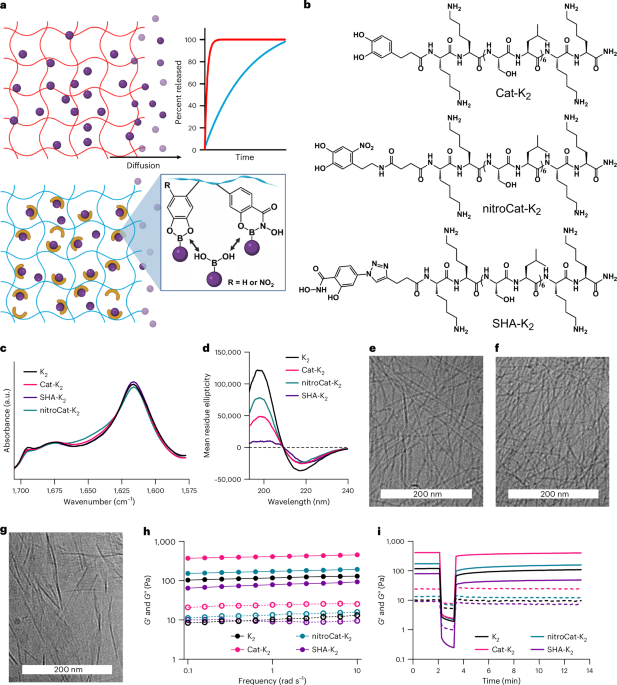
a) Catechol oxidation and degradation occurred rapidly, appearing as changes in the UV-Vis spectrum of dopamine (DOPA) over time in pH 7.4 PBS. The increase in the baseline absorbance indicates increased turbidity of the sample as insoluble oxidation products form black precipitates in solution. b) The UV-Vis spectrum of the nitrocatechol 4-nitrodopamine (nDOPA) shows that the molecule is stable over the course of 15 d. c) Longitudinal analysis of the UV-Vis spectrum salicylhydroxamic acid (SHA) demonstrates that the molecule is largely stable with minor changes observed after 11 d. d) Boronate ester equilibrium constants between chemically distinct boronic acids (BAs) and the dynamic covalent association motifs alizarin red S (ARS), nDOPA, SHA, and DOPA. For all BAs, SHA forms the strongest boronate ester interactions. Equilibrium constants are presented as the mean value of three replicates ± SD (see Supplementary Fig. S1). e-f) Chemical structures, mass spectra, and UPLC chromatograms of e) Cat-K2, f) nitroCat-K2, g) SHA-K2, and h) K2.
Extended Data Fig. 2 In vitro release and drug stability.
a) Cumulative release of bortezomib from SHA-K2 is not significantly altered within physiologically relevant concentrations of glucose. b) The total amount of bortezomib released after 24 h was not statistically different between glucose concentrations. Data are presented as the mean value of three replicates ± SD. c) Gels loaded with drug were dissolved in water and run on UPLC to ensure that all of the drug could be recovered. Bars with ‘#’ reached 100% release in the release experiments shown in Fig. 2 and cumulative release from those experiments after 24 h is shown here. These data demonstrate that all the drug loaded into the gels can be released. Data are presented as the mean value of three replicates ± SD. d) The change in UPLC retention time of ganfeborole and ganfeborole released from Cat-K2 in UPLC suggests that the hydrogel is degrading the drug. The new peak at 3.2 min seen in Cat-K2 + ganfeborole is also observed when the drug is reacted with 280 mM hydrogen peroxide, suggesting that this new peak corresponds to oxidized ganfeborole. e) Electrospray ionization mass spectrometry of ganfeborole alone contains the expected mass of the drug at 258.1 m/z. Ganfeborole released from Cat-K2 has a peak at 248.1 m/z, (f) corresponding to a loss of a boron atom due to oxidative deboronation. g) The stability of ganfeborole loaded in K2, Cat-K2, nitroCat-K2, and SHA-K2 quantified by UPLC shows that the majority of the drug remains stable over the course of two weeks in all hydrogels except for Cat-K2, which rapidly degrades the compound. Data are presented as the mean value of three replicates ± SD. h) SHA-K2 without drug and the hydrogel maximally loaded (1:1 drug-to-peptide molar ratio) have the same β-sheet secondary structure as determined by a minimum at 220 nm seen by circular dichroism, suggesting that drug loading does not perturb peptide self-assembly.
Extended Data Fig. 3 In vitro release of fluorescent BAs.
a) Structures of fluorescein and the six fluorescein BA conjugates synthesized. b) In vitro release of the fluorescent BAs from SHA-K2 over the course of 336 h. All BA-modified compounds demonstrate significantly lower release than unmodified fluorescein. c) A rescaled release curve focusing on the six BA-modified compounds. The higher burst release observed in compound 6 may be due to the presence of a small amount of unconjugated fluorescein. The compounds demonstrate zero-order ‘linear’ release from 72–336 h. d) The linear release regime for each sample was fit to a line to calculate the release rate. All fits resulted in an R2 > 0.97. Compound 5 demonstrated the fastest release rate, which is over two-fold faster than the slowest releasing compounds (2, 4, and 6). These data demonstrate that minor changes to BA structure can impact the release rate from SABER hydrogels. All data is presented as the mean value of three replicates ± SD.
Extended Data Fig. 4 In vivo release of bortezomib.
a) Pharmacokinetics of decreasing bortezomib doses administered as subcutaneous boluses without hydrogel. Data is presented as the mean value of four replicates ± SEM. b) The maximum circulating concentration (Cmax) of bortezomib decreases linearly with the initial dose. Dotted lines represent the Cmax for 700 ng of bortezomib delivered from nitroCat-K2 (blue) and SHA-K2 (purple), indicating that a bolus bortezomib dose of 175 ng yields the same Cmax as these hydrogel formulations loaded with 5-fold more drug. c) Chemical structure of the bortezomib fragment observed in mass spectrometry imaging. d) K2, nitroCat-K2, and SHA-K2 hydrogels loaded with 700 ng of bortezomib imaged by mass spectrometry imaging in vitro show very little bortezomib signal, suggesting that MDP peptides suppress the ionization of bortezomib within the gels. This ionization suppression results in dark spots in mass spectrometry images at the location of the hydrogels.
Extended Data Fig. 5 Hematoxylin & eosin staining and mass spectrometry imaging of injection site tissues.
a) Tissue sections from mice that received subcutaneous injections of bortezomib alone or in a hydrogel at 1-, 7-, and 21-days stained with hematoxylin & eosin. Large dark purple sections in K2, nitroCat-K2, and SHA-K2 are the hydrogels in the skin samples. b) Mass spectrometry imaging of the same tissue samples stained with hematoxylin & eosin shows that bortezomib signal does not significantly overlap with that from heme (616.178 m/z), illustrating that the drug observed in the tissue is not in circulation but in the local environment of the injection site.
Extended Data Fig. 6 Pharmacokinetics of ganfeborole in 50 μL of 10 mg/mL hydrogels.
Longitudinal concentrations of ganfeborole in the blood of mice after a single subcutaneous injection of 75 μg of the drug loaded into 50 μL hydrogels or PBS. Data presented as the mean value of four replicates ± SEM. Injections of ganfeborole without a hydrogel, ganfeborole in K2, and ganfeborole in nitroCat-K2 all led to the rapid release of the drug. SHA-K2 hydrogels were able to retain ganfeborole concentrations over the EC50 for more than 200 h.
Extended Data Fig. 7 In vitro characterization of SHA-E2 and in vivo release of ganfeborole.
a) Chemical structure of SHA-E2 with the mass spectrum and UPLC chromatogram of the material confirming the identity and purity of the peptide. b) Mass spectrum and UPLC chromatogram of the unmodified E2 peptide. c) Frequency sweep collected by oscillatory rheology shows that SHA-E2 hydrogels are more frequency dependent than unmodified E2 and form slightly weaker gels, as indicated by a reduction in the difference between the storage modulus (G′), indicated by filled circles and solid lines, and the loss modulus (G″), indicated by open circles and dotted lines. d) Representative histological sections of SHA-K2 and SHA-E2 gels excised three days after subcutaneous injection. Sections were stained with hematoxylin & eosin (left two images) or Masson’s trichrome (right four images) stains. Black 750 μm scale bar applies to the left four full sized images. Histological analysis shows that SHA-K2 gels swell significantly and are heavily infiltrated by cells, consistent with an inflammatory response. SHA-E2 remains minimally infiltrated by cells, has less collagen deposition on the border of the gel, and does not swell in size. e) Cumulative release of ganfeborole after 24 h from SHA-K2 and SHA-E2 are statistically similar, suggesting that changing the peptide used in SABER hydrogels does not compromise its ability to control the release of BA-containing small molecules. Data is presented as the mean of three replicates ± SD. f) Pharmacokinetic parameters extracted by performing a non-compartmental analysis on the in vivo release of ganfeborole from SHA-E2 show that using the SABER hydrogel improves drug exposure (AUC), half-life (t1/2) and reduces the maximum circulating concentration (Cmax) of the compound. Pharmacokinetic parameters are presented as the mean of n=4-5 replicates ± SD.
Extended Data Fig. 8 Local release of BA-modified IgG.
a) Representative confocal images illustrating fluorescence recovery and photobleaching (FRAP) experiments. Fluorescence recovery was quantified by monitoring the return of fluorescence signal in the bleached region over 10 min using a 640 nm excitation laser. The white scale bar in the bottom left represents 40 μm. b) FRAP data (n=3 for each group) was fit to a first-order exponential equation to extract the FRAP half-time (t1/2) and the mobile fraction (Mf). Loading BA-modified IgG in SABER hydrogels reduced the Mf and increased the t1/2, suggesting that the rate of payload diffusion in these samples is slower. We observed minimal differences between IgG labeled with 11.4 BAs per antibody (IgG high) and 2.4 BAs per antibody (IgG low), demonstrating that the degree of labeling may not play a large role in controlling the rate of diffusion. All data were well-modeled by the first-order exponential equation and had R2 values above 0.95 except for SHA-E2 + IgG high (denoted with an asterisk), which was poorly fit by this model and thus extracted parameters may not accurately describe the data. c) In vivo release data of IgG with low and high degrees of BA modeling was modeled with a first-order exponential equation to determine the half-life (t1/2) and burst release from the site of injection. All SABER hydrogels had a moderate burst release of 20% but significantly extended the t1/2 of the antibody at the injection site. All fits adequately modeled the data (R2 > 0.95). All numerical data in this figure is presented as the mean value of four replicates ± 95% confidence interval.
Extended Data Fig. 9 Basal insulin delivery from SABER hydrogels.
a) Mass spectrum of BA-modified insulin (insulin-PBA) showing that a single phenylboronic acid was added to insulin. b) The UPLC chromatogram of the synthesized insulin-PBA confirmed the purity of the material. c) In vitro release of unmodified insulin from SHA-E2 and E2 illustrates that the phenylboronic acid modification is necessary for the SABER peptide to achieve the delay in the release of the payload observed in Fig. 6a. Data presented as the mean value of three replicates ± SD. d) First 10 h of the initial treatment of diabetic mice with 6 IU of insulin-PBA in SHA-E2 plotted with a repeat treatment with the same formulation in the same mice 6 weeks later. The repeat dose resulted in statistically similar blood glucose levels to the initial dose at all time points. Data points for blood glucose measurements are the mean value of five replicates ± SEM.
Supplementary information
Source data
Rights and permissions
Springer Nature or its licensor (e.g. a society or other partner) holds exclusive rights to this article under a publishing agreement with the author(s) or other rightsholder(s); author self-archiving of the accepted manuscript version of this article is solely governed by the terms of such publishing agreement and applicable law.
About this article

Cite this article
Pogostin, B.H., Wu, S.X., Swierczynski, M.J. et al. Nanofibrous supramolecular peptide hydrogels for controlled release of small-molecule drugs and biologics. Nat. Nanotechnol. (2025). https://doi.org/10.1038/s41565-025-01981-6
-
Received:
-
Accepted:
-
Published:
-
DOI: https://doi.org/10.1038/s41565-025-01981-6