Introduction
Citrus, the genus Citrus L., belongs to the family Rutaceae, the largest genus in any fruit family and is very popular worldwide. Orange is one of the fruits that belong to the citrus family. It is widely cultivated around the world due to its flavor and richness in nutrients such as phenols, minerals, vitamin C, flavonoids, and carotenoids, and it occupies a high position in the global production of fruits. Moreover, oranges have various medicinal properties, such as antioxidant, antiviral, and antibacterial properties1,2,3.
One of the most used techniques to preserve oranges is drying, and this technique can influence the quality of the final dried fruits and result in a decrease in nutritional values. Therefore, some pre-treatments are applied to preserve or increase the nutritional content of oranges. Vacuum osmotic dehydration (VOD) has gained attention as a pretreatment to improve the nutritional and functional quality of fruits subjected to drying4. VOD is performed under vacuum, facilitating the displacement of gas and liquid from fruit pores with an impregnating solution, allowing the infusion of bioactive compounds, vitamins, and minerals into the fruit matrix5,6,7. This technique has been successfully applied in the enrichment of various fruits and vegetables, including apples, courgette and mushrooms6,8,9,10. However, the application of VOD with pomegranate juice concentrate in oranges has not yet been studied. Pomegranate juice concentrate is rich in phenolics and anthocyanins, which may synergistically interact with the naturally high vitamin C and flavonoid content of oranges, resulting in a fortified product with enhanced antioxidant potential. Such functional enrichment can offer new opportunities for the development of value-added citrus-based functional snacks.
Conventional drying methods such as sun and tray drying often cause uneven drying and nutrient loss. Advanced techniques like freeze drying or vacuum microwave drying improve quality but are costly and energy-intensive11,12. Hence, radiofrequency (RF) drying has emerged as an innovative and alternative method of drying to overcome these drawbacks13. RF drying is a creative technology where the heating process is governed volumetrically by dipole rotation and ionic polarization, distinguishing it from traditional methods. RF heating is a form of dielectric heating that excites polar particles, primarily water, to deviate from their equilibrium state. Heat is then produced through molecular friction caused by ionic conduction and dipole rotation within food materials13,14. RF is considered an indirect heating method, as electrical energy is first converted into electromagnetic radiation, which generates heat within the product15. This rapid and volumetric heating shortens drying time, reduces thermal gradients, and minimizes quality losses compared with conventional methods. Moreover, RF provides more uniform heating and greater penetration depth than microwaves, while requiring less time and energy than freeze drying16,17.
Pomegranate juice concentrate rich in its bioactive components could be used as an osmotic solution prior to radiofrequency drying18. While RF drying has been studied in several fruits, its use following VOD pretreatment with pomegranate concentrate in orange slices has not yet been explored. Therefore, this study aimed to (i) optimize VOD parameters (time, Brix of pomegranate juice concentrate, and ratio of osmotic solution to fruit) for the enrichment of orange slices with bioactive compounds, and (ii) evaluate the impact of subsequent HA-RFD compared with HAD on drying performance and the retention of total phenolic content, total flavonoid content, and antioxidant activity. This approach highlights a novel combination of VOD with pomegranate juice concentrate and HA-RFD for producing fortified orange slices with both enhanced nutritional quality and industrial applicability.
Materials and methods
Materials
Oranges (Citrus sinensis L. var. Washington Navel) were sourced from a local field (Adana, Türkiye) and stored at 5 ± 1.0 °C and 80–90% relative humidity until the carrying out of the experiments within 48 hours11. Before the VOD and drying process, oranges were washed, then wiped, and cut into 4 mm thickness slices with peels from the middle zone of the fruit, this specific thickness was chosen based on preliminary experiments and literature reviews, ensuring the desired final quality and drying characteristics11. The initial content of moisture of orange samples was 84.21 ± 0.91% on a wet basis (wb). Folin–Ciocalteau phenol reagent, 2,2-diphenyl-1-picrylhydrazyl radical (DPPH), sodium carbonate (Na2CO3), hydrochloric acid (37%), methanol, gallic acid, rutin, and ascorbic acid standards were bought from Sigma Aldrich (St. Louis, MO, USA). All chemicals and solvents were chromatographic grade. Pomegranate juice concentrate, which was used as an osmotic solution, was purchased from a manufacturer in Turkey.
Experimental design and optimization of the vacuum osmotic dehydration (VOD) process
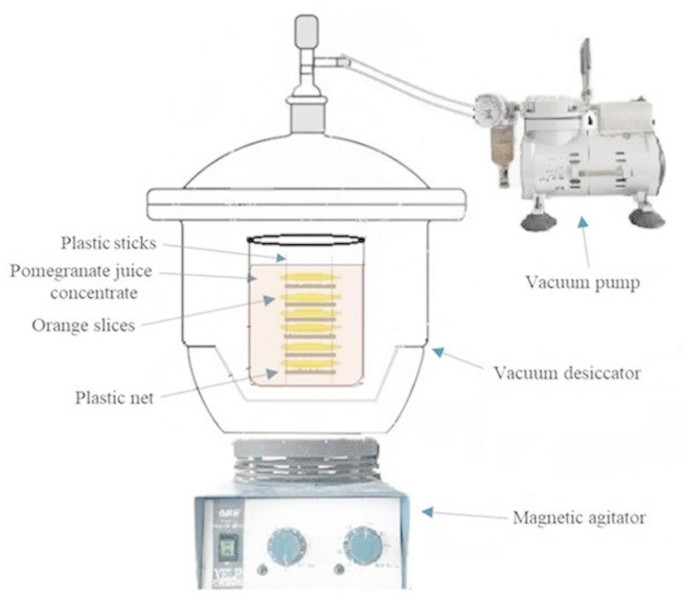
The VOD was done in a vacuum desiccator connected to a vacuum pump. 6 orange slices (~ 138 g) were put in a flask inside the desiccator. The desiccator was sitting on a magnetic stirrer to provide agitation during the VOD process. For VOD, a vacuum of 10 kPa was applied, and the process was done in an air-conditioned cabin at room temperature (25 ± 2 °C) (Fig. 1). The weight of the osmotic solution ranged between 552 and 1104 g and the VOD process time ranged from 0 to 30 min according to the experimental design. After the VOD process, atmospheric pressure was restored, maintaining that the orange slices were immersed until the total time was 3 h. In the end, the osmotic solution was drained using filter paper. The values of mass transfer, water loss (WL), solid gain (SG), and weight reduction (WR) were utilized to indicate the solute and water exchange between the orange slices and pomegranate juice concentrate. WL is a crucial parameter in VOD because it reflects the water loss driven by osmotic gradients between the juice concentrate and the fruit tissue, rather than solely the removal of water due to vacuum effects. This process facilitates the replacement of the native liquid phase of the fruit with the juice concentrate during the atmospheric pressure step. SG is important to assess the amount of solute (in this case, components of pomegranate juice concentrate) that has been transferred into the fruit. This directly reflects the success of the VOD process in enriching the fruit with juice solids. WR is often used as an overall indicator of the combined effect of WL and SG. The loss of water and uptake of juice concentrate both contribute to changes in the total weight of the fruit. Weight reduction is a commonly used parameter in VOD studies, where it was used to quantify the total impact of the process on the fruit mass19,20,21,22. These values were calculated using the following equations of balance22:

Scheme of the vacuum osmotic dehydration process.
$$:text{W}text{L}left(text{%}right)=left(frac{{W}_{{text{W}}_{0}}-{W}_{text{w}}}{{W}_{0}}right)times:100$$
(1)
$$:text{SG}left(text{%}right)=left(frac{{W}_{text{S}}-{W}_{text{S}text{o}}}{{W}_{0}}right)times:100text{}$$
(2)
$$:text{WR}left(text{%}right)=left(frac{{W}_{0}-{W}_{text{T}}}{{W}_{0}}right)times:100$$
(3)
where W0 is the sample’s initial weight of water (g), Ww is the sample’s water weight after treatment (g), W0 is the sample’s initial weight (g); WS is the dry solid’s weight after treatment (g), WS0 is the dry solid’s initial weight in the sample (g); WT is the sample’s weight after treatment (g).
The VOD process was experimentally designed by using a three-level central composite face-centred design (CCFD). The effect of process parameters was investigated on the response values. The pomegranate juice concentrate to orange ratio (X1: 4–8 g/g), brix of the pomegranate juice concentrate (X2: 45–65°), and vacuum time (X3: 0–30 min) were the independent factors. The values found in the pre-experiments were taken into consideration when choosing the variable limits. Water loss (%), solid gain (%), and weight reduction (%) were the response values. With six replicates at the center point, the design comprised twenty experimental runs (Table 1). Regression and graphical analysis, as well as the optimization of VOD parameters, were done by response surface methodology (RSM) utilizing Design Expert v. 7.0 (Stat–Ease, Inc., Minneapolis, MN, USA). A 95% significance level was applied to every analysis. The process conditions were optimized to obtain the highest water loss, solid gain, and weight reduction. The statistical significance of the regression coefficients, the suitability of the created model, and the importance of the independent variables and their interactions were all ascertained using the analysis of variance (ANOVA). Osmotically dehydrated orange samples were subjected to hot air-assisted radiofrequency and hot air drying as described below.
Hot air-assisted radiofrequency drying (HA-RFD) process
A 10 kW/ 27.12 MHz free oscillating through-field electrode system was implemented in the process of RF drying. The RF drying system is combined with a hot-air heating unit (09010RF27/190521, Sonar Company, Izmir, Turkey). The RF equipment has upper and bottom cylindrical rods that serve as electrodes, the electrode on top is charged while the bottom serves as the earth electrode. Small, evenly distributed holes on the bottom electrode’s upper surface ensure the homogeneous hot air distribution from the RF cavity’s bottom side. An electrode gap of 70 mm was used, the selection of drying parameters was based on the methodology outlined in our previous study23. The air temperature inside the RF cavity (40 cm x 80 cm x 57 cm (w x l x h)) was kept around 47 ± 3 °C during the drying experiments with 1.5 m/s of air velocity, and the measuring of air velocity was done in the middle of the RF cavity. To reach this temperature and stabilize the RF system, the system was switched on 1 h before the experiment. 18 slices of osmotically dehydrated orange, divided into 6 groups containing three slices (4 mm thickness per slice), one on top of the other were placed in a polypropylene tray with holes in its bottom which allowed the passing of air through the samples ensuring that the orange slices did not block the air holes. Throughout the drying process, the weight of samples was recorded using an electronic balance (SW, CAS, Korea) by removing the tray from the drying system every 30 min until the weight was constant. Usually orange slices are dried to moisture content levels of 0.07–0.12 g water/g dry matter2,11,24. Therefore, drying was stopped when the moisture content of orange slices was reached below approximately 0.11 ± 0.01 g water/g dry matter.
Hot air drying (HAD)
For comparison with HA-RFD, osmotically dehydrated samples were also dried by hot air (47 ± 3 °C) in the same system without the application of RF for the same number of slices, the same thickness, and in the same conformation.
Effective moisture diffusion coefficient (Deff)
The mass transfer characteristics during the drying process were indicated using the Moisture diffusion coefficient (Deff) which was calculated using Fick’s second law described before by Özbek et al.17.
Color measurement
The surface color of orange samples was determined using a Hunter-Lab ColorFlex A60-1010-615 colorimeter (HunterLab, Reston, VA). The CIE color parameters L*, a* b* and total color difference (ΔE) were determined. (ΔE) was calculated using the following equation, with the fresh slice values as reference:
$$:{Delta:}text{E}:=sqrt{{({Delta:}{text{L}}^{text{*}})}^{2}+{({Delta:}{text{a}}^{text{*}})}^{2}+{({Delta:}{text{b}}^{text{*}})}^{2}}$$
(4)
Moisture, protein, total sugar and dietary fiber contents
Moisture, protein, and dietary fiber contents of samples were indicated by the standard methods of AOAC 920.15125, AOAC 920.15226 and AOAC 991.4327, respectively. Total sugar content of samples was analyzed by the DNS method as previously illustrated by Özbek et al.28.
Analysis of bioactive compounds
Dried samples were subjected to extraction for the analysis of total phenolic content, total flavonoid content, and antioxidant capacity following the method outlined by Ozcan-Sinir et al.29. Specifically, 2 g of the samples were combined with 20 ml of the extraction solution, composed of HCl/methanol/water (1:80:10 v/v/v). The mixture underwent agitation at 25 °C for 2 h in a rotary shaker (Heidolph Instrument GmbH & Co. KG, Schwabach, Germany) at 250 rpm. Subsequently, the mixture was centrifuged at 6000 rpm for 15 min, and the supernatant was collected and stored in tubes at -18 °C for further use.
Total phenolic content (TPC)
The Folin–Ciocalteu colorimetric method was used for the determination of the total phenolic content (TPC) of the samples, following the procedure outlined by Akdaş et al.30. In this method, 0.5 mL of the extract was combined with 2.5 mL of Folin–Ciocelteau’s phenol reagent (0.2 N) and 2 mL of Na2CO3 (7.5%). The mixture was then stored in the dark at room temperature for 30 minutes. Subsequently, the absorbance of the samples was measured at 760 nm using a spectrophotometer (Novaspec II, Pharmacia Biotech, England) after diluting 0.3 ml of the extract with 2.7 ml of distilled water. The TPC of the samples was expressed as mg gallic acid equivalents (GAE) per 100 g of the dry sample.
Total flavonoid content (TFC)
The colorimetric method outlined by Özcan et al.31. was used to determine the total flavonoid content (TFC) of the samples. In this method, 1 ml of the extract was combined with 2 ml of NaOH, 0.3 ml of NaNO2, and 0.3 ml of AlCl3. After shaking the resulting mixture, absorbance values were recorded using a spectrophotometer at 510 nm. The acquired results were expressed as mg of rutin equivalent per 100 g of the dry sample.
Antioxidant capacity
Antioxidant capacity analysis was carried out using the 2,2-diphenylpicrylhydrazyl (DPPH) free radical scavenging capacity described by Akdaş et al.30. 0.1 ml of extract was mixed with 4.9 ml of DPPH solution (0.1 mM) in ethanol. After 30 min of incubation at the temperature of the room, the absorbance was measured at 517 nm. Ethanol was used for control samples. The percentage inhibition of DPPH radical was calculated as follows:
$$:Percent:Inhibition:left(I%right)=:frac{{A}_{control}-{A}_{sample}}{{A}_{control}}:times::100$$
(5)
Asample and Acontrol values are the absorbances of the sample and control, respectively.
Statistical analysis
All experiments were performed in triplicate, and results are expressed as mean ± standard deviation. Statistical analysis was conducted using SPSS Statistics 22.0 (SPSS Inc., Chicago, USA). The one-way ANOVA and Duncan’s multiple range test at a 95% significance level were employed to compare the experimental results. Homogeneity of variance was confirmed before applying Duncan’s multiple range test.
Results and discussion
The effect of vacuum osmotic dehydration process variables on water loss
ANOVA was used for the determination of the variable’s significance of the design for the fitted model, and Table S1 displayed the results. The multiple regression analysis was used to analyze the actual variables. Equation 6 was used to determine the relationship between the water loss and the design’s independent variables.
$$:{Y}_{water:loss}=:35.80-1.19{X}_{1:}+4.68{X}_{2}+0.986{X}_{3}+0.3687{X}_{1}{X}_{2}-0.8387{X}_{1}{X}_{3}-1.35{X}_{2}{X}_{3}-1.52{X}_{1}^{2:}-1.20{X}_{2}^{2}+1.62{X}_{3}^{2}$$
(6)
The high F-value (40.58) and low p-value (< 0.0001) demonstrated that the model was statistically significant (p < 0.05) and the p-value (0.1352) of the lack of fit test was non-significant (p > 0.05), hence, the constructed model is adequately accurate for the outcomes predicted (Table S1). The determination coefficient value (R2) of 0.9733 points to a good correlation between the independent factors and the response variable, moreover, the value of R2 and adjusted R2 (0.9494) displays a strong agreement between the theoretical and experimental values. The coefficient of variation (CV) with a low value (2.49) implies good accuracy and adequate discrimination of the designed model.
The water loss of osmotically dehydrated orange slices was between 26.83 and 41.00% (Table 1). The highest water loss was obtained in run 7 where the brix of pomegranate juice concentrate is 65°, pomegranate juice concentrate to orange ratio is 4:1 g/g, and the vacuum time is 30 min. The 3D response surface plot displays the relation between the water loss and VOD parameters (Fig. 2). According to Fig. 2A, the water loss increased with the increasing brix degree of pomegranate juice concentrate, and these findings align with the results of González-Pérez et al.32., Moreno et al.33 and Mújica-Paz et al.19 who similarly reported that osmotic pressure gradients predominantly drive mass transfer during VOD. The agreement across different fruits suggests that the role of vacuum time is secondary compared with solute concentration, since the osmotic pressure difference is the primary mechanism in controlling water removal. This could be explained by the increasing osmotic pressure gradients during the process with the increase in the concentration of pomegranate juice concentrate. Figure 2B displays the interaction of vacuum time and the pomegranate juice concentrate to orange ratio. According to the figure, the vacuum time had little effect on water loss when it interacted with the ratio of pomegranate juice concentrate to orange. For the impact of the interaction of concentration and the vacuum time on the water loss, Fig. 2C exhibits that the water loss increased with the increasing brix degree of pomegranate juice concentrate and vacuum time, but with less impact for the vacuum time, so that the maximum water loss is under the condition of 65° Brix and 30 min of vacuum pressure. The results indicate that mass transfer during vacuum osmotic dehydration is primarily governed by osmotic concentration differences rather than the vacuum duration itself. While the vacuum step facilitates initial impregnation through hydrodynamic mechanisms, the observed water loss is mainly driven by the osmotic pressure gradient between the fruit matrix and the pomegranate juice. Moreover, the applied vacuum pressure may have contributed to the loss of the native liquid phase in orange tissue, leading to a partial replacement with pomegranate juice during atmospheric pressure equilibration. These findings align with previous studies on vacuum osmotic dehydration, where mass exchange is influenced by both osmotic forces and vacuum-induced structural modifications33,34.

Effect of vacuum osmotic dehydration parameters on water loss (3D plots).
The effect of vacuum osmotic dehydration process variables on solid gain
To determine the relationship between the solid gain and the design’s independent variables Eq. 7 was used.
$$:{Y}_{solid:gain}=:16.34-0.2290{X}_{1:}+2.03{X}_{2}+3.63{X}_{3}+0.6863{X}_{1}{X}_{2}-0.3463{X}_{1}{X}_{3}-2.06{X}_{2}{X}_{3}-2.11{X}_{1}^{2:}-4.89{X}_{2}^{2}+0.5745{X}_{3}^{2}$$
(7)
The model was highly significant and showed a high F value (35.04) and a small p-value (< 0.0001) (Table S2). The lack of fit test came out with a non-significant result (p < 0.05); hence, the constructed model is adequately accurate for the outcomes predicted. The R2 value of 0.9693 points to a good correlation between the independent factors and the response variable. Moreover, the CV value of 6.9% provides better repeatability and indicates good accuracy.
The solid gain of osmotically dehydrated orange slices was between 8.07 and 22.18% (Table 1). The highest solid gain was under the conditions where the Brix of pomegranate juice concentrate is 65°, pomegranate juice concentrate to orange ratio is 4:1 g/g, and the vacuum time is 30 min. The intercellular pores are filled with the osmotic solution and this process improves the mechanisms of diffusion, hence, expanding the solute gain from the external environment33. The 3D response surface plot illustrates the relationship between solid gain and VOD parameters, as depicted in Fig. 3. Figure 3A exhibits the interaction of vacuum time and the brix of the pomegranate juice concentrate and its effect on the solid gain of the orange slices. According to this figure, the vacuum time of 30 min and 65° Brix had the highest solid gain. This may be justified due to the viscosity of the solution at 65 Brix, which could be ideal for the penetration and filling of pores under vacuum pressure19. Figure 3B shows an increase in the solid gain with the increase of vacuum time, with the maximum solid gain under 30 min of vacuum pressure, while the increasing pomegranate juice concentrate to orange ratio did not significantly affect the solid gain in this interaction. Figure 3C shows that the increase in pomegranate juice concentrate to orange ratio did not affect the solid gain, while the solid gain increased with the increasing brix of pomegranate juice concentrate from 45° and reached the maximum under 55° brix. This tendency can be explained by the fact that the diluted solutions enter the pores more easily than the concentrated ones19.

Effect of vacuum osmotic dehydration parameters on solid gain (3D plots).
The effect of vacuum osmotic dehydration process variables on weight reduction
Table S3 displays the results of regression analysis and analysis of variance for weight reduction. The model was highly significant and had an F-value of (28.95) and a very small p-value of (< 0.0001). The lack of fit test showed a non-significant result (p < 0.05) with an F-value of 1.81, therefore, the constructed model is sufficiently accurate for predicting the outcomes. The values of R2 (0.9630) and adjusted R2 (0.9298) demonstrate a strong agreement between the theoretical and experimental values. Equation 8 was used to determine the relationship between the weight reduction and the design’s independent variables.
$$:Ywt:reduction=:19.45-0.9630{X}_{1:}+2.65{X}_{2}+2.64{X}_{3}+1.05{X}_{1}{X}_{2}-0.4925{X}_{1}{X}_{3}-3.42{X}_{2}{X}_{3}-3.62{X}_{1}^{2:}-3.69{X}_{2}^{2}+2.20{X}_{3}^{2}$$
(8)
All independent variables had a statistically significant effect on weight reduction (p < 0.05). Osmotically dehydrated orange samples showed a weight reduction between 14.26 and 30.89%, (Table 1). Figure 4 (A) exhibits the interaction effect of the Brix of the pomegranate juice concentrate and the pomegranate juice concentrate to orange ratio on the weight reduction of the samples. The weight reduction reached the highest value under the 65 Brix and 6:1 (g/g) pomegranate juice concentrate to orange ratio. The interaction between vacuum time and pomegranate juice concentrate to orange ratio did not have a marked effect on weight reduction as shown in Fig. 4B. Figure 4C illustrates the interaction of Brix of the pomegranate juice concentrate and vacuum time. When the vacuum time was short, the weight reduction increased as the Brix of the pomegranate juice concentrate increased. However, when the vacuum time was long, the weight reduction decreased slightly as the Brix increased. The weight reduction is attributed to the exchange of liquids inside the sample tissue and the solids of the osmotic solution33. This behavior can be explained by the mass transfer mechanism occurring during VOD. In the initial stages of the process, water loss and solid gain are predominant due to osmotic gradients. However, as the treatment time increases, relaxation phenomena take place, facilitating the infiltration of the osmotic solution into the fruit tissue due to hydrodynamic forces. This progression towards real equilibrium, rather than compositional equilibrium, results in a shift in the dominant mass transfer mechanism. Consequently, as vacuum time increases, the sample absorbs more of the osmotic solution, leading to a lower net weight reduction despite continued water loss.

Effect of vacuum osmotic dehydration parameters on weight reduction (3D plots).
Optimization of the vacuum osmotic dehydration process variables
The VOD process was optimized to obtain a higher water loss, solid gain, and weight reduction. The optimal conditions were selected as 65° Brix of pomegranate juice concentrate, 4:1 (g/g) pomegranate juice concentrate to orange slices, and 30 min of vacuum time and the WL, SG and WR values were predicted as 41%, 22.18% and 18.82%, respectively. To verify the results predicted by the model, three experiments were carried out under the optimum conditions and a water loss of 40.52 ± 1.31%, a solid gain of 21.57 ± 0.85%, and a weight reduction of 18.60 ± 0.93% were obtained under the optimal conditions of VOD. The differences between the values suggested by the model and the experimental data were not significant (p > 0.05) indicating the reliability of the predicted conditions by RSM, which was confirmed by the One-Sample t-Test.
Comparison of HARF with HA drying
Drying characteristics
Figure 5 (a) and (b) illustrate the influence of HA-RFD and HAD on the drying characteristics of the osmotically dehydrated orange slices. The drying rate of both HA-RFD and HAD exhibited a decrease as the average moisture content of orange slices decreased. The occurrence of drying was within the period of the falling rate, and the constant period does not exist as shown in the drying curve, meaning that the water removal mechanism was diffusion during the drying process. Similar behavior was reported in the microwave-convective drying of the lemon slices35and for the hot-air assistant radio frequency drying of carrots36.

Drying rate (a) and drying curves (b) of osmotically dehydrated orange slices under VOD-HA-RFD and VOD-HAD.
The time of HA-RFD was 420 min, and for HAD was 1110 min, to achieve a constant sample weight. The high sugar content of the saturated samples led to an increase in drying time. The reason behind that is the sugar binds with the water inside the samples during the process of drying, which leads to difficulty in the process of water diffusion outward, hence the difficulty of drying. The results demonstrated that HA-RFD was faster with a 62% decrease in time of drying when compared to HAD, and this could be explained due to the differences in the heating mechanism in both drying techniques. During RF heating, electromagnetic energy penetrates the sample and induces molecular and atomic vibrations. These vibrations create friction within the material, which subsequently generating heat, while in HAD, the heat is initially transported to the sample surface, then penetrates to the inner part of the material resulting in a dry surface and decrease in the conductive heat transfer. Therefore, combining RF and HA proves to be a highly effective technique for enhancing drying efficiency and addressing challenges related to heat and mass transfer, as proven in HA-RFD results. These results agree with the results of the HA-RFD for the carrot pomace37and the HA-RFD of in-shell hazelnuts38. Although HA-RFD substantially reduced drying duration compared with HAD (420 min vs. 1110 min), the total drying time is still relatively long for large-scale applications. Nevertheless, the technique demonstrates potential industrial advantages by reducing energy demand and improving drying efficiency. From an industrial perspective, the combination of VOD and HA-RFD provides dual benefits: (i) enhanced bioactive content through enrichment with pomegranate phenolics and anthocyanins, and (ii) improved drying efficiency compared with HAD. Further optimization of RF power, electrode configuration and air velocity may shorten drying duration and enhance scalability, strengthening its commercial applicability.
Effective moisture diffusivity is associated with both the rate of drying and migration of moisture inside the samples throughout the drying process; it encompasses various mechanisms of water transport within products, such as liquid diffusion, vapor diffusion, and other related effects13,39. The Deff for VOD-HA-RFD and VOD-HAD samples were 3.08 × 10− 9 m2/s and 1.06 × 10− 9 m2/s respectively. Several studies in the literature have reported effective moisture diffusivity (Deff) values for orange slices. Alibas and Yilmaz24 reported that Deff for the microwave-dried orange slices were 5.46 × 10⁻¹¹ m2 s− 1 at 90 W and 2.04 × 10–09 m2 s− 1 at 1000 W, and Deff for convective dried orange were 2.2713 10–10 m2 s− 1 at 125 °C, and 2.7023 10–9 m2 s− 1 at 50 °C. In the convection drying of orange slices, Rafiee et al.40. conveyed that the Deff ranged from 6.57 × 10− 10 m2/s to 35.0 × 10− 10 m2/s depending on the temperature, air velocity, and thickness of the slice. Variations in the findings may be attributed to factors such as sample composition, temperature of drying, pre-treatments, and drying technique41. The HA-RFD showed a higher Deff value than Deff of HAD, which implies that mass transfer occurs more rapidly in the HA-RFD process compared to HAD drying. The higher values of moisture diffusivity in the HA-RFD process can be attributed to the significant internal thermal energy input generated by RF heating42.
Properties of dried products
The moisture, protein, total sugar and dietary fiber contents of fresh and dried samples are given in Table 2. There was no statistically significant difference between the moisture, protein, total sugar and dietary fiber contents of osmotically dehydrated samples dried by HA-RFD and HAD (p > 0.05). The total sugar content of orange slices was increased to approximately 70% after VOD and drying processes as a result of sugar transfer from pomegranate juice concentrate to orange slices. While the ratio of sugar to dietary fiber was 1.4 for the fresh sample, this ratio was 4.3 and 4.1 for the osmotically dehydrated samples dried by HA-RFD and HAD, respectively.
The osmotically dehydrated and dried samples exhibited a great decrease in the L* and b* as shown in Table 2 compared to the fresh samples. As anticipated, these outcomes are due to the penetration of the pomegranate juice concentrate, which has imparted a reddish-violet color from the anthocyanins. According to Tylewicz et al.43., the reduction in L* which indicates lightness can be due to the change on the sample surface after the impregnation in the color sugary solution which covers the whole sample. Moreover, this could be attributed to increased transparency resulting from the substitution of the gas with the osmotic solution inside the intercellular spaces43. The a* value of the sample subjected to the VOD and HA-RFD was 13 ± 1, indicating the redness of the samples that comes from the color of the pomegranate juice concentrate that covers the samples resulting from the anthocyanins. The longer drying time of HAD led to a reduction of the a* value of the osmotically dehydrated sample to 10 ± 0 compared to the HA-RF dried sample, due to the degradation of the anthocyanins. This reduction could be due to the Maillard reaction or the caramelization of the sugars, which contribute to the browning during the drying process44. Osmotically dehydrated and HA dried samples showed lower values of L*, a*, and b* than the samples dried by HA-RFD, and this is due to the effect of the longer drying time. The total color difference (ΔE) after VOD and drying processes was calculated with reference to fresh orange. The total color change was obvious compared to the fresh sample after the VOD and drying processes. But the total color difference was significantly lower (p < 0.05) for osmotically dehydrated samples dried by HA-RFD than that obtained by HAD. In our previous study23 without VOD pretreatment, orange slices dried by HA-RFD and HAD retained their natural orange color and exhibited a crispier texture. In contrast, in the present study, the impregnation with pomegranate juice concentrate led to a darker reddish color and a more chewable structure due to the incorporation of anthocyanins and sugars from the osmotic solution. Regarding water activity (aw), although it was not measured here, we expect that the infused sugars from pomegranate concentrate contributed to lowering aw by binding free water molecules, thus potentially enhancing product stability. These differences highlight that while HA-RFD improved color retention compared with HAD, product appearance and texture were also strongly influenced by the VOD pretreatment. Future work should therefore address sensory evaluation and direct aw measurements to better link consumer perception and shelf-life stability to these structural and compositional changes.
The effect of VOD and drying on the TPC, TFC, and antioxidants of the orange samples was evaluated (Table 2). The results showed that the HA-RF-dried orange slice had the highest TPC, TFC, and antioxidant, and it showed an increase of 58% in TPC compared to fresh samples. The osmotic solution contains high levels of TPC, TFC, and antioxidants, which were transferred into the orange slices through mass transfer. During this process, water of the fruit tissue were released outward, while bioactive components from the osmotic liquid penetrated the orange slices. Similar findings were reported by Tylewicz et al.43. for the strawberry enrichment with TPC and antioxidants using bilberry juice through vacuum impregnation, where the impregnated dried samples demonstrated higher total polyphenolic content and antioxidant levels compared to the fresh samples. The osmotically dehydrated and RF-dried samples maintained a higher content of bioactive compounds when compared to the HA dried samples due to the shorter time of drying which reduced the thermal degradation of these bioactive compounds.
In a previous study by Ismail et al.23., the TPC, TFC, and antioxidant capacity of HA-RF-dried orange slices were 861.2 mg GAE/100 g dw, 185.4 mg rutin/100 g dw, and 59.7%, respectively. In this study, the TPC, TFC, and antioxidant capacity of the osmotically dehydrated and HA-RF-dried orange slices were higher than the values reported by Ismail et al.23. These results indicate that VOD has a significant effect as a drying pretreatment for fruit enrichment. Similarly, TPC, TFC and antioxidant capacity of the samples increased with the application of VOD for HA dried samples. However, there was a relatively lower increase compared to osmotically dehydrated and HA-RF-dried samples due to the long duration of drying and the gradual increase in temperature that causes the degradation of bioactive compounds in hot air drying. Prior studies have shown the importance of VOD in enrichment processes and increasing the content of phenolic compounds and antioxidants in dried fruits and vegetables. A notable increase in phenolic compounds was observed in the mango after vacuum impregnation with grape residue flour as a pretreatment for drying45. Nawirska-Olszańska et al.4. reported that vacuum impregnation as pretreatment with apple-pear juice produced dried Chokeberry Fruit with a higher bioactive compounds content such as phenolics and antioxidants when compared to non-impregnated dried fruit.
To better distinguish the enrichment and preservation effects observed in this study, relative retention values were calculated with reference to fresh orange slices. The increases in TPC and TFC are partly attributable to the transfer of phenolics and anthocyanins from pomegranate juice concentrate into the orange matrix. However, HA-RFD also enabled higher preservation of endogenous orange bioactives compared with HAD, due to its shorter drying time and reduced thermal degradation. This indicates that the enrichment effect is complemented by enhanced retention of native compounds. Moreover, differences in retention levels compared with previous studies4,43 (e.g., strawberries enriched with bilberry juice, mango impregnated with grape flour) can be explained by variations in fruit tissue porosity, osmotic solution composition, and drying kinetics. The more porous structure of citrus tissue and the higher anthocyanin concentration of pomegranate concentrate may have facilitated greater bioactive transfer in the present study. In addition, the shorter HA-RFD drying process minimized degradation compared with conventional hot air drying, which partly explains the higher relative retention obtained here compared with other reports. However, this study did not include sensory analysis (e.g., taste, texture, consumer acceptability) or shelf life evaluation (e.g., stability of bioactives, microbial safety). These aspects are critical for assessing the real-world applicability of fortified dried products. Therefore, future studies should incorporate sensory testing and storage stability assessments to provide a more comprehensive understanding of product quality and consumer acceptance.
Conclusion
This study investigated the fortification of orange slices with pomegranate juice concentrate using VOD and the subsequent impact of drying methods on bioactive compounds. The findings highlight that VOD is an effective technique to enrich orange slices with bioactive compounds. The choice of drying method significantly affected the retention of these compounds, with HA-RFD demonstrating better preservation of total phenolic content, total flavonoid content and antioxidant activity compared to HAD. This suggested that HA-RFD is a promising technique for maintaining the functional properties of fortified dried fruits while reducing drying time by 62% compared with HAD. Despite these promising outcomes, some limitations must be acknowledged. Water activity (aw), texture parameters, shelf life and sensory attributes were not evaluated, although they are critical for determining product stability and consumer acceptability. Moreover, although HA-RFD reduced drying time substantially, the total duration (420 min) remains relatively long for large-scale applications. Future studies should therefore focus on the optimization of drying parameters to improve energy efficiency and scalability, as well as on comprehensive sensory evaluation to assess consumer acceptance and shelf life evaluation to ensure long-term stability.
Data availability
Data will be made available by Hatice Neval Özbek (haticeneval@gantep.edu.tr) upon reasonable request.
References
-
Huang, Y. et al. Effect of ultrasound assisted vacuum osmotic dehydration on the mass transfer kinetics and qualities of orange slices. Dry. Technol. 41, 1636–1650 (2023).
-
Özkan-Karabacak, A., Acoğlu, B., Yolci Ömeroğlu, P. & Çopur, Ö. U. Microwave pre-treatment for vacuum drying of orange slices: drying characteristics, rehydration capacity, and quality properties. J. Food Process. Eng. 43, e13511 (2020).
-
Shiny Derose, J., Nagamaniammai, G., Daradkeh, G., Qoronfleh, W. & Al-Mahrizi, M. Impact of the drying techniques on the functional properties of citrus sinensis (Sweet Orange) Fruit – A review. Int. J. Nutr. Pharmacol. Neurol. Dis. 11, 181–188 (2021).
-
Nawirska-Olszańska, A. et al. Effect of vacuum impregnation with apple-pear juice on content of bioactive compounds and antioxidant activity of dried chokeberry fruit. Foods 9, 108 (2020).
-
Wang, X., Kahraman, O. & Feng, H. Impact of osmotic dehydration with/without vacuum pretreatment on Apple slices fortified with hypertonic fruit juices. Food Bioproc Technol. 15, 1588–1602 (2022).
-
Pasławska, M., Stępień, B., Nawirska-Olszańska, A. & Sala, K. Studies on the effect of mass transfer in vacuum impregnation on the bioactive potential of apples. Molecules 24, 3533 (2019).
-
Zhang, L., Yu, X., Yagoub, A. E. G. A., Xia, G. & Zhou, C. Effect of vacuum impregnation assisted probiotics fermentation suspension on shelf-life quality of freshly cut Lotus root. Food Chem. 381, 132281 (2022).
-
Assis, F. R. et al. Fortified Apple (Malus spp., var. Fuji) snacks by vacuum impregnation of calcium lactate and convective drying. LWT- Food Sci. Technol. 113, 108298 (2019).
-
Kręcisz, M., Stępień, B., Pasławska, M., Popłoński, J. & Dulak, K. Physicochemical and quality properties of dried courgette slices: impact of vacuum impregnation and drying methods. Molecules 26, 4597 (2021).
-
Yılmaz, F. M. & Zungur Bastıoğlu, A. Production of phenolic enriched mushroom powder as affected by impregnation method and air-drying temperature. LWT- Food Sci. Technol. 122, 109036 (2020).
-
Bozkir, H. Effects of hot air, vacuum infrared, and vacuum microwave dryers on the drying kinetics and quality characteristics of orange slices. J. Food Process. Eng. 43, e13485 (2020).
-
Derose, J. S., Nagamaniammai, G., Daradkeh, G., Qoronfleh, W. M. & Al-Mahrizi, M. Impact of the drying techniques on the functional properties of citrus sinensis (Sweet Orange) Fruit – A review. Int. J. Nutr. Pharmacol. Neurol. Dis. 11, 181–188 (2021).
-
Özbek, H. N. Radio frequency-assisted hot air drying of Carrots for the production of Carrot powder: kinetics and product quality. LWT- Food Sci. Technol. 152, 112332 (2021).
-
Liao, M. et al. Hot air-assisted radio frequency heating for stabilization of rice bran: enzyme activity, phenolic content, antioxidant activity and microstructure. LWT- Food Sci. Technol. 131, 109754 (2020).
-
Awuah, G. B., Ramaswamy, H. S. & Tang, J. Radio-frequency Heating in Food Processing: Principles and Applications (CRC, 2015).
-
Elik, A. et al. Impact of radio frequency-assisted hot air drying on drying kinetics behaviors and quality features of orange Peel. Biomass Convers. Bior. 13, 15173–15183 (2023).
-
Özbek, H. N., Koç, B., Koçak Yanık, D. & Göğüş, F. Hot air-assisted radiofrequency drying of avocado: drying behavior and the associated effect on the characteristics of avocado powder. J. Food Process. Eng. 45, e14094 (2022).
-
Dinçer, C., Üstünel, S., Erkoç, H. N., Yiyen, A. & Aykın-Dinçer, E. Effect of vacuum impregnation with anthocyanin rich fruit juices on the quality characteristics of chicken cubes. Food Biophys. 19, 973–981 (2024).
-
Mújica-Paz, H., Valdez-Fragoso, A., López-Malo, A., Palou, E. & Welti-Chanes, J. Impregnation and osmotic dehydration of some fruits: effect of the vacuum pressure and syrup concentration. J. Food Eng. 57, 305–314 (2003).
-
Romero, I. P., Gómez, M. J. R., Iñiguez, F. M. S. & Magro, P. C. Optimization of the osmotic dehydration process of plums (Prunus salicina Lindl.) in solutions enriched with inulin, using response surface methodology. LWT- Food Sci. Technol. 157, 113092 (2022).
-
Salehi, F., Cheraghi, R. & Rasouli, M. Mass transfer kinetics (soluble solids gain and water loss) of ultrasound-assisted osmotic dehydration of Apple slices. Sci. Rep. 12, 15392 (2022).
-
Thomas, B. et al. Optimization and modeling of vacuum impregnation of pineapple rings and comparison with osmotic dehydration. J. Food Sci. 89, 494–512 (2024).
-
Ismail, M., Özbek, H. N. & Göğüş, F. Hot air-assisted radiofrequency drying of orange slices: drying behavior and product quality. J. Food Sci. 89, 6494–6506 (2024).
-
Alibas, I. & Yilmaz, A. Microwave and convective drying kinetics and thermal properties of orange slices and effect of drying on some phytochemical parameters. J. Therm. Anal. Calorim. 147, 8301–8321 (2022).
-
Official methods of analysis of AOAC International. AOAC Official Method 920.151. Solids (total) in fruits and fruits products. (1997).
-
Official methods of analysis of AOAC International. AOAC Official Method 920.152. Protein in Fruit products. (2005).
-
Official methods of analysis of AOAC International. AOAC Official Method 991.43. Total, soluble, and insoluble dietary fiber in foods. (1999).
-
Özbek, H. N., Yanık, D. K., Fadıloğlu, S. & Göğüş, F. Optimization of microwave-assisted extraction of bioactive compounds from pistachio (Pistacia Vera L.) hull. Sep. Sci. Technol. 55, 289–299 (2020).
-
Ozcan-Sinir, G., Ozkan-Karabacak, A., Tamer, C. E. & Copur, O. U. The effect of hot air, vacuum, and microwave drying on drying characteristics, rehydration capacity, color, total phenolic content, and antioxidant capacity of Kumquat (Citrus japonica). Food Sci. Technol. 39, 475–484 (2019).
-
Akdaş, S. & Başlar, M. Dehydration and degradation kinetics of bioactive compounds for Mandarin slices under vacuum and oven drying conditions. J. Food Process. Preserv. 39, 1098–1107 (2015).
-
Özcan, M. M. et al. Influence of drying techniques on bioactive properties, phenolic compounds and fatty acid compositions of dried lemon and orange Peel powders. J. Food Sci. Technol. 58, 147–158 (2020).
-
González-Pérez, J. E., Jiménez-González, O., Romo-Hernández, A., Ramírez-Corona, N. & López-Malo, A. Osmosonication of Apple in concentrated grape juice: evaluation of mass transfer rates and impregnation effectiveness. J. Food Eng. 359, 111692 (2023).
-
Moreno, J., Bugueno, G., Velascc, V. & Petzold, G. Tabilo-munizaga, G. Osmotic dehydration and vacuum impregnation on physicochemical properties of Chilean Papaya (Carica candamarcensis). J. Food Sci. 69, FEP102–FEP106 (2004).
-
Deng, Y. & Zhao, Y. Effects of pulsed-vacuum and ultrasound on the osmodehydration kinetics and microstructure of apples (Fuji). J. Food Eng. 85, 84–93 (2008).
-
Darvishi, H., Khoshtaghaza, M. H. & Minaei, S. Drying kinetics and colour change of lemon slices. Int. Agrophys. 28, 1–6 (2014).
-
Wang, C., Kou, X., Zhou, X., Li, R. & Wang, S. Effects of layer arrangement on heating uniformity and product quality after hot air assisted radio frequency drying of Carrot. Innov. Food Sci. Emerg. Technol. 69, 102667 (2021).
-
Elik, A. Hot air-assisted radio frequency drying of black Carrot pomace: kinetics and product quality. Innov. Food Sci. Emerg. Technol. 73, 102800 (2021).
-
Chen, L., Subbiah, J., Jones, D., Zhao, Y. & Jung, J. Development of effective drying strategy with a combination of radio frequency (RF) and convective hot-air drying for inshell hazelnuts and enhancement of nut quality. Innov. Food Sci. Emerg. Technol. 67, 102555 (2021).
-
Çetin, N. Prediction of moisture ratio and drying rate of orange slices using machine learning approaches. J. Food Process. Preserv. 46, e17011 (2022).
-
Rafiee, S. et al. Modeling effective moisture diffusivity of orange slice (Thompson Cv). Int. J. Food Prop. 13, 32–40 (2010).
-
Doymaz, İ. Drying kinetics, rehydration and colour characteristics of convective hot-air drying of Carrot slices. Heat. Mass. Transf. 53, 25–35 (2017).
-
Zhou, X. et al. Radio Frequency-Vacuum drying of kiwifruits: kinetics, uniformity, and product quality. Food Bioproc Technol. 11, 2094–2109 (2018).
-
Tylewicz, U. et al. Chemical and physicochemical properties of semi-dried organic strawberries enriched with Bilberry juice-based solution. LWT- Food Sci. Technol. 114, 108377 (2019).
-
Rafiq, S., Singh, B. & Gat, Y. Effect of different drying techniques on chemical composition, color and antioxidant properties of Kinnow (Citrus reticulata) Peel. J. Food Sci. Technol. 56, 2458–2466 (2019).
-
de Medeiros, R. A. B. et al. Convective drying of Mango enriched with phenolic compounds from grape residue flour under different impregnation methods. Food Res. Int. 158, 111539 (2022).
Ethics declarations
Competing interests
The authors declare no competing interests.
Additional information
Publisher’s note
Springer Nature remains neutral with regard to jurisdictional claims in published maps and institutional affiliations.
Supplementary Information
Rights and permissions
Open Access This article is licensed under a Creative Commons Attribution-NonCommercial-NoDerivatives 4.0 International License, which permits any non-commercial use, sharing, distribution and reproduction in any medium or format, as long as you give appropriate credit to the original author(s) and the source, provide a link to the Creative Commons licence, and indicate if you modified the licensed material. You do not have permission under this licence to share adapted material derived from this article or parts of it. The images or other third party material in this article are included in the article’s Creative Commons licence, unless indicated otherwise in a credit line to the material. If material is not included in the article’s Creative Commons licence and your intended use is not permitted by statutory regulation or exceeds the permitted use, you will need to obtain permission directly from the copyright holder. To view a copy of this licence, visit http://creativecommons.org/licenses/by-nc-nd/4.0/.
About this article

Cite this article
Ismail, M., Özbek, H.N. & Göğüş, F. Combined vacuum osmotic dehydration by pomegranate juice concentrate and hot-air assisted radiofrequency drying to produce fortified orange slices. Sci Rep 15, 36001 (2025). https://doi.org/10.1038/s41598-025-19708-x
-
Received:
-
Accepted:
-
Published:
-
DOI: https://doi.org/10.1038/s41598-025-19708-x