
Introduction
Vitamins and minerals play an important role in human growth and development as well as in maintaining optimal health. Micronutrient deficiencies are often caused by inadequate intake and an insufficient supply of vitamins and minerals. If micronutrient deficiency occurs in children, it can cause stunting1,2, in which children are shorter than the average for their age. Additionally, stunting is not only a matter of height but also about children who are not developing well, physically or mentally. The impact of stunting can also affect neurocognition, namely stunted brain, thus hindering development, as well as being a symptom of past poverty and a predictor of future poverty3,4. The direct and long-term impacts of stunting on children include increased morbidity and mortality rates, lower development and learning capacity, and increased risk of infectious diseases in adulthood. In the end, it can reduce productivity and global economic capacity5. Stunting intervention strategies are generally carried out on pregnant women and toddlers by providing supplements or micronutrients, vitamins, and adding protein in daily consumption1,2.
Deep seawater concentrate has enormous potential to be used as raw material of supplements as a source of minerals in multivitamins6. As the demand for minerals increases, synthetic mineral sources from mining are diminishing, making concentrated seawater a viable alternative. Deep seawater is a natural resource that is abundantly available and will never run out, without the need of cultivation. It produces a product known as bittern – a concentrated seawater solution with high mineral content of potassium (K), calcium (Ca), and magnesium (Mg). Currently, seawater concentrate has been utilized in the health sector as a raw material for supplements and multivitamins6.
Indonesia has a very long coastline to which 43052.10 hectares of salt land, with approximately 59.7% dedicated to salt production7. Despite the abundant seawater sources, the potential of these materials has not been extensively studied. In the pharmaceutical sector, it is imperative to characterize and standardize raw materials thoroughly to guarantee the safety and quality of the final product. The quality can be assessed through the physical, chemical, and biological parameters8,9. Preliminary study on the quality of deep seawater to enhance the insights concerning the safety and quality of deep seawater concentrate for fabrication has been conducted and validated by using the standards which adopted from those available for drinking water. Quantitative determination of the mineral/metal content can be performed using ICP-OES (Inductively Coupled Plasma – Optical Emission Spectrometry) and X-ray fluorescence (XRF)10,11.
The concentrated deep seawater to be marketed as multivitamins faces the challenge due to its bulky volume. As a solid preparation, stability of pharmaceuticals and nutraceuticals with highly content of minerals which are hygroscopic in nature is greatly affect their shelf life and therapeutic performance12,13,14. The hygroscopic character of pharmaceutical raw materials also significantly affects their stability, appearance, and efficiency. With regard to cover the stability problem of hygroscopic material, Mabrouki (2022) has conducted research related to the formulation and development of tablets from Herniaria Glabra L extract, which is known to be hygroscopic, and improved its properties and physical stability by using a film coating system15. Other study revealed that granulation provides good homogeneity as well as stability of product thus more practical and easy in storage and distribution16. Study on the effect of high mineral content in solid material proved that highly hygroscopic properties of the powder are due to susceptibility in absorbing moisture17. Zhang et al. have conducted research related to the hygroscopic properties of the mineral content by studying the properties of sodium and potassium salts during storage18. Therefore, it is important to study and classify the problem of materials with highly hygroscopic properties and provide information on the handling of these materials19.
Thus, this study aimed to provide information on fabrication of high-quality granules of deep seawater mineral concentrates which bring high hygroscopic property by nature as multivitamins supplementation in stunting management. The information provided includes formulation technology aspects to improve the stability of granules, as well as study on antistunting activity against stunted zebrafish as animal model. The use of zebrafish as an animal model has demonstrated high success in drug discovery research, preclinical drug development, pathophysiology, and pharmacology studies of human diseases20,21. The advantages of this method are rapid development embryos, easy manipulation of the genome, laying eggs that provide hundreds of embryos, low maintenance, and owing 70% homology with human genes22,23. Previous research related to stunting activity using zebrafish (Primihastuti et al.) revealed that a reduction in body length of the stunted zebrafish can be easily observed during treatment24,25. Deep seawater concentrate encapsulation technology increases product stability, which leads to an increase in micronutrient availability in the form of multivitamins to provide the nutrients needed to support optimal growth and development in stunted children26.
Results
Chemical analysis of deep seawater concentrate
Analyses were conducted to qualitatively and quantitatively determine the chemical content of the samples. This was performed using both X-Ray Fluorescence (XRF) and Inductively Coupled Plasma–Optical Emission Spectrometry (ICP-OES), as shown in Table 1.
Fabrication and stability study of deep seawater granules
The fabrication of deep-seawater concentrate granules was conducted using two types of fillers to which l actose anhydrous and Avicel PH 102, to evaluate the effects of different types of fillers. Based on the organoleptic assessment, it was observed that the granules were white for G-Av and G-Av + Fl, whereas G-Lact and G-Lact + Fl were white-yellowish. They were odorless and showe granular form in morphology.
-
G-AV : Avicel Granules.
-
G-AV + FL : Avicel Granules + Florite 10%.
-
G-Lact : Lactose anh. Granules.
-
G-Lact + Fl : Lactose anh. Granules + Florite 10%.
Granules G-Av, G-Av + Fl, and G-Lact + Fl exhibited good stability during storage at room temperature, whereas G-Lact granules were unstable. The formula G-Lact, which uses lactose anh. as a filler without the addition of a drying agent, begins to liquify after 3 days of storage.
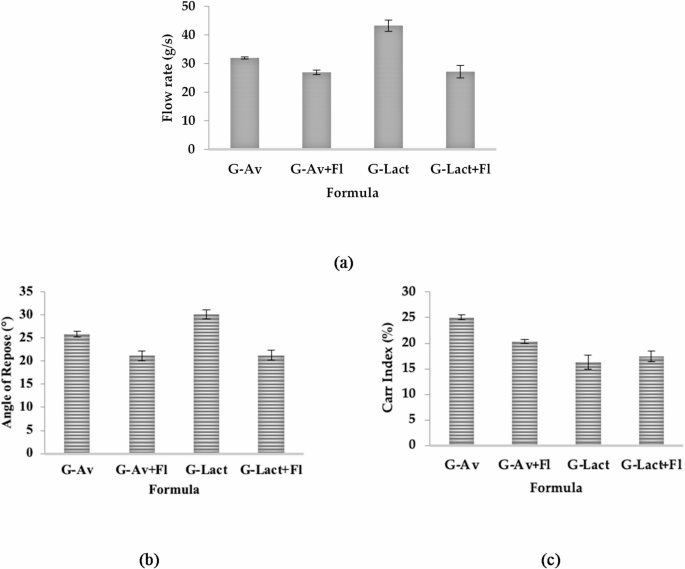
Evaluation of the flow rate of the granules showed that the addition of Florite as a drying agent improved the flowability by using either Avicel or lactose anh. as a filler (Fig. 1a). This finding is in line with the results for the angle of repose, as shown in Fig. 1b. The compressibility/Carr index results are shown in Fig. 1c.

Effect of Florite addition as drying agent on (a) Flow Rate, (b) Angle of Repose, and (c) Carr’s Index Value of granules.

Effect of Florite addition as drying agent on LoD values of granules (a) room temperature and (b) climatic chamber after stability study 0, 1, 2, 3, 4, and 5 months of storage.
Following the preparation of the seawater concentrate granules, their physical stability was analyzed using the LoD parameter based on selectivity for moisture protection. The results in Fig. 2 showed the moisture stability of the granules under two different conditions after 5 months of storage.
Physical stability study of granules using instruments
The dried mineral granules from the seawater concentrate, which were successfully produced using the optimization formula in the previous stage, were introduced into a stability study for 5 months of storage, and the stability parameters of the granules were analyzed using instruments. Hygroscopicity, as the main problem of solid materials with high mineral content, was analyzed in terms of thermal behavior by DSC, crystallinity by XRD, and confirmation of morphological performance by SEM.
Thermal analysis by DSC
The Thermal behavior analysis were conducted on all seawater granule formulations, including lactose anh. granules (G-Lact), lactose anh. granules withFlorite 10% (G-Lact + Fl), Avicel granules (G-Av), and Avicel granules withFlorite 10% (G-Av + Fl) (Fig. 3).

DSC thermogram of deep seawater granules using different filler.
Stability studies by the thermal behavior observation to the granules were conducted after 5 months of storage (Fig. 4). Studies on granules using lactose anh. as filler were performed with formula lactose anh. granules (G-Lact), lactose anh. granules with Florite 10% (G-Lact + Fl), as well as lactose anh. and Florite powder for comparison (Fig. 4a). Accordingly, stability studies on granules with Avicel PH 102 as filler were conducted with formula Avicel granules (G-Av) and Avicel granules with Florite 10% (G-Av + Fl) after formulation (0) and after 5 months of storage under two conditions: room temperature (RT) and climatic chamber (CC), as well as to Avicel PH 102 (Av) powder for comparison (Fig. 4b). During the stability study, it was revealed that the granules with lactose anh. as a filler melted at approximately 2 weeks of storage, and thus could not undergo further stability studies.

DSC thermogram of deep seawater Granules using (a) Lactose anh. and (b) Avicel PH 102 as fillers at day of formulation (0) and after five months of storage at room temperature (RT) and Climatic Chamber (CC).
XRD analysis
The XRD diffraction patterns of deep seawater granules using fillers of Avicel, Avicel with Florite 10%, lactose anh., and lactose anh. with Florite 10%, are shown in Fig. 5.

XRD diffraction patterns of Deep Seawater Granules using different fillers.
The results of the stability study of the XRD pattern were conducted using Avicel as a filler because of the failure of the lactose anh. granule formulation to stand during the study (Fig. 6a). Characterization by XRD during stability studies on granules with Avicel PH 102 as a filler was conducted on Avicel granules (G-Av (0)) and Avicel granules with Florite 10% (G-Av + Fl (0)) after formulation and after 5 months of storage under two conditions: room temperature (RT) and climatic chamber (CC) as well as to Avicel PH 102 (Av) powder for comparison (Fig. 6b).

Difractograms of deep seawater Granules using (a) Lactose anh. and (b) Avicel PH 102 as fillers at day of formulation (0) and after five months of storage at room temperature (RT) and Climatic Chamber (CC).
Morphology study by scanning electron microscope
Observations of the morphology and particle surface of deep seawater granules and standards conducted using Scanning Electron Microscopy (SEM) are shown in Figs. 7, 8 and 9.

Morphology of deep seawater granules using Avicel as filler (G-Av); Avicel PH 102 with Florite 10% (G-Av + Fl); Avicel powder (Av) andFlorite powder (Fl) using magnification of (a) 200 x; (b) 1000 x; and (c) 10,000 x.

Morphology of deep seawater granules using lactose anh. as filler (G-Lact); lactose anh. with Florite 10% (G-Lact + Fl); and lactose anh. (Lact) powder using magnification of (a) 200 x; (b) 1000 x; and (c) 10,000 x.

Morphology of deep seawater granules after 5 months of stability study from granule using Avicel PH 102 as filler (G-Av); Avicel PH 102 with Florite 10% (G-Av + Fl); at room temperature (RT) and at climatic chamber (CC) using magnification of (a) 200 x; (b) 1000 x; and (c) 10,000.
Antistunting activity study
The antistunting study was conducted in vivo using zebrafish (Danio rerio) embryos because of fast embryo development with the ability to provide hundreds of embryos from one individual egg. Not to mention the high homology (70%) with human genes22,23. In studying anti-stunting activity, parameters to be observed in this experiment were hatching rate, brain length, and body length.
Hatching rate
The hatching rate of the zebrafish embryos was observed at 3–5 dpf (days post-fertilization) to evaluate the possibility of delayed egg hatching due to interference with enzyme activity and embryo movement, as shown in Fig. 10.

Percentage of hatched zebrafish eggs (n = 30) after treatment by rotenone continued with concentrate mineral (R + M) compared those induced by rotenone continued with Granule (R + G) compared with controlled Egg in water and controlled egg treated with rotenone (12.5 ppb) as Stunting Inducer agent.
Brain length
The effect of sample treatments on the brain length of the embryo is one of main parameters in this antistunting study due to the stunting effect on neurocognitive responses such as dwarf brain and hindered growth development3. Brain lengths were measured at 24 hpf (hours post-fertilization), to which the division of the brain is still easy to be visually observed, as shown in Fig. 11. The brain length of the embryo from the zebrafish group treated with rotenone (as a stunting inducer agent) was the shortest compared to the group treated with rotenone continued with seawater concentrate (R + M). Surprisingly, the group treated with rotenone and continued with deep seawater granules (R + G) had a similar length to that of the control group (Fig. 12).

Visual Zebrafish’s Brain Length measurement (a) Macroscopic observation of zebrafish’s brain after treatment (white dots with red line); (b) Zebrafish’s brain division based on reference27.

Brain length of Zebrafish embryos at age of 24 hpf (data are mean ± SD, n = 30).
Body length
The effect of treatments with rotenone and deep seawater concentrate on body length of the animal model is the important parameter to be studied since, based on WHO, stunting is defined as a decrease in body length compared with normal standard in child’s growth24. Body length measurement was conducted at 3, 6, and 9 dpf, which was based on the analogy that 6 dpf is equal to a child aged 6 years old and 9 dpf is equal to the child at 8 years25. The results of measurement on a zebrafish’s body length showed that the treatments had affected the body length (Figs. 13 and 14).

Body length of Zebrafish after treatments (data are mean ± SD, n = 30).

Picture body length of Zebrafish after treatments of : controlled Egg in water (K); controlled egg treated with rotenone (12.5 ppb) as Stunting Inducer agent (R) ; rotenone continued with deep seawater concentrate (R + M); rotenone continued with Granule of deep seawater concentrate (R + G).
Cranial cartilage development
Parameter of Cranial Cartilage morphology development is important in stunting case since it directly connected to bone development and growth3. Stunting condition in this experiment was confirmed by the decrease in bone growth from zebra fish group treated by rotenone (R) as stunting inducer. Ceratohyal structure (CH) of different treatment on Zebra fish embryo after 9 Dpf (Fig. 15).

CH -Angle of 9 Dpf Zebra fish embryos at 100x magnification after different treatments ; controlled Egg in water (K); controlled egg treated with rotenone (12.5 ppb) as Stunting Inducer agent (R); rotenone continued with Granule of deep seawater concentrate (R + G); rotenone continued with deep seawater concentrate (R + M) (data are mean ± SD, n = 30). (K), (R), (R + G), (R + M).
Embryonic Cartilage development of zebra fish are evaluated not only by ceratohyal (CH) parameter but also from Meckel angle view (M), palatoquadrate and Meckel cartilage angle view (PQ-M), as well as palatoquadrate and ceratohyal view (PQ-CH) (Fig. 16). The result showed that treatment by deep seawater granule revelaed a significant difference (p < 0,05) compared with that of controle egg water as well as negative control (treated by rotenone 12.5 ppb) when observed as parameters of ceratohyal (CH), Meckel angle view (M), palatoquadrate and Meckel cartilage angle view (PQ-M), as well as palatoquadrate and ceratohyal view (PQ-CH).

Cranial Cartilage measurement of the embryos after different treatments from different angle views; M-Angle (a); CH Angle (b); PQ-M Angle (c); and PQ-CH Angle (d) (data are mean ± SD, n = 30).
Discussion
Quantitative chemical analysis of deep seawater concentrate
The analysis of deep seawater concentrates were conducted by using X-Ray Fluorescence (XRF) and Inductively Coupled Plasma–Optical Emission Spectrometry (ICP-OES) methods, owing to their capability of simultaneous multi-element detection, detection speed, high sensitivity, and wide detection range28,29,30. The results from these two instruments were compared to study their ease and sensitivity for use in mineral content analysis. The results indicated that the seawater concentrate sample or marketed products contained the major components of magnesium (Mg), chloride (Cl), potassium (K), calcium (Ca), sodium (Na), and boron (B) (Table 1).
The difference between the mineral content detected from marketed products compared with deep seawater sample when analyzed using XRF and ICP-OES, either in qualitative or quantitative quantities of the elements, contributed to the variation in sample treatment between XRF and ICP-OES analysis. In the XRF method, the samples do not need to undergo destruction due to their capability to analyze both solid and liquid samples without prior destruction or dissolution. However, this can result in a higher matrix effect, which potentially affects the results28. Seawater concentrate, which was formerly processed into a concentrated form, can precipitate salts during storage31. ICP-OES analysis cannot be conducted directly into solid samples. The sample must be dissolved, requiring the digestion of solids with acid10. Mostly, aqua regia, consisting of HNO3 and HCl in a 1:3 ratio, must be dissolved, which requires the digestion of solids with acid. Acid digestion can alter the form of elements, some of which are not easily soluble or ionized. It can break down complex compounds or minerals, releasing elements10. The differences in sample treatment and matrix composition of the sample of XRF and ICP-OES analyses can affect the results, potentially leading to discrepancies between the outcomes. XRF can detect a greater number of elements than ICP-OES can. However, in terms of trace elements, ICP-OES demonstrates the ability to detect elements at lower concentrations, ranging from 0.0365 to 18,625.8 mg/L, whereas XRF operates within a higher detection range, from 6.61 to 188,319 mg/L. In contrast, XRF is more suitable for detecting a broader range of elements with higher concentrations.
Based on these data, the seawater concentrate sample revealed to contain minerals that are essential for supplementation, including major content of magnesium (Mg), chloride (Cl), potassium (K), calcium (Ca), iron (Fe), copper (Cu), and sodium (Na), which meet the requirements for daily mineral intake as multivitamin supplements. Furthermore, heavy metals such as mercury (Hg), lead (Pb), cadmium (Cd), and arsenic (As) were not detected in the sample, indicating their safety as raw materials for multivitamin source.
Stability study of deep seawater granule formulations
Seawater concentrate is a concentrated liquid of deep seawater rich in minerals that is required for supplement/multivitamin. In terms of stability, raw materials of pharmaceutical dosage forms will be better in solid form either as powders or granules because they are not only stable, but also provide other advantages, such as ease of practical use, handling, and distribution. Deep seawater, as a raw material for multivitamins, most of which are minerals, changes from liquid to solid in the form of granules. Drying and stabilizing granules during storage has become a major challenge. Previous research has shown that a high mineral content makes solid preparations hygroscopic. To overcome this problem, it is necessary to select an optimum diluent and desiccant/drying agent. Lactose anh. has been used as a filler for the reason of affordable price to reduce production unit costs while microcrystalline cellulose was expected to provide better drying capability. The study of multifactor influencing granule stability has been elaborated to provide comprehensive data on the development of granules of deep seawater as a raw material for multivitamins.
Upon formulation, the evaluation of the flow rate of all granules revealed good flow properties (exceeding 10 g/s flow rate, Fig. 1a). Among other formulations, lactose anh. granules (G-Lact) showed the highest flowability owing to their larger particle size compared to that of microcrystalline cellulose (Avicel PH 102). This result is in line with a previous finding that large particles exhibit better flowability32.
In contrast, the angle of repose determination exhibited better flowability for Avicel granules than for those using lactose anh. as a filler (Fig. 1b). The high values of the angle of repose from lactose anh. granules were attributed to the hygroscopic nature of the material, which caused the granules to absorb moisture from the air and stick together in the funnel33,34. The data from the Carr’s Index and flow rate test align with theoretical expectations, indicating good flow properties for G-Lact. However, the results from the angle of repose test showed an anomaly, with the highest angle indicating poor flow. This discrepancy can be attributed to the hygroscopic nature of G-Lact, which significantly influences its flow behavior. The hygroscopicity causes the G-Lact particles to attract moisture, leading them to adhere to each other. As a the result, when measuring the angle of repose, the particles do not disperse evenly, but rather clump together, creating a peak that results in a higher angle of repose. This interaction between particles due to their hygroscopicity explains the observed anomaly in the angle of repose test33.
The flowability increased as measured by smaller values of angles to less than 25 after the addition of Florite as a dying agent. These findings support those of a previous study, which found that the moisture content coated the particles to enhance their sticking ability, thus increasing the particle interaction and increasing the angle of repose.
Based on the compressibility/Carr’s index results shown in Fig. 1c, all formulations exhibited good compressibility values ranging from 5 to 20%, except for G-Av (25.71%). Compressibility refers to the ability of a material to reduce its volume under a certain pressure35. Formula G-Av had smaller granule sizes than those of the other formulations. Granule size affects compressibility: smaller granules tend to have higher compressibility percentages, whereas larger granules exhibit lower percentages36.
The production of granules requires consideration of stability and ease of distribution. To enhance stability, a desiccant is essential to counteract the hygroscopic nature of the mineral content in the granules. In this experiment, Florite was used as the desiccant at a concentration of 10%. It is a synthetic calcium silicate with an outstanding liquid absorption capability up to approximately five times its weight. It has also been reported to exhibit improved compressibility properties37.
The G-Av, G-Av + Fl, and G-Lact + Fl granules remained stable at room temperature, whereas the G-Lact formula melted on the third day of storage. Granules using Avicel as a filler (G-Av and G-Av + Fl) demonstrated good stability for 5 months of storage at room temperature (Fig. 2a) or during stress in a climatic chamber (Fig. 2b). In addition to serving as a filler, Avicel also provides adsorbent capability, thus reducing the hygroscopic properties38,39.
Accordingly, the granule formula using lactose anh. as fillers G-Lact and G-Lact + Fl (lactose anh. filler and Florite as a desiccant) melted in the first month and could not continue the stability testing (Fig. 2a and b). At the early stage of process evaluation, G-Lact granules were obtained and were more hygroscopic than G-Lact + Fl granules, indicating thatFlorite affected the hygroscopic properties of the resulting granules. Nevertheless, these granules could not survive and liquified after 2 weeks of storage. It can be concluded that the filler type has a more dominant influence on the formulation than the desiccant.
The results indicated that Avicel, a model microcrystalline cellulose derivate, can effectively maintain the stability and quality of microscopic granules with a high mineral content in seawater concentrate. Thus, moisture protection of deep-sea water in the form of a solid material (granule) has been successfully developed.
Thermal behavior analysis of granules by DSC testing
Differential scanning calorimetry (DSC) was used to observe the melting point shifts and the transition points of the samples. DSC can also be used as a parameter for stability testing40. The thermal analysis of deep seawater granule formulations – including Avicel granules (G-Av), Avicel granules withFlorite 10% (G-Av + Fl), lactose anh. granules (G-Lact), and lactose anh. granules withFlorite 10% (G-Lact + Fl) – were conducted by using DSC (Fig. 3). The results in Fig. 3 show that the addition of a drying agent (Florite) improves the melting point of the granules to become higher. Notably, there were differences in the melting peaks between the granules with lactose anh. and those with Avicel as fillers. This shift in melting point correlated with enhanced stability of the granules containingFlorite 10%, showing greater thermal stability. Similarly, differences in thermal transition points were observed between lactose anh. granules (G-Lact) and lactose anh. granules withFlorite (G-Lact + Fl), indicating that the addition ofFlorite positively affected the stability of the granules. The melting point ofFlorite is 1.540 °C, that of lactose anh. is 201–202 °C , and that of Avicel is 260–270 °C41,42.
Distinct differences were observed in the thermal behavior of the two formulations (Fig. 4a and b), which were due to the different physical properties of lactose anh. (crystalline) and Avicel/microcrystalline cellulose (semicrystalline). This hypothesis is discussed in the section on XRD analysis. During the stability study, Avicel granules (G-Av) and Avicel granules withFlorite (G-Av + Fl) showed a more robust formulation, suggesting that the type of filler significantly influenced granule stability. Granules with lactose anh. as a filler could not withstand the stability testing and began to melt in the second week of storage; thus, further observation on stability testing could not be continued (Fig. 4a). The hygroscopic properties of lactose anh. granules are not only due to the chemical properties of lactose anh. but also due to the larger particle size and porosity of the granules. The granules using Avicel PH 102 as a filler successfully revealed good stability until 5 months of storage, showing a similar diffractogram either at room temperature or in a climatic chamber. A slight shift in melting point was found when comparing the formulation using Florite as a drying agent with the formulation without it.
XRD analysis of granules
XRD analysis was used to identify the crystalline phases within the material 43,44. Based on the x-ray diffraction patterns of mineral granules with various fillers andFlorite as a drying agent, it was evident that the peak intensities differed among the samples. Lactose anh. granules and lactose anh. granules withFlorite 10% exhibited sharp and high diffraction peaks due to the crystalline properties of lactose anh. as a filler. In contrast, Avicel granules, Avicel granules withFlorite 10% addition, as well as Avicel powder displayed less pronounced crystalline patterns (Figs. 5 and 6b). The diffraction pattern of Avicel was characterized by its microcrystalline structure, resulting in broad peaks due to its low crystallinity45. Notably, the addition ofFlorite 10% to the mineral granules did not alter the crystalline form of the filler, as exhibited by lactose anh. (Fig. 6a). Thus, the granules failed in the stability study, which was performed after 5 months of storage. These results are in line with previous data on LoD and DSC thermograms (Figs. 2 and 4). In conclusion, a formulation of moisture-resistant granules containing deep seawater, which is physically stable, was successfully developed using Avicel PH 102 as a filler by adding a desiccant/drying agent.
Study on morphology and surface particles by using scanning electron microscopy (SEM)
SEM analysis was conducted to characterize the morphology and structure of the deep seawater granules. SEM also aids in determining the structure and homogeneity of particles46. Based on the morphological observations of granules with Avicel as filler and Avicel granules with Florite 10% addition, it was found that Avicel granules with the addition of Florite exhibited a more porous morphology compared to other formulations (Fig. 7), resulting in increased LoD (Fig. 2a) as well as higher melting points in the Avicel or lactose anh. filler formulations (Fig. 3).
The Morphological analysis of granules with lactose anh. as filler revealed that the granules with Florite 10% addition were physically improved in morphology compared with those without drying agent. Lactose anh. powder typically appears as heterogeneous flakes, whereas on the day of formulation, granules with lactose anh. filler exhibit a dense, non-porous texture. A few hours after granulation, a stability problem arose, and the granules became hygroscopic (G-lact, Fig. 8), leading to the formation of melted particles. With the addition of Florite as a drying agent, the granules became more stable, showing a porous particle morphology. In terms of hygroscopicity, porous morphology tends to be more adsorptive because of its larger surface area for interaction with surrounding molecules. Materials with porous morphology can absorb and retain moisture more efficiently47. Nevertheless, the adsorptive property of the drying agent at 10% concentration was not strong enough to stabilize the microscopic nature of lactose anh., thus these formulations failed in stability studies, which were performed for 5 months of storage. Based on stability testing, the findings of this study showed that deep seawater concentrate can be produced into granules by employing Avicel as a filler (Fig. 9). The addition of Florite 10% as a drying agent was the most favorable outcome because of more individualized particles after the study, either at room temperature or climatic chamber (Fig. 9).
Antistunting activity study
The anti-stunting activity of deep-seawater concentrate samples before and after encapsulation into granules (G-Lact + Fl) was evaluated in vivo based on three parameters: hatching rate, brain length, body length and cartilage growth of zebrafish embryos. The sample treatment on the hatching rate was aimed to determine the hatching rate of the embryos compared to a normal zebrafish control group which was 48–72 hpf or 2–3 dpf48. A faster hatching rate is the result of stimulation on enzyme activity, thus an increase in embryo movements49. Accordingly, embryo movement, which defines the muscle strength of the larva, is highly affected by nutrients provided by the media environtment. A sufficient nutrient intake that penetrates the corion of the larva will strengthen its muscle and, in the end, will support spontaneous movement for egg hatching. As expected, the group which showed the highest (99.33%) and fastest hatching rate at 3 dpf was the Control Egg Water group (Fig. 10). The group of Controlled eggs treated with rotenone (12.5 ppb) as a Stunting Inducer agent showed delayed hatching (56,67%). rotenone was used as a negative control, namely the group experiencing stunted growth due to its ability to inhibit mitochondria I, thus a decrease in ATP production,50,51 followed by high ROS (reactive oxygen species) causing cytochrome C release and Caspase 3 activation resulted increase in apoptosis52. ATP as a processed product from Glucose to pyruvate plays the main role in Glucose transport into the cell as GLUT 1 53. A decrease in ATP will highly influence the formation of muscle cells, bone (Osteocalcin as osteoblast product), as well as neuron cells. Disturbance in muscle cell growth inside the larva due to stunted conditions has been quantitatively proven by a lower hatching rate (Fig. 10). At 3 dpf investigation, treatment with deep seawater concentrate after being induced into stunted conditions by rotenone has increased the hatching rate (80%) compared with the stunted group without treatment (56.67%). Surprisingly, the group treated with granules of deep seawater concentrate after rotenone induction showed the highest hatching rate (86.66%), which may due to additional nutrition of sugar derivate (lactose anh.) to the larvae as a granule filler. It can be concluded that treatment with deep-seawater concentrates can increase the hatching rate of stunted zebrafish larvae.
Malnutrition of neurotic cells leads to growth disturbances such as stunted conditions (Muscular Dystrophy Association, 2016). The main effect of stunting on neurocognitive growth is in the dwarf brain,3 with a healthy and optimum size depicting normal embryo growth. It is very important to define the activity and connectivity pattern between distinct units within the nervous system25. The brain size in zebrafish embryos is measured as its length, which is 1.5 mm at the age of 5 dpf. The brain consists of neurons, and the size will grow with age, reaching circa 4.5 mm long upon reaching adulthood54. Thus, the effect of sample treatment on the brain length of zebrafish is an important parameter in antistunting activity due to the effect of stunting on neurocognitive growth3.
As expected, the smallest zebrafish brain was found in the group treated with rotenone (1.050 mm), a stunting inducer agent (Fig. 12). Accordingly, the group treated with deep seawater granules after rotenone induction had the longest brain (1.117 mm), while the egg water in the control group was 1.116 mm. This can also be explained by the presence of sugar (lactose anh.) as a filler in the granule formulation, which provides nutrition to the embryo. The group of embryos treated with deep seawater following rotenone treatment showed improved brain growth (1.108 mm) compared to that without treatment after rotenone induction (1.050 mm). Based on these results, it can be concluded that, by evaluating the parameters of brain growth (measured as length), the stunting condition caused by rotenone induction in zebrafish can be improved by treatment with deep seawater because of its rich mineral content.
According to the World Health Organization (WHO) definition, stunting is the impaired growth and development that children experience from poor nutrition, repeated infections, and inadequate psychosocial stimulation. Children are defined as stunted when they show a decrease in body length compared with the normal standard in their growth24. Therefore, in this experiment, the body length of zebrafish as an animal model of antistunting activity is an important parameter to be studied. rotenone, which was subjected to the zebrafish embryo, significantly decreased larval growth and body length compared with the other animal groups (Figs. 13 and 14). This result is in line with a previous study that found that rotenone (12.5 ppb) decreased the body length of zebrafish larvae24,25. Similar to observations on hatching rate and brain length, the antistunting activity measured by the parameter of body length showed that introduction of deep seawater either as concentrate or as granules had improved the larval growth that had been induced to experience stunting conditions by rotenone.
Stunting directly affect bone growth or development. Pabic et al. (2022) found that cartilage growth in zebra fish has similarities to bones in humans so that understanding the mechanism of human’s bone growth with stunting conditions can be studied with the stunted zebra fish as animal model 55. Figure 15 represents ceratohyal (CH) angle of embryos after treatments including control egg water (K), control rotenone (R), emrbryos induces by rotenone followed by sample of deep seawater (R + M), and those followed by granule of deep seawater (R + G). Based on the results of angle measurement from cranial cartilage it is found that angles of ceratohyal (CH) Meckel (M), palatoquadrate and Meckel cartilage (PQ-M), as well as palatoquadrate and ceratohyal view (PQ-CH) after the treatments by rotenone; deep seawater; and the deep seawater granule was significantly affected compared with that by control egg water at p < 0.05. The groups treated by rotenone continued by deep seawater (R + M) and that treated by rotenone continued by the granule (R + G) showed the cranial angles close to that of egg water control group (Fig. 16). This can be explained by the improvement in cranial cartilage development due to mineral supplementation from deepseawater and its granule.
Cartilage development is a dynamic process governed by the critical time of differentiation, proliferation, migration, and remodeling of the extracellular matrix of cranial nerve chrysta cells, involving a number of growth factors and enzymes56. Bone growth and regeneration are related to four important properties in bone regeneration. First, the osteoconductive matrix acts as a scaffolding or skeleton where bone growth occurs. Second, osteoconductive factors stimulate bone growth, including growth factors, such as bone morphogenetic proteins and growth-β (TGF-β) transformations. Third, osteogenic cells include osteoblasts, primitive mesenchymal cells, and osteocytes, which guarantee structural integrity57. This is greatly influenced by nutrient intake derived from nutritious foods thus food deficiencies will directly impact the bone growth.
Methods
Chemical content analysis of deep seawater concentrates
If the chemical contents of the deep-seawater samples were analyzed using X-Ray Fluorescence (XRF). The tests were conducted by adjusting the helium gas at a flow rate of 0.66 L/minute with a pressure of 10–15 psi. Before analysis, the XRF instrument was calibrated using an “MCA calibration sample” 58.
The chemical contents of the samples were analyzed by ICP-OES (Inductively Coupled Plasma–Optical Emission Spectrometry). Calibration was performed using preprepared calibration solutions. The samples were destroyed beforehand owing to their propensity for precipitation and instrument sensitivity. Standard solutions were prepared for each element. Following the completion of testing with ICP-OES, the results from both XRF and ICP-OES analyses were compared59.
Production of deep seawater granules
The granules were formulated using two types of fillers, lactose anh. and microcrystalline cellulose (Avicel PH 102), using Florite as a dessicant/drying agent. The formulas for the granules are listed in Table 2. The granules were prepared in a fluid bed dryer by spraying deep seawater concentrate containing amylum 10% as a binder into the filler powder. After finishing the spraying process, the granules were dried for 15 min, and Florite was added as a desiccant and prepared for further processing, including physical evaluation and stability study.
Evaluation of granules
- a.
Organoleptic Evaluation.
The mineral granules underwent organoleptic evaluation, including assessments of color and shape.
- b.
Flow Properties Evaluation.
Granule as much as 25 g were passed through a flow tester, and the time taken for the sample to flow was recorded. A good flow rate is generally defined as more than 10 g/s 60,61.
- c.
Angle of Repose.
Granule samples were carefully poured into a flow tester. Upon opening the bottom part, the diameter (d) and height (h) of the powder heap were measured and calculated using the following formula. A smaller angle indicates better flow properties, while larger one suggests poor flowability. A good flow property is indicated by an angle of repose of less than 35o60,61.
$$:{tan}^{-1}:=frac{2left(hright):}{left(dright)}$$
- d.
Compressibility/Carr’s Index.
Compressibility characterizes the material’s capacity to decrease in volume under pressure, with values under 15% indicating good flowability and that over 25% indicating poor flow flowability. The compressibility factor was calculated using the following formula 60,62. V0 is the unsettled apparent volume, and Vf is the final tapped volume.
$$:Compressibility:%=frac{{V}_{0}:-:{V}_{f}}{{V}_{0}}times:100$$
- e.
Loss on Drying (LoD).
One gram of the granules was placed in a moisture-balance apparatus. The apparatus was set to 105 °C until a constant weight was obtained. The results were observed on the screen upon completion. Regular checks were conducted every month for 5 months 63,64.
- f.
Stability Testing.
The Physical stability tests of the granules were carried out for 5 months using climatic chamber (40 ± 2 °C, RH 75 ± 5%) and at room temperature (25 ± 2 °C, RH 70 ± 5%). To evaluate the moisture protection ability of the system, physical stability testing of the granules was performed using organoleptic, LoD, Differential Scanning Calorimetry (DSC), XRD, and SEM65.
- g.
Quality Parameter Testing of Granules Using Instruments.
Advanced characterization of the granules was conducted by evaluating their thermal behavior using DSC, crystallinity by XRD, and morphology by SEM. In this study, DSC testing (Shimadzu 60 A plus) was conducted by placing the sample (5–10 mg) into a crimping (sample) pan, and the nitrogen and oxygen gas bases were turned on. The difference in heat flow between the sample and reference was noted as the temperature changed. The resulting data were plotted as a function of the temperature, resulting in a DSC curve66.
Powder X-ray diffraction (XRD, Malvern Panalytical) patterns of the granules were recorded using a Cu anode X-ray tube, and the generator voltage and current were 40 kV and 30 mA, angle of 2θ in increments of 2 °C/min67.
SEM (Scanning Electron Microscopy) study of the granule used an electron microscope (JED-2300 Analysis Station) for viewing the morphology of the surface of the granules. The working principle of SEM is that the sample is placed at the bottom of the electron column. The electrons in the sample were scattered and captured by an electron detector. Photomultipliers converted voltage signals into images on a PC screen. The magnifications used in this test were 200x, 1000x and 10,000 × 68.
Antistunting activity
Preparation of solutions
An egg water solution was prepared by mixing 1 L Reverse osmosis (RO) water with methylene blue and 1.5 ml salt stock69. Salt stock was prepared by mixing 40 g fish salt with 1 L RO water. rotenone solution was prepared by dissolving rotenone (Sigma, R8875) impurity > 95% in egg water and diluting to 12.5 ppb. This concentration has also been shown to inhibit the zebrafish growth24,25.
Animals and experimental design
Wild type zebrafish (Danio rerio) were obtained from Leiden University and cultivated at the Faculty of Biology, Gadjah Mada University. The fish were maintained in a cycled aquarium at room temperature between 27 and 28 °C and feed three times a day. The embryos used in this experiment were aged 2 Hpf (hours post-fertilization) which were observed until 9 dpf (days post-fertilization). They were fertilized from one male and two adult female zebrafish on media at 27–28 °C.
The experimental design consisted of four groups: (1) control embryos in egg water media; (2) embryos treated with rotenone (12.5 ppb); (3) embryos treated with rotenone (12.5 ppb), followed by deep seawater granules with magnesium content equivalent to 0.05238 ppt; and (4) embryos treated with rotenone (12.5 ppb), followed by deep seawater at 84.73 × 10⁻⁸ µl, also equivalent to magnesium 0.05238 ppt. Each group was replicated three times, with each replicate consisting of 10 embryos, resulting in 30 embryos per group 70.
Magnesium, one of the main minerals found in deep seawater, was subjected to the zebrafish embryos based on dose conversion for embryos compared with adult human’s dose of magnesium. The concentration of 0.05238 ppt magnesium was chosen based on the calculated nutrient dose for zebrafish embryos, which have an average weight of 0.95 mg. This magnesium dose was then applied to the treatment groups as described above.
All experimental procedures were conducted in accordance with ethical standards established by the Research Ethics Committee of Universitas Padjadjaran, Bandung, with Ethical approval from the Research Ethics Committee at Universitas Padjadjaran Bandung under Ethical Approval No. 189/UN6.KEP/EC/2025. All methods were carried out in accordance with relevant guidelines and regulations, and the study is reported in compliance with the ARRIVE guidelines (https://arriveguidelines.org).
Stunting parameters evaluation
Several parameters for stunting evaluation, including hatching rate, brain length, and body length, were measured to living zebrafish. For cranial cartilage evaluation, zebrafish were euthanized using the rapid chilling method in accordance with the American Veterinary Medical Association (AVMA) Guidelines on Euthanasia: 2020 Edition.
Hatching rate
Embryos were observed at 3–5 dpf Normally, embryos hatch at 72 hpf or 3 dpf, and observations until 5 dpf are conducted to evaluate the delay of egg hatching.
Brain length
Brain length observation was conducted by measuring the length of the embryo’s brain at 24 hpf, when brain division can easily be seen in a microscope (Leica ICC50E).
Body length
The length of embryos was measured at 3, 6, and 9 dpf, the larva on the object glass was observed using a microscope, and images were taken to measure body length using ImageJ software from the anterior nose (tip of the snout) to the end of the tail fin (caudalfin) or snout–fin69.
Cranial Cartilage morphology: Embryonic Cartilage development were conducted by observing ceratohyal (CH) parameter, Meckel angle (M), palatoquadrate and Meckel cartilage angle (PQ-M), as well as palatoquadrate and ceratohyal angle (PQ-CH). The morphologies were observed based on staining reaction using ARAB (Alizarin Red Alcian Blue). The larve at age of 9 Dpf were euthanized by using rapid chilling in accordance with the AVMA Guidelines on Euthanasia: 2020 Edition. Following euthanasia, the specimens were fixed in 96% ethanol, then soaked in ARAB for three days for staining. After staining, the samples were washed thoroughly with distilled water, followed by bleaching in a 0.05% KOH solution for 24–36 h. Next, the solution was replaced by Moll’s solution and after 14 h it was removed and replaced by Glycerin for storage. The samples were observed under Leica ICC50E Microscope at 100x magnification. Cartilage development were observed by viewing parameters angles of ceratohyal (CH), Meckel (M), palatoquadrate and Meckel cartilage (PQ-M), as well as palatoquadrate and ceratohyal (PQ-CH) (Fig. 17).

Cranial morphology of Zebra fish’s head cartilage after ARAB staining from different view of angles.
Conclusions
Deep seawater concentrate contains magnesium (Mg), chloride (Cl), potassium (K), calcium (Ca), iron (Fe), copper (Cu), and sodium (Na), and is a potential source of minerals for multivitamin. Despite very hygroscopic in nature, the formulation of deep seawater into granules is highly needed due to practical purposes and it had been successfully conducted. It can be concluded that Avicel PH 102 (as a derivative of microcrystalline cellulose) was the most promising filler to provide good properties and stability of the granules in terms of moisture protection of highly hygroscopic granules. The addition of Florite as dessicant into the powder improves the physical properties of the granules. An anti-stunting activity study on deep-sea water concentrate and granules showed potential results and revealed that they can improve zebrafish growth by increasing hatching rate, brain length, and body length after stunting induction by rotenone. The cranial cartilage development of the fish after stunting inducement were found to be improved after treatment with deep seawater either as concentrate or as granules.
Data availability
I state the datasets used and/or analyzed during the current study available from the corresponding author on reasonable request. (corresponding author: [anis.yohana.chaerunisaa@unpad.ac.id] (mailto: anis.yohana.chaerunisaa@unpad.ac.id) )
References
-
Bhutta, Z. A. et al. Evidence-based interventions for improvement of maternal and child nutrition: what can be done and at what cost? Lancet 382, 452–477 (2013).
-
Elisaria, E., Mrema, J., Bogale, T., Segafredo, G. & Festo, C. Effectiveness of integrated nutrition interventions on childhood stunting: a quasi-experimental evaluation design. BMC Nutr. 7, 1–8 (2021).
-
de Onis, M. & Branca, F. Childhood stunting: A global perspective. Matern Child. Nutr. 12, 12–26 (2016).
-
Keeley, B., Little, C. & Zuehlke, E. The state of the world’s children 2019: children, food and Nutrition–Growing well in a changing world. Unicef (2019).
-
Stewart, C. P., Iannotti, L., Dewey, K. G., Michaelsen, K. F. & Onyango, A. W. Contextualising complementary feeding in a broader framework for stunting prevention. Matern Child. Nutr. 9, 27–45 (2013).
-
Sriwidodo; Umar, A. K., Megawati, E., Butarbutar, M., Wathoni, N. & Alaydrus, S. Physicochemical characterization of concentrated mineral and magnesium isolate of sea water Pamekasan Madura. Int. J. Res. Pharm. Sci. 11, 2154–2157 (2020).
-
Apriani, M., Hadi, W. & Masduqi, A. Physicochemical properties of sea water and Bittern in indonesia: quality improvement and potential resources utilization for marine environmental sustainability. J. Ecol. Eng. 19, 1–10 (2018).
-
Mahmoud, M. G. et al. An assessment on the coastal seawater quality of the Gulf of Suez, Egypt. J. Environ. Prot. (Irvine Calif). 11, 34–47 (2020).
-
Landrigan, P. J. et al. Human health and ocean pollution. Ann. Glob Health. 86, 1–64 (2020).
-
Barin, J. S., Mello, P. A., Mesko, M. F., Duarte, F. A., Flores, E. M. M. & Determination of elemental impurities in pharmaceutical products and related matrices by ICP-based methods: a review. Anal. Bioanal Chem. 408, 4547–4566 (2016).
-
Marguí, E., Queralt, I. & de Almeida, E. X-ray fluorescence spectrometry for environmental analysis: basic principles, instrumentation, applications and recent trends. Chemosphere 303, 135006 (2022).
-
Ng, L. H., Kim, J., Ling, U. & Hadinoto, K. Formulation Strategies to Improve the Stability and Handling of Oral Solid Dosage Forms of Highly Hygroscopic Pharmaceuticals and Nutraceuticals. (2022).
-
Weyh, C., Krüger, K., Peeling, P. & Castell, L. The role of minerals in the optimal functioning of the immune system. Nutrients 14, 1–15 (2022).
-
Petersen, S. Marine mineral resources. Encyclopedia Mar. Geosci. 1–10. https://doi.org/10.1007/978-94-007-6644-0 (2015).
-
El Mabrouki, H. & Kaukhova, I. E. Formulation and development of aqueous film coating for moisture protection of hygroscopic herniaria glabra L. Tablets. Turk. J. Pharm. Sci. 19, 153–160 (2022).
-
Jadav, M. et al. Formulation, optimization and evaluation of nutraceutical effervescent granules containing Curcumin and ascorbic acid by fusion technique using full factorial design. J. Nat. Remedies. 23, 1509–1516 (2023).
-
Guo, L. et al. A comprehensive study of hygroscopic properties of calcium-and magnesium-containing salts: implication for hygroscopicity of mineral dust and sea salt aerosols. Atmos. Chem. Phys. 19, 2115–2133 (2019).
-
Zhang, H., Gu, W., Li, Y. J. & Tang, M. Hygroscopic properties of sodium and potassium salts as related to saline mineral dusts and sea salt aerosols. J. Environ. Sci. (China). 95, 65–72 (2020).
-
Anbarasan, A., Nataraj, J., Shanmukhan, N. & Radhakrishnan, A. Effect of hygroscopicity on pharmaceutical Ingredients, methods to determine and overcome: an overview. Available Online Www Jocpr com. J. Chem. Pharm. Res. 10, 61–67 (2018).
-
Hung, K. W. Y. et al. Detection of water toxicity using cytochrome P450 Transgenic zebrafish as live biosensor: for polychlorinated biphenyls toxicity. Biosens. Bioelectron. 31, 548–553 (2012).
-
Seto, S. W. et al. Zebrafish models of cardiovascular diseases and their applications in herbal medicine research. Eur. J. Pharmacol. 768, 77–86 (2015).
-
Howe, K. et al. The zebrafish reference genome sequence and its relationship to the human genome. Nature 498–503. https://doi.org/10.1038/nature12111.The (2013).
-
Littleton, R. M., Hove, J. R. & Zebrafish A nontraditional model of traditional medicine. J. Ethnopharmacol. 145, 677–685 (2013).
-
Primihastuti, D. et al. The effect of ethanol extract of Pegagan (Centella asiatica) on bone ossification and osteoclastogenesis on the stunting model of zebrafish (Danio rerio) larvae induced by rotenonee. (2022).
-
Yuningsih et al. The effect of centella Asiatica ethanolic extract on expression of glucose transporter 1 and osteocalcin on stunting larvae of zebrafish (Danio rerio). GSC Biol. Pharm. Sci. 19, 178–189 (2022).
-
Breik, L., Tatucu-Babet, O. A. & Ridley, E. J. Micronutrient intake from enteral nutrition in critically ill adults: A systematic review of randomised controlled trials. Australian Crit. Care. 35, 564–574 (2022).
-
Vaz, R., Hofmeister, W. & Lindstrand, A. Zebrafish models of neurodevelopmental disorders: limitations and benefits of current tools and techniques. Int J. Mol. Sci 20, (2019).
-
Moriya, T. Analysis of trace impurities in pharmaceutical products using polarized EDXRF spectrometer NEX CG. Rigaku J. 29, 19–21 (2013).
-
Nölte, J. ICP Emission Spectrometry: A Practical Guide (Wiley-VCH, 2021).
-
Singh, V. K., Kawai, J. & Tripathi, D. K. X-Ray Fluorescence in Biological Sciences: Principles, Instrumentation, and Applications (Wiley, 2022).
-
Na, C., Park, H. & Jho, E. H. Utilization of waste Bittern from saltern as a source for magnesium and an absorbent for carbon dioxide capture. Environ. Sci. Pollut Res. 24, 22980–22989 (2017).
-
Kudo, Y., Yasuda, M. & Matsusaka, S. Effect of particle size distribution on flowability of granulated lactose. Advancedfile:///C:/Users/Lenovo/Downloads/powders-03-00006.pdf (2020). Powder Technology 31, 121–127.
-
Juarez-Enriquez, E. et al. Effect of water content on the flowability of hygroscopic powders. J. Food Eng. 205, 12–17 (2017).
-
Shah, D. S. et al. A concise summary of powder processing methodologies for flow enhancement. Heliyon 9, e16498 (2023).
-
Berkenkemper, S., Klinken, S. & Kleinebudde, P. Investigating compressibility descriptors for binary mixtures of different deformation behavior. Powder Technol. 424, 118571 (2023).
-
Baumgartner, A. & Planinšek, O. Effect of process parameters in high shear granulation on characteristics of a novel co-processed mesoporous silica material. European Journal of Pharmaceutical Sciences 188, Tomita ph. Florite. (2018). (2023).
-
Tomita ph. Florite. (2018).
-
Rowe, C. R., Sheskey, J. P. & Owen, C. S. Hanbook of Pharmaceutical Excipients Sixth Edition (RPS Publishing, 2009).
-
Nofrerias, I. et al. Comparison between microcrystalline celluloses of different grades made by four manufacturers using the sedem diagram expert system as a pharmaceutical characterization tool. Powder Technol. 342, 780–788 (2019).
-
Almoselhy, R. I. M. Applications of differential scanning calorimetry (DSC) in oils and fats Research. A review. Am. Res. J. Agric. 6, 1–9 (2020).
-
Bonnaud, P. A., Ji, Q. & Van Vliet, K. J. Effects of elevated temperature on the structure and properties of calcium-silicate-hydrate gels: the role of confined water. Soft Matter. 9, 6418–6429 (2013).
-
Rowe, R. C., Sheskey, P. J. & Quinn, M. E. Handbook Pharmaceutical Excepients (6th Ed.)by the Pharmaceutical Press,. (2009).
-
Rafiu, R., Khulna & University of Engineering and Technology Department of Materials Science and Engineering Course Title Materials Characterization Sessional X-Ray. Diffraction (XRD) Analysis Name: Rifat Rafiu. 0–7 (2024). https://doi.org/10.13140/RG.2.2.19894.92482
-
Ali, A., Chiang, Y. W. & Santos, R. M. X-Ray Diffraction Techniques for Mineral Characterization: A Review for Engineers of the Fundamentals, Applications, and Research Directions. Minerals 12, (2022).
-
Ulbrich, M. et al. Specific modification of granular potato starch by means of partial debranching using pullulanase. Starch/Staerke 2300154, 1–14 (2023).
-
El-Naggar, N. E. A., El-Malkey, S. E., Abu-Saied, M. A. & Mohammed, A. B. A. Exploration of a novel and efficient source for production of bacterial nanocellulose, bioprocess optimization and characterization. Sci. Rep. 12, 1–22 (2022).
-
Velarde, L., Nabavi, M. S., Escalera, E., Antti, M. L. & Akhtar, F. Adsorption of heavy metals on natural zeolites: A review. Chemosphere 328, 138508 (2023).
-
Wisenden, B. D., Paulson, D. C. & Orr, M. Zebrafish embryos hatch early in response to chemical and mechanical indicators of predation risk, resulting in underdeveloped swimming ability of hatchling larvae. Biol Open 11, (2022).
-
Samaee, S. M., Rabbani, S., Jovanović, B., Mohajeri-Tehrani, M. R. & Haghpanah, V. Efficacy of the hatching event in assessing the embryo toxicity of the nano-sized TiO2 particles in zebrafish: A comparison between two different classes of hatching-derived variables. Ecotoxicol. Environ. Saf. 116, 121–128 (2015).
-
Krauss, S., Zhang, C. Y. & Lowell, B. B. The mitochondrial uncoupling-protein homologues. Nat. Rev. Mol. Cell. Biol. 6, 248–261 (2005).
-
Turner, L., Jacobson, S. & Shoemaker, L. Risk assessment for piscicidal formulations of rotenonee. Compliance Serv. Int. Lakewood WA 1–140 (2007).
-
Cocco, T., Pacelli, C., Sgobbo, P. & Villani, G. Control of OXPHOS efficiency by complex I in brain mitochondria. Neurobiol. Aging. 30, 622–629 (2009).
-
Hammerman, P. S., Fox, C. J. & Thompson, C. B. Beginnings of a signal-transduction pathway for bioenergetic control of cell survival. Trends Biochem. Sci. 29, 586–592 (2004).
-
Friedrich, R. W., Jacobson, G. A. & Zhu, P. Circuit neuroscience in zebrafish. Curr. Biol. 20, R371–R381 (2010).
-
Le Pabic, P., Dranow, D. B., Hoyle, D. J. & Schilling, T. F. Zebrafish endochondral growth zones as they relate to human bone size, shape and disease. Front. Endocrinol. (Lausanne). 13, 1–14 (2022).
-
Huang, W. et al. Effect of bisphenol A on craniofacial cartilage development in zebrafish (Danio rerio) embryos: A morphological study. Ecotoxicol Environ. Saf 212, (2021).
-
Oley, M. C. et al. Effects of platelet-rich plasma and carbonated hydroxyapatite combination on cranial defect bone regeneration: an animal study. Wound Med. 21, 12–15 (2018).
-
Marguí, E. & Queralt, I. Sample Preparation for X-Ray fluorescence analysis. Encyclopedia Anal. Chem. 1–29 https://doi.org/10.1002/9780470027318.a6806m.pub4 (2024).
-
Icp, S. & Emission, O. Agilent 700 Series ICP Optical Emission Spectrometers User’s Guide 2 Agilent 700 Series ICP Optical Emission Spectrometers User’ (s Guide Notices Manual Part Number Instrument Manufacturing, 2018).
-
Aulton, M. E. & Kevin, M. G. T. Pharmaceutics the Design and Manufacture of Medicines (Elsevier, 2018).
-
Sriwidodo, S. et al. Preparation of Mangosteen Peel Extract Microcapsules by Fluidized Bed Spray-Drying for Tableting: Improving the Solubility and Antioxidant Stability. Antioxidants 11, (2022).
-
United States Pharmacopeial Convention. US Pharmacopeia (USP). US Pharmacopeia (USP). (2024).
-
Republic of Indonesia Ministry of Health. Indonesian Pharmacopoeia Edition V (Ministry of Health of the Republic of Indonesia, 2014).
-
Kusuma, S. A. F., Mita, S. R. & Ermawati, R. F. Effect of maltodextrin ratio to Klutuk banana fruit extract (Musa balbisiana colla) combined with its pseudostem extract on anti-dysentery granule performance and effectivity. Int. J. Appl. Pharm. 10, 187–193 (2018).
-
Kholodenko, A. L. Applications of contact geometry and topology in physics. Appl. Contact Geom. Topol. Phys. 02, 1–475 (2013).
-
Leyva-Porras, C., Cruz-Alcantar, P., Espinosa-Sol, V. & Saavedra-Leos, M. Z. Application of differential scanning calorimetry (DSC) and modulated differential scanning. Polym. (Basel). 12, 1–21 (2019).
-
Ermrich, M. & Opper, D. X-Ray Powder Diffraction for the Analyst. PANalytical (2011).
-
Mohammed, A. & A. Abdullah. Scanning Electron Microscopy (SEM): A review. Proceedings of International Conference on Hydraulics and Pneumatics – HERVEX 77–85 (2018). 77–85 (2018). (2018).
-
Avdesh, A. et al. Regular care and maintenance of a zebrafish (Danio rerio) laboratory: an introduction. J. Visualized Experiments. https://doi.org/10.3791/4196 (2012).
-
Pratama, S. F., Retnoaji, B. & Ana, I. D. Effects of carbonate hydroxyapatite (CHA) on the development of heart and cranium cartilage of zebrafish (Danio rerio Hamilton, 1882) larvae. Chiang Mai Univ. J. Nat. Sci. 21, 1–16 (2022).
Acknowledgements
The authors thank The National Research and Innovation Agency (BRIN) and Indonesia Endowment Fund for Education Agency (LPDP), Republic of Indonesia for funding the research through Research and Innovation for Advance Indonesia Grant (RIIM) year 2023/2024, Batch number 4.
Funding
Open access funding provided by University of Padjadjaran. The Research receive the Funding from The National Research and Innovation Agency (BRIN) and Indonesia Endowment Fund for Education Agency (LPDP), Republic of Indonesia as Research and Innovation for Advance Indonesia Grant (RIIM) year 2023/2024, Batch number 4.
Ethics declarations
Competing interests
The authors declare no competing interests.
Additional information
Publisher’s note
Springer Nature remains neutral with regard to jurisdictional claims in published maps and institutional affiliations.
Rights and permissions
Open Access This article is licensed under a Creative Commons Attribution 4.0 International License, which permits use, sharing, adaptation, distribution and reproduction in any medium or format, as long as you give appropriate credit to the original author(s) and the source, provide a link to the Creative Commons licence, and indicate if changes were made. The images or other third party material in this article are included in the article’s Creative Commons licence, unless indicated otherwise in a credit line to the material. If material is not included in the article’s Creative Commons licence and your intended use is not permitted by statutory regulation or exceeds the permitted use, you will need to obtain permission directly from the copyright holder. To view a copy of this licence, visit http://creativecommons.org/licenses/by/4.0/.
About this article

Cite this article
Hartesi, B., Retnoaji, B., Sriwidodo, S. et al. Antistunting potential of deepsea water concentrate as multivitamin granules: stability and in vivo activity study. Sci Rep 15, 37905 (2025). https://doi.org/10.1038/s41598-025-21661-8
-
Received:
-
Accepted:
-
Published:
-
DOI: https://doi.org/10.1038/s41598-025-21661-8