
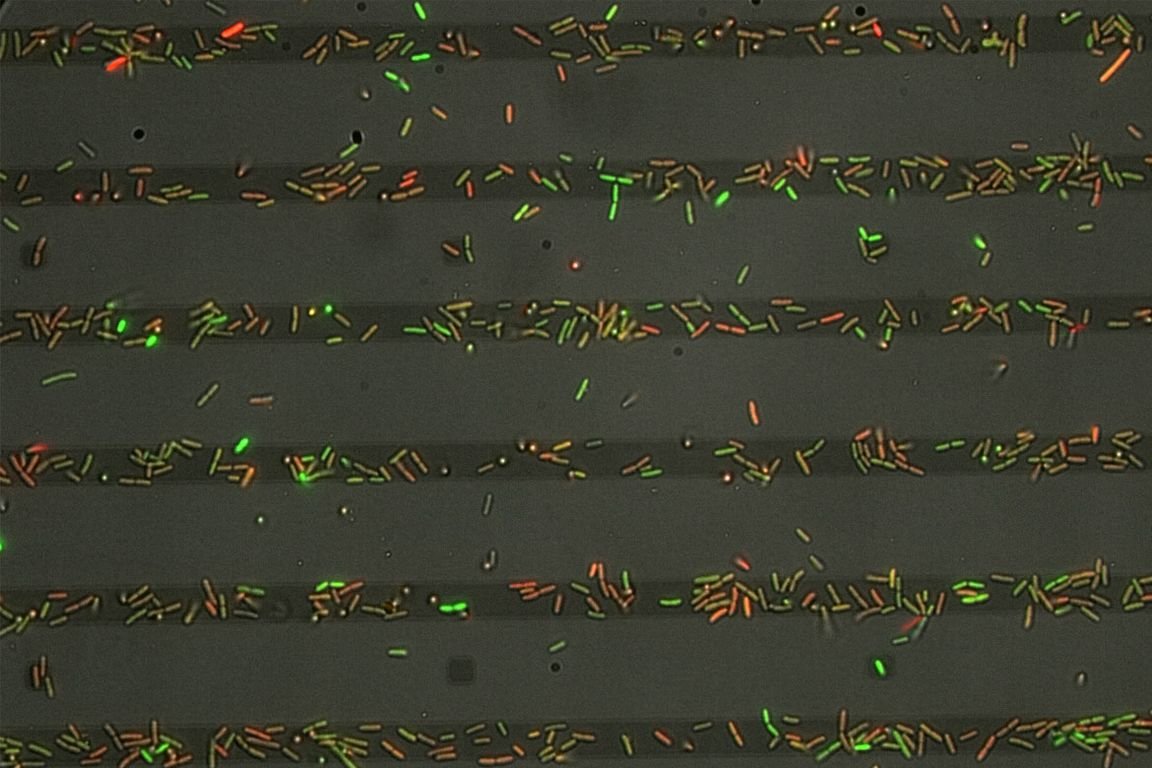
Extracellular polysaccharides (EPS) secreted by bacteria are not only important for surface attachment, they are key components to maintain structural integrity within biofilms. The Psl polysaccharide is a critical component of biofilm formation in Pseudomonas aeruginosa—one of the antibiotic-resistant bacteria presenting the biggest threat to human health according to the WHO list of bacterial priority pathogens.
It was previously known that, during early stages of biofilm formation, Pseudomonas aeruginosa (PAO1) can sense EPS trails of Psl deposited on a surface by Pseudomonas that had been there previously. In doing so, they can detect trajectories of other cells which dictates their motility. This signal occurs through cyclic diGMP second messengers, however no known Psl receptors and adhesins participate in signal transduction.
Now, new findings reveal how Pseudomonas uses type IV pili and adhesins to sense the EPS trails during biofilm formation. The paper, “Pseudomonas aeruginosa senses exopolysaccharide trails using type IV pili and adhesins during biofilm formation,” is published in Nature Microbiology.
The team used bacteria-secreted Psl trails, glycopolymer-patterned surfaces, longitudinal cell tracking, second messenger dual reporters and genetic mutations targeting EPS binding and surface twitching to uncover that Pseudomonas is capable of sensing EPS directly through mutually constitutive interactions between type IV pili (T4P)-powered twitching and specific adhesin–EPS bonds.
The information is translated into chemical signals that guide the operation of processes such as the controlled secretion of more sugars to make biofilms.
More specifically, the mechanochemical surveillance of the Pseudmonas environment, where pili pull against cell-body localized adhesins interacting with EPS trails, “generates a hybrid, transitional planktonic-to-biofilm population with elevated cyclic diGMP and elevated cyclic AMP, as well as increased motility capable of following EPS trails.”
“This form of signal generation is new to the field,” said Gerard Wong, PhD, a professor of bioengineering in the UCLA Samueli School of Engineering. “People have thought of pili mostly as appendages for moving around. It turns out they also act as sensors that translate force into chemical signals within bacteria, which they use to identify sugars. We’re seeing how sensory information is encoded in bacteria by their appendages for the first time.”
Research following up on the study has the potential to yield solutions for Pseudomonas infections in cystic fibrosis patients and others. “There’s the possibility of turning back the clock on biofilm formation,” said Calvin Lee, PhD, a UCLA postdoctoral researcher. “Even if you already have a biofilm, you may be able to make the bacteria take it apart by themselves.”
The study may also inform solutions to other problems created by bacterial communities. Biofilms foul up pipes and filters as well as reactors used for chemical reactions in industry. They’re also the first phase in the accumulations of flora and fauna encrusting ships at sea.
“We can ask, ‘Is it possible to make a surface invisible to bacteria?’” said Wong. “If you get a surface to mimic empty space enough, as far as the bacteria perceive things, it may be possible to solve this multibillion-dollar problem of biofouling.”
The researchers are looking into the wider repertoire of sugars sensed by surface proteins in Pseudomonas, as well as how differently shaped surfaces affect the bacteria’s travels. The scientists also intend to investigate connections between these findings and previous results indicating that cellular signaling persists across generations of bacteria in biofilms.
“We can envision building on these results to influence the bacteria’s behavior,” said William Schmidt, a UCLA doctoral student in bioengineering. “We might be able to turn the cells into more antibiotic-susceptible versions of themselves that are easier to treat.”
The post Pseudomonas aeruginosa Biofilm Formation Driven by Pili–Mediated Sugar Trail Sensing appeared first on GEN – Genetic Engineering and Biotechnology News.


