
- Research Briefing
- Published:
Subjects
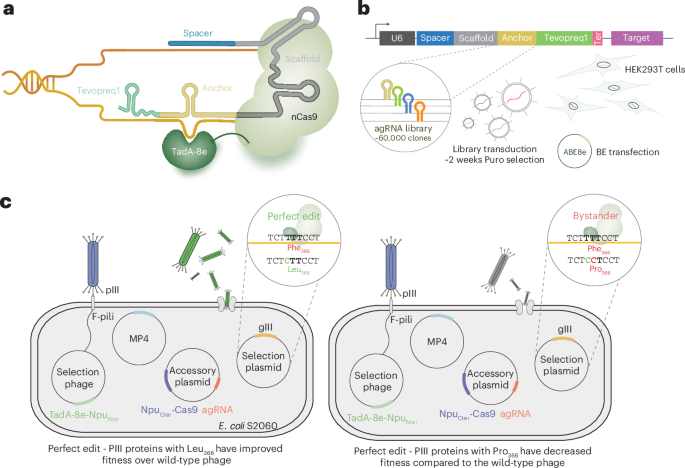
Although base editing has potential as a gene therapy tool, bystander edits limit its clinical use for many pathogenic mutations. This work uses directed evolution to optimize adenine base editors and 3′-extended guide RNAs to enhance targeting, producing more precise editors with reduced bystander effects.
This is a preview of subscription content, access via your institution
Access options
Access Nature and 54 other Nature Portfolio journals
Get Nature+, our best-value online-access subscription
$32.99 / 30 days
cancel any time
Subscribe to this journal
Receive 12 print issues and online access
$259.00 per year
only $21.58 per issue
Buy this article
- Purchase on SpringerLink
- Instant access to the full article PDF.
USD 39.95
Prices may be subject to local taxes which are calculated during checkout

References
-
Healey, N. Next-generation CRISPR-based gene-editing therapies tested in clinical trials. Nat. Med. 30, 2380–2381 (2023). A news article that describes current CRISPR-based gene editing clinical trials.
-
Musunuru, K. et al. Patient-specific in vivo gene editing to treat a rare genetic disease. N. Engl. J. Med. 392, 2235–2243 (2025). This paper reports the first personalized base editing therapy.
-
Rees, H. A. & Liu, D. R. Base editing: precision chemistry on the genome and transcriptome of living cells. Nat. Rev. Genet. 19, 770–788 (2018). This review describes different base editing systems.
-
Urnov, F. D. Imagine CRISPR cures. Mol. Ther. 29, 3103–3106 (2021). This review discusses the need for the faster development of personalized gene therapy.
-
Gaudelli, N. M. et al. Programmable base editing of A•T to G•C in genomic DNA without DNA cleavage. Nature 551, 464–471 (2017). This paper presents the development of the ABE technology.
Additional information
Publisher’s note Springer Nature remains neutral with regard to jurisdictional claims in published maps and institutional affiliations.
This is a summary of: Perrotta, R. M. et al. Engineered base editors with reduced bystander editing through directed evolution. Nat. Biotechnol. https://doi.org/10.1038/s41587-025-02937-w (2025).
Rights and permissions
About this article

Cite this article
Improving adenine base editor precision with directed evolution and extended guide RNAs. Nat Biotechnol (2026). https://doi.org/10.1038/s41587-025-02977-2
-
Published:
-
Version of record:
-
DOI: https://doi.org/10.1038/s41587-025-02977-2


