Introduction
Plastics are now ubiquitous across all environmental compartments1,2,3,4,5,6. While initially considered resistant to biological degradation, recent discoveries have identified microorganisms capable of degrading various types of plastics, including those once thought to be non-biodegradable7. Among them, polystyrene (PS) and polyvinyl chloride (PVC) stand out as two of the six most widely used plastics globally, alongside polypropylene (PP), polyethylene (PE), polyurethane (PUR), and polyethylene terephthalate8. Their widespread applications stem from properties such as hydrophobicity, chemical stability, and mechanical strength, often enhanced by additives9. However, these same properties also contribute to their resistance to biodegradation10. Despite this, studies have suggested that some organisms, including beetle larvae and microorganisms, including the gut microbiota of superworms (Zophobas morio larvae) and mealworms (Tenebrio molitor larvae), can physically break down these plastics, with specific enzymes facilitating their degradation11,12,13,14,15,16,17
It is worth noting that plastic degradation is a broad term encompassing various modifications of the polymer structure. Two major degradation pathways are commonly described: fragmentation, where plastic breaks down into progressively smaller particles18, reaching the micro- and nanometer scale, and depolymerization, where polymer chains are cleaved into oligomers and other molecular compounds19.
While chemical, physical and mechanical degradation pathways have been documented, there is relatively little data on biodegradation3. Most biodegradation studies focus on the biological aspects of plastic degradation, such as microbial growth and genetic adaptations, as well as modifications of the plastic’s surface and physical properties. Yet, the detection of degradation products in the dispersion medium, where bacterial activity actually takes place, remains largely overlooked3 despite the fact that these by-products, whether molecular or in the form of micro- and nanoplastics (MNPs), are most likely to accumulate there and exert significant impacts. First, from an environmental and health perspective, plastic fragmentation into nanoparticles could increase toxicity risks20, while depolymerization may release toxic and bioavailable molecules21. Second, from an industrial standpoint, depolymerization can generate new opportunities for plastic recycling and circular economy strategies22. However, the formation of MNPs may also represent a loss of valuable starting material, potentially reducing the efficiency of recovery processes and limiting the yield of molecular products for industrial reuse22.
The scarcity of studies on plastic biodegradation by microbes is largely due to the lack of analytical methods capable of identifying and characterizing the molecules and particles resulting from degradation. Distinguishing between molecular breakdown products from plastic particles is particularly challenging, as their properties differ significantly at the molecular and particulate scales23. Molecular breakdown products can be analyzed using conventional chromatographic techniques7, whereas solid plastic particulate requires different detection approaches at (ultra)-trace concentrations24. No universal method currently exists to simultaneously separate and characterize these two degradation by-products. This analytical limitation hinders the comprehensive understanding of plastic breakdown pathways and the environmental fate of degradation products. Developing a robust methodology to overcome this challenge is therefore crucial for advancing research in plastic biodegradation.
PS degradation has been extensively studied using a conventional gas chromatography – mass spectrometry (GC-MS) approach7, with depolymerization products identified as phenol derivates25,26,27,28,29, aromatic hydrocarbons30,31,32, and esters33. PVC has also been investigated, with alcohols34, organochlorines35, esters11 as the main depolymerization products (Supplementary Table 1). Interestingly, no consistent patterns in the depolymerization products are observed across studies, likely due to variations in microbial metabolic pathways, additive compositions, and degradation stages.
Although, Py-GC-MS has been increasingly used to identify and characterize plastic debris at both the nanoscale (<1 µm) and microscale (1 µm–5 mm) in various environmental matrices such as soil4, sediment36, freshwater37, marine water38, and living organisms39, few researcher have investigated for studying plastic particles resulting from biodegradation40,41. Plastic identification by Py-GC-MS relies on reference databases that overlook bacterial degradation, leaving structural and chemical changes largely undetected. To better understand microbial degradation, an integrated approach is needed to link depolymerization oligomers with the resulting particles. However, conventional GC-MS and Py-GC-MS cannot be sequentially applied to the same sample, as GC-MS requires filtration that removes plastic fragments, and pyrolysis may alter degradation products, hindering accurate identification.
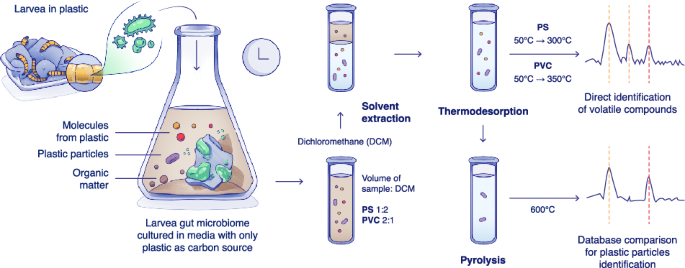
To track plastic biodegradation, this study aims to develop an integrated method to detect both depolymerization and fragmentation products in microbial cultures. We optimized thermodesorption (TDS)/Py-GC-MS parameters and refined dichloromethane extraction to improve product recovery and reduce organic interference. Thermodesorption first volatilizes small molecules by gradual heating for GC-MS analysis, followed by pyrolysis of the remaining non-volatile fraction to detect plastic fragments. While previously applied to oxidation42 and additive detection43, this method has not yet been optimized for biodegradation. Using plastics exposed to mixed microbial communities, we identified PS and PVC degradation products such as (2-phenylcyclopropyl)benzene, biphenyl30, as well as novel compounds, never detected in studies of plastic biodegradation, including (1E)-1-benzylideneindene, 2-ethylcyclopentan-1-one, and benzene.
Results and discussion
Optimization of thermodesorption and pyrolysis temperatures
The main analytical challenge in distinguishing depolymerization products from fragmentation products lies in their thermal stability. To address this, we first investigated the optimal thermodesorption temperature for pristine polystyrene (PS) and PVC.
For PS, Fig. 1A shows the evolution of styrene and toluene peak areas (TDS-GC-MS) across a range of thermodesorption temperatures. These semi-volatile molecules, known to adsorb strongly onto plastics44, are major by-products of PS pyrolysis, typically characterized by a styrene/toluene ratio above 10 under optimal conditions (600 °C). Up to 300 °C, toluene remains low and stable, suggesting minimal surface adsorption. Styrene follows a similar trend, but at 325–350 °C, its signal sharply increases, indicating the onset of thermal degradation and active polymer breakdown (Supplementary Fig. 1).

A The relative area of the styrene peak (in brown) (m/z 104) and toluene peak (in orange) (m/z 91) divided by the area of the internal standard (IS) (m/z 112), during the thermodesorption of PS as a function of the maximum thermodesorption temperature. B Relative area of the 2-methyl naphthalene peak (in purple) (m/z 142) and 2-ethylhexyl butanoate peak (in blue) (m/z 71) divided by the area of the internal standard (m/z 112) during the thermodesorption of PVC as a function of the maximum thermodesorption temperature. C Relative area of styrene peak (in dark orange) (m/z 104) and naphthalene peak (in fir green) (m/z 128) divided by the area of the internal standard (m/z 112) during the pyrolysis of PS and PVC respectively as a function of the pyrolysis temperature. Dots: value of each replicate, lines: mean values and standard deviations, three stars: significant difference <0.01, two stars: significant difference between 0.01 and 0.05, one star: significant difference between 0.05 and 0.1.
Similarly, for PVC, typical pyrolysis products such as naphthalene and 2-methylnaphthalene, also observed in PS degradation, were monitored, alongside 2-ethylhexyl-butanoate, a plasticizer not resulting from pyrolysis45. As shown in Fig. 1B, the plasticizer’s signal remains stable across all thermodesorption temperatures, confirming its desorption behavior and suitability as a proxy marker (Supplementary Fig. 2). In contrast, 2-methylnaphthalene shows a clear threshold beyond 350 °C, with a marked signal increase reflecting the onset of PVC pyrolysis.
To refine pyrolysis conditions, we compared three temperatures: 500 °C, 600 °C, and 700 °C. As shown in Fig. 1C, 500 °C yielded low-intensity peaks due to incomplete pyrolysis, whereas 700 °C led to extensive fragmentation, reduced specificity, and increased variability. Although 700 °C generated higher peak intensities, it compromised reproducibility. In contrast, 600 °C provided consistent and representative pyrolyzate profiles for both PS and PVC, with better repeatability and alignment with existing literature46,47,48. For PS, although signal variability was slightly higher at 600 °C than at 500 °C, Dunn’s test showed no significant differences. Therefore, 600 °C was selected as the optimal temperature, offering a robust compromise between intensity, reproducibility, and comparability across studies.
Optimization of extraction conditions
Another key analytical challenge lies in minimizing the interference of natural organic matter (OM), which can affect the accuracy of TDS and Py-GC-MS signals. We therefore examined the effect of varying the ratio of plastic to DCM on which molecules could be detected during thermodesorption of media collected from a long-term biodegradation experiment. For this optimization work, we selected one flask per plastic polymer based on prioritizing flasks with well-developed biofilms on the associated plastic film (M6 for PS, and bsPVC_control_28 for PVC). Although the presence of a well-developed biofilm does not guarantee biodegradation occurred, we selected flasks based on the presence of a biofilm as we view it as an important pre-requisite to biodegradation.
Figure 2A presents the range of molecules detected during thermodesorption of PS. Styrene and pentadecane are detected in all three of the extraction ratios. When using a 1:1 sample: DCM ratio, 1-benzofuran was also detected. The number of molecules detected with high signal intensities increased to seven when using a 1:2 sample: DCM ratio. These seven molecules include styrene, pentadecane, and 1-benzofuran as noted for other conditions, as well as tetradec-1-ene, undecan-2-ylbenzene, pentylbenzene, and [6-cyclopentyl-3-(3-cyclopentylpropyl)hexyl]benzene. These results suggest that higher DCM proportions enhance the recovery of depolymerization products, likely due to improved solubilization and reduced solvent saturation during extraction. The strong correlation between high log Kow values (supplementary Table 2) and extraction efficiency confirms the effective solubilization of the degradation compounds in DCM. However, due to experimental constraints, only these specific ratios were tested. Further studies should investigate whether higher DCM proportions could further optimize the recovery process.

A Relative presence of detected molecules from polystyrene (PS) degradation, normalized to the condition where their abundance is highest. Gray cells indicate molecules that were not detected under the given conditions. C25H40 [6-cyclopentyl-3-(3-cyclopentylpropyl)hexyl]benzene. (n = 3, RSD 24%). B Evolution of PS markers (styrene, m/z 104; alpha-methylstyrene, m/z 118) as a function of extraction ratio. Data points represent individual replicates, solid lines indicate the mean and standard deviation, (blk:1 = blank with 50% Milli-Q water and 50% DCM), three stars: significant difference <0.01, two stars: significant difference between 0.01 and 0.05. C Relative presence of detected molecules from PVC degradation, normalized to the condition where their abundance is highest. Gray cells indicate molecules that were not detected under the given conditions. C14H12O34–methylpentyl phenyl carbonate (n = 3, RSD 31%).
To evaluate potential interference from natural organic matter (NOM), pyrolysis results for primary PS pyrolyzates, styrene (m/z 104), and α-methylstyrene (m/z 118) are presented in Fig. 2B. Two key observations emerged. First, no PS pyrolyzates were detected in the blank sample, confirming that the target molecules originate from degraded plastic rather than external contamination. Second, pyrolyzate signal intensity increased with DCM concentration, without evidence of co-extracted organic matter, indicating selective and efficient extraction of degradation products. The increasing signal areas observed with higher DCM proportions indicate that complete extraction of PS was not achieved when DCM was not the major phase. Although increasing the DCM ratio may improve recovery, excessive dilution at constant sample concentration could compromise sensitivity and could increase the risk of contamination due to repetitive deposit in cup.
The optimized extraction protocol was also applied to PVC, and the thermodesorption results are shown in Fig. 2C. A 1:2 sample: DCM ratio enabled the extraction and detection of benzene, benzonitrile, 1,1’-biphenyl, 4-methylpentyl phenyl carbonates, and octanenitrile. These compounds are mostly hydrophilic, with log Kow values around 2 (Supplementary Table 2). The 1:1 ratio allowed the extraction of the same compounds, along with decanedinitrile and naphthalene, which are more hydrophobic. Interestingly, the 2:1 sample: DCM ratio yielded six of the same seven compounds detected under the 1:1 ratio but generally at significantly higher concentrations. The one molecule detected exclusively under the 1:1 condition (naphthalene) was also present in the culture medium, suggesting potential background interference.
Overall, extraction efficiency appeared higher with lower DCM content, as signal intensities were consistently stronger across all molecules. This observation is consistent with the correlation between lower logKow values and improved recovery under these conditions. A higher sample: solvent ratio (reduced DCM volume) resulted in more concentrated extracts, thereby enhancing analytical performance. As in the PS tests, higher solvent proportions were not tested due to instrumental limitations. Interestingly, no PVC particles were detected in these extraction experiments, preventing direct validation of PVC fragment recovery. However, independent analyses (data shown in supplementary Fig. 3) confirmed the presence of PVC fragments, thereby supporting the efficacy of the 2:1 extraction protocol (sample:DCM) for recovering PVC particles.
Application of optimized TDS/Py-GC-MS methods to study PS biodegradation
To further evaluate the robustness of the extraction and analytical workflow, two additional biodegradation samples extracted were analyzed per plastic polymer. As described in the Materials and Methods, superworm gut microbiota were collected and incubated in liquid cultures with PS or PVC as the sole carbon source at two temperatures: 28 °C and 37 °C (flasks S6, S7, S10, and S11 in Table 1, n). After 11 months, aliquots of the samples were extracted and analyzed in triplicates using thermodesorption (50–300 °C) followed by pyrolysis at 600 °C.
For PS incubated at 28 °C (n = 1, flask S6), 14 molecules were identified, including (2-phenylcyclopropyl)benzene, (1E)-1-benzylideneindene, 1-phenylethanone, 9-ethenylanthracene, and hexadecanoic acid (see supplementary Table 4 for full list and compound descriptions) (Fig. 3A). At 37 °C (n = 1, flask S7), 15 molecules were detected, including decanal, dodecanal, 1-O-[(E)-dodec-2-enyl]-4-O-(2,4,4-trimethylpentyl)-(E)-but-2-enedioate, N-(2-trifluoroacetyloxyethyl)-9Z-hexadecenamide, hexadecanoic acid, (Z)-hexadec-9-enoic acid (palmitoleic acid), and tetradecanoic acid (Fig. 3A). Only four molecules were common to both temperature conditions: diphenylmethanone (likely from a UV stabilizer), hexadecenoic acid, tetradecanoic acid (both known to be linked to depolymerization products of PE and HDPE49,50), and pentadecanal (a lipid metabolism product). In addition, three molecules, 1,2-dihydroacenaphthylene, decanal, and naphthalene, were present in both the unexposed plastic and the culture media of flask S6, indicating that they are likely additives or residual synthesis by-products. Their absence in flask S7 suggests either their initial absence from the medium, hydrolysis or microbial degradation.

Biological replicate =1, analytical replicate = 3. A Relative presence of detected molecules, normalized to the condition where their abundance is highest. Gray cells indicate molecules that were not detected under the given conditions. C24H42O4 : 1-O-[(E)-dodec-2-enyl] 4-O-(2,4,4-trimethylpentyl) (E)-but-2-enedioate; C22H33F6NO4 : N-(2-Trifluoroacetyloxyethyl)-9Z-hexadecenamide, N-trifluoroacetyl-. (n = 3, RSD 34%). B Evolution of polystyrene markers: relative area of styrene (m/z 104) divided by internal standard (m/z 112) and ratio of toluene (m/z 91) : styrene (m/z 104) following DCM extraction. Data points represent individual replicates, solid lines indicate the mean values and standard deviation, media is culture media means alone without degradation.
Among the identified compounds, (2-phenylcyclopropyl)benzene, biphenyl, and naphthalene derivatives have been previously reported as PS depolymerization products30. The other compounds have not been associated with PS biodegradation to date. Interestingly, molecules detected in flask S6 are primarily aromatic and polycyclic, reflecting structural complexity and the typical aromatic backbone of PS, suggesting their origin from PS depolymerization. In contrast, molecules found in S7 are predominantly linear (aldehydes, fatty acids, nitrogen-containing compounds) such as dodecanal and nonanenitrile. While not found in control samples, these metabolites are likely derived from lipid metabolism and thus may be derived by standard microbial metabolism independent of PS degradation.
Following pyrolysis, both samples exhibited a significantly stronger styrene signal resulting in a toluene:styrene ratio below 1, compared to the blank culture medium that had a toluene:styrene ratio of ~ 2 (Fig. 3B). Both samples showed detectable PS signals, confirming that fragmentation occurred during the long-term biodegradation experiment (Fig. 3B). However, the styrene peak was 10 times larger flask S6 compared to flask S7, and five times greater than in the pure PS control, suggesting that significantly more PS, and/or non-polymerized styrene remaining in the PS film from the synthesis process, was fragmented off the PS film and released into the liquid medium. Based on Py-GC-MS quantification, the estimated PS concentration in the medium of flask S7 was ~12 ng.ml−1, whereas in flask S6, the styrene signal exceeded the calibration range, suggesting a concentration near 3800 ng.ml−1.
Application of optimized TDS/Py-GC-MS methods to study PVC biodegradation
Regarding PVC, cultures were extracted using a 2:1 sample: DCM ratio and subjected to thermodesorption (50–350 °C) followed by pyrolysis at 600 °C in analytical triplicates. A total of 13 molecules were detected in flask S11 (incubated at 37 °C, n = 1) while 8 molecules were detected in flask S10 (incubated at 28 °C, n = 1) (Fig. 4A). Among them, 2-benzofuran-1,3-dione (phthalic anhydride) and 1,2-dihydroacenaphthylene (acenaphthene) were also present in unprocessed PVC, confirming their origin as additives51. Two additional compounds, 2-propylheptan-1-ol and 2-methyloctan-1-ol, were found in pure PVC and in flask S10 certainly as additive but absent in flask S11, suggesting microbial degradation of those molecules in S11. In flask S10, other prominent molecules included 2-ethylhexan-1-ol (a common additive), 2-ethyldecan-1-ol, and methyl 2-ethylhexanoate (Fig. 4A), compounds previously reported as being found in plastic materials51. In flask S11, the dominant molecules included isoindole-1,3-dione (phthalamide, a known additive), cyclooctenone (not previously linked to plastics), 2-ethylcyclopentan-1-one, and benzene, which may originate from microbial metabolism or residual additives.

Biological replicate = 1, analytical replicate = 3. A The relative presence of detected molecules, normalized to the condition where their abundance is highest. Gray cells indicate molecules not detected under the given conditions. C17H24O3: 7,9-ditert-butyl-1-oxaspiro[4.5]deca-6,9-diene-2,8-dione (n = 3, RSD = 26%). B Heatmap showing the relative presence of pyrolysis markers of PVC, normalized to the molecule with the highest abundance (n = 3, RSD = 32%).
To date, only two studies have reported PVC34,52 depolymerization products, and none identified the same molecules. However, similar functional groups, such as alcohols, have been observed by Py-GC-MS34. No chlorine-containing compounds were detected, which likely suggests that no PVC was depolymerized from the PVC film into the liquid. On the other hand, benzene derivatives were also identified, consistent with degradation patterns observed in PS30 and the possibility of microbial depolymerization of the PVC films.
Despite these molecular signatures, major PVC degradation markers were absent, and minor ones were detected in insufficient quantities (Fig. 4B). Moreover, no evidence of PVC fragmentation was observed in the samples analyzed (Fig. 4B). Taking together with the lack of chlorine-containing compounds, these results likely suggest no PVC biodegradation (depolymerization or fragmentation) occurred under the tested conditions.
Perspectives
Although the thermodesorption-GC-MS approach developed here offers valuable insights into the identification of volatile and semi-volatile degradation products, it presents intrinsic limitations regarding the detection of higher-molecular-weight oligomers or insoluble polymeric residues. These less volatile fractions are, however, environmentally relevant as they often persist in natural systems in particulate or colloidal forms. In this context, the present method should be considered as a complementary analytical tool rather than a standalone approach. When coupled with non-volatile analytical strategies such as pyrolysis-GC-MS, field-flow fractionation or mass spectrometry–based non-targeted screening, it can provide a more complete understanding of the continuum of polymer degradation products in real samples. Such combined approaches will be essential to link laboratory degradation experiments with environmentally realistic processes occurring in soils, sediments, and aquatic systems.
The application of double-shot TDS/pyrolysis-GC-MS seemed to be an effective approach for detecting both depolymerization and fragmentation products during plastic degradation. The method developed in this study underscores the importance of optimizing extraction parameters based on the solubility of degradation products. PS and its breakdown products were best recovered using a 1:2 sample: DCM ratio, whereas for PVC, the best sample: DCM ratio was 2:1. Desorption temperatures were tailored to each polymer, 300 °C for PS and 350 °C for PVC, while a pyrolysis temperature of 600 °C was selected to maximize signal intensity without inducing over-degradation. These optimized conditions enhanced the detection of degradation products while minimizing cross-contamination.
Our analysis revealed the presence of several compound classes when analyzing liquid samples from a long-term incubation of a mixed microbial community incubated with PS or PVC: known additives (e.g., isoindole-1,3-dione for PVC, 1-phenylethanone for PS), metabolic by-products (notably fatty acids), and recognized depolymerization markers such as (2-phenylcyclopropyl)benzene for PS and benzene. In addition, novel depolymerization-related compounds seemed to be identified, including (1E)-1-benzylideneindene and [(1S,2R)-2-phenylcyclobutyl]benzene for PS. PS fragmentation was also confirmed, demonstrating the method’s ability to capture both molecular and particulate degradation products.
This first study clearly highlights the complexity of identifying biotic degradation products compared to abiotic ones and underscores the need to develop comprehensive databases of biodegradation products. Such databases would enable non-targeted screening approaches and, when coupled with DNA analyses, allow for a multidimensional understanding of biodegradation versus fragmentation processes.
Methods
Reagents
Polystyrene (PS) plastics beads (9003-53-6, Goodfellow Inc, Canada) were dissolved in dichloromethane (DCM, HPLC grade, Thermo Scientific, USA). Polyvinyl chloride (PVC, 81388, Sigma Aldrich, Germany) powder was dissolved in tetrahydrofuran (THF, HPLC grade, Fischer Chemical, Canada) and diluted in DCM for optimization of the method. The solutions were visually inspected to ensure that the plastics had dissolved properly. The internal standard of deuterated polystyrene (PS-D8, P3585F3A-dPS, Polymer Source Inc, Canada) was dissolved in DCM. DCM is also the solvent used for the liquid-liquid extractions.
Plastics used for rearing of mealworm and superworms included post-consumer PS foam (used Fisher Scientific Canada shipping material), consumer-grade PVC foam (Pixiu Solutions Inc., Canada), and consumer-grade, brown PVC film (Pixiu Solutions Inc., Canada). Plastics used for the long-term flask incubations included PS film (thickness of 0.05 mm, weight of ~34 mg; Product No. ST31-FM-000150, Goodfellow Cambridge Ltd., England) and brown PVC film (area of 6.45 cm2, thickness of 0.1 mm thickness, weight of ~187 mg; Pixiu Solutions Inc., Canada). To verify that starting materials were not pre-aged, starting samples were analyzed for chemical oxidation by attenuated total reflection Fourier transform infrared spectroscopy, and for roughness by scanning electron microscopy and profilometry (method and results are provided in Zenodo) before and after biodegradation. The PS and PVC films used for crops were also dissolved in DCM and THF, respectively, in order to determine their additive composition and use them as a point of comparison as pristine plastic during validation.
Plastic biodegradation experiments
Mealworms or superworms were reared in glass containers with the following three diets at room temperature: a diet consisting solely of post-consumer PS foam, consumer-grade PVC foam, or consumer-grade, brown PVC film. A total of six containers were prepared: three mealworm containers (one container per diet) and three superworm containers (one container per diet). Following 21 to 22 days, for each superworm container, four insects were collected, sterilized by submerging them in 70% ethanol, and then pooled by container yielding three pools of four superworms per pool. Similarly, for each mealworm container, 12 insects were collected, sterilized by submerging them in 70% ethanol, and then pooled by container yielding three pools of 12 mealworms per pool; a larger number of mealworms were used compared to superworms due to their smaller size. Subsequently, the digestive tracts of all insects per pool were collected and transferred to 1 mL of saline (8.5 g NaCl per L of ddH2O). Digestive tracts were cut open and the gut microbiota massaged out into the saline, after which the bulk digestive tract fragments were discarded. The saline samples were then centrifuged at a low speed (1000 × g for 1 min in an Eppendorf 5425 centrifuge) to discard remaining insect tissue, after which the supernatant was transferred to a new tube and centrifuged at a high speed (16,000 × g for 3 min in an Eppendorf 5425 centrifuge) to pellet the microbes. The supernatant was then discarded, and the pellet resuspended in 600 µL of saline. Lastly, the microbial suspensions from superworms fed the two PVC diets were combined, and likewise, the microbial suspensions from mealworms fed the two PVC diets were combined.
To set up the long-term incubations, 125 mL flasks were filled with 50 mL of LCFBM minimal medium supplemented with Wolfe’s vitamin solution and Wolfe’s trace mineral supplement53, plugged with cotton, covered with aluminium foil, and autoclaved (121 ˚C, 15 psi, 45 min). A single 6.45 cm2 piece of either PS film or brown PVC film was added to each flask, after sterilization of the film by submerging in 70% ethanol for 10 min followed by air-drying under sterile conditions. The added plastic films represented the only source of carbon added to the flasks aside from trace carbon present in the vitamin and trace mineral solutions. Finally, a 150 µL aliquot of one of the microbial suspensions or sterile saline was added to each flask; flasks with PS films were inoculated with the microbial suspensions collected from PS-fed larvae or sterile saline, while the flasks with PVC films were inoculated with the microbial suspensions collected from PVC-fed larvae or sterile saline (Table 1). The cultures were incubated in the dark with shaking (200 rpm using Eppendorf 40R shakers) at either 28 °C or 37 °C (Table 1). Over time, microbial growth and/or biofilm formation was evident, including in flasks that were not initially inoculated with larvae microbiota. Eleven months into the planned 24 months of incubation, aliquots of the culture medium were collected from each flask and carefully stored at 4 °C for 4 months until analysis to preserve the integrity of the degradation products.
Extraction and thermodesorption – pyrolysis gas chromatography mass spectroscopy (TDS/Py-GC-MS)
A classical TDS/Py-GC-MS analysis includes evaporating in a stainless cup (Eco-cup LF, Frontier Lab, Japan) at ambient temperature. During the evaporation process, the pyrolysis cups are covered with a beaker to minimize the risk of contamination. For PS analysis, 20 ng of PS-D8 was added to the cups as an internal standard. PVC was analyzed prior to the use of an internal standard (IS), as the method was not yet calibrated. However, a sensitivity check (20 ng of PS) was run every six samples. Once dry, samples were inserted into the pyrolizer sampler (multi-shot pyrolizer EGA/Py-3030D, Frontier Lab, Japan) through the long stick (Eco-Stick DF, Frontier Lab, Japan). All TDS/Py-GC-MS analyses are performed using gas chromatography (GC system 7890A, Agilent Technologies, California, USA) and mass spectrometry (GC/MS Triple Quad 7000A, Agilent Technologies, California, USA). GC/MS parameters are presented in supplementary Table 5 and supplementary Fig. 4.
The thermodesorption and pyrolysis temperatures were optimized using dissolved pristine PS and PVC for each analysis (supplementary Table 4). The measurements start with a thermodesorption program starting at 50 °C and increasing at 40 °C/min. The thermodesorption program was repeated several times, each time finishing at a different maximum temperature. For PS, the maximum temperature was set between 250 °C and 350 °C (at increments of 25 °C). For PVC, the maximum temperature was set between 200 °C and 400 °C (at increments of 50 °C). Once the optimum maximal temperature for thermodesorption was determined, the pyrolysis optimum temperature was investigated from 500 to 700 °C for PS and PVC (at increments of 100 °C).
Before TDS/Py-GC-MS analysis, plastics and associated degradation biomarkers had to be extracted to minimize interference from organic matter. Extraction protocols were tested on both plastic types using liquid culture medium (named sample for this part), varying sample: DCM ratios. For each plastic type, samples for the optimization experiments were selected based on the presence of a well-developed biofilm (flask M6 for PS and flask bsPVC_control_28 for PVC), assumed to be a precursor to biodegradation. Different proportions of volume of sample and DCM were tested (2:1, 1:1, 1:2 sample: DCM for a total of 3 ml). After 30 min in an ultrasonic bath (37 Hz, 100%, 30 °C), extractions were left to settle overnight at ambient temperature. Aliquots of the DCM phasis, corresponding to each ratio were then evaporated to dryness prior to analysis. All condition of extraction were subsequently analyzed using a double-shot TDS/Py-GC-MS approach. For all three tests, the analyses were performed in analytical triplicate. Procedure controls were performed with DCM to replace dissolved plastics and with MilliQ water for extractions.
Molecules desorbed and pyrolyzates from the DCM extraction were eluted into a GC-column (DB-5MS UI, 60 m Agilent Technologies, California, USA) with helium as the carrier gas, passing an interface temperature at 300 °C with a split ratio of 5:1. Optimal gas chromatography separation and mass spectrometer parameters are described in the supplemental information (Supplementary Table 5). After analyses, chromatograms were deconvoluted using the Unknown Analysis software (Mass Hunter Workstation Unknown Analysis, version 12.0, Agilent Technologies) and molecules were identified with the NIST17 database (National Institute of Standards and Technology). Molecules have been selected with a match factor superior to 80%. Area extractions were performed with quantitative analysis (Mass Hunter Workstation Quantitative Analysis, version 12.0, Agilent Technologies) for the higher m/z.
Culture media from the long-term plastic biodegradation experiment from flasks inoculated with superworm microbiota (flasks S6, S7, S10, and S11) were used to validate the method. The protocol of extraction and analysis was used according to the results of the tests. The negative control was pure LCFBM and for fragmentation, the positive control was pure plastic dissolved in DCM for PS and in THF for PVC, then diluted in DCM for analysis. Internal quantification was performed in the laboratory using PS dissolved in DCM, analyzed in triplicate in 10 quantities between 0.5 and 100 ng, with PS-D8 as IS. Six cups with only IS have been analyzed to determine the noise. Styrene is used as markor (m/z 104) divided by IS (m/z 112), limit of detection (3 times signal-to-noise ratio) was 1.8 ng and 5 ng for limit of quantification (10 times signal-to-noise ratio) (calibration details are present in supplementary Fig. 5). PVC and molecules from thermodesorption are detected only semi-quantitatively, with the integration of chromatogram peaks.
All data analysis was done in RStudio54 with R version 4.4.0, using the ggplot255, Rstatix56, and dplyr57 packages. Statistical tests were performed for the method optimization using Kruskall–Wallis tests and paired comparisons with Dunn tests and the Hochberg method for p-value correction.
Data availability
References
-
Eriksen, M. et al. Plastic pollution in the South Pacific subtropical gyre. Mar. Pollut. Bull. 68, 71–76 (2013).
-
Arini, A., Gigault, J., Venel, Z., Bertucci, A. & Baudrimont, M. The underestimated toxic effects of nanoplastics coming from marine sources: a demonstration on oysters (Isognomon alatus). Chemosphere 295, 133824 (2022).
-
Lear, G. et al. Plastics and the microbiome: impacts and solutions. Environ. Microbiome 16, 2 (2021).
-
Wahl, A. et al. Nanoplastic occurrence in a soil amended with plastic debris. Chemosphere 262, 127784 (2021).
-
Bergmann, M. et al. White and wonderful? Microplastics prevail in snow from the Alps to the Arctic. Sci. Adv. 5, eaax1157 (2019).
-
Lacerda, A. L. D. F. et al. Plastics in sea surface waters around the Antarctic Peninsula. Sci. Rep. 9, 3977 (2019).
-
Gambarini, V. et al. Phylogenetic distribution of plastic-degrading microorganisms. mSystems 6, e01112-20 (2021).
-
Geyer, R. Chapter 2-production, use, and fate of synthetic polymers. in Plastic Waste and Recycling 13–32 (Elsevier, 2020), https://doi.org/10.1016/B978-0-12-817880-5.00002-5.
-
Maddela, N. R., Kakarla, D., Venkateswarlu, K. & Megharaj, M. Additives of plastics: entry into the environment and potential risks to human and ecological health. J. Environ. Manag. 348, 119364 (2023).
-
Zeenat, Elahi, A., Bukhari, D. A., Shamim, S. & Rehman, A. Plastics degradation by microbes: a sustainable approach. J. King Saud Univ. Sci. 33, 101538 (2021).
-
Zhang, Y., Pedersen, J. N., Eser, B. E. & Guo, Z. Biodegradation of polyethylene and polystyrene: From microbial deterioration to enzyme discovery. Biotechnol. Adv. 60, 107991 (2022).
-
Gowthami, A. et al. Marine microalgae – mediated biodegradation of polystyrene microplastics: Insights from enzymatic and molecular docking studies. Chemosphere 144024 https://doi.org/10.1016/j.chemosphere.2024.144024 (2024)
-
Sanz, L., Tran, T. & Kainer, D. Potential of Tenebrio molitor and Zophobas morio in Plastic Degradation: Mechanisms, Microorganisms, and Enzymes. https://doi.org/10.5281/ZENODO.13621718 (2024)
-
Jiang, S., Su, T., Zhao, J. & Wang, Z. Biodegradation of Polystyrene by Tenebrio molitor, Galleria mellonella, and Zophobas atratus Larvae and comparison of their degradation effects. Polymers 13, 3539 (2021).
-
Vital-Vilchis, I. & Karunakaran, E. Using insect larvae and their microbiota for plastic degradation. Insects 16, 165 (2025).
-
Sun, J., Prabhu, A., Aroney, S. T. N. & Rinke, C. Insights into plastic biodegradation: community composition and functional capabilities of the superworm (Zophobas morio) microbiome in styrofoam feeding trials. Microb. Genomics 8, 000842 (2022).
-
Yang, Y., Wang, J. & Xia, M. Biodegradation and mineralization of polystyrene by plastic-eating superworms Zophobas atratus. Sci. Total Environ. 708, 135233 (2020).
-
Andrady, A. L. et al. Oxidation and fragmentation of plastics in a changing environment; from UV-radiation to biological degradation. Sci. Total Environ. 851, 158022 (2022).
-
Liu, L., Xu, M., Ye, Y. & Zhang, B. On the degradation of (micro)plastics: degradation methods, influencing factors, environmental impacts. Sci. Total Environ. 806, 151312 (2022).
-
Teuten, E. L. et al. Transport and release of chemicals from plastics to the environment and to wildlife. Philos. Trans. R. Soc. B Biol. Sci. 364, 2027–2045 (2009).
-
Djapovic, M. et al. Synthesis and characterization of polyethylene terephthalate (PET) precursors and potential degradation products: toxicity study and application in discovery of novel PETases. Chemosphere 275, 130005 (2021).
-
Vollmer, I. et al. Beyond mechanical recycling: giving new life to plastic waste. Angew. Chem. Int. Ed. 59, 15402–15423 (2020).
-
Campbell, C. G., Astorga, D. J., Duemichen, E. & Celina, M. Thermoset materials characterization by thermal desorption or pyrolysis based gas chromatography-mass spectrometry methods. Polym. Degrad. Stab. 174, 109032 (2020).
-
Le Juge, C., Grassl, B., Allan, I. J. & Gigault, J. Identification of polystyrene nanoplastics from natural organic matter in complex environmental matrices by pyrolysis–gas chromatography–mass spectrometry. Anal. Bioanal. Chem. 415, 2999–3006 (2023).
-
Wang, Q., Chen, H., Gu, W., Wang, S. & Li, Y. Biodegradation of aged polyethylene (PE) and polystyrene (PS) microplastics by yellow mealworms (Tenebrio molitor larvae). Sci. Total Environ. 927, 172243 (2024).
-
Chen, Z. et al. Enhanced in situ biodegradation of microplastics in sewage sludge using hyperthermophilic composting technology. J. Hazard. Mater. 384, 121271 (2020).
-
Sekhar, V. C. et al. Microbial degradation of high impact polystyrene (HIPS), an e-plastic with decabromodiphenyl oxide and antimony trioxide. J. Hazard. Mater. 318, 347–354 (2016).
-
Mohan, A. J., Sekhar, V. C., Bhaskar, T. & Nampoothiri, K. M. Microbial assisted high impact polystyrene (HIPS) degradation. Bioresour. Technol. 213, 204–207 (2016).
-
Tsochatzis, E. D., Berggreen, I. E., Nørgaard, J. V., Theodoridis, G. & Dalsgaard, T. K. Biodegradation of expanded polystyrene by mealworm larvae under different feeding strategies evaluated by metabolic profiling using GC-TOF-MS. Chemosphere 281, 130840 (2021).
-
Savoldelli, J., Tomback, D. & Savoldelli, H. Breaking down polystyrene through the application of a two-step thermal degradation and bacterial method to produce usable byproducts. Waste Manag. 60, 123–126 (2017).
-
Mamtimin, T. et al. Gut microbiome of mealworms (Tenebrio molitor Larvae) show similar responses to polystyrene and corn straw diets. Microbiome. 11, 98 (2023).
-
Tsochatzis, E., Lopes, J. A., Gika, H. & Theodoridis, G. Polystyrene biodegradation by Tenebrio molitor larvae: identification of generated substances using a GC-MS untargeted screening method. Polymers 13, 17 (2021).
-
Yang, Y. et al. Biodegradation and mineralization of polystyrene by plastic-eating mealworms: part 2. Role of gut microorganisms. Environ. Sci. Technol. 49, 12087–12093 (2015).
-
Xu, Y., Xian, Z.-N., Yue, W., Yin, C.-F. & Zhou, N.-Y. Degradation of polyvinyl chloride by a bacterial consortium enriched from the gut of Tenebrio molitor larvae. Chemosphere 318, 137944 (2023).
-
Sumathi, T., Viswanath, B., Sri Lakshmi, A. & SaiGopal, D. V. R. Production of Laccase by Cochliobolus sp. isolated from plastic dumped soils and their ability to degrade low molecular weight PVC. Biochem. Res. Int. 2016, 9519527 (2016).
-
Bouzid, N. et al. Quantification of microplastics by pyrolysis coupled with gas chromatography and mass spectrometry in sediments: challenges and implications. Microplastics 1, 229–239 (2022).
-
Vilakati, B. et al. Qualitative characterisation and identification of microplastics in a freshwater dam at Gauteng Province, South Africa, using pyrolysis–gas chromatography–time of flight–mass spectrometry (Py–GC–ToF–MS). Environ. Sci. Pollut. Res. 29, 83452–83468 (2022).
-
Ter Halle, A. et al. Nanoplastic in the North Atlantic subtropical gyre. Environ. Sci. Technol. 51, 13689–13697 (2017).
-
Peters, C. A. et al. Pyr-GC/MS analysis of microplastics extracted from the stomach content of benthivore fish from the Texas Gulf Coast. Mar. Pollut. Bull. 137, 91–95 (2018).
-
Xu, J. & Dong, Y. Analysis of the gut microbiome associated to PVC biodegradation in yellow mealworms. Ecotoxicol. Environ. Saf. 272, 116046 (2024).
-
Richard, C. M. C., Renault, D. & Colinet, H. Can the plastic-eating insect Alphitobius diaperinus be used as a new biodegradation agent for synthetic plastic insulator wastes? Environ. Technol. Innov. 39, 104315 (2025).
-
Toapanta, T. et al. Influence of surface oxidation on the quantification of polypropylene microplastics by pyrolysis gas chromatography mass spectrometry. Sci. Total Environ. 796, 148835 (2021).
-
Akoueson, F. et al. Identification and quantification of plastic additives using pyrolysis-GC/MS: A review. Sci. Total Environ. 773, 145073 (2021).
-
Le Juge, C. et al. Volatile organic compounds identification and specific stable isotopic analysis (δ13C) in microplastics by purge and trap gas chromatography coupled to mass spectrometry and combustion isotope ratio mass spectrometry (PT-GC-MS-C-IRMS). Anal. Bioanal. Chem. https://doi.org/10.1007/s00216-023-04595-w (2023).
-
Wypych, G. Handbook of Polymers (Elsevier, 2012) https://doi.org/10.1016/C2011-0-04631-8.
-
Tsuge, S., Ohtani, H. & Watanabe, C. Pyrolysis-GC/MS Data Book of Synthetic Polymers: Pyrograms, Thermograms and MS of Pyrolyzates (Elsevier, Amsterdam, Boston, 2011).
-
Blancho, F., Davranche, M., Hadri, H. E., Grassl, B. & Gigault, J. Nanoplastics identification in complex environmental matrices: strategies for polystyrene and polypropylene. Environ. Sci. Technol. 55, 8753–8759 (2021).
-
Dehaut, A. et al. Microplastics in seafood: Benchmark protocol for their extraction and characterization. Environ. Pollut. 215, 223–233 (2016).
-
Sanniyasi, E., Gopal, R. K., Gunasekar, D. K. & Raj, P. P. Biodegradation of low-density polyethylene (LDPE) sheet by microalga, Uronema africanum Borge. Sci. Rep. 11, 17233 (2021).
-
Awasthi, S., Srivastava, P., Singh, P., Tiwary, D. & Mishra, P. K. Biodegradation of thermally treated high-density polyethylene (HDPE) by Klebsiella pneumoniae CH001. 3 Biotech 7, 332 (2017).
-
Wagner, M. et al. State of the Science on Plastic Chemicals – Identifying and Addressing Chemicals and Polymers of Concern. https://doi.org/10.5281/zenodo.10701706 (2024)
-
Zhang, Z. et al. Polyvinyl chloride degradation by a bacterium isolated from the gut of insect larvae. Nat. Commun. 13, 5360 (2022).
-
Wu, W.-M. & Criddle, C. S. Chapter Five – Characterization of biodegradation of plastics in insect larvae. in Methods in Enzymology (eds Weber, G., Bornscheuer, U. T. & Wei, R.) Vol. 648 95–120 (Academic Press, 2021).
-
Posit team. RStudio: Integrated Development Environment for R. (Posit Software, 2024).
-
Wickham, H. Ggplot2: Elegant Graphics for Data Analysis (Springer-Verlag New York, 2016).
-
Kassambara, A. rstatix: Pipe-Friendly Framework for Basic Statistical Tests (2023).
-
Wickham, H., François, R., Henry, L., Müller, K. & Vaughan, D. dplyr. A Grammar of Data Manipulation (2023).
Acknowledgements
This research was supported by the “Optimizing a microbial platform to break down and valorize waste plastic” project funded by the Government of Canada through Genome Canada, Génome Québec, Ontario Genomics (OGI-207), the project “NANO-QUEBEC” funded by the Natural Sciences and Engineering Research Council of Canada (NSERC – Alliance Subvention program) and the Quebec City, and the Government of Ontario through an Ontario Research Fund (ORF)—Large Scale Applied Research Project (LSARP) grant (File 18414). Authors thanks Armand PROUST for his help in developing the PS method.
Ethics declarations
Competing interests
The authors declare no competing interests.
Additional information
Publisher’s note Springer Nature remains neutral with regard to jurisdictional claims in published maps and institutional affiliations.
Supplementary information
Rights and permissions
Open Access This article is licensed under a Creative Commons Attribution-NonCommercial-NoDerivatives 4.0 International License, which permits any non-commercial use, sharing, distribution and reproduction in any medium or format, as long as you give appropriate credit to the original author(s) and the source, provide a link to the Creative Commons licence, and indicate if you modified the licensed material. You do not have permission under this licence to share adapted material derived from this article or parts of it. The images or other third party material in this article are included in the article’s Creative Commons licence, unless indicated otherwise in a credit line to the material. If material is not included in the article’s Creative Commons licence and your intended use is not permitted by statutory regulation or exceeds the permitted use, you will need to obtain permission directly from the copyright holder. To view a copy of this licence, visit http://creativecommons.org/licenses/by-nc-nd/4.0/.
About this article

Cite this article
Luthi-Maire, A., Rondinelli, M., Kaur, S. et al. A combined thermodesorption and pyrolysis GC–MS approach reveals fragmentation and depolymerization products during plastic biodegradation. npj Emerg. Contam. 2, 3 (2026). https://doi.org/10.1038/s44454-025-00023-z
-
Received:
-
Accepted:
-
Published:
-
Version of record:
-
DOI: https://doi.org/10.1038/s44454-025-00023-z