Sponsored content brought to you by

The successful application of RNA therapies to rare diseases, neurological disorders, and other conditions as well as the plethora of biopharmaceutical companies developing new RNA-based therapeutics, is driving regulators to update expectations for the purity of manufactured oligonucleotides used to make these products. During a recent U.S. Food and Drug Administration-hosted webinar, regulators disclosed a desired purity threshold of approximately 80% for single guide RNA products, particularly those in the 60–120 nucleotide range.
It is a target that is readily achievable for shorter oligonucleotides using conventional chromatography methods. However, longer sequences—often around 100 nucleotides and heavily chemically modified—present a significant challenge. In a webinar, which aired on October 9, 2025, Joe Guiles, PhD, a senior scientist from Agilent, outlined a new two-dimensional (2D) chromatography approach that is designed to address the challenges of modern GMP manufacturing of therapeutic oligonucleotides.
The standard manufacturing workflow for oligonucleotide therapeutics typically includes solid-phase synthesis where the oligo chain is built, cleavage from solid support, ultrafiltration, a single step of strong anion exchange (AX) chromatography, followed by ultrafiltration and isolation of the final product. A central limitation arises during synthesis itself: as oligonucleotide length increases, overall purity declines exponentially due to cumulative coupling inefficiencies at each nucleotide addition. Agilent scientists found that even with high coupling efficiencies approaching 99%, oligonucleotides frequently enter the purification process with crude purities that strain the resolving power of one-dimensional chromatography.
This becomes particularly pertinent for longer oligonucleotides like guide RNAs. Anion exchange chromatography can provide roughly a 30% improvement in purity, often sufficient to reach regulatory targets for shorter sequences. However, for standard-length guide RNAs (~100 nucleotides) and longer constructs, AX alone lacks the power needed to reach the 80% threshold. Figuring out a way to close this gap motivated Agilent’s development of a complementary second dimension purification approach described in the webinar that combines traditional anion exchange with ion-pair reverse-phase (IP-RP) chromatography as a second dimension.
Guiles explained that the approach leverages Agilent’s experience and facility with ion-pair chromatography and a proprietary IP-RP particle that is thermally robust, highly hydrophobic, and compatible with GMP-scale operations. Among other key considerations, the approach had to have “universal chemical compatibility,” Guiles noted. Specifically, it had to address a range of challenging sequences including those with modifications, and it could not rely on chemically tagging oligonucleotides, avoiding the need to develop new chemical compatibility schemes and the risks of residual tags ending up in the final product.
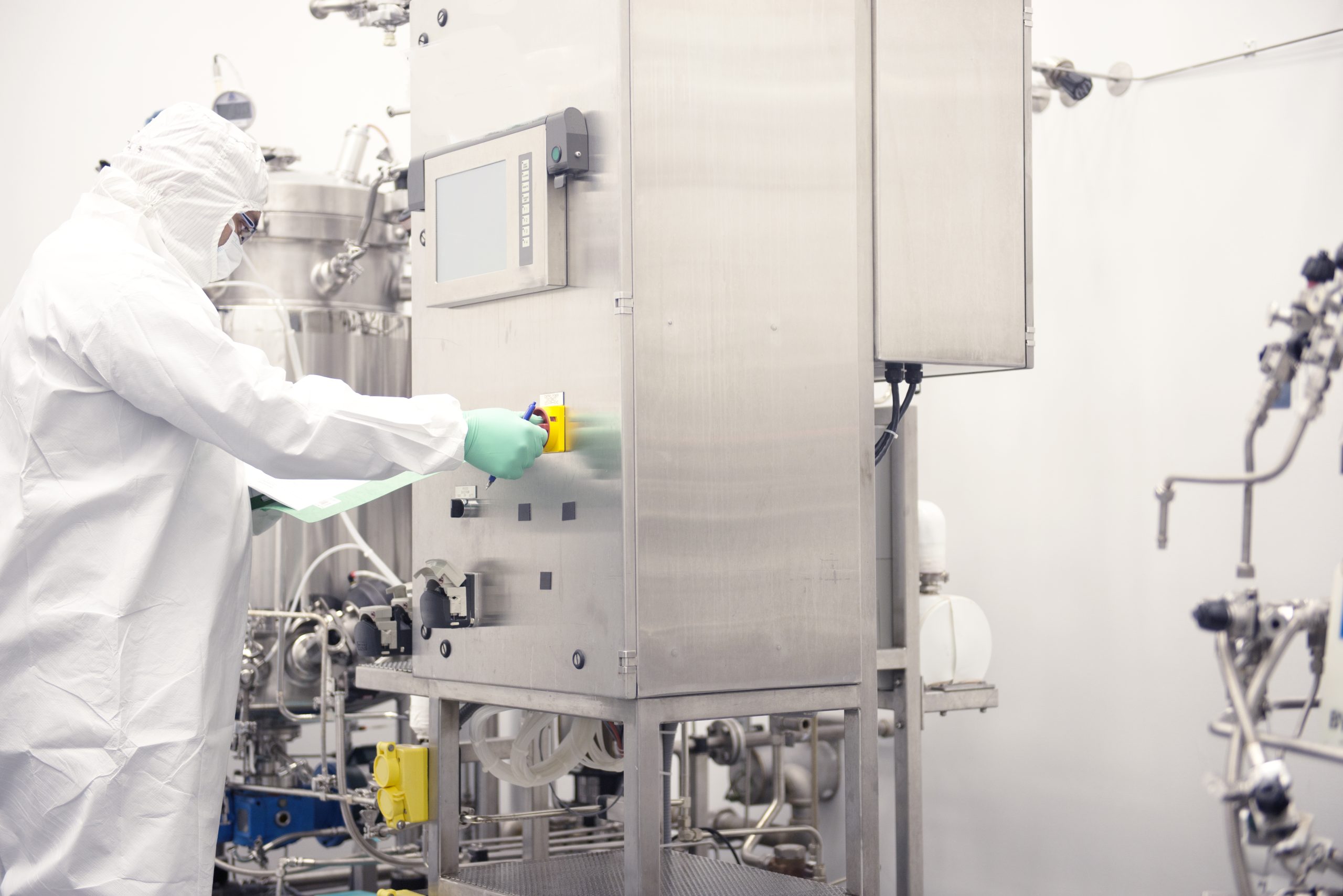
Operational compatibility with existing standard equipment was also an important part of the design. Agilent’s 2D process was developed to run on existing medium-pressure GMP chromatography systems already used for siRNA, antisense oligonucleotides, and guide RNAs. The team selected buffer components and conditions with operator safety and downstream compatibility in mind, and they planned a system that could scale from laboratory development to production from the outset.
During the webinar, Guiles presented data that demonstrated the limitations of running repeated anion exchange alone using a 100-mer nucleotide guide RNA as an example. In this example, the first AX yielded a 69-74% range in purity but a second run failed to make further purity gains, which Guiles attributed to the inherent resolving limits of one-dimensional separations. In contrast, applying reverse-phase chromatography as a second dimension yielded substantial gains in purity. Using the same 100-mer sequence, Guiles showed that the reverse-phase step boosted purity by more than 10% up to 84%, easily surpassing the 80% target set by the FDA.
Full GMP production examples reinforced these findings. A GMP example that involved producing 7 mmol of a similar 100-mer sequence showed that Agilent’s 2D approach achieved 88% product purity. Similar benefits were observed across oligonucleotides of varying lengths, including shorter (~66 nt) constructs that already met regulatory thresholds after AX but achieved purities exceeding 90% with the second dimension. Overall, in manufacturing-scale runs, reverse-phase chromatography produced tighter elution profiles and more effective rejection of closely related impurities than AX purification alone based on the examples shown.
Furthermore, the approach proved particularly valuable for highly challenging sequences, such as 120-nucleotide guide RNAs used for CRISPR-Cas9 enzymes and oligonucleotides modified with GalNAc ligands, which are used in siRNA therapeutics. These species are smaller and can exhibit acceptable purity—as high as 90%—using conventional methods even with complex chemical moieties like GalNAc attached, a clinically safe purity level by FDA’s standards, noted Guiles. However, adding a reverse-phase step further reduced residual impurities and improved baseline cleanliness. In one example, utilizing the 2D approach boosted product purity by almost five percent.
Beyond purity gains, there are important operational efficiencies enabled by Agilent’s 2D AX/IP-RP workflow. This includes the potential for semi-continuous processing through center-cut fraction selection, said Guiles, which significantly reduces analytical turnaround time—to hours instead of 1-3 days—without comprising yield and process control.
To learn more about this topic, you can watch the full webinar, “Enhanced 2D Purification Strategies for Manufacturing Oligonucleotide Therapeutics” on demand.
The post Advancing Purification Standards for Oligonucleotide Manufacturing with Two-Dimensional Chromatography appeared first on GEN – Genetic Engineering and Biotechnology News.