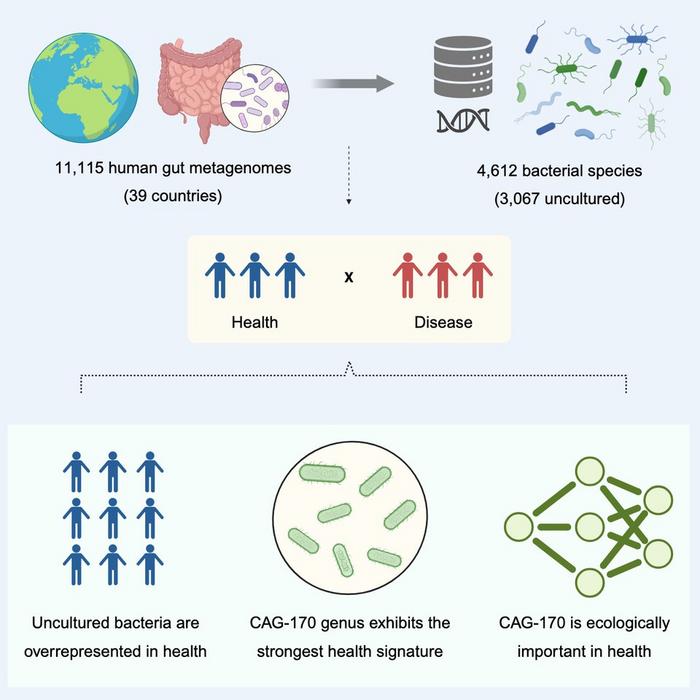
In a study using gut microbiome samples from over 11,000 people across 39 countries, a single group of bacteria (CAG-170) has been found in higher numbers in the gut microbiomes of healthy people. CAG-170 remain unculturable in the lab, and are only identifiable from their genetic fingerprints.
Further analysis of CAG-170 revealed the bacteria have the capacity to produce high levels of Vitamin B12 and enzymes that break down a wide range of carbohydrates, sugars, and fibers in our gut. The researchers suggest that Vitamin B12 supports other species of gut bacteria, rather than supporting the humans whose guts it is being produced in. CAG-170 could, in the future, be used as an indicator of our gut microbiome health or serve as the basis for the development of probiotics specifically designed to support and maintain healthy levels of CAG‑170 in the gut.
The study is published today in the journal Cell Host & Microbe in the paper, “Meta-analysis of the uncultured gut microbiome across 11,115 global metagenomes reveals a candidate signature of health.”
“Our work has revealed that CAG-170 bacteria—part of the ‘hidden microbiome’—appear to be key players in human health, likely by helping us to digest the main components of our food and keeping the whole microbiome running smoothly,” notes Alexandre Almeida, PhD, a principal investigator in the University of Cambridge’s Department of Veterinary Medicine. “We looked at the gut microbes of thousands of people across 39 countries and 13 different diseases including Crohn’s and obesity. We consistently found that people with these diseases had lower levels of CAG-170 bacteria in their gut.”
The study builds on Almeida’s previous work to create a comprehensive reference catalogue of all the genomes in the human gut microbiome—the Unified Human Gastrointestinal Genome catalogue. This past work revealed over 4,600 bacterial species, including over 3,000 that hadn’t previously been seen in the gut before, and provided reference genomes for each species, including CAG-170.
By comparing the samples in the new study to each sample to the Unified Human Gastrointestinal Genome catalogue, the researchers observed that CAG-170 bacteria are most strongly linked with health—and that it is consistent across countries.
The team computationally analyzed the full make-up of the gut microbiome of over 6,000 healthy people to investigate which species had the strongest potential to keep the gut microbiome balanced. CAG-170 were again most consistently associated with health.
In addition, they measured the level of CAG-170 present in the gut microbiomes of people with dysbiosis, which is linked with many long-term conditions including irritable bowel syndrome, rheumatoid arthritis, anxiety, and depression. This revealed that lower levels of CAG-170 in the gut are linked with a higher likelihood of having a gut imbalance.
“The probiotic industry hasn’t really kept up with gut microbiome research—people are still using the same probiotic species that were being used decades ago. We’re now discovering new groups of bacteria like CAG-170 with important links to our health, and probiotics aimed at supporting them could have a much greater health benefit,” said Almeida.
The post Previously Unknown Gut Bacteria Emerge as Global Marker of Health appeared first on GEN – Genetic Engineering and Biotechnology News.