
- Research Briefing
- Published:
Subjects
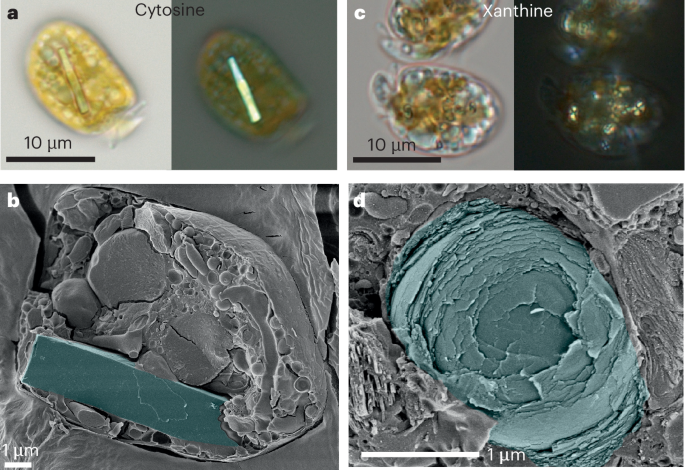
We show that dinoflagellates accumulate and crystallize nitrogen-rich molecules from aqueous solutions and use these crystals for growth. This behavior might have implications for understanding marine nitrogen cycling. Moreover, the crystallization behavior can be manipulated to biosynthesize difficult-to-crystallize reflective materials with tailored morphologies and optical properties.
This is a preview of subscription content, access via your institution
Access options
Access Nature and 54 other Nature Portfolio journals
Get Nature+, our best-value online-access subscription
$32.99 / 30 days
cancel any time
Subscribe to this journal
Receive 12 print issues and online access
$259.00 per year
only $21.58 per issue
Buy this article
- Purchase on SpringerLink
- Instant access to the full article PDF.
USD 39.95
Prices may be subject to local taxes which are calculated during checkout

References
-
Gur, D., Palmer, B. A., Weiner, S. & Addadi, L. Light manipulation by guanine crystals in organisms: biogenic scatterers, mirrors, multilayer reflectors and photonic crystals. Adv. Funct. Mater. 27, 1603514 (2017). This review article presents the different types of photonic assemblies found in animals and their optical properties.
-
Mojzeš, P. et al. Guanine, a high-capacity and rapid-turnover nitrogen reserve in microalgal cells. Proc. Natl Acad. Sci. USA 117, 32722–32730 (2020). This paper characterizes the kinetics of nitrogen and guanine crystallization in microalgae cells using Raman microscopy.
-
Pilátová, J., Pánek, T., Oborník, M., Čepička, I. & Mojzeš, P. Revisiting biocrystallization: purine crystalline inclusions are widespread in eukaryotes. ISME J. 16, 2290–2294 (2022). This article reports the identification of purine crystals (guanine, xanthine, uric acid) in over 200 species of unicellular eukaryotes, demonstrating how widespread the phenomenon is.
-
Palmer, B. A. et al. Optically functional isoxanthopterin crystals in the mirrored eyes of decapod crustaceans. Proc. Natl Acad. Sci. USA 115, 2299–2304 (2018). This article reports the discovery and optical characterization of nanosized spherulites composed of isoxanthopterin crystals in the eyes of crustaceans.
-
Alus, L. et al. Bio-inspired crystalline core-shell guanine spherulites. Adv. Mater. 36, 202308832 (2024). This article describes a protocol to synthesize birefringent crystalline spherulitic assemblies.
Additional information
Publisher’s note Springer Nature remains neutral with regard to jurisdictional claims in published maps and institutional affiliations.
This is a summary of: Wagner, A. et al. Harnessing microalgae for the biosynthesis of molecular crystals. Nat. Biotechnol. https://doi.org/10.1038/s41587-026-03006-6 (2026).
Rights and permissions
About this article

Cite this article
Microalgae as cellular factories for molecular crystals. Nat Biotechnol (2026). https://doi.org/10.1038/s41587-026-03017-3
-
Published:
-
Version of record:
-
DOI: https://doi.org/10.1038/s41587-026-03017-3