
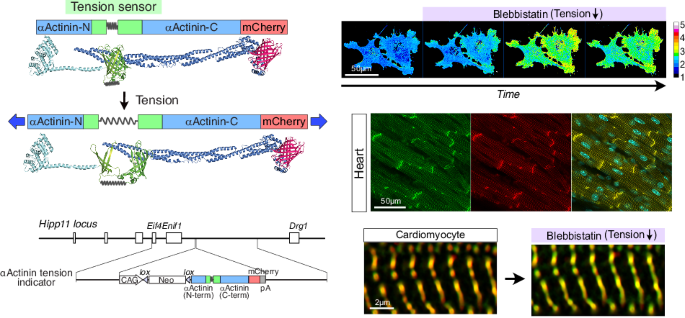
Data availability
The data supporting the findings of this study are available within the paper and its Supplementary Information. Plasmids generated in this study have been deposited in Addgene under accession codes: 252385 and 252386. Uncropped and unedited images of blots and gels are available in the Supplementary Information. Numerical source data for graphs and charts can be found in Supplementary Data 1. All other data are available from the corresponding author upon reasonable request.
References
-
Grashoff, C. et al. Measuring mechanical tension across vinculin reveals regulation of focal adhesion dynamics. Nature 466, 263–266 (2010).
-
LaCroix, A. S., Lynch, A. D., Berginski, M. E. & Hoffman, B. D. Tunable molecular tension sensors reveal extension-based control of vinculin loading. eLife 7, e33927 (2018).
-
Déjardin, T. et al. Nesprins are mechanotransducers that discriminate epithelial–mesenchymal transition programs. J. Cell Biol. 219, e201908036 (2020).
-
Kim, T.-J. et al. Dynamic visualization of α-catenin reveals rapid, reversible conformation switching between tension states. Curr. Biol. 25, 218–224 (2015).
-
Kumar, A. et al. Talin tension sensor reveals novel features of focal adhesion force transmission and mechanosensitivity. J. Cell Biol. 213, 371–383 (2016).
-
Lagendijk, A. K. et al. Live imaging molecular changes in junctional tension upon VE-cadherin in zebrafish. Nat. Commun. 8, 1402 (2017).
-
Morimatsu, M., Mekhdjian, A. H., Adhikari, A. S. & Dunn, A. R. Molecular tension sensors report forces generated by single integrin molecules in living cells. Nano Lett. 13, 3985–3989 (2013).
-
Yamashita, S., Tsuboi, T., Ishinabe, N., Kitaguchi, T. & Michiue, T. Wide and high resolution tension measurement using FRET in embryo. Sci. Rep. 6, 28535 (2016).
-
Lemke, S. B., Weidemann, T., Cost, A.-L., Grashoff, C. & Schnorrer, F. A small proportion of Talin molecules transmit forces at developing muscle attachments in vivo. PLOS Biol. 17, e3000057 (2019).
-
Wang, J. et al. In situ FRET measurement of cellular tension using conventional confocal laser microscopy in newly established reporter mice expressing actinin tension sensor. Sci. Rep. 13, 22729 (2023).
-
Sanfeliu-Cerdán, N., Lin, L.-C., Dunn, A. R., Goodman, M. B. & Krieg, M. Visualizing neurons under tension in vivo with optogenetic molecular force sensors. Methods Mol. Biol. 2600, 239–266 (2023).
-
Eder, D., Basler, K. & Aegerter, C. M. Challenging FRET-based E-Cadherin force measurements in Drosophila. Sci. Rep. 7, 13692 (2017).
-
Ham, T. R., Collins, K. L. & Hoffman, B. D. Molecular tension sensors: moving beyond force. Curr. Opin. Biomed. Eng. 12, 83–94 (2019).
-
Baird, G. S., Zacharias, D. A. & Tsien, R. Y. Circular permutation and receptor insertion within green fluorescent proteins. Proc. Natl. Acad. Sci. 96, 11241–11246 (1999).
-
Nakai, J., Ohkura, M. & Imoto, K. A high signal-to-noise Ca2+ probe composed of a single green fluorescent protein. Nat. Biotechnol. 19, 137–141 (2001).
-
Ohkura, M. et al. Genetically encoded green fluorescent Ca2+ indicators with improved detectability for neuronal Ca2+ signals. PLoS ONE 7, e51286 (2012).
-
Yonemura, S., Wada, Y., Watanabe, T., Nagafuchi, A. & Shibata, M. α-Catenin as a tension transducer that induces adherens junction development. Nat. Cell Biol. 12, 533–542 (2010).
-
Maki, K. et al. Mechano-adaptive sensory mechanism of α-catenin under tension. Sci. Rep. 6, 24878 (2016).
-
Meng, F. & Sachs, F. Visualizing dynamic cytoplasmic forces with a compliance-matched FRET sensor. J. Cell Sci. 124, 261–269 (2011).
-
Várkuti, B. H. et al. A highly soluble, non-phototoxic, non-fluorescent blebbistatin derivative. Sci. Rep. 6, 26141 (2016).
-
Aberle, H. et al. Assembly of the cadherin-catenin complex in vitro with recombinant proteins. J. Cell Sci. 107, 3655–3663 (1994).
-
Pokutta, S. & Weis, W. I. Structure of the dimerization and β-catenin- binding region of α-catenin. Mol. Cell 5, 533–543 (2000).
-
Tu, Y., Pal, K., Austin, J. & Wang, X. Filopodial adhesive force in discrete nodes revealed by integrin molecular tension imaging. Curr. Biol. 32, 4386–4396.e3 (2022).
-
Hippenmeyer, S. et al. Genetic mosaic dissection of Lis1 and Ndel1 in neuronal migration. Neuron 68, 695–709 (2010).
-
Jiao, K. et al. An essential role of Bmp4 in the atrioventricular septation of the mouse heart. Genes Dev. 17, 2362–2367 (2003).
-
Niwa, H. et al. An efficient gene-trap method using poly A trap vectors and characterization of gene-trap events1. J. Biochem. 113, 343–349 (1993).
-
Horiguchi, M. et al. Fibulin-4 conducts proper elastogenesis via interaction with cross-linking enzyme lysyl oxidase. Proc. Natl. Acad. Sci. 106, 19029–19034 (2009).
-
Dietz, H. & Rief, M. Exploring the energy landscape of GFP by single-molecule mechanical experiments. Proc. Natl. Acad. Sci. 101, 16192–16197 (2004).
-
Mickler, M. et al. Revealing the bifurcation in the unfolding pathways of GFP by using single-molecule experiments and simulations. Proc. Natl. Acad. Sci. 104, 20268–20273 (2007).
-
Fischer, L. S., Rangarajan, S., Sadhanasatish, T. & Grashoff, C. Molecular force measurement with tension sensors. Annu. Rev. Biophys. 50, 595–616 (2021).
-
Hsu, P. D. et al. DNA targeting specificity of RNA-guided Cas9 nucleases. Nat. Biotechnol. 31, 827–832 (2013).
-
Yin, J. et al. Genetically encoded short peptide tag for versatile protein labeling by Sfp phosphopantetheinyl transferase. Proc. Natl. Acad. Sci. 102, 15815–15820 (2005).
-
Matsuda, A., Schermelleh, L., Hirano, Y., Haraguchi, T. & Hiraoka, Y. Accurate and fi ducial-marker-free correction forthree-dimensional chromatic shift in biological fl uorescence microscopy. Sci. Rep. 8, 7583 (2018).
Acknowledgements
We thank N. Watanabe (Kyoto University, Kyoto, Japan), S.H. Yoshimura (Kyoto University, Kyoto, Japan), Y. Kamioka (Kansai Medical University, Osaka, Japan) and S. Hirano (Kansai Medical University, Osaka, Japan), for insightful discussions, M. Ohkura (Kyushu University of Health and Welfare, Miyazaki, Japan) for providing an expression plasmid of G-CaMP8. This project was supported by grants from Japan Society for the Promotion of Science (16H07353, 17K09586, 20K08502, and 23K07589 to M.H.), TAKEDA Science Foundation, The Novartis Foundation (16-113), SENSHIN Medical Research Foundation to M.H, and the Strategic Project for Proofreading and Submission Support of International Academic Papers by Kansai Medical University to M.H. This research was also supported by Research Support Project for Life Science and Drug Discovery (Basis for Supporting Innovative Drug Discovery and Life Science Research (BINDS)) from AMED under Grant Number JP24ama121020.
Ethics declarations
Competing interests
The authors declare no competing interests.
Peer review
Peer review information
Communications Biology thanks Daniel Conway, Zheng Liu, and the other, anonymous, reviewer for their contribution to the peer review of this work. Primary Handling Editors: Yingke Xu & Rosie Bunton-Stasyshyn. A peer review file is available.
Additional information
Publisher’s note Springer Nature remains neutral with regard to jurisdictional claims in published maps and institutional affiliations.
Supplementary information
Rights and permissions
Open Access This article is licensed under a Creative Commons Attribution 4.0 International License, which permits use, sharing, adaptation, distribution and reproduction in any medium or format, as long as you give appropriate credit to the original author(s) and the source, provide a link to the Creative Commons licence, and indicate if changes were made. The images or other third party material in this article are included in the article’s Creative Commons licence, unless indicated otherwise in a credit line to the material. If material is not included in the article’s Creative Commons licence and your intended use is not permitted by statutory regulation or exceeds the permitted use, you will need to obtain permission directly from the copyright holder. To view a copy of this licence, visit http://creativecommons.org/licenses/by/4.0/.
About this article

Cite this article
Fujiwara, K., Fujiki, K., Akama, T.O. et al. Molecular tension indicators reveal unexpectedly complex regulation of tension in live mouse organs. Commun Biol (2026). https://doi.org/10.1038/s42003-026-09746-0
-
Received:
-
Accepted:
-
Published:
-
DOI: https://doi.org/10.1038/s42003-026-09746-0