
- Comment
- Published:
Subjects
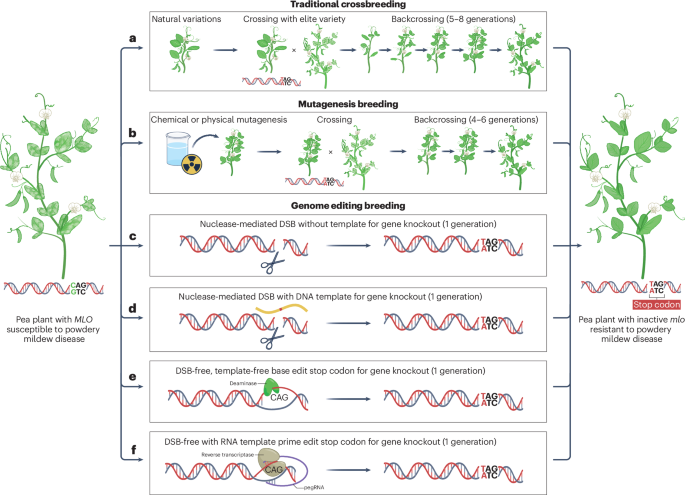
Site-directed nuclease (SDN) classification into SDN-1, SDN-2 and SDN-3 outcomes is used for regulating genome-edited plant products in some countries. This reductive categorization system fails to cover the breadth of genome editing technologies developed over the past decade and their rapidly approaching commercial use. Here, we argue that, in the context of plant breeding, regulations should focus on the characteristics of the genome editing outcome, rather than specific methods used in the development process. Such a science-based, outcome-focused regulatory approach would future-proof the risk-proportionate oversight of plant breeding innovations and enable a more efficient delivery of improved crop varieties amidst growing concerns of climate change and evolving pests and diseases.
This is a preview of subscription content, access via your institution
Access options
Access Nature and 54 other Nature Portfolio journals
Get Nature+, our best-value online-access subscription
$32.99 / 30 days
cancel any time
Subscribe to this journal
Receive 12 print issues and online access
$259.00 per year
only $21.58 per issue
Buy this article
- Purchase on SpringerLink
- Instant access to the full article PDF.
USD 39.95
Prices may be subject to local taxes which are calculated during checkout

References
-
Slewinski, T. L., Turner-Hissong, S., Paciorek, T., Brower-Toland, B. & Shyu, C. Plant Physiol. 199, kiaf378 (2025).
-
Voss-Fels, K. P., Stahl, A. & Hickey, L. T. Q. BMC Biol. 17, 18 (2019).
-
Podevin, N., Davies, H. V., Hartung, F., Nogué, F. & Casacuberta, J. M. Trends Biotechnol. 31, 375–383 (2013).
-
Komor, A. C., Kim, Y. B., Packer, M. S., Zuris, J. A. & Liu, D. R. Nature 533, 420–424 (2016).
-
Anzalone, A. V. et al. Nature 576, 149–157 (2019).
-
Papikian, A., Liu, W., Gallego-Bartolomé, J. & Jacobsen, S. E. Nat. Commun. 10, 729 (2019).
-
Thiebaut, F., Hemerly, A. S. & Ferreira, P. C. G. Front. Plant Sci. 10, 246 (2019).
-
Kakoulidou, I. et al. Biology (Basel) 10, 766 (2021).
-
Mercé, C., Bayer, P. E., Tay Fernandez, C., Batley, J. & Edwards, D. Agronomy (Basel) 10, 1484 (2020).
-
Lynagh, P. G. et al. Preprint at bioRxiv https://doi.org/10.1101/400507 (2018).
-
Gehrke, F., Schindele, A. & Puchta, H. Plant Physiol. 188, 1769–1779 (2022).
-
Zhao, Y. et al. Nat. Plants 11, 2461–2475 (2025).
-
Schwartz, C. et al. Nat. Plants 6, 1427–1431 (2020).
-
Sun, C. et al. Nat. Biotechnol. 42, 316–327 (2024).
-
Lyzenga, W. J., Pozniak, C. J. & Kagale, S. Plant Biotechnol. J. 19, 660–670 (2021).
-
Taagen, E., Bogdanove, A. J. & Sorrells, M. E. Trends Plant Sci. 25, 455–465 (2020).
-
Jenkins, D., Juba, N., Crawford, B., Worthington, M. & Hummel, A. Nat. Plants 9, 679–684 (2023).
-
Plant breeding innovation: consistent criteria for the scope of regulatory oversight. International Seed Federation https://worldseed.org/wp-content/uploads/2018/06/Plant-breeding-innovation-Consistent-criteria-for-the-scope-of-regulatory-oversight.pdf (2018).
Acknowledgements
We would like to acknowledge the support of the teams and leadership at BASF, CropLife International, Qi Biodesign, Bayer CropScience, Syngenta and Corteva Agriscience.
Ethics declarations
Competing interests
O.M. and A.A. are employees of BASF. J.M. is an employee of CropLife International. L.B. and N.S. are employees of Bayer CropScience. S.H. is an employee of Syngenta. M.F. and K.D. are employees of Corteva Agriscience. K.T.Z. is a founder and employee of Qi Biodesign.
Rights and permissions
About this article

Cite this article
Mewett, O., McMurdy, J., Bertho, L. et al. Re-evaluating the site-directed nuclease classification as a regulatory trigger for genome-edited plant products. Nat Biotechnol (2026). https://doi.org/10.1038/s41587-026-03028-0
-
Published:
-
Version of record:
-
DOI: https://doi.org/10.1038/s41587-026-03028-0