
- Correspondence
- Published:
Nature Food (2026)Cite this article
Subjects
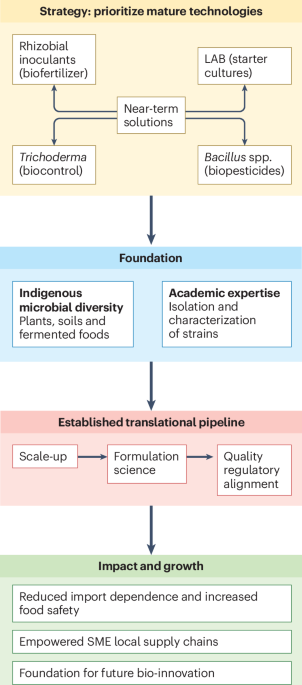
Microbial inoculants are increasingly central to sustainable agriculture and food systems, supporting nutrient efficiency, biological pest control and fermentation-based food production. Across Africa, however, most microbial products in use, from rhizobial biofertilizers to Bacillus-based biopesticides and dairy starter cultures, are imported. This dependence persists despite many years of academic expertise, suggesting that the principal constraint is not microbial discovery but the lack of translational and manufacturing capacity. Addressing this gap is essential not only for strengthening African food systems, but also for illustrating how emerging bioeconomies can more effectively convert microbiome research into deployable, locally rooted technologies.
Africa hosts extraordinary microbial diversity across soils, plants, animals and fermented foods, with many organisms exhibiting many beneficial traits. Research institutions across the continent have generated substantial knowledge on nitrogen fixation, plant growth-promoting microorganisms, biological control agents and food fermentation1,2. However, laboratory-scale strain discovery has rarely translated into reliable and regulated products3. This gap reflects a lack of translational capacity, including inadequate microbial culture collections, pilot-scale fermentation, formulation science, quality control and regulatory alignment, which remain institutionally underdeveloped and underfunded4.
This is a preview of subscription content, access via your institution
Access options
Access Nature and 54 other Nature Portfolio journals
Get Nature+, our best-value online-access subscription
$32.99 / 30 days
cancel any time
Subscribe to this journal
Receive 12 digital issues and online access to articles
$119.00 per year
only $9.92 per issue
Buy this article
- Purchase on SpringerLink
- Instant access to the full article PDF.
USD 39.95
Prices may be subject to local taxes which are calculated during checkout

References
-
Alori, E. T. & Babalola, O. O. Front. Microbiol. 9, 2213 (2018).
-
Franz, C. M. A. P. et al. Int. J. Food Microbiol. 190, 84–96 (2014).
-
Berg, G. et al. Microbiome 8, 103 (2020).
-
Adeniji, A. A. & Loots, D. T. Microbiol. Mol. Biol. Rev. https://doi.org/10.1128/mmbr.00174-25 (2025).
-
O’Callaghan, M. Appl. Microbiol. Biotechnol. 100, 5729–5746 (2016).
-
Leroy, F. & De Vuyst, L. Trends Food Sci. Technol. 15, 67–78 (2004).
-
Tamang, J. P. et al. Compr. Rev. Food Sci. Food Saf. 19, 184–217 (2020).
-
Rukwishuro, T., Musengi, A., Ndemera, M., Mugiyo, H. & Gonde, L. Food Res. Int. 218, 116743 (2025).
Acknowledgements
The B-INOC project of the International Centre for Genetic Engineering and Biotechnology (ICGEB), funded by the Piano Mattei programme for Africa of the Italian Ministry of Foreign Affairs and International Cooperation (MAECI), is gratefully acknowledged.
Ethics declarations
Competing interests
The author declares no competing interests.
Rights and permissions
About this article

Cite this article
Venturi, V. Activating Africa’s microbial inoculant sector through prioritization of mature technologies. Nat Food (2026). https://doi.org/10.1038/s43016-026-01327-y
-
Published:
-
Version of record:
-
DOI: https://doi.org/10.1038/s43016-026-01327-y