- Comment
- Published:
Subjects
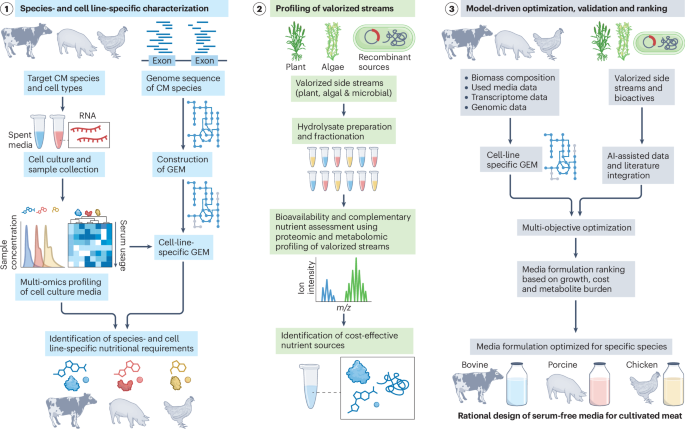
The commercialization of cultivated meat remains limited by the high cost of cell culture medium. Here, we discuss how multi-omics characterization and computational modelling can enable the design of cell line-specific, serum-free medium using valorized sources, offering improved cost-efficiency and sustainability.
This is a preview of subscription content, access via your institution
Access options
Subscribe to this journal
Receive 12 digital issues and online access to articles
$119.00 per year
only $9.92 per issue
Buy this article
- Purchase on SpringerLink
- Instant access to the full article PDF.
USD 39.95
Prices may be subject to local taxes which are calculated during checkout

References
-
Post, M. J. Development of cell culture media for cultivated meat production. Adv. Biochem. Eng. Biotechnol. https://doi.org/10.1007/10_2025_312 (2025).
-
Quek, J. P. et al. Exploring cost reduction strategies for serum free media development. npj Sci. Food 8, 107 (2024).
-
Messmer, T. et al. A serum-free media formulation for cultured meat production supports bovine satellite cell differentiation in the absence of serum starvation. Nat. Food 3, 74–85 (2022).
-
Zhang, S. et al. An efficient serum-free medium for ex vivo expansion of myoblasts from Larimichthys crocea for cultured meat production. Food Res. Int. 196, 115073 (2024).
-
O’Neill, E. N. et al. Spent media analysis suggests cultivated meat media will require species and cell type optimization. npj Sci. Food 6, 46 (2022).
-
Mardinoglu, A. & Palsson, B. Ø. Genome-scale models in human metabologenomics. Nat. Rev. Genet. 26, 123–140 (2025).
-
Park, S. Y. et al. Driving towards digital biomanufacturing by CHO genome-scale models. Trends Biotechnol 42, 1192–1203 (2024).
-
Chandrasekaran, S. et al. Comprehensive mapping of pluripotent stem cell metabolism using dynamic genome-scale network modeling. Cell Rep. 21, 2965–2977 (2017).
-
Dong, N. et al. Auxenochlorella pyrenoidosa extract supplementation replacing fetal bovine serum for Carassius auratus muscle cell culture under low-serum conditions. Food Res. Int. 164, 112438 (2023).
-
Park, H. et al. Metabolomic insights of cultured meat compared to conventional meat. Sci. Rep. 15, 15668 (2025).
-
Mathieu, T. et al. Integrative multi-omics modeling for cultivated meat production, quality, and safety. Trends Food Sci. Technol. 166, 105364 (2025).
Acknowledgements
S.S. acknowledges the Half-Time Research Assistantship (HTRA) from the Ministry of Education, Government of India and the Smart Protein Advanced Research & Knowledge (SPARK) Fellowship from the Good Food Institute India (GFI India). M.L. acknowledges funding support from the Indian Institute of Technology Madras through New Faculty Scheme (IP23242264BTNFSC009058) and Good Food Institute India (SP25260802BTAPSL009058). Y.S.H. and Y.Y.H. thank the SFS R&D 2.0 Programme Future Food Main Grant, NRF-SFSR&D2FF-0003 for supporting this work. The authors thank A. Manayankath for useful discussions.
Ethics declarations
Competing interests
The authors declare no conflicts of interest.
Additional information
Rights and permissions
About this article

Cite this article
Ho, Y.Y., Sivakumar, S., Ho, Y.S. et al. Rational design of serum-free media for cultivated meat. Nat Rev Bioeng (2026). https://doi.org/10.1038/s44222-026-00428-4
-
Published:
-
Version of record:
-
DOI: https://doi.org/10.1038/s44222-026-00428-4