
- Research Briefing
- Published:
Subjects
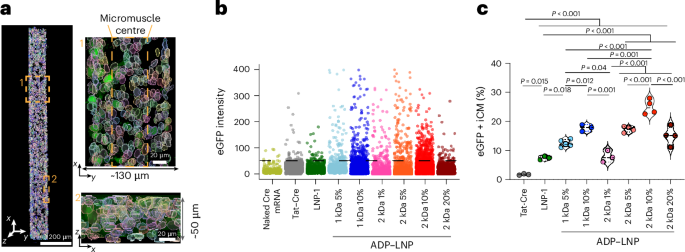
Lipid nanoparticle–mRNA complexes hold promise for treating cardiac diseases, but their transfection efficiency into the heart is limited. Using our previously developed human cardiac microphysiological screen, we identified modified lipid nanoparticle–mRNA complexes with improved transfection and gene editing efficacy, both in 3D micromuscles and in vivo in mice.
This is a preview of subscription content, access via your institution
Access options
Access Nature and 54 other Nature Portfolio journals
Get Nature+, our best-value online-access subscription
$32.99 / 30 days
cancel any time
Subscribe to this journal
Receive 12 digital issues and online access to articles
$119.00 per year
only $9.92 per issue
Buy this article
- Purchase on SpringerLink
- Instant access to full article PDF
Prices may be subject to local taxes which are calculated during checkout

References
-
Tsao, C. W. et al. Heart disease and stroke statistics-2022 update: a report from the American Heart Association. Circulation 145, e153–e639 (2022). A review article that presents how heart failure is the leading cause of death worldwide.
-
Wadman, M. FDA no longer has to require animal testing for new drugs. Science 379, 127–128 (2023). This communication reports that the FDA now has the authority to approve human clinical drug trials without mandatory animal testing.
-
Yang, Q., Fang, J., Lei, Z., Sluijter, J. P. G. & Schiffelers, R. Repairing the heart: state-of the art delivery strategies for biological therapeutics. Adv. Drug Deliv. Rev. 160, 1–18 (2020). A review article that summarizes the use of mRNA therapeutics for cardiac repair.
-
Huebsch, N. et al. Metabolically driven maturation of human-induced-pluripotent-stem-cell-derived cardiac microtissues on microfluidic chips. Nat. Biomed. Eng. 6, 372–388 (2022). This paper reports that geometrically aligned human cardiac microtissues on a chip reduce cell-phenotype-dependent variabilities in action potential and calcium handling of cardiomyocytes.
-
Zhao, S. et al. Acid-degradable lipid nanoparticles enhance the delivery of mRNA. Nat. Nanotechnol. 19, 1702–1711 (2024). This paper presents lipids with an acid-degradable linker termed ‘azido-acetal’ that hydrolyses within minutes of entering endosomes and enables the production of highly effective LNPs.
Additional information
Publisher’s note Springer Nature remains neutral with regard to jurisdictional claims in published maps and institutional affiliations.
This is a summary of: Neiman, G. et al. A microphysiological system for screening lipid nanoparticle−mRNA complexes predicts in vivo heart transfection efficacy. Nat. Biomed. Eng. https://doi.org/10.1038/s41551-025-01523-4 (2025).
Rights and permissions
About this article

Cite this article
A modified nanoparticle–mRNA complex for improved gene editing in the heart. Nat. Biomed. Eng (2025). https://doi.org/10.1038/s41551-025-01559-6
-
Published:
-
Version of record:
-
DOI: https://doi.org/10.1038/s41551-025-01559-6