
- Research Briefing
- Published:
Subjects
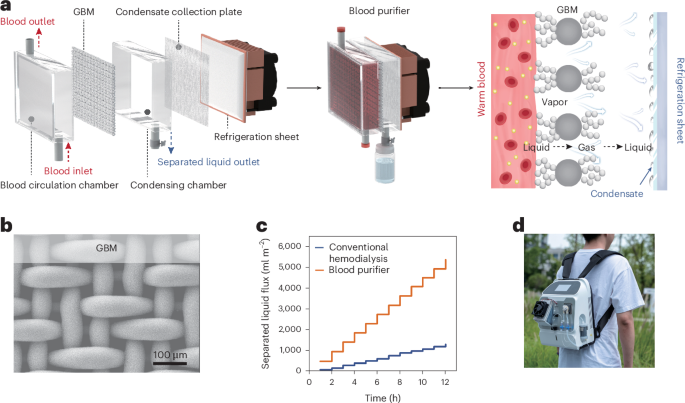
The wearability of conventional artificial kidneys is limited by their dependence on large volumes of dialysate required for dialysis to remove excess water and toxins from the blood. Now, a dialysate-free wearable artificial kidney prototype employs vapor-driven water removal and adsorption to clear toxins. This system achieves a high water clearance rate in renal replacement therapy in animal models.
This is a preview of subscription content, access via your institution
Access options
Subscribe to this journal
Receive 12 digital issues and online access to articles
$119.00 per year
only $9.92 per issue
Buy this article
- Purchase on SpringerLink
- Instant access to the full article PDF.
USD 39.95
Prices may be subject to local taxes which are calculated during checkout

References
-
Ramada, D. L. et al. Portable, wearable and implantable artificial kidney systems: needs, opportunities and challenges. Nat. Rev. Nephrol. 19, 481–490 (2023). This review article highlights kidney failure as a major global health challenge affecting millions of individuals worldwide and discusses various aspects of different artificial kidney systems.
-
McFarlane, P. A. et al. The quality of life and cost utility of home nocturnal and conventional in-center hemodialysis. Kidney Int. 64, 1004–1011 (2003). This article investigates the quality of life and cost effectiveness of hemodialysis devices.
-
Davenport, A. et al. A wearable haemodialysis device for patients with end-stage renal failure: a pilot study. Lancet 370, 2005–2010 (2007). This article presents a wearable hemodialysis device based on the principle of dialysate regeneration.
-
Savage, N. Could implantable artificial kidneys end the need for dialysis? Nature 615, S12–S13 (2023). This article highlights that the development of a portable dialysis device independent of an external water supply system can substantially enhance patient autonomy.
-
Deng, X. et al. Candle soot as a template for a transparent robust superamphiphobic coating. Science 335, 66–70 (2012). This article presents a method for fabricating super-liquid-repellent coatings.
Additional information
Publisher’s note Springer Nature remains neutral with regard to jurisdictional claims in published maps and institutional affiliations.
This is a summary of: Luo, J. et al. A dialysate-free wearable artificial kidney prototype driven by a liquid–gas phase transition. Nat. Chem. Eng. https://doi.org/10.1038/s44286-026-00355-6 (2026).
Rights and permissions
About this article

Cite this article
A prototype of a dialysate fluid-free wearable artificial kidney for dialysis on the go. Nat Chem Eng (2026). https://doi.org/10.1038/s44286-026-00354-7
-
Published:
-
Version of record:
-
DOI: https://doi.org/10.1038/s44286-026-00354-7