
- News & Views
- Published:
Biochemical sensing
Subjects
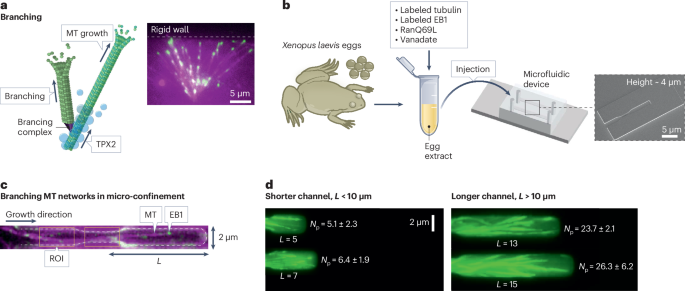
An engineered confinement device reveals how the microtubule cytoskeleton senses and adapts to its environment by harnessing the interplay between catastrophe instability and branching nucleation.
This is a preview of subscription content, access via your institution
Access options
Subscribe to this journal
Receive 12 digital issues and online access to articles
$119.00 per year
only $9.92 per issue
Buy this article
- Purchase on SpringerLink
- Instant access to full article PDF
Prices may be subject to local taxes which are calculated during checkout

References
-
Gudimchuk, N. B. & McIntosh, J. R. Nat. Rev. Mol. Cell Biol. 22, 777–795 (2021).
-
Minc, N., Burgess, D. & Chang, F. Cell 144, 414–426 (2011).
-
Mitchison, T. & Kirschner, M. Nature 312, 237–242 (1984).
-
Janson, M. E., de Dood, M. E. & Dogterom, M. J. Cell Biol. 161, 1029–1034 (2003).
-
Zaferani, M., Song, R., Wingreen, N. S., Stone, H. A. & Petry, S. Nat. Chem. Eng. https://doi.org/10.1038/s44286-025-00264-0 (2025).
-
Petry, S. et al. Cell 152, 768–777 (2013).
-
Takagi, J. et al. Dev. Cell 49, 267–278 (2019).
-
Dogterom, M. & Koenderink, G. H. Nat. Rev. Mol. Cell Biol. 20, 38–54 (2019).
-
Bieling, P. et al. Cell 164, 115–127 (2016).
Ethics declarations
Competing interests
The authors declare no competing interests.
Rights and permissions
About this article

Cite this article
Sakamoto, R., Maeda, Y.T. A search-and-branch mechanism for microtubule sensing. Nat Chem Eng (2025). https://doi.org/10.1038/s44286-025-00276-w
-
Published:
-
DOI: https://doi.org/10.1038/s44286-025-00276-w