- Research Briefing
- Published:
Subjects
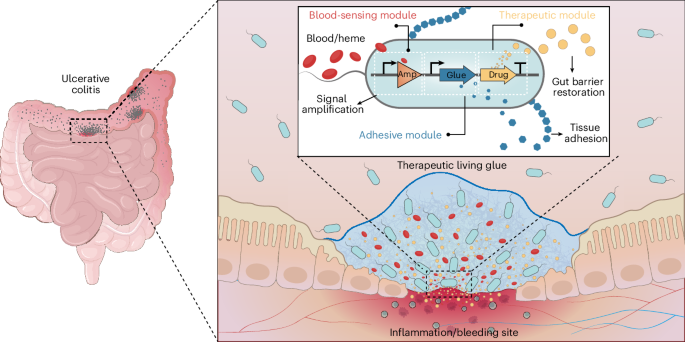
We engineered bacteria to function as therapeutic ‘living glues’ that autonomously detect gastrointestinal bleeding and, in response, secrete adhesive and therapeutic proteins to enable targeted mucosal adhesion, promote healing and reduce inflammation in mouse models of inflammatory bowel disease.
This is a preview of subscription content, access via your institution
Access options
Access Nature and 54 other Nature Portfolio journals
Get Nature+, our best-value online-access subscription
$32.99 / 30 days
cancel any time
Subscribe to this journal
Receive 12 print issues and online access
$259.00 per year
only $21.58 per issue
Buy this article
- Purchase on SpringerLink
- Instant access to the full article PDF.
USD 39.95
Prices may be subject to local taxes which are calculated during checkout

References
-
An, B. et al. Engineered living materials for sustainability. Chem. Rev. 123, 2349–2419 (2023). This review article highlights key developments and emerging strategies in the field of engineered living materials.
-
Mimee, M. et al. An ingestible bacterial-electronic system to monitor gastrointestinal health. Science 360, 915–918 (2018). This paper reports a blood-inducible genetic circuit for monitoring gastrointestinal health.
-
Wan, X. et al. Cascaded amplifying circuits enable ultrasensitive cellular sensors for toxic metals. Nat. Chem. Biol. 15, 540–548 (2019). This paper presents a cascaded amplifier strategy applicable to diverse biosensor systems, ensuring robust and tunable signal amplification.
-
Zhong, C. et al. Strong underwater adhesives made by self-assembling multi-protein nanofibres. Nat. Nanotechnol. 9, 858–866 (2014). This study reports a robust protein adhesive system engineered by fusing the E. coli amyloid protein CsgA with mussel foot protein (Mfp), resulting in exceptional cohesive and adhesive performance.
-
An, B. et al. Programming living glue systems to perform autonomous mechanical repairs. Matter 3, 2080–2092 (2020). This paper describes engineered living glue materials capable of sensing environmental cues and executing functions in an on-demand manner.
Additional information
Publisher’s note Springer Nature remains neutral with regard to jurisdictional claims in published maps and institutional affiliations.
This is a summary of: Ge, C. et al. Engineered living glues secrete therapeutic proteins for treatment of inflammatory bowel disease. Nat. Biotechnol. https://doi.org/10.1038/s41587-025-02970-9 (2026).
Rights and permissions
About this article

Cite this article
A therapeutic glue that autonomously targets gut bleeding in inflammatory bowel disease. Nat Biotechnol (2026). https://doi.org/10.1038/s41587-025-02976-3
-
Published:
-
Version of record:
-
DOI: https://doi.org/10.1038/s41587-025-02976-3