Climate change, population growth, and mounting pressures from plant diseases are helping drive a global food crisis. Reliable crop production is becoming increasingly challenging, exposing the limits of conventional crop improvement, and fueling demands for more precise solutions. While CRISPR-based genome editing represents a powerful tool for enhancing crop resilience, yield stability, and sustainability, its use is still evolving. Many agricultural biotechnology (AgBio) scientists are advancing the technology while also confronting key issues such as delivery constraints, biological complexity, long development timelines, cost, and public acceptance.
Industry innovators are meeting at the 8th Annual CRISPR AgBio Congress (March 23–25) to discuss the next generation of plant genome engineering. Featured approaches include viral delivery systems that bypass tissue culture, systematic optimization of promoters and coding regions for enhancing complex traits, precision editing breakthroughs such as non-browning bananas, multiplex editing platforms that accelerate trait stacking, and AI-driven frameworks that convert vast biological datasets into actionable trait targets.
Climate-resilient crop traits
Although CRISPR-based genome editing offers a promising tool for engineering stronger, more resilient crops, its agricultural application faces technical hurdles and crop-specific constraints. “The molecular size of first-generation CRISPR tools like the Cas9 limits their use with viral vectors,” reports Shira Corem, PhD, vice president of R&D at BetterSeeds. “CRISPR’s use in agriculture is also limited by heavy reliance on tissue culture and regeneration, long development timelines, and high costs.”
Corem says the company has developed a technology that aims to broaden the application of CRISPR. “Our EDGE (Efficient Delivery of Genome Editing) platform uses engineered plant viruses to deliver next-generation small genome-editing components directly into plant cells. Viral delivery enables highly efficient systemic expression of editing machinery, which is critical for achieving edits without the need for specific, long, and laborious tissue culture and regeneration procedures, dramatically shortening timelines and reducing costs.”
 by BetterSeeds aims to overcome viral cargo constraints by delivering both the nuclease and guide RNA using viral vectors, enabling assembly of a complete CRISPR system directly in wild-type plants and allowing the practical use of multi-kilobase cargos. Right – To visualize gene editing in real time, LIVE-EDGE utilizes a unique green fluorescent protein (GFP)-based reporter in which targeted editing activates GFP expression [BetterSeeds]
According to Corem, BetterSeeds also provides a portfolio of small, highly active, and cost-efficient nucleases that are particularly well suited for viral delivery. She elucidates, “Their compact size enables efficient packaging and higher viral genome stability, supporting robust editing performance. This combination significantly expands the range of crops and tissues that can be edited.”
To better enable rapid deployment, the company also provides access to a validated set of robustly applicable climate-resilience genes that allow rapid deployment of traits such as stress tolerance, improved yield stability, disease resistance, and environmental adaptability.
Corem believes gene-edited crops will be essential for addressing climate change, food security, and sustainability. “We aim to democratize genome editing so it is no longer limited to a small number of crops, companies, or regions, but can be used by all breeders, researchers, and farmers worldwide.”
Optimizing promoter and coding regions
For many agronomic traits, gene editing strategies based solely on gene knockouts fail to deliver meaningful improvements, according to Dror Shalitin, PhD, founder and CEO of PlantArcBio. “Instead, traits often require precise optimization of gene regulation and/or gene function, through targeted modification of promoters and/or coding regions, to enhance expression levels, expression patterns, or protein performance.”
Shalitin says a key challenge, though, is the “lack of a systematic, high-throughput way to test and identify the exact regulatory or coding changes required directly in plants and under relevant biological conditions. Without such capability, unlocking the full potential of gene editing for complex traits remains limited.”
To help solve this bottleneck, the company has developed its DIP and DIPPER platforms for gene discovery and gene editing, respectively. Shalitin explains that “DIP is a powerful, high-throughput in-plant discovery platform designed to identify novel genes from nature that enhance crop performance through gene introduction. By screening millions of genes directly in plants, under relevant growth and stress conditions, DIP identifies the best-performing genes for traits such as yield improvement and drought tolerance, with strong and reproducible results already demonstrated in crops including corn.”
On the other hand, the DIPPER platform enables systematic in-plant optimization of gene regulation and gene function through screening of promoter and coding-region variants. Shalitin continues, “Promoter variant screening enables identification of optimal expression levels required for a given trait. This is particularly important for traits such as drought tolerance or other abiotic stress tolerance, and traits such as herbicide tolerance, nutrition improvement, and disease resistance, where over- or under-expression can reduce performance. Systematic screening allows selection of precise regulatory variants that maximize trait performance.”
Shalitin says a key advantage of the company’s approach is the ability to de-risk gene-editing programs. “We do this by identifying the most effective gene modifications before investing in CRISPR or related genome-editing efforts, significantly improving efficiency and success rates.”

Looking ahead, Shalitin emphasizes, “Our greatest hope is that systematic in-plant discovery and optimization will become an integral part of crop improvement, enabling faster development of resilient, high-yielding crops to address global agricultural challenges.” He is further encouraged by the increasing acceptance of advanced gene-editing technologies, which he believes will help accelerate the widespread adoption of these approaches across agriculture.
Banana breakthrough
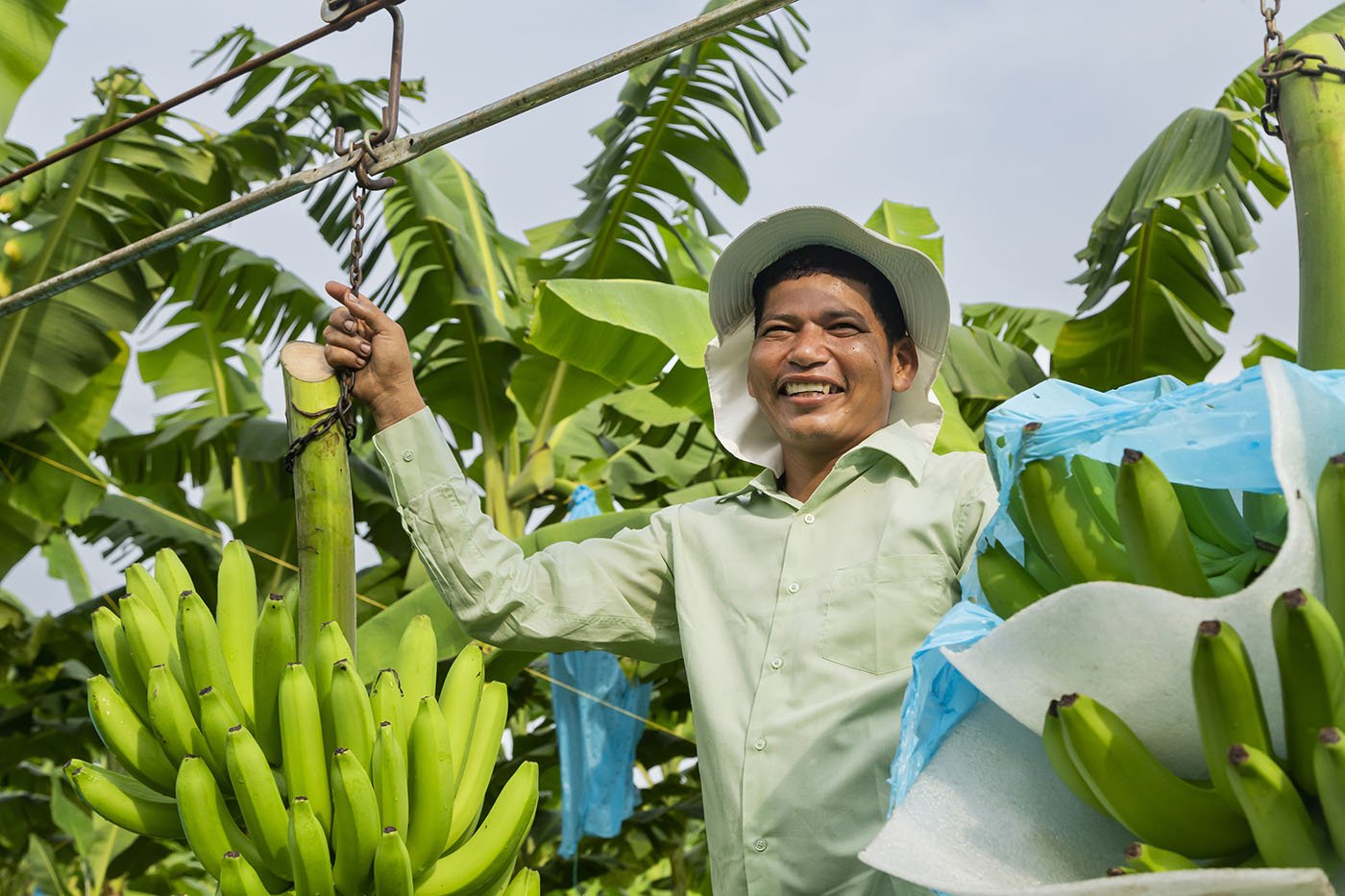
Ranking as one of the world’s most widely consumed fruits, bananas also help sustain the livelihoods of millions of farmers worldwide. Yet they are particularly vulnerable to climate change issues since more than 90% of global exports rest almost entirely on a single cultivar, the Cavendish. Mihir Kekre, head of commercial partnerships at Tropic Biosciences, provides a perspective: “Bananas are a sterile crop and cannot be hybridized, leaving the industry unable to introduce new traits and favorable variation through traditional breeding to protect against global disease pressures such as Panama Disease and Black Sigatoka, which are threatening supply.”
However, utilizing its GEiGS® platform and other gene editing technologies, the company recently made a breakthrough in engineering the first non-browning banana. Kekre comments, “In 2025, Tropic brought the world’s favorite fruit into the 21st century with a new commercial variety, the first in over 75 years, with the launch of our non-browning Cavendish banana,” Kekre comments. “The banana stays firm and yellow after peeling and slicing… has the same great flavor, texture, and aroma as the standard Cavendish banana we are accustomed to—but stays fresher for longer.”
Kekre says the key innovation came from the company’s ability to make very precise changes in the fruit’s DNA that allowed them to switch off the gene responsible for polyphenol oxidase, an enzyme responsible for browning. “We create small, targeted edits to genes already present in the plant, without introducing any foreign DNA. Using this method, we are able to ‘fast forward’ the natural breeding process, bringing about traits far more rapidly than conventional breeding. This approach is especially powerful for sterile crops such as banana and is considered non‑GM with the emerging regulatory frameworks in most global geographies.”
The impact and originality of Tropic’s breakthrough were recognized by earning a place on TIME Magazine’s Best Inventions of 2025. Kekre summarizes, “This innovation not only unlocks new opportunities across retail and food service categories but also significantly cuts waste throughout the supply chain.”
In addition to collaborations licensing their GEiGS technology, Tropic is also working on other crops. Kekre notes, “In our rice program we have varieties resistant to Rice Blast, a fungal disease that destroys up to 30% of annual harvests, and ‘increased yield’ varieties which will enable more rice with less land, water, and emissions required—helping to improve food security, whilst reducing the pressure on natural resources.”
Multiplex editing for breeding
One of plant breeding’s biggest bottlenecks stems from the fact that many prioritized crop traits (e.g., durable disease resistance) are polygenic, requiring years of crossing to “stack” the correct alleles. Further, unwanted linked DNA may cross-contaminate the process, resulting in the need for repeated backcrossing. Corteva Agriscience is positioning multiplex genome editing as a way to break this bottleneck.
Jeffry Sander, PhD, program lead for genome editing, envisions CRISPR as a scalable breeding tool capable of editing multiple targets at once in order to accelerate trait creation and stacking. Thus, rather than editing one gene at a time, multiplex editing enables the simultaneous, targeted modification of multiple genomic sites within a single plant. This approach allows breeders to introduce, tune, or disable several trait-relevant genes in parallel to significantly compress timelines that once spanned years.
Sander also believes that integrating enabling technologies, including CRISPR-Cas, base editors, and other DNA-modifying tools, will not only improve multiplex efficiency, but also reduce development timelines for many types of crops. Technically, multiplex editing relies on the introduction of multiple guide RNAs (delivered together as plasmids, RNA/protein RNPs, or guide arrays) to direct genome-editing enzymes to different loci at once. Depending on the particular application, this approach can support gene knockouts, small sequence changes, or modulation of gene regulation.

Corteva has introduced its Genlytix ecosystem that is driving high-throughput editing, data analysis, and third-party collaborations that accelerate discovery initiatives.
AI-driven trait discovery
In plant sciences, as with other fields, the ability to generate complex biological data often far exceeds the capability to translate those data into actionable targets. While genomics, transcriptomics, and large-scale phenotyping have become routine, identifying the critical genes and regulatory networks that control complex agronomic traits remains a slow and resource-intensive process.
Simplot Plant Sciences is employing a data-centric approach to plant trait discovery that integrates multi-omics datasets with agentic AI (i.e., systems that autonomously prioritize targets and adapt decisions as new data emerge). This strategy brings together genetic diversity panels, molecular profiling, and phenotypic measurements into unified machine-learning models designed to uncover non-obvious biological relationships.
By comparing AI-guided predictions with traditional statistical analyses, the platform may improve the reliability of target selection and reduce downstream validation failures. These insights can be directly coupled to CRISPR-based genome editing, enabling rapid functional testing and precise trait development.
The post AgBio: Redesigning Tomorrow’s Crops appeared first on GEN – Genetic Engineering and Biotechnology News.