Artificial intelligence (AI) is moving from offline analysis into the laboratory itself, reshaping how experiments are designed, executed, and interpreted. In chemistry and materials science, autonomous platforms already run closed-loop discovery cycles. In the life sciences, breakthroughs like protein-structure prediction and AI-guided drug discovery highlight AI’s transformative potential. Yet in bioprocess engineering, the path to autonomy is less straightforward.
A recent review by Laura Marie Helleckes, Dr.-Ing., an Eric and Wendy Schmidt AI in Science postdoctoral fellow at Imperial College London, and her colleagues argue that fully autonomous “robot scientists” are neither realistic nor desirable for most bioprocess applications—at least not yet. Instead, the future lies in hybrid laboratories that balance AI-driven automation with human oversight.
Bioprocessing poses unique challenges. Living systems are inherently variable, sensitive to context, and difficult to model across scales. A strain that performs well in a milliliter-scale screen might behave very differently in a 100,000-liter bioreactor. On top of this biological complexity comes strict regulatory and safety requirements, especially in pharmaceuticals and industrial biotechnology. Any automated system must produce traceable, auditable decisions and avoid rare but high-impact risks, such as generating unsafe organisms or violating controlled-substance regulations.
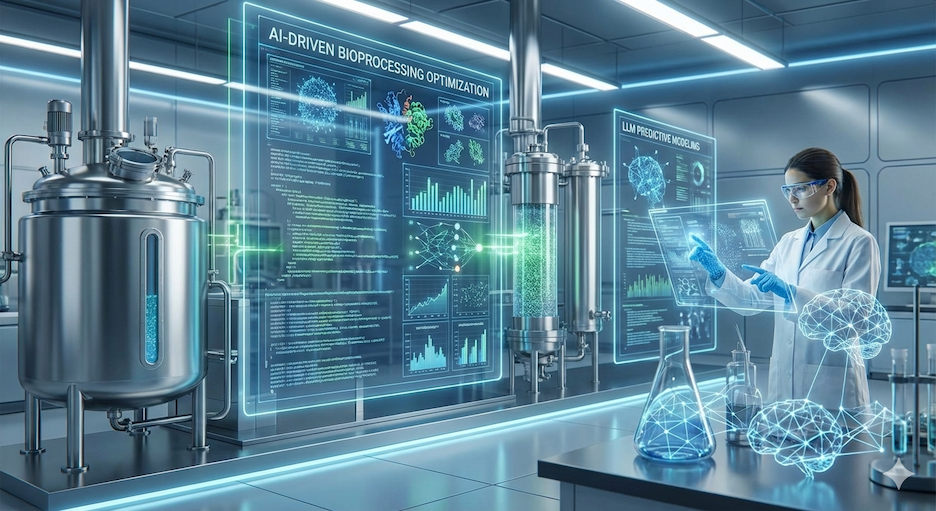
Rather than pushing for maximum autonomy everywhere, the review proposes modular hybrid labs. Highly automated “core processes”—for example, high-throughput strain screening or media optimization—can operate at higher autonomy levels, where benefits clearly outweigh risks. Around these cores sit auxiliary processes that are used less frequently or are harder to automate, remaining partially automated or manual. Humans remain central in defining goals, interpreting unexpected results, and making safety-critical decisions.
Large language models (LLMs) play a growing role in this vision. By translating high-level scientific goals into executable protocols, LLM-based agents lower the barrier to automation and free researchers from low-level robotic programming. However, because such models can be error-prone, hybrid systems enforce guardrails: clear decision tiers, human checkpoints for out-of-range results, and comprehensive audit trails compatible with regulatory standards.
Scaling up remains the biggest hurdle. While self-driving labs excel at micro- to laboratory-scale experimentation, autonomy becomes less practical at pilot and manufacturing scales. Here, digital twins and uncertainty-aware optimization help bridge bench and plant, but human-in-the-loop control remains essential.
Ultimately, the review concludes that progress in bioprocess automation will come not from replacing scientists, but from designing systems where AI and humans complement one another. The most impactful advances will emerge from this balance—accelerating discovery while preserving accountability, safety, and trust.
The post Autonomy and Accountability in Bioprocessing appeared first on GEN – Genetic Engineering and Biotechnology News.