
Introduction
From May to November 2015, eighteen out of the twenty-seven states of Brazil reported a high incidence of microcephaly among newborns, thereby capturing global attention towards the country1,2,3, a fact that has been linked to the Orthoflavivirus zikaense (ZIKV) infection3,4. The ZIKV was initially identified in 1947 in the Ziika forest of Uganda5. The first human infection was documented in 19525, with experimental verification of virus replication in humans occurring in 19566. The ZIKV was historically categorised as having little clinical relevance, primarily circulating in Africa and Asia, predominantly infecting wild primates and mosquitoes, and sporadically causing human infections7. In Brazil, Zika was initially identified as a “dengue-like” syndrome due to the similarity of symptoms with dengue fever8. After the first identification of ZIKV in 20158,9, severe conditions such as microcephaly and other congenital malformations, as well as neurological complications in adults, such as Guillain-Barré syndrome began to be reported10. ZIKV’s ability to cross the placental barrier and persist in fetal tissues underscores the importance of understanding the maternal-fetal immune interface, particularly in the context of Congenital Zika Syndrome (CZS)10. ZIKV is a mosquito-borne viral pathogen, evolutionarily classified as a member of the Flaviviridae family, genus Orthoflavivirus, with a single-stranded positive-sense genomic RNA, comprising approximately 11 kb11. As an urban arbovirus, the transmission of the ZIKV in nature involves Aedes aegypti mosquitoes and vertebrate hosts, including humans12. Other Aedes species act as vectors in African forest environments and transmit the virus to susceptible vertebrate hosts, such as non-human primates (NHP)13. Diagnosing Zika infection is quite challenging because its symptoms often overlap with those caused by other arboviruses, including the infections caused by Orthoflavivirus denguei (DENV), Alphavirus chikungunya (CHIKV), and Orthoflavivirus flavi (YFV), moreover it shares common symptoms including fever, rash, and joint pain with these diseases14,15,16,17,18, but the severity and specific characteristics can vary — for instance, dengue may develop into more severe conditions19,20, Chikungunya often causes more persistent joint pain14,21,22, and Yellow Fever can add symptoms like jaundice and gastrointestinal issues23,24. Adding to the complexity, diagnostic tests like serological assays may cross-react with other Orthoflavivirus infections, and the molecular techniques, though useful, has a limited detection window and requires early testing25. The simultaneous outbreaks of multiple arboviruses further complicate the diagnostic process, making it difficult to accurately identify ZIKV infection, and the dynamics of viral spread often characterized by sequential waves of different arboviruses raise important questions about ecological interactions, vector competence, and population immunity, and equally critical is the need to elucidate the human immune response to ZIKV infection, particularly in vulnerable groups such as pregnant individuals and neonates24,26. This study aims to comprehensively map epitopes within the polyprotein of the ZIKV using serum samples from mothers and newborns affected during the Brazilian epidemic. Given the challenges in distinguishing conformational and linear epitope responses, linear peptide mapping offers a high-resolution method to dissect specific humoral targets, especially in paired mother–newborn samples27. Employing the SPOT-synthesis and ELISA-Spot techniques, our research seeks to evaluate how these epitopes interact with the immune system and activate responses in both mothers and their babies, those with IgG positive serology for ZIKV27. This approach enables us to not only identify immunodominant regions within the ZIKV proteome, but also to assess the extent and fidelity of maternal IgG transfer to newborns at the epitope level.
Materials and methods
Ethical considerations
All procedures involving human participants followed the ethical principles outlined in the Declaration of Helsinki and complied with Brazil’s national regulations, including Resolution No. 466/2012 of the National Health Council. Written informed consent was obtained from all adult participants, as well as from the parents of all newborns involved in the study.
This study was approved by the Ethics Committee of the Department of Microbiology of the Institute of Biomedical Sciences of the University of São Paulo (Protocol #1284/CEPSH – CAAE #54937216.5.0000.5467) and Jundiaí Medical College Ethics Committee (Protocol #9561/2016 – CAAE #53248616.2.0000.5412).
Samples
The samples were collected from patients from Jundiaí city (State of São Paulo) during 2016. The metadata associated with the sample collection included date of birth, biological sex, date and time of collection, and a unique sample number, and paired samples of mothers and their respective newborns. Additionally, comprehensive features for each mother patient were collected, encompassing all reported symptoms during the febrile episodes that occurred during pregnancy. Blood samples, amounting to 5 ml per patient, were collected using tube systems with a tourniquet application period of equal to or less than one minute. The blood was drawn into dry tubes, with or without a separator gel. Following clot retraction, the samples underwent centrifugation at 3000 rpm for 10 min. To eliminate DENV cross-reactive epitopes, we used a control pool consisting of 10 serum samples that tested positive for anti-DENV IgG antibodies in prior serological screening, obtained from individuals involved in a previously characterized outbreak of Dengue virus serotype 4 (DENV-4) in São Paulo, Brazil3. The outbreak was associated with DENV-4 positive during the original surveillance study, and the samples were stored in our sample repository for comparative Orthoflavivirus research.
Serological characterization
The samples used in this study were confirmed to be positive for IgG against ZIKV using the Anti-Zika Virus ELISA (IgM/IgG) assay from Euroimmun (Euroimmun, Lübeck, Germany). To identify and quantify specific antibodies in these positive samples, we followed the IgG antibody protocol provided by Euroimmun. The samples, along with calibrators, positive and negative controls, were diluted 1:101 with sample buffer and added to microplate wells coated with ZIKV antigens. The plates were incubated for 1 h at 37 °C. After incubation, the plates were washed three times with 300 µL of a wash solution per well. Then, 100 µL of an enzymatic conjugate (anti-human IgG marked with peroxidase) was added to each well, followed by a 30-minute incubation at room temperature (18 to 25 °C). Following another wash step, 100 µL of a substrate/chromogenic solution was added to each well, and the plates were incubated for 15 min at room temperature. Finally, 100 µL of stop solution was added to each well, and the optical density (O.D.) was measured.
Epitope prediction
Linear B-cell epitope prediction was performed using BepiPred-3.0, a deep learning-based tool trained on validated epitope data from the Immune Epitope Database (IEDB). The algorithm analyses protein sequences in FASTA format and assigns epitope likelihood scores to each residue based on sequence-derived features such as surface accessibility, hydrophilicity, and structural flexibility. To identify epitope-positive residues, we applied the default threshold of 0.5 across the entire ZIKV polyprotein, as recommended by the BepiPred-3.0 algorithm. This single, uniform cutoff was chosen to preserve methodological consistency and ensure reproducibility. The value of 0.5 represents a balance point defined by the model developers to optimize the trade-off between sensitivity and specificity. Such a threshold is particularly appropriate in exploratory studies like ours, where the priority lies in capturing potentially meaningful epitope candidates for downstream validation, rather than minimizing false-positive rates at the expense of true-positive detection. Applying a consistent cutoff across all protein regions avoids introducing bias and facilitates direct comparison among domains. Moreover, adherence to the default threshold enables alignment with previously published studies using BepiPred-3.0, thus supporting replicability and allowing our findings to be interpreted within the broader context of the literature.
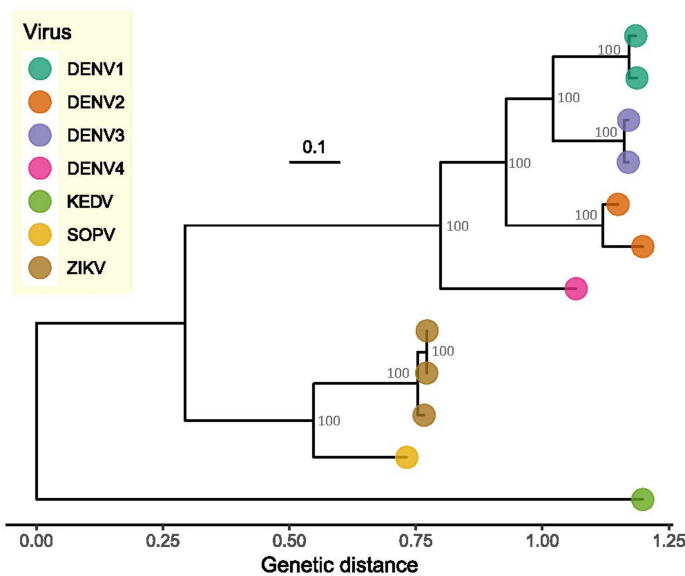
For this analysis, the full-length polyprotein sequence of Orthoflavivirus zikaense (GenBank: KU365777.1) was used as input (Fig. 1).

Phylogenetic reconstruction based on the complete polyprotein (amino acid sequences) of the Orthoflavivirus genus. The tree is midpoint-rooted, and the values near the nodes represent the bootstrap support values. Orthoflavivirus zikaense sequences are highlighted in brown. The analyses were conducted using twelve viral sequences: ZIKV_KU365777, ZIKV_DQ859059, and ZIKV_KU527068 (Orthoflavivirus zikaense); SOPV_DQ859064 (Spondweni virus); KEDV_DQ859061 (Orthoflavivirus kedougouense); DENV4_AY618991 (Orthoflavivirus denguei serotype 4); DENV2_JX079694 and DENV2_EF105385 (Orthoflavivirus denguei serotype 2); DENV3_AY648961 and DENV3_EU482458 (Orthoflavivirus denguei serotype 3); and DENV1_GQ199877 and DENV1_EU482822 (Orthoflavivirus denguei serotype 1).
Additionally, secondary structure predictions from NetSurfP-2.0 provide insights into the spatial properties of the proteins, such as surface accessibility and folding patterns. This method provides valuable insights into spatial features such as alpha-helices, beta-strands, and disordered regions, as well as the likelihood of each residue being exposed on the protein surface. These structural predictions help refine epitope selection by highlighting regions more likely to be accessible to antibodies in chosen epitopes.
This comprehensive approach not only predicts immunologically significant regions in the ZIKV proteins but also facilitates further investigation into their potential for vaccine design and diagnostic development.
B-cell epitope mapping
Spot synthesis technique was developed to achieve a broad diversity of peptides, with automation equipment enabling a reduction in time and costs of peptide synthesis27,28,29. The process of deposition of amino acids onto the membrane is carried out with a minimal volume (0.6 µl) using an automatic micropipette, aiming to obtain 100 nanomoles of peptide per spot. The nitrocellulose membrane functions as a support for amino groups, facilitating the binding of amino acids27,28,29. The binding process involves the esterification of an Fmoc-βAla-OH to hydroxyl functions on cellulose, creating a functional support. This addition of a grouping between the carrier and the peptide enhances stability in the binding of the peptide to the membrane. Peptide synthesis initiates from the C-terminus of the last amino acid in the established sequence. Following deprotection of the Fmoc-linked group with the addition of 20% piperidine in dimethylformamide (DMF), the amine functions become accessible to react with the amino acid to be coupled27,28,29. Subsequently, the amino acid activation uses the reagent complex DIPC/HOBt and is deposited; these activators yield a bond efficiency ranging from 74 to 87% per cycle. Two cycles per amino acid are performed, with reaction monitoring through colour changes in the spots. To prevent undesired reactions, free or unreacted NH2 functions are acetylated with 10% acetic anhydride in DMF. At the synthesis’s conclusion, the membrane undergoes treatment with trifluoroacetic acid (TFA) in association with dichloromethane and triethylsilane to remove side-protecting groups of the amino acids27,28,29,30. The membranes were reusable, requiring a regeneration treatment involving washing with specific reagents. This process starts with 3 washes of 10 min each with dimethylformamide (DMF), followed by 3 additional washes with reagent A (8 M urea + 1% SDS + 0.1% 2-mercaptoethanol) and a further 3 washes with reagent B (ethanol/water/acetic acid in the proportions 50:40:10 vol/vol/vol). As a control, a conjugate test is performed by incubating the blocked membrane with the conjugate27,28,29,30.
Peptide arrays
The cellulose membrane containing the spots was composed of the ZIKV peptides corresponding to the non-structural proteins arranged in a size of 15 amino acids (aa) each spot, with an offset of 5 aa positions, based on a Brazilian strain BeH818995 (GenBank accession number #KU365777.1) (Fig. 2). In total, the membrane included 719 spots corresponding to the ZIKV polyprotein. For the measurement of the signal intensity of the spots, a densitometric method was employed using the TotalLab Quant software, which quantifies spot intensity from the scanned membrane image and reports values in arbitrary units (a.u.). Because SPOT synthesis presents peptides in a linear, denatured format, the array preferentially detects continuous (linear) B-cell epitopes and may under-represent conformational determinants, particularly relevant for proteins such as NS1 and the glycoprotein E.

Schematic representation of the peptide array used to map B-cell epitopes of the Orthoflavivirus zikaense. Nitrocellulose membrane contains peptides derived from the ZIKV polyprotein, designed as 15-amino-acid fragments with a 5-amino-acid overlap between each.
Software and computational tools
The following software and web-based tools were used throughout the study: GraphPad Prism version 6.0 (GraphPad Software, USA) for statistical analysis and graph generation (https://www.graphpad.com/); TotalLab Quant version 2.0 (2017, TotalLab Ltd.) for densitometric quantification of peptide spot intensities (https://www.totallab.com/quant/); BepiPred version 3.0 (https://services.healthtech.dtu.dk/services/BepiPred-3.0/) and NetSurfP version 2.0 (https://services.healthtech.dtu.dk/service.php?NetSurfP-2.0) for linear B-cell epitope prediction and secondary structure analysis, respectively; PyMOL version 2.5 (Schrödinger, LLC) for molecular visualization (https://pymol.org/2/); The phylogenetic tree was reconstructed (based on Clustal Omega alignment) using IQTREE software version 2.0.7 (http://www.iqtree.org); and YASARA Structure version 17.4.17 (YASARA Biosciences GmbH) for homology modeling (https://www.yasara.org/). For language refinement and assistance in figure caption drafting, we used ChatGPT (https://chat.openai.com/) and Grammarly (https://www.grammarly.com/). All scientific content was critically reviewed and validated by the authors to ensure accuracy and integrity.
Results
The IgG-positive serum samples for Orthoflavivirus zikaense (ZIKV) were collected from two mothers and their newborns (n = 4) enrolled in the Jundiaí cohort (Brazil) during the convalescent period (Table 1). These specimens provide a snapshot of the post-infection antibody landscape, capturing both the immunity developed by the mothers during pregnancy and the antibodies transferred to their babies. By analyzing sera obtained shortly after birth, we gain insight into how maternal immunity is conveyed to the child and how newborns begin to build their own defenses. Serum pools from convalescent DENV-positive individuals served as controls to remove non-specific cross-reactivity and to enable direct comparisons.
Polyprotein sequences from representative Orthoflavivirus members, including the Brazilian ZIKV strain BeH818995 (GenBank KU365777.1), were aligned to generate homology models (Fig. 1). Predicted B-cell epitope scores from BepiPred-3.0 agreed well with empirically detected reactive peptides (Figs. 3 and 4). Most of the nine final candidates mapped to surface-exposed regions with high probability values, highlighting their structural accessibility (Fig. 5).

Epitope prediction along the Orthoflavivirus zikaense polyprotein. The graph shows the epitope scores predicted across the full-length ZIKV polyprotein, with the x-axis representing the amino acid residue positions and the y-axis representing the predicted epitope score. Higher scores indicate a higher probability of B-cell epitope presence. The schematic below illustrates the organization of ZIKV structural (C, pr/M, E) and non-structural (NS1–NS5) proteins, based on the amino acid positions of the polyprotein.

Prediction of linear B-cell epitopes across the ZIKV proteins. (A) Epitope score profiles for the structural proteins C, pr/M, and E. (B) Epitope score profiles for the non-structural proteins NS1 to NS5. Epitope scores were calculated based on residue position, with higher scores indicating a greater likelihood of epitope presence. The x-axis represents the amino acid residue position along each protein, and the y-axis represents the predicted epitope score ranging from 0 to 0.8. Distinct patterns of epitope distribution were observed across the different proteins, reflecting their structural and functional variability. Notably, proteins E, C, NS1, NS3, and NS5 exhibited broader regions with elevated epitope scores, suggesting potential immunodominant regions relevant for vaccine and diagnostic development.

Homology modeling and epitope prediction on ZIKV structural and non-structural proteins. (A) Surface representations of the modeled proteins C, E, NS1, and NS5, respectively. (B) Corresponding ribbon structures highlighting the secondary elements of each protein. Predicted B-cell epitopes are mapped onto the protein surfaces using a color-coded scheme: blue indicates predicted epitopes, purple marks regions where predicted epitopes overlap with experimental membrane results, red highlights reactive peptides recognized by anti-ZIKV antibodies, green shows reactive peptides recognized by anti-DENV antibodies, orange identifies regions where anti-ZIKV and anti-DENV antibody responses overlap, and cyan (and yellow, specifically in protein E) indicates regions where anti-DENV reactive peptides overlap with predicted epitopes. These structural models reveal the spatial distribution of epitope regions across the ZIKV proteins and underscore potential immunoreactive hotspots relevant for possible diagnostic design. Homology models were generated using YASARA Structure version 17.4.17 (YASARA Biosciences GmbH) and visualized using PyMOL version 2.5 (Schrödinger, LLC).
From the complete panel of 719 overlapping ZIKV peptides, 188 displayed normalized spot intensities ≥ 0.7 in at least one serum. After excluding 40 peptides that also reacted with the positive-IgG anti-DENV pool (≥ 0.7), 148 peptides were retained as ZIKV-specific for quantitative analyses. Mother 87 recognized 40 such peptides (mean ± SD = 0.84 ± 0.13), whereas her newborn recognized 39 (0.82 ± 0.10). Mother 128 exhibited broader reactivity with 64 peptides above the threshold (0.83 ± 0.11), and her newborn recognized 65 (0.84 ± 0.12). Across the full peptide panel, Pearson correlations were high for each pair (Mother 87 × Newborn 87: r = 0.89; Mother 128 × Newborn 128: r = 0.90; p < 0.0001 in both cases; Fig. 6). Pooled maternal and neonatal sera yielded similar profiles with 41 and 40 reactive peptides, respectively, and nearly identical mean intensities (0.83 ± 0.12 versus 0.82 ± 0.11).
Epitope mapping showed that most reactive peptides resided in the envelope (E) protein (n = 36), followed by NS2A (18), NS3 (17), and NS5 (16). Structural proteins capsid C (13) and membrane M(2), together with non-structural proteins NS1 (11), NS2B (6), NS4A (8), and NS4B (4), were also recognized. Three reactive peptides derived from prM exceeded the threshold. The dominance of E-protein epitopes is consistent with its surface exposure and central role in host-cell attachment and fusion. Nevertheless, both structural and non-structural proteins elicited strong humoral responses, reflecting the complexity of ZIKV immunity.
Although individual signal intensities differed, substantial overlap was observed between mothers and their newborns, suggesting vertical antibody transfer. This was initially supported by a global Pearson coefficient of r = 0.93 (p < 0.0001) across all peptides (Fig. 7C).

Normalized IgG reactivity profiles against the ZIKV polyprotein and correlation of epitope recognition between mother–newborn pairs. (A) and (B) Normalized spot intensities (y-axis) for each peptide (x-axis, spot number) across the ZIKV polyprotein are shown for Mother 87 and Newborn 87 (left), and Mother 128 and Newborn 128 (right). The red dashed line indicates the reactivity threshold (0.7). Peptides above this cut-off were considered potentially reactive. The schematic below each graph maps spot numbers to ZIKV protein domains. Bottom panels show Pearson correlation plots of normalized spot intensities between mothers and their respective newborns. Each dot represents one peptide. Strong positive correlations were observed for both dyads: r = 0.89 for Mother–Newborn 87 and r = 0.90 for Mother–Newborn 128 (both p < 0.0001), indicating substantial overlap in epitope recognition patterns, consistent with vertical antibody transfer.

Analysis of antigenic recognition profiles of Orthoflavivirus zikaense proteins in maternal and newborn serum samples. (A) Epitope recognition profiles of the ZIKV polyprotein for pooled maternal (top) and newborn (bottom) serum samples, showing normalized spot volume according to spot number. The red dashed line indicates the threshold for positive reactivity. (B) Comparison of epitope recognition between ZIKV (blue) and cross-reactive DENV (red) epitopes in pooled maternal (top) and newborn (bottom) serum samples. (C) Correlation of ZIKV polyprotein epitope recognition profiles between mothers and newborns, showing a strong positive correlation (r = 0.93). (D) Comparison of spot density for nine selected epitopes between ZIKV-positive and DENV-positive individuals.
Pairwise correlation within mother–newborn dyads
When the analysis was restricted to peptides with intensities ≥ 0.7 a.u., Pearson correlations dropped to r = − 0.16 for Mother 87 × Newborn 87 and r = 0.14 for Mother 128 × Newborn 128. Spearman coefficients showed a similar pattern (ρ = − 0.13 and 0.14, respectively), indicating that high-intensity responses do not follow consistent linear or monotonic trends between mothers and their newborns.
Binary similarity of epitope repertoires
To evaluate qualitative overlap independent of magnitude, the data were binarized (1 = intensity ≥ 0.7; 0 = < 0.7), and overlap metrics were applied. The Jaccard index showed that 41% of high-reactivity epitopes in Mother 87 × Newborn 87 and 52% in Mother 128 × Newborn 128 were shared. Cohen’s κ reached 0.55 and 0.65, respectively, demonstrating moderate to substantial agreement beyond chance. Thus, while the magnitude of antibody responses varied between mothers and their newborns, nearly half of the immunodominant epitopes were conserved, which supports the idea of passive antibody transfer followed by individual modulation in the newborn.
Considering peptide intensity (≥ 0.7 a.u.), secondary structure, and surface exposure, nine peptides located in C, E, NS1 and NS5 were selected as representative epitope sites (Table 2). Pairwise Mann–Whitney U tests comparing IgG reactivity among C, E, NS1, and NS5 confirmed the immunodominance of E and NS5 in both mothers and newborns. For example, in Mother 87, E peptides were significantly more reactive than C (U = 1,392.5, p = 0.00088), a pattern mirrored in Newborn 87 (U = 1,590.0, p = 1.7 × 10⁻⁶). NS5 also exceeded C in both samples (p < 0.0001). Direct E-versus-NS5 comparisons favoured E in both mother (U = 12,361.5, p = 4.4 × 10⁻⁸) and newborn (U = 14,802.5, p = 1.6 × 10⁻²⁰). Although NS1 showed the lowest overall signals, C peptides still surpassed NS1 in both mother and newborn (p < 0.0001). These results support the prioritisation of E and NS5, justify the inclusion of C despite its internal localisation, and suggest that NS1 reactivity may be limited by conformational factors in the linear peptide format.
For each pooled serum (mothers, n = 2; newborns, n = 2), spot intensities were normalised to membrane background, signals from a negative-control serum were subtracted, and corrected values were summed to derive group-level profiles. The cutoff value of 0.7 a.u. was determined empirically by subtracting the mean intensity of the negative-control serum and membrane background from each peptide signal. This threshold corresponds to the upper distribution of normalized spot intensities observed in non-reactive regions, ensuring that only highly reactive peptides were retained for further analysis.
The E protein displayed the most prominent reactivity, with four dominant epitopes. Among NS5 peptides, four showed markedly higher intensities in newborn sera compared to maternal samples, suggesting differential immunogenicity or antibody persistence (Fig. 7).
To investigate whether the intensity of maternal and neonatal responses to high-reactivity peptides aligned quantitatively, we performed correlation analyses restricted to peptides with normalized intensities ≥ 0.7 a.u. Surprisingly, Pearson correlation coefficients dropped substantially (Mother 87 × Newborn 87: r = − 0.16; Mother 128 × Newborn 128: r = 0.14), and Spearman coefficients yielded similarly weak results (ρ = − 0.13 and 0.14, respectively), indicating a lack of consistent linear or monotonic trends. However, binary overlap metrics based on epitope presence (≥ 0.7 = positive; < 0.7 = negative) revealed substantial qualitative agreement. Jaccard indices reached 0.41 for the first dyad and 0.52 for the second, while Cohen’s kappa values were 0.55 and 0.65, respectively—suggesting moderate to substantial concordance beyond chance. These findings indicate that although the repertoire of recognized epitopes is largely conserved between mother and newborn, the magnitude of specific responses is variably modulated, possibly due to antibody subclass differences, FcRn binding affinities, or neonatal catabolism. Testing the DENV-positive pool against the ZIKV array highlighted cross-reactive regions that were excluded from epitope selection (Fig. 8).

Comparative analysis of antigenic profiles between ZIKV and DENV. Line graphs show spot density measurements across peptides corresponding to Protein C, E, NS1, and NS5. Mothers (yellow), newborns (cyan), and DENV-positive control samples (purple) are compared.
From the 148 ZIKV-specific peptides, nine were ultimately selected based on high reactivity, consistent recognition across both dyads, absence of DENV cross-reactivity, non-redundancy of sequence, and predicted surface exposure, highlighting the most structurally accessible B-cell epitopes.
Discussion
The emergence of Orthoflavivirus zikaense (ZIKV) reshaped the immunoepidemiological landscape of arboviruses in the Americas, not only by triggering a public health emergency but also by redefining the endemic dynamics of DENV. Co-circulation of these Orthoflavivirus , along with their immunological cross-reactivity, presents challenges for clinical diagnosis, serological testing, and vaccine development. In this context, our study provides rare insight into the vertical humoral interaction between convalescent ZIKV-infected pregnant women and their newborns, using high-resolution linear B-cell epitope mapping. By analyzing paired maternal and neonatal sera, we identified shared and distinct patterns of epitope recognition that illuminate how the immune repertoire is partially transferred and modulated across the placental barrier.[31]
Although our paired-sera design yields uniquely detailed insights, the study is intrinsically exploratory because it comprises only two mother–newborn dyads; larger cohorts will be required to confirm the generality of the patterns reported here.
Out of 719 peptides spanning the ZIKV polyprotein, 148 were classified as ZIKV-specific based on a stringent threshold (≥ 0.7 a.u.) and exclusion of DENV cross-reactive sequences. Within this subset, mothers and their newborns exhibited a partial qualitative overlap in targeted epitopes: 41% and 52% of peptides were shared in Mother–Newborn pairs 87 and 128, respectively. This was supported by Jaccard indices (0.41, 0.52) and moderate-to-substantial agreement via Cohen’s kappa (0.55, 0.65). These findings confirm effective placental transfer of key IgG specificities, aligned with the known role of FcRn-mediated IgG transport during late pregnancy44,45. Notably, however, Pearson and Spearman correlations between maternal and neonatal intensities across the shared high-reactivity epitopes were weak, indicating poor linear concordance in the magnitude of responses. This dissociation suggests that while the newborn partially inherits the qualitative ‘map’ of which epitopes to target, the quantitative antibody levels are reshaped, likely influenced by maternal antibody titres, subclass distribution, gestational timing of infection, and neonatal antibody catabolism.
This selective transmission of humoral memory is particularly evident in protein-specific patterns. The envelope (E) protein, as expected, was the most frequently and intensely recognized target in both maternal and neonatal samples, reflecting its surface exposure and central role in viral entry and neutralization47,48,49,50. Domain-level analysis revealed robust recognition of EDIII, a domain rich in neutralizing epitopes, with relatively stronger signal in neonates48. This could reflect preferential transplacental transfer of IgG1 or IgG3 subclasses with higher affinity for FcRn, or longer half-life post-transfer. On the other hand, four peptides within the non-structural protein NS5, typically localized intracellularly, showed unexpectedly stronger recognition in newborns than in their mothers33,4151. This could be due to selective transfer of high-affinity maternal antibodies or, hypothetically, in utero priming and early neonatal B-cell activity in response to transplacental ZIKV exposure, a phenomenon documented in other congenital infections52.
The NS1 protein presents a particularly interesting case. Though highly immunogenic and a key diagnostic target, its conformational epitope landscape limits detection via linear peptide arrays32,35,38,40,42,43. Nevertheless, one region in the wing domain was commonly recognized by both mothers and newborns, albeit at lower intensity in the latter, consistent with passive IgG transfer followed by natural postnatal decline. This low linear reactivity also aligns with the structural nature of NS1, whose immunodominant epitopes are largely conformational and dependent on its dimeric and hexameric forms 37,39,51,52,53. These observations highlight a limitation of the current approach but also provide a roadmap for future studies incorporating conformationally preserved antigens59.
Interestingly, the capsid (C) protein, a structural protein not traditionally highlighted in Orthoflavivirus immunology, showed moderate but consistent recognition across all subjects. Its predicted α-helical domains appear surface-accessible in the spot-synthesis array27, suggesting B-cell epitope potential, especially in early infection28. Since C is exposed during viral uncoating and cell lysis, antibodies targeting this protein could mediate antibody-dependent effector functions such as ADCC, even if not neutralizing per se 34,46. Its consistent maternal–neonatal detection reinforces its potential utility as a diagnostic or vaccine target, especially in combination with E or NS proteins53.
Together, these observations indicate that vertical transfer of immunity is not a simple copy-paste process. Rather, it appears highly selective, favoring certain epitope profiles while modulating the magnitude of transferred antibodies. This insight has direct translational implications. Maternal vaccination strategies against ZIKV must account not only for the selection of immunodominant and protective epitopes, but also for their ability to be efficiently transferred across the placenta and to persist in the newborn50,54,55. Our data suggest that peptides from E and NS5 fulfil these criteria, and thus represent promising targets for maternal immunization. However, the modest correlation in intensity reinforces that boosting maternal titres does not guarantee proportional increases in neonatal titres, depending on factors such as IgG subclass profile, adjuvant selection, and timing of vaccination during gestation55.
Our study is limited by its small sample size (n = 2), precluding statistical generalization. Nevertheless, the internal consistency of the observations across both pairs strengthens their biological relevance. The exclusive use of linear peptide arrays precludes detection of conformational epitopes, which are central to NS1 and E protein reactivity32,36,37,38. This limitation will be addressed in future studies employing full-length recombinant proteins and functional assays such as virus neutralization and antibody-dependent enhancement56, 57,59. Moreover, longitudinal follow-up of the neonates will be critical to assess antibody persistence, seroconversion, and potential priming for future responses to Orthoflavivirus infection or vaccination.
Despite the exploratory nature of this study, the identification of conserved, structurally accessible B-cell epitopes shared between mothers and newborns provides valuable insight into passive immunity. These findings support the strategic selection of linear epitopes in future maternal vaccine formulations and serological tools.
In conclusion, our data provide a detailed landscape of maternal–newborn humoral interaction in ZIKV infection, showing that although the newborn inherits a substantial fraction of maternal B-cell memory, the resulting antibody profile is both quantitatively distinct and qualitatively selective. This finding refines our understanding of passive immunity, supports epitope-level precision in maternal vaccine design, and underscores the need for diagnostics and prevention strategies tailored to the unique immunological reality of early life.
Data availability
The datasets generated and/or analyzed during the current study are available from the corresponding author on reasonable request.
References
-
Ventura, C. V., Maia, M., Bravo-Filho, V., Góis, A. L. & Belfort, R. Zika virus in Brazil and macular atrophy in a child with microcephaly. Lancet 387(10015), 228 (2016).
-
Oehler, E. et al. Zika virus infection complicated by guillain-barré syndrome–case report, French polynesia, December 2013. Eurosurveillance. 19, (2014).
-
Cunha, M. P. et al. Epidemiological dynamics of an urban dengue 4 outbreak in São paulo, Brazil. Rev. Inst. Med. Trop. São Paulo. 62, e101. https://doi.org/10.1590/s1678-9946202062101 (2020).
-
Mlakar, J. et al. Zika Virus Associated with Microcephaly. N Engl. J. Med. 374, 951–958 (2016).
-
Dick, G. W. A. Zika Virus (I). Isolations and serological specificity. Trans. R Soc. Trop. Med. Hyg. 46, 509–520 (1952).
-
Bearcroft, W. G. C. Zika virus infection experimentally induced in a human volunteer. Trans. R Soc. Trop. Med. Hyg. 50, (1956).
-
Dahiya, N., Yadav, M., Singh, H., Jakhar, R. & Sehrawat, N. ZIKV: Epidemiology, infection mechanism and current therapeutics. Front. Trop. Dis. 3, 1059283 (2022).
-
Zanluca, C. et al. First report of autochthonous transmission of Zika virus in Brazil. Mem. Inst. Oswaldo Cruz. 110, 569–572 (2015).
-
Campos, G. S., Bandeira, A. C. & Sardi, S. I. Zika virus outbreak 21(10), 1885 (2015).
-
Brasil, P. et al. Guillain-Barré syndrome associated with Zika virus infection. Lancet 387, 1482 (2016).
-
Chambers, T. J., Hahn, C. S., Galler, R. & Rice, C. M. Flavivirus genome organization, expression, and replication. Annu. Rev. 44, 649–688 (1990).
-
Gomes, E. O. et al. Detection of Zika Virus in aedes aegypti and aedes albopictus mosquitoes collected in urban forest fragments in the Brazilian Amazon. Viruses 15(6), 1356 (2023).
-
Faye, M. et al. Biological characteristics and patterns of codon usage evolution for the african genotype zika virus. Viruses 12(11), 1306 (2020).
-
Nkoghe, D. et al. Clinical forms of Chikungunya in Gabon, 2010. PLoS Negl. Trop. Dis. 6(2), e1517 (2012).
-
Soares-Schanoski, A. et al. Systems analysis of subjects acutely infected with the chikungunya virus. PLoS Pathog 15(6), e1007880 (2019).
-
Cunha, M. dos P. et al. Outbreak of Chikungunya virus in a vulnerable population of sergipe, Brazil—A molecular and serological survey. J. Clin. Virol. 97, 44–49 (2017).
-
Soares, A. P. et al. Evaluation of renal markers and liver enzymes in patients infected with the Chikungunya virus. J. Med. Virol. 95, (2023).
-
Kallas, E. G. et al. Predictors of mortality in patients with yellow fever: an observational cohort study. Lancet Infect. Dis. 19(7), 750–758 (2019).
-
Cunha, M. D. P. et al. Systemic dengue infection associated with a new dengue virus type 2 introduction in Brazil – a case report. BMC Infect Dis [Internet]. [cited 2022 Apr 6] 21:1–6. Available from: https://bmcinfectdis.biomedcentral.com/articles/10.1186/s12879-021-05959-2 (2021)
-
Macias, A. E. et al. Mortality among hospitalized dengue patients with comorbidities in Mexico, Brazil, and Colombia. Am. J. Trop. Med. Hyg. 105(1), 102 (2021).
-
Teixeira, M. G. et al. East/central/South African genotype Chikungunya virus, brazil, 2014. Emerg. Infect. Dis. 21, 906–908 (2015).
-
Manimunda, S. P. et al. Clinical progression of Chikungunya fever during acute and chronic arthritic stages and the changes in joint morphology as revealed by imaging. Trans. R Soc. Trop. Med. Hyg. 104, 392–399 (2010).
-
Lemos, F. et al. Molecular Mechanism for Protection Against Liver Failure in Human Yellow Fever Infection. Hepatol. Commun. 4(5), 657–669 (2020).
-
Duarte-Neto, A. N. et al. Yellow Fever and Orthotopic Liver Transplantation: new insights from the autopsy room for an old but reemerging disease. Histopathology 1–11 (2019).
-
Dias, B. D. P. et al. Challenges in Direct Detection of Flaviviruses: A Review.. Pathogens 12(5), 643 (2023).
-
Freire, C. C. M. et al. NS1 codon usage adaptation to humans in pandemic Zika virus. Mem. Inst. Oswaldo Cruz. 113 (5), e170385. https://doi.org/10.1590/0074-02760170385 (2018). PMID: 29768530; PMCID: PMC5942634.
-
Frank, R. The SPOT-synthesis technique synthetic peptide arrays on membrane supports — principles and applications. J. Immunol. Methods. 267, 13–26 (2002).
-
Volkmer, R. Synthesis and application of peptide arrays: Quo vadis SPOT technology. ChemBioChem 10(9), 1431–1442 (2009).
-
Hilpert, K., Winkler, D. F. H. & Hancock, R. E. W. Peptide arrays on cellulose support: SPOT synthesis, a time and cost efficient method for synthesis of large numbers of peptides in a parallel and addressable fashion. Nat. Protoc. 2(6), 1333–1349 (2007).
-
Weiser, A. A. et al. SPOT synthesis: Reliability of array-based measurement of peptide binding affinity. Anal. Biochem. 342(2), 300–311 (2005).
-
Postler, T. S. et al. Renaming of the genus flavivirus to orthoflavivirus and extension of binomial species names within the family flaviviridae. Arch. Virol. (2023).
-
Reyes-Sandoval, A. & Ludert, J. E. The dual role of the antibody response against the flavivirus non-structural protein 1 (NS1) in protection and immuno-pathogenesis. Front. Immunol. (2019).
-
Dos Santos Alves, R. P. et al. Production of a Recombinant dengue virus 2 NS5 protein and potential use as a vaccine antigen. Clin. Vaccine Immunol. 23, (2016).
-
Kumar, P., Sulochana, P., Nirmala, G., Haridattatreya, M. & Satchidanandam, V. Conserved amino acids 193–324 of non-structural protein 3 are a dominant source of peptide determinants for CD4 + and CD8 + T cells in a healthy Japanese encephalitis virus-endemic cohort. J. Gen. Virol. 85, (2004).
-
Lindenbach, B. D. & Rice, C. M. trans-Complementation of yellow fever virus NS1 reveals a role in early RNA replication. J. Virol. 71, (1997).
-
Petersen, B., Petersen, T. N., Andersen, P., Nielsen, M. & Lundegaard, C. A generic method for assignment of reliability scores applied to solvent accessibility predictions. BMC Struct. Biol. 9, (2009).
-
Sweredoski, M. J. & Baldi, P. PEPITO: improved discontinuous B-cell epitope prediction using multiple distance thresholds and half sphere exposure. Bioinformatics. 24, (2008).
-
Song, H., Qi, J., Haywood, J., Shi, Y. & Gao, G. F. Zika virus NS1 structure reveals diversity of electrostatic surfaces among flaviviruses. Nat. Struct. Mol. Biol. 23, (2016).
-
Petphong, V. et al. Detection of Anti-ZIKV NS1 iga, igm, and combined iga/igm and identification of IL-4 and IL-10 as potential biomarkers for early ZIKV and DENV infections in hyperendemic regions, Thailand. Trop. Med. Infect. Dis. 8, (2023).
-
Shi, Y., Dai, L., Song, H. & Gao, G. F. Structures of Zika virus E & NS1: relations with virus infection and host immune responses. Adv. Exp. Med. Biol. (2018).
-
Bollati, M. et al. Structure and functionality in flavivirus NS-proteins: perspectives for drug design. Antiviral Res. (2010).
-
Viranaicken, W. et al. Recombinant Zika NS1 protein secreted from Vero cells is efficient for inducing production of immune serum directed against NS1 dimer. Int. J. Mol. Sci. 19, (2018).
-
Brown, W. C. et al. Extended surface for membrane association in Zika virus NS1 structure. Nat. Struct. Mol. Biol. (2016).
-
Junghans, R. P. Finally! The Brambell receptor (FcRB). Mediator of transmission of immunity and protection from catabolism for IgG. Immunol. Res. 16. (1997).
-
Hanson, L. Å. et al. The transfer of immunity from mother to child. Ann. N Y Acad. Sci. (2003).
-
Byk, L. A. & Gamarnik, A. V. The flavivirus capsid protein: structure, function and roles in viral assembly and pathogenesis. Virus Res. 218, 1–6 (2016).
-
Zhao, H. et al. Structural basis of Zika Virus-Specific antibody protection. Cell 166 (4), 1016–1027 (2017).
-
Kostyuchenko, V. A. et al. Structure of the thermally stable Zika virus. Nature 533 (7603), 425–428. https://doi.org/10.1038/nature17994 (2016).
-
Sirohi, D. et al. The 3.8 Å resolution cryo-EM structure of Zika virus. Science 352 (6284), 467–470. https://doi.org/10.1126/science.aaf5316 (2016).
-
Robbiani, D. F. et al. Recurrent potent human neutralizing antibodies to Zika virus in Brazil and Mexico. Cell 169 (4), 597–609e11. https://doi.org/10.1016/j.cell.2017.04.024 (2017).
-
Freire, M. C. L. C. et al. Mapping putative B-Cell Zika virus NS1 epitopes provides molecular basis for Anti-NS1 antibody discrimination between Zika and dengue viruses. ACS Omega. 2, 3913–3920 (2017).
-
Versiani, A. F. et al. Identification of B-Cell epitopes with potential to serologicaly discrimnate dengue from Zika infections. Viruses 11, (2019).
-
Lee, H. J. et al. Identification of peptide based B-cell epitopes in Zika virus NS1. Biochem. Biophys. Res. Commun. 505 (2018).
-
Kubiszeski, J. R. et al. ZIKV B-cell epitopes for immunodiagnostic tests. J. Immunol. Methods 504, (2022).
-
Amrun, S. N. et al. Novel differential linear B-cell epitopes to identify Zika and dengue virus infections in patients. Clin. Transl Immunol. 8, (2019).
-
Wen, J. & Shresta, S. Antigenic cross-reactivity between Zika and dengue viruses: is it time to develop a universal vaccine? Curr. Opin. Immunol. (2019).
-
Sekaran, S. D. et al. Host immune response against DENV and ZIKV infections. Front. Cell. Infect. Microbiol. (2022).
-
Coldbeck-Shackley, R. C., Eyre, N. S. & Beard, M. R. The molecular interactions of Zikv and Denv with the type-i IFN response. Vaccines. 8, (2020).
-
Paulo, J. et al. Chikungunya virus E2 structural protein B-cell epitopes analysis. Viruses 2022. 14, 1839 [Internet]. [cited 2022 Sep 6]. Available from: https://www.mdpi.com/1999-4915/14/8/1839/htm (2022)
Acknowledgements
First, we thank all members of the Biochemistry and Immunology Laboratory from the Biological Sciences Institute of UFMG. Second, during the preparation of this manuscript, Professor Carlos Francisco Sampaio Bonafé passed away, and we wish to thank him in memoriam. Also, we thank all the professionals from the Fundação de Saúde Parreiras Horta/LACEN from Sergipe, Brazil, for helping to organize the human sample collection used in this study.
Funding
PMAZ was supported by the Brazilian National Council of Scientific and Technological Development (CNPq) (grant #441105/2016-5), by the São Paulo Research Foundation (FAPESP) (grant #2016/08578-0 and #2017/23281-6), by the Fiocruz/Pasteur/USP (grant #314502), and by the London School of Hygiene & Tropical Medicine (LSHTM) (grant #ER1605). MPC received a FAPESP fellowship (grant #2016/08204-2). The funders had no role in study design, data collection and analysis, the preparation of the manuscript, or the decision to publish.
Ethics declarations
Competing interests
The authors declare no competing interests.
Ethical approval
This study was approved by the Ethics Committee of the Department of Microbiology of the Institute of Biomedical Sciences of the University of São Paulo (Statement 933/CEP) (Protocol 1284/CEPSH – CAAE: 54937216.5.0000.5467), and Jundiaí Medical College Ethics Committee, Voucher Number: 9561/2016 – CAAE: 53248616.2.0000.5412.
Consent for publication
All authors consent to the publication.
Additional information
Publisher’s note
Springer Nature remains neutral with regard to jurisdictional claims in published maps and institutional affiliations.
Rights and permissions
Open Access This article is licensed under a Creative Commons Attribution-NonCommercial-NoDerivatives 4.0 International License, which permits any non-commercial use, sharing, distribution and reproduction in any medium or format, as long as you give appropriate credit to the original author(s) and the source, provide a link to the Creative Commons licence, and indicate if you modified the licensed material. You do not have permission under this licence to share adapted material derived from this article or parts of it. The images or other third party material in this article are included in the article’s Creative Commons licence, unless indicated otherwise in a credit line to the material. If material is not included in the article’s Creative Commons licence and your intended use is not permitted by statutory regulation or exceeds the permitted use, you will need to obtain permission directly from the copyright holder. To view a copy of this licence, visit http://creativecommons.org/licenses/by-nc-nd/4.0/.
About this article

Cite this article
Soares, A.P., Chávez-Olórtegui, C., de Lima Neto, D.F. et al. B-cell epitope mapping of Orthoflavivirus zikaense in mother-newborn immune interaction reveals postnatal immune signatures. Sci Rep 15, 36530 (2025). https://doi.org/10.1038/s41598-025-16702-1
-
Received:
-
Accepted:
-
Published:
-
DOI: https://doi.org/10.1038/s41598-025-16702-1
