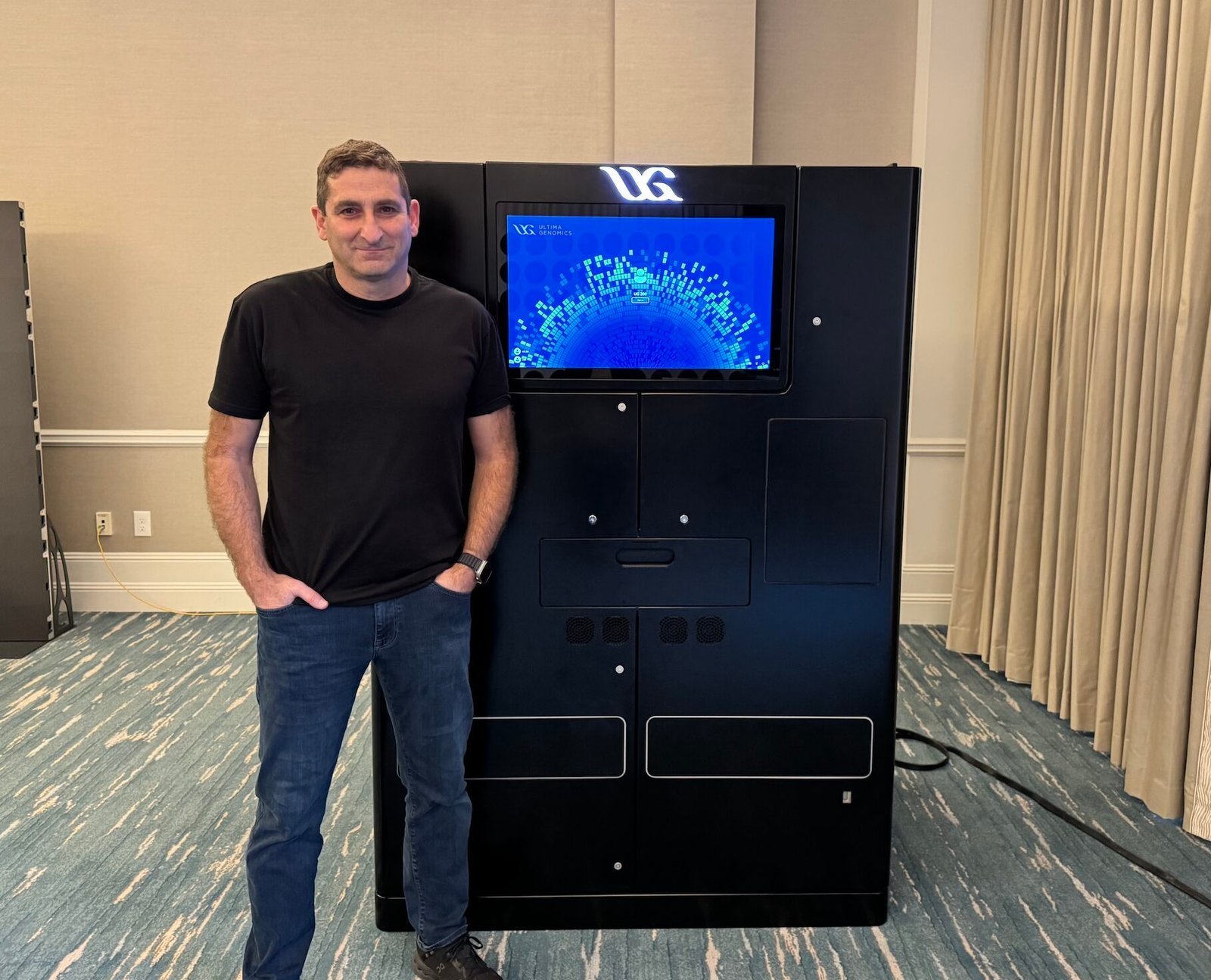
AGBT hasn’t even started, and Ultima Genomics is out of the gate, with a Monday morning announcement of the launch of the second generation of its platform: the UG 200 series and next-generation Solaris 2.0 workflow.
“We have doubled down on our strengths and closed our gaps,” noted Gilad Almogy, PhD, Ultima’s CEO. “We made our existing technology into a better platform, all around, with half the footprint, twice the output, and half the runtime.”
“It’s like a beast now,” he asserted.
The company is launching two new instruments: the UG 200 single wafer and the UG 200 Ultra dual wafer. Almogy describes the UG 200 Ultra as “an extreme high output” and the UG 200 as a medium (but still higher than the current UG 100) output. The two have different price points, both of which are less expensive than the UG 100: the UG 200 single-wafer platform has a U.S. list price as low as $850,000 and can be upgraded to the UG 200 Ultra. Both instruments are available for purchase now, with shipments beginning in June and more flow cell options coming later in the year.
The UG 200 Ultra dual-wafer platform offers higher throughput capabilities for sequencing over 60,000 whole genomes per year at 30x coverage. It can run up to 60 fully automated wafer runs per week (10 wafers are loaded into the machine at one time.)
“With this new tool, we have achieved the highest level of productivity in genomes per square foot, by far,” said Almogy. Both instruments (which are the same size) are half the size of the UG 100—because they no longer include the PCR amplification component of the platform.
Laser focused on DNA in a multi-omic frenzy
Many in the NGS field are moving toward integrated multi-omic platforms—layering transcriptomics, proteomics, and spatial assays onto a single system. However, Ultima is deliberately holding its ground in DNA sequencing while pairing with open collaborations in multi-omics.
“We don’t want to force anyone to use the solution that we think is best for single cell, spatial, or proteomics,” Almogy told GEN. “We like to consider ourselves collaborative, open partners who work with the best of breed; we have tight collaborations in the multi-omics world.”
Maturing the platform
What did Ultima focus on to develop the next generation of instrument? The UG 200 series, Almogy said, is more mature because it has been developed through “a ton of learning of how it performed in the field.” Also, time has helped: for example, Almogy explained that they now have much faster cameras because they waited for the latest improvements.
Also, the move from emulsion PCR to isothermal amplification not only allows for more genomic coverage but is faster and more compact. With the UG 100, a second tool was necessary to make the beads—a downside for some customers. Now, Almogy noted, “we solved the emulsion PCR issue. We went from long and big to fast and tiny. This change has reduced the footprint in half.” And with the addition of liquid handling, the prep is integrated into the pipeline. Customers can either use their own liquid handler or obtain an Opentrons Flex from Ultima for an additional cost. There is more flexibility with the choice of a wafer output of 20B, 10B, and 5B and greater capacity because the beads are closer together in the new instrument. Lastly, improvements have been made in data processing—the UG200 Ultra enables faster data rates and a total wafer output of up to 60 wafers per week for certain applications. Importantly, current UG 100 customers can access the upgrades without changing the instrument.
A hotter NGS race, a bolder Ultima
Ultima is no stranger to a competitive market. The company destealthed in June 2022 (at the same Orlando hotel where AGBT is being held this year). At that time, multiple other new companies were also emerging while market leaders were responding with new products. Today, Ultima is competing with the same batch of companies that it did in 2022. And with Roche’s Axelios hot on everyone’s heels, the race is perhaps hotter than it has ever been.
But Almogy remains confident: “We are getting great traction with the product that we have, and we are releasing a much, much better one now,” he noted. “It used to be that everyone would think of one solution when they thought of sequencing. Now, you realize there are multiple solutions, and you have to pause and think. That’s a competition I’ll take any day.”
The post Before AGBT Kicks Off, Ultima Unveils the UG 200 appeared first on GEN – Genetic Engineering and Biotechnology News.