In the past decade, genomic technologies have evolved from specialized research tools to crucial engines of discovery and clinical translation. Sequencing costs have fallen dramatically, multiomic methods have expanded, and artificial intelligence (AI) has begun to drive deeper knowledge of biological complexity. Yet as the scale and scope of genomics grow, its workflows remain a bottleneck. The challenge is not just generating data—it’s doing so efficiently, reproducibly, and at a scale that matches the ambition of modern biology.
“Genomic workflows, especially single-cell and spatial workflows, are incredibly powerful because they can be applied to so many different biological questions,” says Michael Schnall-Levin, PhD, CTO at 10x Genomics. But as he and others note, these capabilities can only reach their potential if the underlying processes are automated and interconnected. From library preparation to single-cell analysis, automation is becoming the foundation of scalable genomics.
The pace problem
Few scientific fields move as quickly as genomics. Every year brings new chemistries, sequencing platforms, and bioinformatics pipelines. “One of the most pressing challenges is keeping pace with the rapid evolution of technologies,” says Michelle Hiscutt, PhD, market specialist manager for life science and diagnostics at Agilent. “This creates a dilemma: when do you lock in a process, and when do you pivot?”
That balance between stability and adaptability defines today’s automation strategies. Fixed-function systems deliver reproducibility but often struggle to accommodate evolving assays. For clinical labs bound by regulatory validation, even minor changes—such as a reagent substitution or software update—can trigger a revalidation cycle. Automation helps enforce consistency, but if it’s rigid, it can hinder innovation.
Fran Slater, PhD, senior director of strategic marketing at Opentrons Labworks, believes flexibility is now a defining requirement. “A lab might be adding a new sequencing platform, incorporating affinity-based proteomics or methylation, or simply swapping from one library-prep chemistry to another,” she explains. “Traditional automation platforms aren’t designed to flex with that level of change.”
Opentrons’s modular Flex System is designed for such agility, enabling labs to scale or reconfigure workflows on demand. This approach has gained further momentum through a collaboration with BD (Becton, Dickinson and Company), which integrates Opentrons’s robotic handling into BD’s Rhapsody single-cell multiomics instruments. “By revealing multiple layers of biological information within cells, single-cell multiomics is transforming oncology and immunology,” said Ranga Partha, PhD, vice president of global marketing at BD Biosciences, when announcing the partnership. “Automation can further accelerate adoption in translational and biopharma settings.”
Library prep
“Automation of genomics is largely the automation of library preparation,” says Michael Benway, senior automation field application scientist at New England Biolabs (NEB). Before sequencing, every sample must be converted into a high-quality library—molecularly tagged fragments ready for analysis.
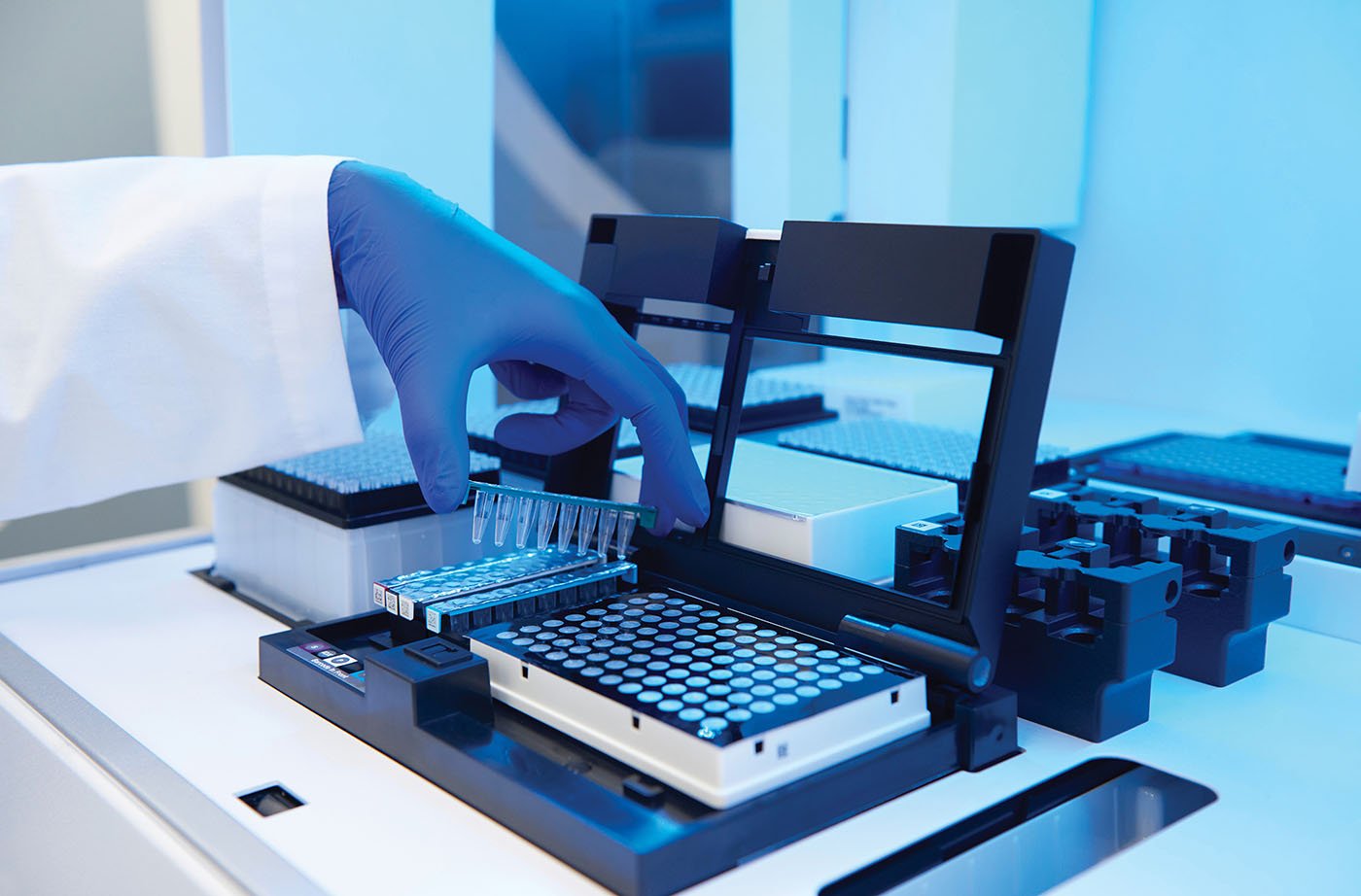
Automation brings clear benefits: higher throughput, reproducible quality, and less hands-on time. But Benway notes a major technical hurdle: “The biggest challenge is balancing lower reaction volumes with the limits of liquid-handling platforms’ ability to reliably transfer low fluid volumes.” At these scales—often microliters or less—mechanical precision meets its physical limits.
To bridge this gap, NEB and others have developed automation-friendly, library-prep kits such as NEBNext UltraExpress and EM-seq v2, with prevalidated scripts for multiple liquid-handling platforms. These developments highlight an industry-wide push toward modularity and standardization. By aligning consumables, reagents, software protocols, and liquid-handling techniques, vendors can reduce custom automation integrations to more easily reuse script modules for different workflows.
Single-cell scale
Single-cell and spatial genomics embody both the complexity and potential of automation. Profiling individual cells delivers transformative biological insight, but studies that include thousands or even millions of single-cell reactions are greatly enhanced by the consistency and reproducibility that come with robotic precision.
This is the focus of a collaboration between 10x Genomics and SPT Labtech, which automates 10x’s Chromium workflows on SPT’s firefly platform. “The partnership was established through a mutual recognition of the need for reliable, high-throughput automation in the single-cell and spatial biology markets,” explains Morten Frost, chief commercial officer at SPT Labtech.
Three trends underlie this partnership: the explosion of cell-atlas projects requiring industrial-scale throughput; the rising complexity of multiomic workflows combining transcriptomic, epigenomic, and proteomic data; and the need for validated, accessible automation across labs of all sizes. Firefly’s precision liquid handling—non-contact and optimized for low volumes—reduces variability, conserves reagents, and delivers reproducible results.
Validation data presented at ASHG 2025 demonstrated that automated workflows matched or exceeded manual methods while drastically reducing setup time. Automation, once optional, is now crucial for scaling single-cell studies to population-level research.
For Schnall-Levin, automation is also a stepping stone toward AI-driven discovery. “We believe this is just a first step to powering a far broader set of analyses and discovery using AI tools,” he says. “That means analyzing data with broader sets of tools and integrating insights from literature and public datasets into any analysis.”
AI integration
Other experts agree that automation’s full impact lies in its convergence with AI. Hiscutt emphasizes this synergy: “Integrating AI-driven bioinformatics with automated sample prep will be transformative.” Platforms such as SeqOne and SOPHiA DDM already show how machine learning can streamline variant calling, prioritize actionable mutations, and accelerate clinical reporting.
In June 2025, Agilent and SeqOne announced a strategic collaboration to enhance liquid-biopsy analysis, combining Agilent’s Avida Cancer Panels with SeqOne’s bioinformatics. The resulting platforms—SomaMethyl for methylation and SomaLBx for DNA sequencing—enable end-to-end automation, from sample to clinical insight. By integrating Agilent’s methylation-index algorithm, these tools optimize the detection of minimal residual disease, turning cfDNA methylation into a clinically actionable signal.
Earlier collaborations between Agilent and SOPHiA GENETICS reinforced this trend toward automation-ready analytics. Their joint cancer-profiling solution combined Agilent’s SureSelect CGP assay with SOPHiA’s DDM Platform, empowering clinical researchers to detect multiple tumor biomarkers within a unified, cloud-enabled workflow.
Together, these efforts exemplify the rise of closed-loop, AI-integrated automation—where instruments, software, and analytics communicate seamlessly. “The goal is to make genomic testing as seamless, scalable, and reliable as any other laboratory assay,” says Richard Shippy, vice president of marketing at Illumina. “Automation enables more sequencing, which generates more data. To interpret that data, AI technologies will be essential, especially in an era of multiomics.”
Such adaptive workflows promise fewer errors, faster turnaround, and higher trust—but only if shared digital standards ensure compatibility across platforms.
Open systems
As AI and automation advance, the industry faces a structural challenge: how to move from proprietary, closed systems to open, modular ecosystems. Yang Meng, PhD, senior vice president at MGI Tech, argues that genomics must “break away from the entrenched closed-system paradigm.”
MGI’s αBrick platform exemplifies that open approach. Designed as a modular, programmable sequencing system, αBrick lets laboratories reconfigure workflows quickly using standardized hardware and software interfaces. “By leveraging decoupled modular technology, we can flexibly reconfigure systems to meet diverse clinical needs,” says Meng. The result is a sequencing ecosystem adaptable to infectious disease testing, oncology, and other clinical applications.
This philosophy echoes the shift in clinical biochemistry from all-in-one analyzers to modular systems that defined modern diagnostics. For genomics, an open, standardized foundation could democratize sequencing and make precision medicine truly accessible.
A unified ecosystem
Automation has moved from convenience to necessity. It underpins reproducibility, scalability, and the translation of genomics into precision medicine. But realizing this vision requires more than advanced robotics—it depends on interoperability.
“Ultimately, we’re seeing a convergence,” says Schnall-Levin. “Single-cell and spatial tools are broadly applicable to almost every area of biology and human disease.” As automation merges with AI, the boundaries between experimentation, analysis, and interpretation are dissolving.
Leading innovators are responding through collaboration: Agilent, SeqOne, and SOPHiA uniting assays with bioinformatics; 10x Genomics and SPT Labtech combining chemistry with robotics; BD and Opentrons integrating instruments and modular automation. Together, they are constructing a connected ecosystem where automation, analytics, and accessibility reinforce one another.
Benway at NEB summarizes the goal: making technology “compatible with a wide variety of liquid-handling platforms” and supported by prebuilt workflows. The next frontier lies not in individual instruments but in their synergy—the orchestration of hardware and software across applications and environments.
From workflow to insight
For genomics professionals, automation is not an end but a means to accelerate biological discovery. As Hiscutt points out, “Further advances in modular automation, such as plug-and-play systems for single-cell and spatial genomics, will expand access to high-resolution data across clinical and research settings.”
That expansion—driven by AI, robotics, and modular design—will define the next decade. Tomorrow’s laboratories will not only process more samples faster; they will learn from every run, adapting parameters, integrating knowledge, and continuously refining discovery pipelines.
In that future, the once-manual art of sample preparation, sequencing, and data analysis will fade into the background—replaced by an intelligent, automated infrastructure quietly powering a new age of precision biology.
The post Building Intelligent Workflows for the Multiomic Era appeared first on GEN – Genetic Engineering and Biotechnology News.