
- Comment
- Published:
Subjects
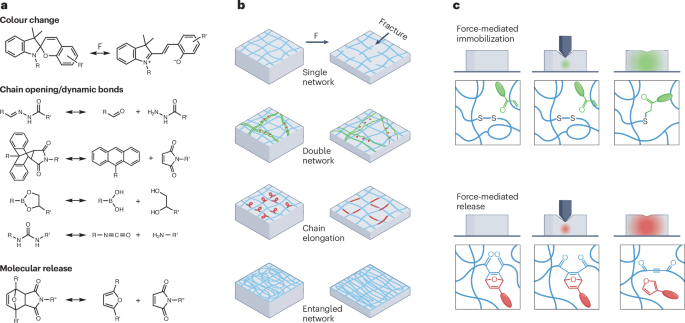
When soft tissue is mechanically deformed, new material properties and functionalities can emerge. Through rational design of dynamic covalent chemistry and network architecture, new force-catalysed activities in hydrogels can be achieved, forming the basis of a ‘mechanochemical toolbox’ to expand the functionality of soft synthetic biomaterials.
This is a preview of subscription content, access via your institution
Access options
Subscribe to this journal
Receive 12 digital issues and online access to articles
$119.00 per year
only $9.92 per issue
Buy this article
- Purchase on SpringerLink
- Instant access to the full article PDF.
USD 39.95
Prices may be subject to local taxes which are calculated during checkout

References
-
Humphrey, J. D., Dufresne, E. R. & Schwartz, M. A. Mechanotransduction and extracellular matrix homeostasis. Nat. Rev. Mol. Cell Biol. 15, 802–812 (2014).
-
Lloyd, E. M., Vakil, J. R., Yao, Y., Sottos, N. R. & Craig, S. L. Covalent mechanochemistry and contemporary polymer network chemistry: a marriage in the making. J. Am. Chem. Soc. 145, 751–768 (2023).
-
Potisek, S. L., Davis, D. A., Sottos, N. R., White, S. R. & Moore, J. S. Mechanophore-linked addition polymers. J. Am. Chem. Soc. 129, 13808–13809 (2007).
-
Wang, Z. J. & Gong, J. P. Mechanochemistry for on-demand polymer network materials. Macromolecules 58, 4–17 (2025).
-
Jayathilaka, P. B. et al. Force-mediated molecule release from double network hydrogels. Chem. Commun. 57, 8484–8487 (2021).
-
Chen, H., Yang, F., Chen, Q. & Zheng, J. A novel design of multi-mechanoresponsive and mechanically strong hydrogels. Adv. Mater. 29, 1606900 (2017).
-
Huang, Y. et al. Structural aspects controlling the mechanical and biological properties of tough, double network hydrogels. Acta Biomater. 138, 301–312 (2022).
-
Bosnjak, N. & Silberstein, M. N. Pathways to tough yet soft materials. Science 374, 150–151 (2021).
-
Huang, Y. et al. Stretch activated molecule immobilization in disulfide linked double network hydrogels. Acta Biomater. 198, 174–187 (2025).
-
Li, Z. et al. Multi-step functionalization of hydrogels through mechano- and photo-responsive linkages. Mater. Horiz. 12, 3084–3090 (2025).
-
Goor, O. J. G. M., Hendrikse, S. I. S., Dankers, P. Y. W. & Meijer, E. W. From supramolecular polymers to multi-component biomaterials. Chem. Soc. Rev. 46, 6621–6637 (2017).
Acknowledgements
K.A.K. thanks J. Kruzic from the School of Mechanical and Manufacturing Engineering for discussions and for his shared vision of bringing mechanochemistry to hydrogel biomaterials. K.A.K. thanks C. Ranaweera from the School of Chemistry for her assistance in generating the artwork shown in Fig. 1. K.A.K. acknowledges the Australian Research Council for funding the research described in this Comment (DP210103654).
Ethics declarations
Competing interests
The author declares no competing interests.
Rights and permissions
About this article

Cite this article
Kilian, K.A. Building mechanochemistry into soft biomaterials. Nat Rev Bioeng (2026). https://doi.org/10.1038/s44222-026-00406-w
-
Published:
-
Version of record:
-
DOI: https://doi.org/10.1038/s44222-026-00406-w

