
- RESEARCH BRIEFINGS
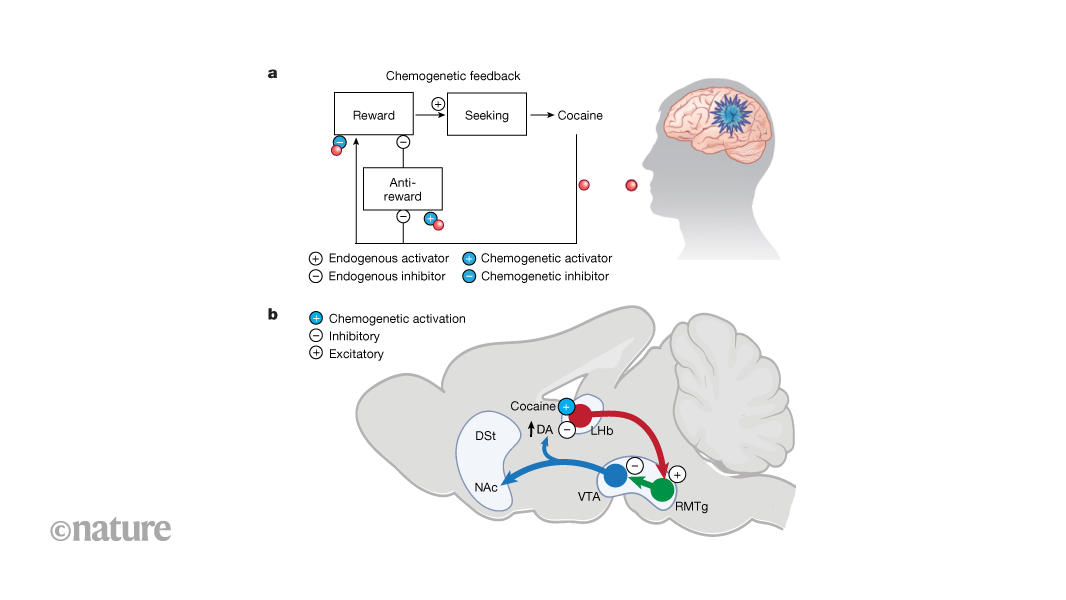
Ion channels have been created that are selectively activated by cocaine and that act to either stimulate or inhibit the electrical activity of neuronal cells in the brain. These cocaine-activated ion channels are used to engineer neural circuits in rats to respond to cocaine in a manner that reduces cocaine seeking but not food seeking.
This is a summary of: Gomez, J. L. et al. Cocaine chemogenetics blunts drug-seeking by synthetic physiology. Nature https://doi.org/10.1038/s41586-025-09427-8 (2025).
Access options
Access Nature and 54 other Nature Portfolio journals
Get Nature+, our best-value online-access subscription
$32.99 / 30 days
cancel any time
Subscribe to this journal
Receive 51 print issues and online access
$199.00 per year
only $3.90 per issue
Rent or buy this article
Prices vary by article type
from$1.95
to$39.95
Prices may be subject to local taxes which are calculated during checkout
doi: https://doi.org/10.1038/d41586-025-02609-4
‘Expert opinion’ and the figure are published under a CC BY 4.0 licence.
References
-
Lüscher, C. Annu. Rev. Neurosci. 39, 257–276 (2016).
-
Volkow, N. D. & Swanson, J. M. Am. J. Psychiatry 160, 1909–1918 (2003).
-
Koob, G. F. & Volkow, N. D. Lancet Psychiatry 3, 760–773 (2016).
-
Jhou, T. C. et al. J. Neurosci. 33, 7501–7512 (2013).
-
Magnus, C. J. et al. Science 364, eaav5282 (2019).
Related Articles
-
 Read the paper: Cocaine chemogenetics blunts drug-seeking by synthetic physiology
 -
 Neural pathways for reward and relief promote fentanyl addiction
 -
 Structures of the dopamine transporter point to ways to target addiction and disease