In recent years, the rise of general-purpose AI models that interface with human prompts, such as ChatGPT from OpenAI, Gemini from Google, and Claude from Anthropic, has corresponded with autonomous systems across a wide range of disciplines, including scientific research. While natural language domains benefit from readily available internet-scale datasets, biological data that drive therapeutic discovery remains limited, labor intensive to generate, and highly dependent on domain-specific expertise.
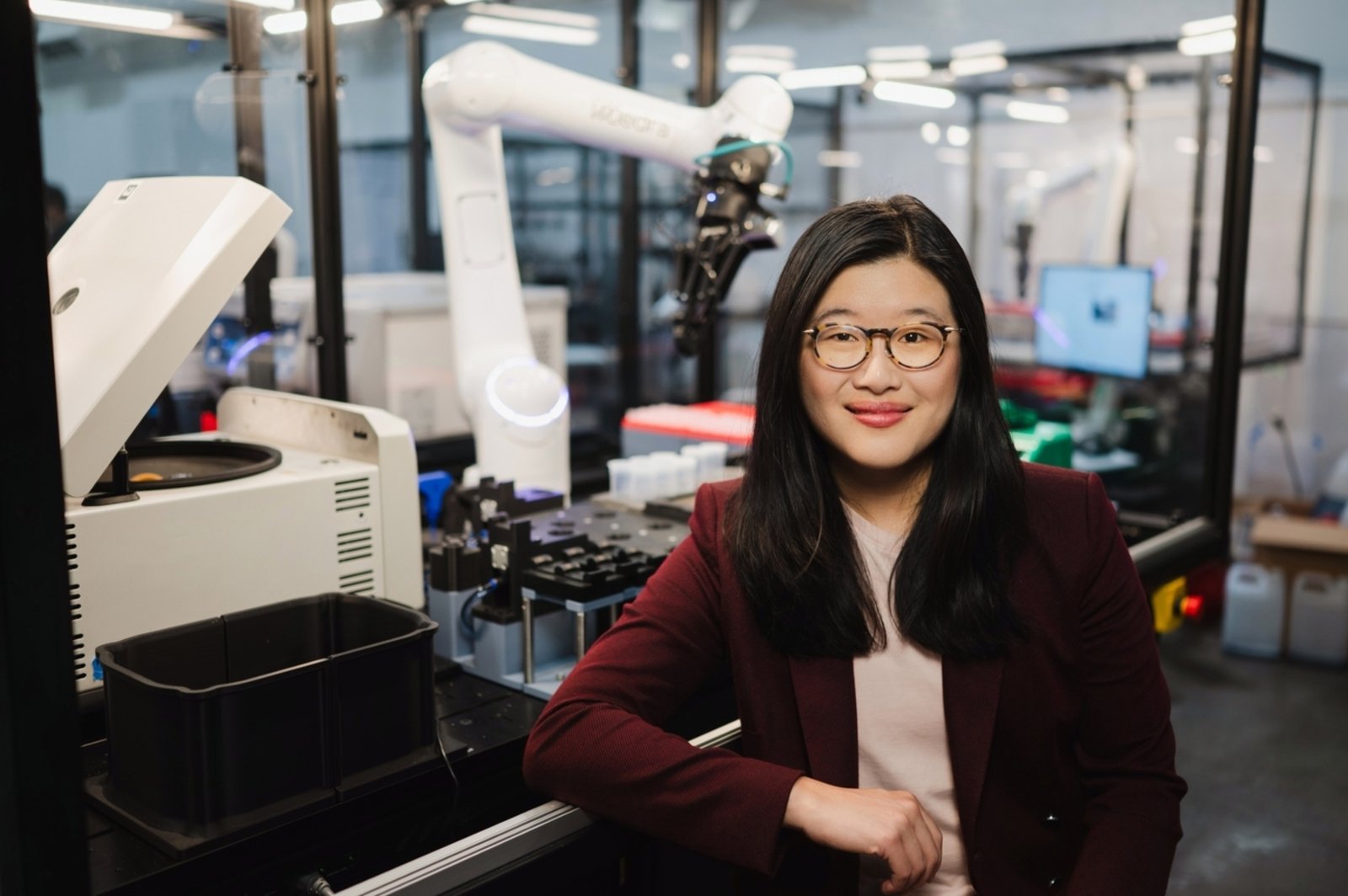
Medra seeks to address this gap by building Physical AI Scientists that can develop hypotheses, design experiments, and interpret results. The closed loop system integrates companion robotics that autonomously run experiments for large-scale data generation.
Unveiled from stealth last September, the San Francisco-based start-up closed out 2026 with a $52 million Series A led by Human Capital. Additional investors include Lux Capital, Neo, and NFDG, Catalio Capital Management, Menlo Ventures, and 776.
In this GEN Edge interview, Fay Lin, PhD, senior editor, technology, spoke with Michelle Lee, PhD, founder and CEO of Medra, on how the rising adoption of Physical AI across life sciences will drastically expand the scale of biological discovery. Lee holds experience across Nvidia, SpaceX, and McKinsey and was an assistant professor in computer science and electrical computer engineering at New York University (NYU) before founding Medra.
This interview has been edited for length and clarity.
GEN: How do you differentiate automation from Physical AI, and where do you see this shift happening in practice? How did your own journey in robotics lead you to found Medra?
Lee: I did my PhD at the Stanford AI lab where I focused on Physical AI, robotics, and reinforcement learning. I entered robotics because I believe it will change the world.
Industrial automation, where you write programs to different hardware, has been around for decades. A Roomba is industrial automation where a software algorithm says, “if you hit a wall, change direction using a random generator.” In manufacturing, industrial automation robots can go to the exact same place to pick up something and put it on a pallet. Industrial automation within a lab setting (also called lab automation) has been very powerful in combinatorial chemistry, screening, and high throughput work because you’re doing the exact same thing over and over again.
Physical AI started around 2016. What if you could equip the same hardware with sensors to give it intelligence to make decisions? The best example is the self-driving car, which prior to 2016, was still primarily rule-based. Today’s deep learning allows AI systems, like San Francisco’s self-driving Waymos, to take an image with sensors, like cameras, and intelligently decide what to do next. It’s taken until 2024 for widespread adoption of Physical AI.
I entered life sciences when AlphaFold 2 was released in 2021. I got excited about the idea of building AI models, not just for protein folding, but to predict protein functions and more. What if in the next 60 or 80 years, we can build foundation models that can eradicate disease? Solving this problem would be the most impactful thing anyone can do for humanity. It felt so compelling that I decided to leave my faculty position at NYU to start Medra and build the infrastructure for this mission.
Our vision is to automate science itself, and not to do lab automation. At Medra, we’re intentionally focused on investing in AI rather than custom hardware. Building in this space requires a long-term mindset, and we’re developing robotic systems to change how science is done.
When you look at how science actually gets done today, where do you see the biggest bottlenecks?
Lee: The thing that I hear over and over again is that we don’t have enough data. Building foundation models in biology that can predict and cure disease will take thousands of years of data generation. The more I looked at the field, the more I realized that this data problem is actually a robotics problem.
Since the mid-2010s, we’ve seen increasing investment in the dry lab with deep learning, biological foundation models, and even AI scientists. It’s completely flipped from the 1990s, where the rise of PCR and NGS caused the wet lab to push forward the dry lab. Today, we’re not seeing the same speed and improvements in the wet lab.
Biology requires going physically into the lab and running experiments. It’s incredibly laborious, repetitive, and requires highly trained, educated individuals. In antibody design, for example, we need a single platform that can take a predicted DNA sequence and turn it into experiments that can test functional attributes, like binding and thermal stability. The AI Scientist then trains on the results, cross references with the literature, and conducts the next set of experiments needed to validate or invalidate the hypothesis. That doesn’t exist right now.
What obstacles, if solved, would most unlock the value of Physical AI in biological research?
Lee: The biggest barrier is inherent to biology itself. Unlike tasks like folding laundry, biology is variable, probabilistic, and non-deterministic. At Medra, we think about how to accept this inherent variability to create a technology platform that allows our customers to make more shots on goal. How do we build a system that is robust, measures all parameters, undergoes optimization, and scales?
Another huge obstacle is having enough context. AI models need as much information as possible to make good decisions. I hear all the time, “how can we connect our large language model (LLM) to Slack or Google Drive?” We need an AI scientist that can reason through, not just one set of experiments, but all experiments done in the past 365 days.
We need the nuances of every instrument, including the exact angle and depth of the tip of the pipette when you entered the well plate, and timing when reagent A was added to reagent B. The artisanal nature of science is actually what makes certain experiments work and others fail. Without this context, we can’t make progress in making science truly autonomous.
Everyone is driven by patient impact. Our partners, including Genentech, Cultivarium, and Addition Therapeutics, are excited about generating orders of magnitude more data and experiments that were not possible before. From a leadership position, they wonder, what does this mean at scale? How is the Physical AI Scientist going to transform our workforce? They want solutions that can decrease the cost and timeline to new drugs. The excitement is about patients and what the technology enables.
The post Data Is a Robotics Problem, Medra CEO Says Physical AI Will Transform Biology appeared first on GEN – Genetic Engineering and Biotechnology News.