
- Research Briefing
- Published:
Subjects
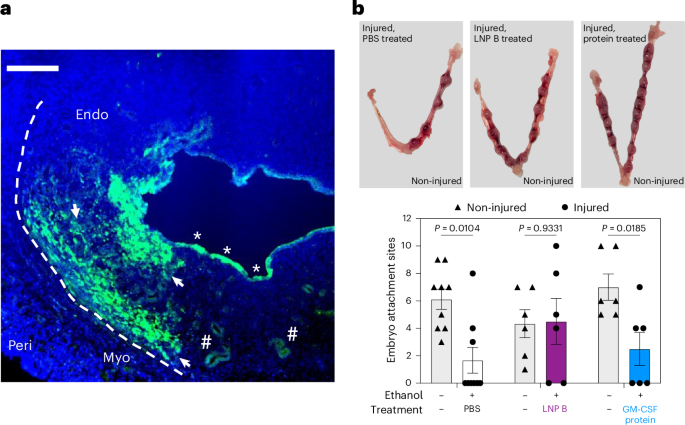
Dysfunctions of the endometrium can impair the first stage of pregnancy: embryo implantation. We developed a strategy to deliver therapeutic mRNA to the endometrium with high specificity using a ligand-conjugated mRNA- lipid nanoparticle, restoring implantation rates in a murine model of endometrial injury with improved safety profiles.
This is a preview of subscription content, access via your institution
Access options
Access Nature and 54 other Nature Portfolio journals
Get Nature+, our best-value online-access subscription
$32.99 / 30 days
cancel any time
Subscribe to this journal
Receive 12 print issues and online access
$259.00 per year
only $21.58 per issue
Buy this article
- Purchase on SpringerLink
- Instant access to the full article PDF.
USD 39.95
Prices may be subject to local taxes which are calculated during checkout

References
-
Musunuru, K. et al. Patient-specific in vivo gene editing to treat a rare genetic disease. N. Engl. J. Med. 392, 2235–2243 (2025). A clinical study that demonstrates the promise of mRNA-LNP in delivering safe and effective cures in neonates.
-
Swingle, K. L. et al. Placenta-tropic VEGF mRNA lipid nanoparticles ameliorate murine pre-eclampsia. Nature 637, 412–421 (2025). This paper reports the treatment of a life-threatening pregnancy-related disorder using an mRNA-LNP technology.
-
Lessey, B. A. et al. Integrin adhesion molecules in the human endometrium. Correlation with the normal and abnormal menstrual cycle. J. Clin. Invest. 90, 188–195 (1992). An article showing that integrin receptors are cyclically regulated and overexpressed on the endometrium during the WOI.
-
Hatakeyama, H., Akita, H. & Harashima, H. The polyethyleneglycol dilemma: advantage and disadvantage of PEGylation of liposomes for systemic genes and nucleic acids delivery to tumors. Biol. Pharm. Bull. 36, 892–899 (2013). A review article discussing the pros and cons of using PEG in lipid-based formulations for nucleic acid delivery.
-
Emera, D., Romero, R. & Wagner, G. The evolution of menstruation: a new model for genetic assimilation: explaining molecular origins of maternal responses to fetal invasiveness. Bioessays 34, 26–35 (2012). A perspective explaining the molecular origins of menstruation across species.
Additional information
Publisher’s note Springer Nature remains neutral with regard to jurisdictional claims in published maps and institutional affiliations.
This is a summary of: Abbasi, S. et al. Spatiotemporal targeting of messenger RNA lipid nanoparticles to the endometrium for the treatment of reproductive disorders. Nat. Nanotechnol. https://doi.org/10.1038/s41565-025-02108-7 (2026).
Rights and permissions
About this article

Cite this article
Endometrium-targeted mRNA-lipid nanoparticles for treating reproductive conditions. Nat. Nanotechnol. (2026). https://doi.org/10.1038/s41565-025-02116-7
-
Published:
-
Version of record:
-
DOI: https://doi.org/10.1038/s41565-025-02116-7