Introduction
Global food security is facing unprecedented challenges owing to population growth, climate variability, and the urgent need to adopt sustainable agricultural practices. In this context, optimizing seed germination has emerged as a critical factor in ensuring successful crop establishment. Conventional methods (such as the use of agrochemicals, intensive tillage, flood irrigation, genetic improvement, and chemical fertilization), although effective, face limitations owing to their environmental impact, microbial resistance, and regulatory constraints1. This has driven the exploration of innovative physical technologies, among which cold plasma generated by dielectric barrier discharges (DBD) stands out for its ability to modify the surface and biochemical properties of seeds without compromising their viability2,3,4,5,6,7,8.
DBD systems generally operate through the controlled ionization of gases, such as air, at atmospheric pressure, generating reactive oxygen and nitrogen species (RONS), ultraviolet photons, and charged particles. These species induce changes in the hydrophilicity, permeability, and enzymatic activity of seeds, thereby enhancing water uptake, metabolic activation, and pathogen resistance9,10,11,12,13,14,15. Studies on soft spring wheat (Triticum aestivum), a staple crop that provides approximately 20% of the global caloric intake, have reported increases of up to 60% in germination rates following DBD treatments, along with a significant reduction in pathogens such as Fusarium graminearum. However, conventional devices, typically based on metal electrodes and a single dielectric barrier, face limitations, such as plasma inhomogeneity, electrochemical degradation, and the generation of toxic by-products16,17,18,19.
As a result, there is a growing interest in developing innovative DBD reactor configurations that incorporate different materials for both electrodes and dielectric barriers to improve treatment uniformity and extend applicability to large volumes of seeds. This approach not only minimizes contamination from metallic particles associated with conventional electrodes but also enables modulation of the chemical composition of the plasma through the controlled introduction of gaseous impurities. Furthermore, the implementation of double dielectric barrier systems has demonstrated significant potential for enhancing plasma uniformity and adjusting the delivered energy density, which are critical factors for avoiding thermal damage to seeds and maximizing the beneficial effects of the treatment20.
One of these beneficial effects is the increased hydrophilicity of the seed surface, which can be assessed through the apparent contact angle, a key parameter for evaluating the interaction between dielectric barrier discharge (DBD) and the treated surface. This measurement provides essential information regarding plasma-induced effects in terms of material wettability modification, which is directly related to changes in surface chemistry and topography.
The analysis was conducted as a function of the applied voltage and the DBD treatment duration. The correlation between the contact angle and these parameters helps to elucidate the efficiency of the treatment and its impact on surface reactivity. Thus, the study aims to establish a quantitative relationship between the operational conditions of the plasma and the induced modifications in the surface energy of the treated material21.
This paper presents an innovative DBD reactor equipped with a double dielectric barrier and electrodes immersed in conductive liquid for the direct treatment of wheat seeds. The seed lot used was recently harvested (2024) and provided by INIFAP, but it had been classified by the institution as a low-vigor batch and discarded for commercial sowing. Such classification is typically based on physiological and sanitary limitations such as heterogeneity in seed quality, incomplete physiological maturity, presence of natural inhibitors in the seed coat, or latent microbial contamination, all of which are known to reduce germination and vigor even in recently harvested seeds. From an experimental standpoint, this provided a valuable opportunity to assess whether dielectric barrier discharge (DBD) plasma could mitigate these constraints.
The primary objective of this study was to evaluate the germination rate of wheat seeds under varying dissipated power and exposure times. The results provide new insights into the optimization of this technology and highlight its potential as a sustainable tool for modern agriculture, aligned with the goals of ecological intensification proposed by international organizations such as the Food and Agriculture Organization of the United Nations (FAO). This study aims to lay the foundation for the development of scalable and environmentally responsible seed treatment technologies, contributing to the advancement of sustainable agricultural practices.
Experimental configuration
The DBD system used in this study was designed for direct treatment of wheat seeds through cold plasma interactions at atmospheric pressure. The device consists of two stainless steel metallic electrodes with an effective length of 2 cm, housed inside 12 cm Pyrex tubes filled with an H₂O + NaCl solution. The tube and electrode length follow a ratio of Lmetal / Ltube = 2/12, which allows confinement of the metal–liquid coupling to a reduced central zone, limiting field perturbations and hot spots; taking advantage of the longer liquid column as a distributed resistive–capacitive element, which smooths current transients and homogenizes microdischarges; and avoiding edge effects near the dielectric ends. Our electro-geometric analysis suggests that with Lmetal = 2 cm (while maintaining a 12 cm tube), longer metallic lengths increased local current density and the probability of microarcs, whereas shorter lengths hindered ignition at the same voltages. The 2/12 cm configuration provided the best balance between ease of ignition, stability, and uniformity.
A saline solution was prepared by dissolving 1.1 g of NaCl in 30 mL of deionized water (18.2 MΩ·cm). The final conductivity was κ = 80 ± 5 mS·cm⁻¹ at 23 ± 1 °C, verified with an edge™ pH • CE • OD conductimeter calibrated with traceable standards. The choice of κ ≈ 80 mS·cm⁻¹ was based on non-systematic preliminary tests (κ ≈ 10–100 mS·cm⁻¹), in which we observed greater discharge stability (closed Q–V loops and absence of microarcs) and reproducible power; along with OES trends consistent with robust RONS production, without appreciable thermal increase. Very low κ values increased the impedance of the liquid electrode, hindering homogeneous ignition; very high values favored current spikes. Therefore, κ ≈ 80 mS·cm⁻¹ was adopted due to its electrical stability and potential chemical performance.
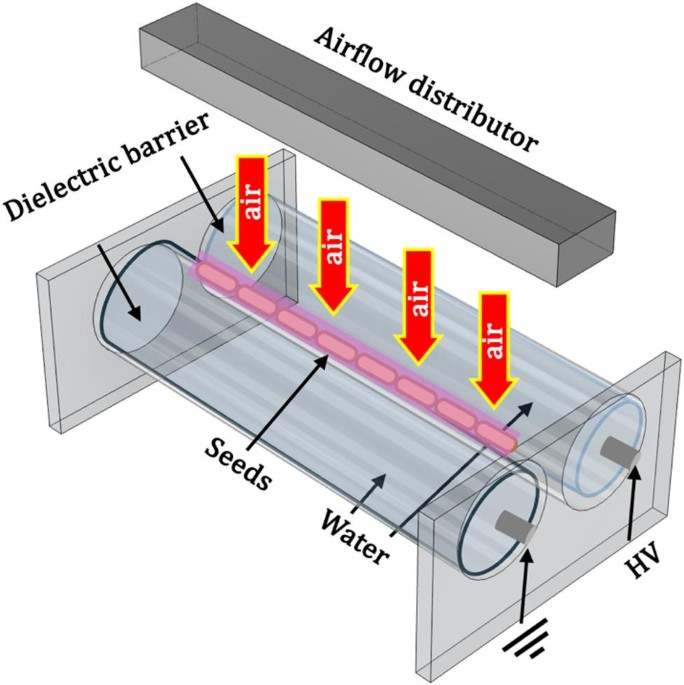
The electrodes immersed in the saline solution were arranged in parallel, with a gap of 0.3 cm between them, ensuring stability in the plasma distribution during treatment (Fig. 1).

The image shows a schematic of the dielectric barrier discharge (DBD) system featuring a double dielectric barrier and electrodes immersed in saline solution. Wheat seeds are positioned between the electrodes and exposed to the plasma generated in the central region of the system. An air flow distributor directs the gas toward the discharge zone, promoting the generation of reactive species. The dielectric barrier covers the electrodes, ensuring stable plasma operation.
Ambient air was supplied at a flow rate of 0.8 L·min⁻¹ (low forced convection) at 21–23 °C and 40–60% RH, directing the flow parallel to the seed surface at a height of 12 mm. The flow rate was selected to renew the boundary layer without causing excessive cooling or seed displacement; during the tests, no seed movement was observed. These conditions provided stable OES spectra and Q–V curves, consistent with reproducible RONS production.
To generate the DBD, a Minipuls Universal generator (GBS Elektronik) was used, based on a full-bridge configuration that delivers two square-wave signals in antiphase (50% duty cycle) to drive a step-up/cascade transformer. Owing to the transformer response and the capacitive load of the DBD reactor, the voltage applied to the reactor (:{V}_{reactor}left(tright)) is quasi-sinusoidal at approximately ∼13 kHz, in agreement with the oscillograms shown in Fig 3.
Voltage and current waveforms were monitored using a SIGLENT SDS1204X-E digital oscilloscope equipped with a 200 MHz passive probe (PP215 A) configured with a ×10 attenuation factor. To precisely determine the dissipated power, a 0.46 µF metallized polypropylene capacitor was connected in series with the discharge circuit. Additionally, a compressed air system was employed to supply continuous airflow into the discharge region. The complete experimental setup is illustrated in Fig. 2.

Diagram of the experimental setup used for plasma generation and characterization in a dielectric barrier discharge (DBD) system. The system consists of the following components: (a) Oscilloscope, (b) GBS Minipuls high-voltage power supply, (c) Plasma system: discharge configuration with a dual dielectric barrier, (d) Air injection system: introduces a gas flow over the discharge region to enhance the generation of reactive species, (e) Measurement probe: connects the plasma system to the measurement circuit, (f) 0.46 µF metallized polypropylene capacitor, used for the electrical characterization of the plasma, enabling the calculation of dissipated power through charge-voltage diagrams, (g) Ground connection: completes the electrical circuit, ensuring system stability.
The reactor was modeled as two capacitances in series (glass, (:{C}_{glass}), and liquid electrode, (:{C}_{liq})) plus the ionic resistance of the liquid (:{R}_{liq}), as well as the capacitance of the discharge gap (:{C}_{gap}) and the resistance of the discharge medium (:{R}_{md}). The final configuration of the device is represented as ((:({C}_{glass}-{R}_{liq}-left({C}_{gap}parallel:{R}_{md}left(tright)right)-{R}_{liq}-{C}_{glas})). This topology distributes the potential drop and limits the peak current, thereby stabilizing the multifilamentary regime and suppressing microarcs. The metallic electrodes remain completely isolated from the ambient plasma by the dielectric (glass thickness: 2.0 mm), ensuring that there is no direct metal–plasma contact. The dissipated power was obtained as shown in Eq. 7, using charge–voltage (Q–V) diagrams and the operating frequency of approximately ≈13,148 Hz. This metric was employed as a control parameter to modulate the energy density and, consequently, the production rate of reactive species.
The experimental setup illustrated in Fig. 2 enables the application of DBD treatment on wheat seeds, varying both treatment duration and applied voltage. The treatment times were set to 10, 20, 30, 40, 50, and 60 s, while the applied peak voltages were 9.83 kV, 8.75 kV, and 8.27 kV. These parameters enabled the assessment of the influence of DBD treatment on germination rate, surface hydrophilicity, and seed viability.
Electrical characterization
For the electrical characterization, charge–voltage (:(Q-V)) Lissajous figures were analyzed to determine the average power dissipated in the discharge, based on the area enclosed by these plots21,22,23,24. To relate the enclosed area to the dissipated power, we begin with the expression that defines the charge as a function of voltage across a capacitor:
$$:Qleft(tright)={C}_{:}{cdot:V}_{c}left(tright)$$
(1)
Where (:{C}_{:}) is the capacitance of the monitoring capacitor connected in series with the DBD system and (:{V}_{c}left(tright)) is the voltage measured across its terminals.
By differentiating Eq. (1) with respect to time, the current through the capacitor can be obtained as follows:
$$:{i}_{:}left(tright)={frac{dQleft(tright)}{dt}=C}_{:}frac{d{V}_{:c}left(tright)}{dt}$$
(2)
Because the circuit is configured in series, the current flowing through the monitoring capacitor is equal to the current flowing through the DBD system, that is, (:{i}_{:}left(tright):)which justifies the second equality in Eq. (2).
The instantaneous power dissipated in the DBD can thus be expressed as:
$$:Pleft(tright)=Vleft(tright)cdot:ileft(tright)=Vleft(tright)cdot:{C}_{:}frac{{dV}_{c}left(tright)}{dt}:$$
(3)
Where (:Vleft(tright)) is the voltage applied to the DBD system.
The average power dissipated over one complete cycle of duration (:T) is obtained by integrating (3) over the period:
$$:::::::::::::::::::::::::::::::::::::::::::::::::::::::::::stackrel{-}{P}=frac{1}{T}underset{0}{overset{T}{int:}}Pleft(tright)dt=frac{1}{T}underset{0}{overset{T}{int:}}Vleft(tright)cdot:{C}_{:}frac{{dV}_{c}left(tright)}{dt}dt$$
(4)
Using again Eq. (1), it follows that:
$$::::{dQleft(tright)=C}_{:}{cdot:dV}_{c}left(tright):$$
(5)
Substituting into Eq. (4) yields:
$$::stackrel{-}{P}=frac{1}{T}underset{0}{overset{T}{int:}}Vleft(tright)cdot:dQleft(tright)$$
(6)
Finally, when the integral is performed over a complete and closed cycle in the (:Q-V) space, the line integral becomes:
$$::::::::::::::::::::::::::::::::::::::::::::::::::::::::::::::::::::::::::::stackrel{-}{P}=fcdot:oint:Vleft(tright)dQleft(tright):$$
(7)
Where (:f=1/T) denotes the frequency of the discharge cycle. This equation demonstrates that the average power dissipated is given by the area enclosed within the (:Q-V) diagram, multiplied by the discharge frequency.
Optical emission spectroscopy
The reactive species generated during the discharge were characterized by optical emission spectroscopy (OES) using a high-sensitivity FLAME spectrometer (Ocean Optics, Orlando, FL, USA) specifically designed for the acquisition of optical emission spectra. This model operates over a spectral range of 200 to 900 nm, allowing complete coverage of the ultraviolet (UV), visible (VIS), and near-infrared (NIR) regions.
The device is equipped with a 2048-pixel linear array detector, which provides a high spectral information density. Its optical configuration is customizable to optimize the spectral resolution, which can reach values in the range of 0.3–1.5 nm FWHM (Full Width at Half Maximum (FWHM), depending on the selected slit width and other system parameters.
Data acquisition and processing were performed using the OceanView 2.0 software (Ocean Optics), which enables spectral calibration, real-time visualization, and comprehensive analysis of the acquired spectra.
Seed preparation
In this study, a wheat variety (Triticum aestivum) provided by the National Institute for Forestry, Agriculture, and Livestock Research (INIFAP) from the Centro Altos de Jalisco Experimental Station was used. The seeds were carefully stored in a dry environment at an optimal temperature of 20.0 °C ± 2.0 °C and relative humidity (RH) below 60%.
Healthy mature seeds of uniform size and without visible defects were selected for this investigation. A total of 120 seeds per condition (voltage × time) were used, distributed across 5 Petri dishes of 90 mm (120 seeds/dish). The control group included 120 seeds prepared identically except for plasma exposure. The experimental unit was the dish; germination percentages and indices were calculated per dish based on daily counts. Seed-level counts within the same dish were considered technical sub-replicates. The entire protocol was repeated in five independent runs under identical experimental conditions.
Overall, the protocol follows seed testing standards (ISTA/AOSA practices) to ensure validity and comparability, while incorporating intermediate counts and an exposure window typically reported in plasma literature to study germination kinetics and prevent overtreatment.
Biological analysis
The dishes were incubated under a full-spectrum lamp positioned 35 cm above the samples, maintaining a constant temperature of 22.0 °C ± 2.0 °C for six days. Seeds (soft spring wheat, INIFAP 2024 harvest) were placed in 90-mm Petri dishes on moistened filter paper 30 min after plasma treatment and incubated under the stated conditions. According to INIFAP, this batch was classified as low vigor and discarded for commercial sowing, making it appropriate for assessing plasma effects on seeds with compromised quality. Germination was recorded at 24-hour intervals, considering the seeds in which the radicle had emerged to a minimum length of 1 mm. Seedling growth was monitored for a period of six days, and the number of germinated seeds in each Petri dish was recorded daily. Germination was determined by visible protrusion of the embryo, and these data were used to calculate germination-related parameters.
The substrate consisted of filter paper moistened with deionized water (18.2 MΩ·cm) at a ratio of 15 mL·g⁻¹ of substrate (≈ 5–6 mL per 90 mm dish with two sheets), avoiding waterlogging and hypoxia and following standardized practices for cereal germination. A seed was considered germinated when the radicle length was ≥ 1 mm. Seed assignment to dishes/trays was randomized, and counts were performed blindly by an independent evaluator to minimize observer bias; no signs of hypoxia or visible contamination were observed within ≤ 7 days.
Germination proportions were analyzed using a binomial GLM (logit link) with Holm adjustment for multiple comparisons; model fit was verified using Pearson residual deviance. For germination times, when applicable, Kaplan–Meier curves and/or median time to first radicle were reported.
The germination parameters of wheat seeds, such as germination potential (indicating the percentage of seeds that germinate during the early days), germination rate (reflecting the speed at which germination occurs), and germination index (integrating both the quantity and speed of germination), were calculated as follows25:
$$:Germination:potential:left(%:right)=frac{Number:of:seeds:germinated:on:the:1st:day}{:total:EquationNumber:of:seeds}:*:100:$$
(8)
$$::::::Germination:rate:left(%:right):=frac{Number:of:seeds:germinated:after:6:days}{total:EquationNumber:of:seeds}*:100$$
(9)
$$:::::::::::::::::::::::::::::::::::::::::::::::::::::::Germination:index:=:sum:left(frac{{G}_{n}}{{n}_{:}}right):$$
(10)
where (:{G}_{n}) is the number of seedlings emerging on day (:n).
The surface wettability of wheat seeds was investigated through apparent contact angle (APCA) measurements26,27 performed using the static drop method with deionized water droplets (~ 3 (:mu:)L) at room temperature. An ultra-wide-angle camera equipped with a 12-megapixel sensor, f/2.2 aperture, and 120° field of view was used. The obtained images were analyzed using Python script to calculate the apparent contact angle. The average APCA value was obtained by repeating each measurement five times.
Statistical analysis
All germination data were subjected to statistical analysis using the OriginLab software. Differences in germination rate, applied voltage, and treatment time between the treated and control groups were independently evaluated using two-way analysis of variance (ANOVA), followed by Tukey’s post hoc test, with exposure time and applied voltage as the main factors. When significant differences were detected, a Holm-Sidak post hoc test was performed to identify specific treatments with statistically significant deviations. Additionally, multivariate analysis of covariance (MANCOVA) was conducted to assess the relationship between experimental factors. All experiments were performed in quintuplicates to ensure reproducibility.
Unless otherwise indicated, results are reported as mean ± standard deviation (SD), and error bars in the figures correspond to SD (experimental unit = dish). Statistical significance was set at p < 0.05. Detailed statistical outputs, including descriptive statistics and post-hoc comparisons for germination rates under different voltages and treatment times, are provided in Supplementary Table S1. Anova table (type III tests); the corresponding plot is provided in Supplementary Figure S1. ART (Aligned Rank Transform) and non-parametric ANOVA results.
Results
Charge-voltage diagrams
The electrical parameters of the dielectric barrier discharge (DBD) system at three peak voltage levels were determined by analyzing the current and voltage waveforms, as shown in Fig. 3a, b, and c. The current was determined using a reference capacitor. This approach does not resolve nanosecond-scale microdischarge pulses due to the distributed impedance of the reactor (double barrier + liquid electrode) and the measurement path (effective filtering). Consequently, the pulses appear attenuated in the recordings and are mainly manifested in the hysteresis of the Q–V loops. In this study, no dedicated current monitor was employed; power was estimated using Eq. 7. These analyses allowed the identification of the optimal operating conditions of the experimental setup, which employed stainless steel electrodes immersed in an H₂O + NaCl solution and separated by a distance of 0.3 cm. The selected conditions corresponded to the most suitable power consumption for wheat seed treatment under the specified geometric and electrical parameters. The power dissipated in the DBD system was calculated using charge–voltage (Q–V) diagrams, as illustrated in Fig. 3d, e, and f. These diagrams provide a graphical representation of the energy dynamics within the plasma discharge, facilitating the estimation of active power dissipation, which is an essential factor for assessing the effectiveness of the plasma treatment applied to the seeds.

Current and voltage signals for each treatment applied: (a) V1: 9.83 kV, (b) V2: 8.75 kV, (c) V3: 8.27 kV. Additionally, the charge-voltage diagrams with a Savitzky-Golay smoothing filter corresponding to each treatment used on wheat seeds are shown: (d) associated with V1, (e) associated with V2, and (f) associated with V3.
Table 1 presents the experimentally obtained values for the peak voltage (:left({V}_{p}right)), peak current (:{(I}_{p})), operating frequency (:left(Fright)), and dissipated power (:left(Pright)), calculated using Eq. 7.
The operating parameters of the DBD system (Table 1) revealed a direct relationship between the applied voltage and dissipated power. As the peak voltage increased from 8.27 kV to 9.83 kV, the power increased from 4.90 W to 6.47 W, indicating enhanced energy transfer to the plasma. The peak current exhibited slight variation (0.220–0.248 A), which was attributed to the formation of inhomogeneous microdischarges within the liquid electrode configuration.
It should be noted that the conductivity of the liquid electrode (κ) and the geometric ratio Lmetal/Ltube influence the electrical regime (field distribution, current peaks) and, by extension, the composition and flux of RONS. In our case, κ ≈ 80 mS·cm⁻¹ and Lmetal/Ltube=2/12 provided the best configuration in terms of ignition, stability, and uniformity. A systematic study of these variables (including higher forced flow rates) remains open as future work to quantitatively map their effect on OES and biological response.
The operating frequency remained stable at an average of 13,148 Hz, with fluctuations below 2%, demonstrating precise control of the power supply behavior that is characteristic of DBD systems operating under atmospheric conditions and previously reported in similar configurations28,29.
Previous studies have shown that dissipated power directly influences the generation of reactive oxygen and nitrogen species, which play a critical role in modifying the seed surface by increasing its hydrophilicity30. This phenomenon occurs because higher energy input into the plasma promotes the formation and densification of excited species such as O·, OH·, NO·, and O₃, which interact with the functional groups present on the outer seed layer. These interactions drive surface oxidation reactions that introduce polar groups (e.g., –OH, –COOH), thereby increasing the surface energy and enhancing the seed’s affinity for water. This physicochemical modification facilitates key processes such as water uptake (imbibition) and the activation of metabolic pathways essential for germination.
Figure 4 depicts the double dielectric barrier discharge (DBD) generated using liquid electrodes based on saline solution and Pyrex as the dielectric material. The image shows two experimental configurations: on the right, the plasma interacts directly with the seeds placed within the discharge region, whereas on the left, the discharge is generated in the absence of seeds, allowing for the assessment of the spatial homogeneity and temporal stability of the dielectric barrier discharge.

Dual dielectric barrier discharge (DBD) generated using water electrodes and Pyrex as the dielectric material. On the right, the plasma interacts with wheat seeds placed in the discharge zone, while on the left, the discharge is observed in the absence of seeds.
The characteristic optical emission of the discharge, predominantly violet in tone, is indicative of electronic transitions associated with excited species in the gaseous medium, primarily originating from atmospheric air and dominated by molecular nitrogen (N₂). The presence of discrete filaments within the discharge suggests a heterogeneous distribution of the electric field, which is a consequence of the typical filamentary nature of the DBDs. This filamentary structure may have significant implications for the spatial distribution of the generated reactive species and the localized interaction of the plasma with the seed surface.
A comparison of the experimental conditions, as shown in Fig. 4, reveals that the introduction of seeds alters the discharge dynamics, manifesting as a localized perturbation in filament uniformity and in the calculated dissipated power. For the system without seeds, the power values corresponded to 5.98 W, 6.13 W, and 7.69 W, whereas for the system with seeds, the obtained power values were 4.90 W, 5.07 W, and 6.47 W. This phenomenon can be attributed to the absorption of energy by the seeds and to modifications in the local dielectric properties, due to the interaction between the seed surface and the plasma-generated reactive species, such as free radicals (e.g., O•, OH•) and charged ions. These effects are critical for understanding the underlying mechanisms of seed surface modification, including changes in hydrophobicity, activation of biochemical processes induced by reactive oxygen and nitrogen species (ROS and RNS), and enhancement of germination rates31.
The comparison with/without seeds in Fig. 4 shows that the introduction of seeds locally perturbs filament uniformity, consistent with changes in impedance and field distribution. Under the same electrical settings, the OES (Fig. 5) identifies the N₂ (SPS), N₂⁺ (FNS), and NO-γ bands, which are used as markers of plasma activity in air. This visual–spectral transition enables the correlation of discharge morphology with optical composition and guides the interpretation of seed response.
Optical emission spectra
Figure 5 shows the optical emission spectra (OES) corresponding to the dual dielectric barrier discharge (DBD)operated in atmospheric-pressure air for wheat seed treatment. The observed spectral distribution reveals homogeneous emission in the active region of the plasma, indicating uniform ionization and stable plasma generation. A detailed analysis of the spectrum enabled the identification of the main molecular bands and atomic lines associated with the active species present in the discharge.
The spectrum exhibits prominent molecular nitrogen (:left({N}_{2}right)) emission systems, including The Second Positive System (:N₂:(N₂:SPS)), which is dominant in the near-ultraviolet range (300–380 nm), associated with electronic transitions between (:{C}^{3}{varPi:}_{u}to:{B}^{3}{varPi:}_{g}) states. The First Negative System of (:{text{N}}_{2}^{+}:left(N{₂}^{+}:FNSright)), appearing between 380 and 500 nm, originates from the (:{B}^{2}{{{Sigma:}}_{u}^{+}}_{:}to:{X}^{2}{{{Sigma:}}_{g}^{+}}_{:}) transitions of ionized nitrogen (:{text{N}}_{2}^{+}). The first positive System of (:N₂:(N₂:FPS)), extending into the visible range (500–800 nm), was linked to (:{B}^{3}{varPi:}_{g}to:{{A}^{3}{Sigma:}}_{u}^{+}:)transitions. The NO-γ band, detected in the ultraviolet region (220–260 nm), is attributed to the vibrational transitions of nitric oxide ((:{A}^{2}{{{Sigma:}}_{:}^{+}to:{X}^{2}{Pi:})}_{:}).

Optical emission spectrum (OES) of a dielectric barrier discharge (DBD) in atmospheric-pressure air. Characteristic molecular nitrogen bands are observed, including the Second Positive System (N₂ SPS, 300–380 nm) and the First Negative System (N₂+ FNS, 380–500 nm), along with the NO-γ band (220–260 nm). The relative intensity (arbitrary units, a.u.) indicates higher activity in N₂ transitions, which are typical of non-thermal plasmas dominated by molecular excitation and de-excitation processes. The wavelength axis spans from the ultraviolet (200 nm) to the near infrared (800 nm).
The predominance of (:{N}_{2}) emission systems confirms that plasma dynamics are governed by the excitation, ionization, and recombination of nitrogen molecules, a characteristic phenomenon of DBD discharges in air. The presence of secondary bands, such as NO-γ, suggests residual chemical interactions between reactive species. These results are consistent with non-thermal plasmas generated under atmospheric conditions, where (:{N}_{2}) serves as the primary active component.
Germination percentage
Wheat seed treatments were analyzed using double dielectric barrier discharge (DBD) with saline solution electrodes by applying three different dissipated powers: 6.47 W, 5.07 W, and 4.90 W. Seeds were exposed to plasma for six different treatment durations:10, 20, 30, 40, 50, and 60 s. Additionally, a control was included for each treatment voltage.
A total of 2,160 seeds were used in the treatments, and 360 seeds were used in the control, with five repetitions per experiment, resulting in 720 seeds per treatment voltage plus 120 control seeds. The seeds were randomly selected to ensure unbiased statistical analysis. A multifactorial analysis of variance with covariates (MANCOVA) indicated that germination was significantly affected by treatment duration (F = 66.54, df = 5, p < 0.05) and applied voltage (F = 70.25, df = 2, p < 0.05). The p-values confirmed the statistical significance of these factors, as all were < 0.05, demonstrating a statistically significant effect of plasma treatment on germination percentage at the 95% confidence level.
ANOVA further indicated significant differences among the voltage treatments (F = 33.98, p < 0.05), suggesting that germination is influenced by the dissipated power level. The proportion of germinated seeds obtained for each power level was as follows: P1: 63.69% ± 31.58%, P2: 84.53% ± 18.52%, P3: 83.87% ± 22.08%, Control: 44.75% ± 16.84%. The complete ANOVA tables and pairwise comparisons are provided in Supplementary Table S1. Anova table (type III tests); see Supplementary Material, Figure S1. ART (Aligned Rank Transform) and non parametric ANOVA results for the ART non-parametric ANOVA plot.
Multiple comparison analysis (Bonferroni test) revealed that V2 and V3 had significantly higher germination rates than V1 and the control (p < 0.05). However, no significant differences were found between V2 and V3, indicating that increasing the voltage enhances germination up to a certain threshold, but not in a strictly linear manner.
ANOVA also revealed significant differences in germination as a function of exposure time (F = 46.19, p < 0.05), demonstrating that plasma treatment duration influenced seed response. The germination percentages obtained were control (0 s): 44.75% ± 16.84%, 10 s: 88.55% ± 17.51%, 20 s: 90.58% ± 13.76%, 30 s: 84.99% ± 21.79%, 40 s: 83.08% ± 22.91%, 50 s: 69.95% ± 23.20%, 60 s: 47.28% ± 28.89%.
The statistical results from ANOVA and MANCOVA indicated that 20 s of plasma exposure was optimal for germination, showing a significant improvement compared to the control and longer exposure times (50–60 s), which exhibited a decrease in the proportion of germinated seeds.
Figure 6a and b illustrate the effect of the applied voltage and exposure time on average seed germination. In Fig. 6a, the influence of voltage is evident: V2 and V3 exhibited the highest germination rates and belonged to group A, V1 showed an intermediate effect (group B), and the control group (C) had the lowest germination percentage.

Germination percentage of wheat seeds in relation to (a) applied voltage and (b) treatment duration (s). Bars sharing letters do not differ (Tukey, α = 0.05). Note that 60 s (D) ≈ Control (D), whereas 50 s (C) is lower than A–B but higher than the Control.
Although the 10 s and 20 s treatments belonged to the same statistical group (p > 0.05), 20 s showed the highest mean and lower dispersion among dishes/runs; moreover, the effect was consistent across the three voltages tested. Therefore, 20 swas adopted as the optimal operational time. In comparison with the optimal window (10–30 s; groups A–B), germination decreased at 50 s (C) and returned to the control level at 60 s (D). The post-hoc analysis (Tukey, α = 0.05) indicated A–B > C > D = Control. Letters indicate homogeneous groups, where different letters denote statistically significant differences.
Daily germination average
The results corresponding to the number of germinated seeds per day as a function of treatment duration and applied voltage are presented in Fig. 7, which corresponds to a voltage of V₁ = 9.83 kV with a dissipated power of P = 6.47 W; Fig. 8, corresponding to V₂ = 8.75 kV with P = 5.07 W; and Fig. 9, corresponding to V₃ = 8.27 kV with P = 4.90 W. For the purposes of temporal analysis, ‘day 1’ refers to the first 24 hours elapsed after plasma exposure; ‘day 2’ to 48 hours; ‘day 3’ to 72 h, etc.

(a) Number of germinated seeds per day as a function of treatment duration and applied voltage. The graph illustrates the variation in germination of plasma-treated seeds at a voltage of V1 = 9.83 kV and a dissipated power of P = 6.47 W. (b) A progressive increase in germination is observed with longer treatment times, reaching a saturation point. The images suggest that plasma exposure enhances the activation of biological mechanisms that promote germination.
The results, illustrated in Fig. 7, revealed a significant correlation between plasma exposure duration and germination rate over a six-day period. Seeds were subjected to plasma treatments for 10, 20, 30, 40, 50, and 60 s, with an untreated control group. The data demonstrated that intermediate exposure times (10–40 s) yielded the highest germination rates, outperforming both shorter and longer treatments.
Germination was observed across all groups within the first 24 h, a phenomenon attributable to the imbibition phase and gradual activation of essential metabolic processes required for radicle emergence. From the third day onward, plasma-treated seeds exhibited accelerated germination compared with the control group, suggesting that plasma-induced modifications, such as alterations in seed coat permeability, may facilitate water uptake and stimulate critical physiological pathways. This relatively low germination reflects the intrinsic characteristics of the lot, classified by INIFAP as low vigor despite being recently harvested. Rather than a methodological limitation, this baseline condition highlights the opportunity to evaluate the relative benefits of plasma treatment.
Prolonged plasma exposure (≥ 50 s) resulted in an overexposure effect, wherein the differences in germination rates among groups diminished over time. This behavior indicates that excessive treatment duration may induce oxidative stress or compromise cellular integrity, thereby counteracting the initial benefits of plasma application. These findings highlight the importance of optimizing the treatment parameters to achieve a balance between stimulatory and adverse effects.

(a) Number of germinated seeds per day as a function of treatment duration and applied voltage. The graph illustrates the variation in germination of plasma-treated seeds at a voltage of V2 = 8.75 kV and a dissipated power of P = 5.07 W. (b) A progressive increase in germination is observed with longer treatment times, reaching a saturation point. The images suggest that plasma exposure enhances the activation of biological mechanisms that promote germination.
In contrast to the previous results shown in Fig. 7, the modulation of voltage and dissipated power presented in Fig. 8 altered the kinetics of germination, with a pronounced improvement observed in the intermediate treatments (20–40 s). These exposure times resulted in higher germination rates during the early days, suggesting that optimizing the electrical parameters of the plasma could enhance physiological mechanisms such as the activation of hydrolytic enzymes or the reduction of inhibitory compounds in the seed coat. This effect could be attributed to the controlled generation of reactive oxygen species (ROS) and nitrogen species (RNS), which act as secondary signaling molecules in metabolic activation. In prolonged treatments (50–60 s), although germination remained higher than that in the control group, the difference compared to intermediate exposure times decreased significantly. This behavior suggests a dose-effect threshold, where excessive accumulation of ROS/RNS may exceed the antioxidant defense mechanisms of the seed, potentially inducing oxidative stress or cellular damage. These findings highlight the need to balance treatment intensity to maximize benefits, while avoiding adverse effects.
A comparative analysis with Fig. 7 confirms that optimizing the voltage and dissipated power enhances the positive impact of plasma on germination, reinforcing the importance of fine-tuning the plasma parameters to achieve the most effective and sustainable seed treatment conditions.

(a) Number of germinated seeds per day as a function of treatment duration and applied voltage. The graph illustrates the variation in germination of plasma-treated seeds at a voltage of V3 = 8.27 kV and a dissipated power of P = 4.90 W. (b) A progressive increase in germination is observed with longer treatment times, reaching a saturation point. The images suggest that plasma exposure enhances the activation of biological mechanisms that promote germination.
Finally, the Fig. 9 presents the results obtained under a new experimental condition involving modifications in the applied voltage and dissipated power. These results exhibit trends like those previously observed in Figs. 7 and 8, but with key differences in the germination dynamics over the six-day monitoring period. The graph in Fig. 9 reflects the relationship between treatment duration and germination percentage, confirming that intermediate exposure times (20–40 s) continue to promote the highest germination rates compared to both shorter and longer treatments. However, as incubation progressed, a reduction in variability among the treatment groups was observed, suggesting that adjustments in voltage and dissipated power modified the seed response to plasma treatment. A notable aspect is the reduced difference between the 50 s and 60 s treatments compared to the optimal exposure times, indicating that under this specific configuration, plasma-induced metabolic activation stabilizes more rapidly, thereby minimizing potential adverse effects associated with prolonged exposure.
Short exposures (10–20 s) produced an early increase in germination during days 1–2 compared to the control, whereas 50–60 s treatments exhibited an initial slowdown (lower slope at 24–72 h) and tended to converge with the control by the end of the observation period. This kinetic pattern is consistently observed in Figs. 7, 8 and 9. This behavior can be explained by the fact that seeds were hydrated 30 min after plasma treatment. The early hydration period coincides with the transient surface modification induced by plasma exposure, which is functionally relevant for water uptake. Therefore, the enhanced imbibition observed on day 1 and the subsequent plateau are consistent with the temporary nature of wettability changes. The error bars document the variability among Petri dishes. The control group consistently exhibited significantly lower germination rates than plasma-treated seeds, reinforcing the hypothesis that DBD exposure triggers the key physiological processes necessary for germination. The decreased dispersion of data in later days suggests that treatment-related differences stabilize over time, likely due to the completion of germination in the most viable seeds.
Compared with previous findings (e.g., Fig. 7), these results indicate that voltage and dissipated power modulate plasma treatment efficiency, influencing both the kinetics of germination and the temporal stability of its effects. For instance, optimized electrical parameters may accelerate seed coat permeabilization or enzymatic activation, whereas excessive power dissipation may induce stress responses that counteract the initial benefits of plasma exposure. The low germination percentage in the control (≈ 45%) was expected given the low-vigor classification of the lot. Such conditions reduced imbibition, potential surface inhibitors, and latent microbial effects are consistent with the physiological limitations targeted by DBD plasma (enhanced wettability, inhibitor attenuation, and antimicrobial RONS). Accordingly, the significant relative improvement in plasma-treated seeds indicates that the treatment mitigates constraints typical of compromised lots, expressed here as earlier emergence (24–48 h) and higher final rate.
Germination potential %, germination rate %, germination index
The germination potential was calculated on day 1 using Eq. (8), whereas the germination rate and germination index were determined at the end of day 6 using Eqs. (9) and (10), respectively. The results of the wheat seed germination after plasma exposure are presented in Table 2.
The measurements used to calculate germination parameters were replicated five times and statistically analyzed using the statistical module of OriginLab.
The analysis of the germination curves (Figs. 7, 8 and 9) and quantitative summaries (Table 2) shows that short plasma exposures (10–20 s) advance emergence to 24–48 h, whereas prolonged exposures (50–60 s) slow down the kinetics and reduce the integral indices. This dynamic is reflected in the germination potential (GP) on day 1, which captures the initial advancement; in the germination rate (GR) on day 6, which summarizes the percentage reached at the end of the intermediate monitoring period; and in the germination index (GI), which integrates speed and uniformity.
Under the lowest voltage (V₁), the kinetics show a moderate advancement at 10–20 s, consistent with GP values of 46.67–53.33%, but the response loses robustness as exposure is prolonged: GR, which reaches 97.50% at 40 s, decreases to 83.33% at 50–60 s, and GI falls from 130.83 at 20 s to 21.50 at 60 s. At the intermediate voltage (V₂), the advancement is clear; the curves display a steeper slope at 24–48 h, and Table 2 records GP values of 88.33–94.17% for 10–20 s, GR of 97.66% within the same range (upper statistical group), and GI between 253.33 and 270.12. Extending exposure to 60 s results in evident deceleration (e.g., GP = 15.01% and GI = 48.33), consistent with the reduced early slope in the curves. The highest voltage (V₃) provides the most marked acceleration: at 10–20 s, early emergence is maximal and is accompanied by GP values of 93.33–95.83%, GR within the upper group (99.33% at 10 s; 97.50% at 20–30 s), and the overall maximum GI at 20 s (279.16). However, at 60 s, overtreatment is evident, with GR of 48.33%and GI of 38.33, and the kinetics tend to converge toward the control at the end of the period.
Considering voltage and time together, the optimal window is concentrated at 10–20 s, particularly for V₂–V₃, where multiple conditions belong to the upper statistical group according to Tukey’s post hoc test. Within this window, 20 s was selected as the operational optimum because, although 10 s and 20 s do not differ significantly in several comparisons, 20 s shows the highest mean value with the lowest variability among plates/runs, maintains consistency across voltages, and coincides with the minimum contact angle observed at 20–30 s, providing mechanistic plausibility. The control group exhibits GP = 13.33%, GR = 60.33%, and GI = 30.83, well below the values achieved in the optimal window, supporting the positive effect of plasma treatment when restricted to short durations.
The GP (day 1), GR (day 6), and GI metrics capture the onset, speed, and uniformity of germination. They do not evaluate the morphological establishment of seedlings (“normal seedlings”); therefore, comparison with criteria requiring multiple radicles and aerial parts exceeds the scope of this study.
APCA
The results of the apparent contact angle (APCA) analysis as a function of plasma exposure time are presented in Fig. 10, revealing a dynamic behavior characteristic of surfaces modified by electrical discharges. During the first 10–20 s of treatment, a marked reduction in APCA was observed, indicating a significant increase in surface hydrophilicity; that is, the lower the APCA, the greater the hydrophilicity. This phenomenon is attributed to the incorporation of polar functional groups, mainly hydroxyl (–OH) and carboxyl (–COOH)32, generated by the energetic interaction between the plasma and the material matrix. These groups act as active sites that enhance interactions with polar molecules, such as water, thereby reducing interfacial tension.

Variation of the Apparent Contact Angle (APCA) as a function of plasma treatment time and applied voltage. The graph also includes images of the water droplet on the wheat seed surface as a visual reference of the procedure.
The apparent contact angle (APCA) reached its minimum value within the 20 to 30-second treatment range, establishing an optimal threshold for maximizing surface wettability.
The choice of 20 s is based on a multi-evidence criterion: highest average germination within the upper plateau, lowest experimental variability, and inter-voltage robustness. Additionally, this exposure time coincides with the minimum APCA (20–30 s), supporting improved wettability as a proximal mechanism. Thus, 20 s provides an operational window that maximizes the benefit without approaching the overtreatment regimes observed at ≥ 50–60 s. However, prolonged exposure times (> 30 s) led to a progressive increase in APCA, suggesting the occurrence of competing mechanisms, such as saturation of plasma reactive species, conformational restructuring of polymeric chains, or adsorption of environmental contaminants. These results align with those of previous studies, indicating the partial reversibility of surface modifications after extended plasma exposure, a phenomenon attributed to molecular relaxation or free radical recombination.
The experimental unit was the seed; one droplet was measured per seed in five independent seeds per condition (n = 5 seeds). The APCA reported for each condition corresponds to the mean ± SD across seeds, considering that the experiment was performed in quintuplicate.
The reduction in contact angle after plasma exposure facilitates imbibition within minutes to hours, which may advance early metabolic activation. Within the same time window, the interaction of RONS/NO with the seed coat and tissues modulates redox signaling and the ABA/GA balance. These processes precede cell wall loosening and radicle protrusion, typically observed at 24–48 h, consistent with the acceleration recorded for 10–20 s. Longer exposures (≥ 50–60 s) may increase oxidative stress and reduce the initial slope of emergence, explaining the slower kinetics.
The applied voltage had a nonlinear impact on treatment efficiency. At 8.27 kV, the most pronounced APCA reduction was observed (close to 40°), whereas at 9.83 kV the decrease was less effective. This non-monotonic behavior suggests that beyond certain voltage thresholds, secondary effects such as surface ablation, thermal decomposition of the material, or the accelerated recombination of active species may counteract the benefits of functionalization. These findings emphasize the importance of optimizing electrical parameters to avoid operating regimes in which hydrophilicity deteriorates33,34.
Instantaneous APCA measurements following droplet deposition confirmed that surface modification occurs on short timescales (< 30 s), with maximum efficiency in the 20–30 s range. Figure 10 includes two reference images corresponding to the control and one of the most efficient treatments observed, which corresponds to a seed treated for 20 s at a dissipated power of 5.07 W. However, the increasing trend in APCA for prolonged exposures highlights the need for strict control over exposure time to prevent functional loss. These results provide essential criteria for the design of plasma treatment protocols in technological applications that require highly hydrophilic surfaces, such as biomaterials, sensors, or microfluidic systems, where the temporal stability of surface properties is a critical factor.
The decrease in APCA observed at 20–30 s implies an increase in(::costheta:) and, consequently, in the capillary pressure that drives imbibition (Lucas–Washburn type relationship), thereby advancing emergence (24–48 h) even under conditions of ample external water availability. This physical mechanism explains the 10–20 s optimal window and the decline in benefits at 50–60 s, without requiring assumptions about unmeasured biochemical changes.
The correlation between power, APCA, and germination (minimum contact angle of ~ 40° at 20–30 s; germination maxima > 95% within moderate voltage windows) suggests a chemical optimum, rather than merely an effect of clean electrodes. Taken together with the previous results, these findings provide sufficient evidence to confirm that the device with a double dielectric barrier and electrodes immersed in saline solution benefits the treated seeds.
Scope of the biochemical interpretation
The increases in germination speed and percentage, together with the marked decrease in contact angle, are consistent with surface oxidation induced by RONS and with the possible incorporation of polar groups (e.g., –OH and –COOH) into the seed coat. However, at this stage we do not have direct chemical verification of these functionalities; therefore, we consider this mechanism as plausible and supported by the literature, but not conclusive. Consequently, we restrict our statements to the correlation between the electrical control of the discharge, wettability, and the biological response, and we explicitly highlight the need for analytical confirmation of functional groups.
The germination increases observed at 10–20 s, together with the sharp decrease in APCA (≈ 40° at 20–30 s) and the voltage-dependent OES response (intensification of N₂ (SPS) and N₂⁺ (FNS), with more moderate NO(γ)), are consistent with surface activation that facilitates imbibition and with plausible chemical modifications (greater density of polar groups and/or microstructural changes). However, we did not directly quantify –OH/–COOH groups in this study; therefore, we treat the biochemical attribution as plausible and literature-supported, but not conclusive, and we clearly separate it from the functional effects measured (wettability and emergence kinetics).
Conclusion
This study demonstrates that dielectric barrier discharge (DBD) treatment using a dual liquid-electrode system operated in atmospheric-pressure air is a promising technology for enhancing the germination and vigor of wheat seeds (Triticum aestivum). The results indicate that the modulation of voltage and exposure time defines an operational window that optimizes the plasma–seed interaction and is consistent with plausible surface modifications and biochemical changes that enhance performance; these pathways were not directly confirmed here and will be the subject of verification in future studies. The proposed experimental configuration, which is based on saline solution electrodes and a dual Pyrex dielectric barrier, demonstrated significant advantages over conventional systems. Owing to the homogeneous plasma distribution, absence of electrochemical degradation, and ability to modulate energy density by controlling the voltage and reactor geometry position, this technology appears amenable to scale-up for seed treatment. Additionally, the use of H2O + NaCl as an electrode component reduces the risk of metallic particle contamination, aligning with sustainable agricultural practices.
Effect of DBD treatment on germination
Intermediate exposure times (10–30 s) and moderate voltages (8.27–8.75 kV) maximized germination rates, reaching values above 95%, compared to 44.75% in the control group. Although the absolute germination in the control was low, this reflects the use of a lot discarded by INIFAP for commercial sowing due to low vigor. The fact that plasma treatment yields significant improvements under these conditions confirms its potential to ‘rescue’ suboptimal seed lots and strengthens its practical applicability in seed science and technology. This effect is consistent with the controlled generation of reactive oxygen and nitrogen species (ROS/RNS), which may act as secondary signals (e.g., seed-coat permeabilization, mobilization of energy reserves, and synthesis of hydrolytic enzymes); however, these biochemical pathways were not directly measured in this study. Prolonged exposure times (> 50 s) or high voltages (9.83 kV) resulted in a significant reduction in germination, likely because of oxidative stress, surface ablation, or accelerated recombination of reactive species. These findings emphasize the existence of an optimal treatment threshold, where the dose–effect relationship must be carefully balanced to prevent damage to cellular integrity.
Surface modifications and hydrophilicity
The apparent contact angle (APCA) analysis revealed a drastic reduction within the first 20–30 s of treatment, reaching values close to 40°, indicating a significant increase in surface hydrophilicity. This effect correlates with an increased density of polar functional groups (–OH and –COOH) and/or microstructural changes, facilitating water absorption and accelerating imbibition; we did not directly quantify these chemical groups here. The partial recovery of APCA at prolonged exposure times suggests molecular restructuring mechanisms or post-treatment environmental contamination, which requires further investigation to ensure the long-term stability of surface modifications.
Scale-up considerations
Although the present source is laboratory-scale, the approach is scalable by numbering-up rather than by simply enlarging a single discharge. Practical implementations include multi-head arrays aligned over a conveyor-based moving seed bed or a gently agitated drum, preserving the per-seed residence time (~ 10–20 s) identified here as effective. Critical constraints are maintaining uniform electric field and E/N, ensuring homogeneous RONS delivery with controlled air renewal, avoiding seed motion or overheating, and using modular power supplies for reliability and maintenance. A pilot-scale and techno-economic assessment (throughput, specific energy, seed-lot variability) will be addressed in future work.
Implications for sustainable agriculture
These results support the potential of DBD technology as a non-thermal, environmentally friendly tool for enhancing agricultural productivity. By improving germination rates and reducing agrochemical dependency, this technique contributes to the ecological intensification goals proposed by international organizations. Future studies should evaluate the field-scale impact of plasma treatment as well as its effects on pathogen resistance and final crop yield.
In conclusion, this study not only advances the understanding of plasma–seed interactions, but also establishes technical foundations for the design of cost-effective, high-efficiency DBD devices, which are essential for the transition towards more resilient and sustainable agricultural systems.
Data availability
Data is provided within the manuscript or supplementary information files.
References
-
Arora, N. K. Impact of climate change on agriculture production and its sustainable solutions. Environ. Sustain. 2, 95–96. https://doi.org/10.1007/s42398-019-00078-w (2019).
-
Waskow, A., Howling, A. & Furno, I. Mechanisms of plasma-seed treatments as a potential seed processing technology. Front. Phys. 14 (9), 617345. https://doi.org/10.3389/fphy.2021.617345 (2021).
-
Randeniya, L. K. & De Groot, G. J. J. B. Non-thermal plasma treatment of agricultural seeds for stimulation of germination, removal of surface contamination and other benefits: A review. Plasma Processes Polym. 12, 608–623. https://doi.org/10.1002/ppap.201500042 (2015).
-
Šimek, M. & Homola, T. Plasma-assisted agriculture: History, presence, and prospects—A review. Eur. Phys. J. D. 75, 210. https://doi.org/10.1140/epjd/s10053-021-00206-4 (2021).
-
Mitra, A. et al. Inactivation of surface-borne microorganisms and increased germination of seed specimen by cold atmospheric plasma. Food Bioprocess Technol. 7, 645–653. https://doi.org/10.1007/s11947-013-1126-4 (2014).
-
Bourke, P. et al. The potential of cold plasma for safe and sustainable food production. Trends Biotechnol. 36, 615–626. https://doi.org/10.1016/j.tibtech.2017.11.001 (2018).
-
Starek-Wójcicka, A. et al. Pilot study on the use of cold atmospheric plasma for preservation of bread. Sci. Rep. 12, 22003. https://doi.org/10.1038/s41598-022-26701-1 (2022).
-
Waskow, A., Avino, F., Howling, A. & Furno, I. Entering the plasma agriculture field: an attempt to standardize protocols for plasma treatment of seeds. Plasma Processes Polym. 19, e2100152. https://doi.org/10.1002/ppap.202100152 (2022).
-
Adhikari, B., Adhikari, M. & Park, G. The effects of plasma on plant growth, development, and sustainability. Appl. Sci. 10, 6045. https://doi.org/10.3390/app10176045 (2020).
-
Mukherjee, M. et al. Dielectric barrier discharge (DBD) plasma treatment for microbial disinfection and enhanced germination in paddy seeds. Appl. Food Res. 5 (1), 100854. https://doi.org/10.1016/j.afres.2025.100854 (2025).
-
Mohajer, M. H. et al. Optimizing beet seed germination via dielectric barrier discharge plasma parameters. Heliyon 10 (21). https://doi.org/10.1016/j.heliyon.2024.e40020 (2024).
-
Dubinov, A. E., Lazarenko, E. M. & Selemir, V. D. Effect of glow discharge air plasma on grain crops seed. IEEE Trans. Plasma Sci. 28, 180–183. https://doi.org/10.1109/27.842898 (2000).
-
Stolárik, T. et al. Effect of low-temperature plasma on the structure of seeds, growth and metabolism of endogenous phytohormones in pea (*Pisum sativum* L). Plasma Chem. Plasma Process. 35, 659–676. https://doi.org/10.1007/s11090-015-9627-8 (2015).
-
Bormashenko, E., Grynyov, R., Bormashenko, Y. & Drori, E. Cold radiofrequency plasma treatment modifies wettability and germination speed of plant seeds. Sci. Rep. 2, 741. https://doi.org/10.1038/srep00741 (2012).
-
Holubová, L. et al. Non-thermal plasma—a new green priming agent for plants? Int. J. Mol. Sci. 21, 9466. https://doi.org/10.3390/ijms21249466 (2020).
-
Gou, X. et al. Enhancing Ozone production in dielectric barrier discharge utilizing water as electrode. Vacuum 112047 https://doi.org/10.1016/j.vacuum.2023.112047 (2023).
-
Shao, T. et al. A comparative study of water electrodes versus metal electrodes for excitation of nanosecond-pulse homogeneous dielectric barrier discharge in open air. IEEE Trans. Plasma Sci. 41 (10), 3069–3078. https://doi.org/10.1109/TPS.2013.2279254 (2013).
-
Krähling, T., Müller, S., Meyer, C., Stark, A. K. & Franzke, J. Liquid electrode dielectric barrier discharge for the analysis of solved metals. J. Anal. At. Spectrom. 26 (10), 1974–1978. https://doi.org/10.1039/C1JA10138B (2011).
-
Galmiz, O., Pavlinak, D., Zemánek, M., Brablec, A. & Cernak, M. Study of surface dielectric barrier discharge generated using liquid electrodes in different gases. J. Phys. D. 49 (6), 065201. https://doi.org/10.1088/0022-3727/49/6/065201 (2015).
-
Galmiz, O., Zemánek, M., Pavliňák, D. & Černák, M. Plasma treatment of polyethylene tubes in continuous regime using surface dielectric barrier discharge with water electrodes. J. Phys. D. 51 (19), 195201. https://doi.org/10.1088/1361-6463/aabb49 (2018).
-
Gennes, P. G., Brochard-Wyart, F. & Quéré, D. Capillarity and wetting phenomena: Drops, bubbles, pearls, waves, Springer. (2003). https://doi.org/10.1007/978-0-387-21656-0
-
Manley, T. C. The electric characteristics of the ozonator discharge. Trans. Electrochem. Soc. 84 (1), 83–96. https://doi.org/10.1149/1.3071554 (1943).
-
Pipa, A. V., Koskulics, J., Brandenburg, R. & Hoder, T. The simplest equivalent circuit of a pulsed dielectric barrier discharge and the determination of the gas gap charge transfer. Rev. Sci. Instrum. 83 (11), 115112. https://doi.org/10.1063/1.4768541 (2012).
-
Peeters, F. J. J. & van de Sanden, M. C. M. The influence of partial surface discharging on the electrical characterization of DBDs. Plasma Sources Sci. Technol. 24 (1), 015016. https://doi.org/10.1088/0963-0252/24/1/015016 (2014).
-
Ashpis, D., Laun, M. & Griebeler, E. Progress toward accurate measurements of power consumption of DBD plasma actuators. 50th AIAA Aerosp. Sci. Meeting Including New. Horizons Forum Aerosp. Exposition. https://doi.org/10.2514/6.2012-825 (2012).
-
Tong, J. Y. et al. Effects of atmospheric pressure air plasma pretreatment on the seed germination and early growth of Andrographis paniculata. Plasma Sci. Technol. 16 (3), 260–266. https://doi.org/10.1088/1009-0630/16/3/09 (2014).
-
Bormashenko, E., Shapira, Y., Grynyov, R., Bormashenko, Y. & Drori, E. Interaction of cold radiofrequency plasma with seeds of beans (Phaseolus vulgaris). J. Exp. Bot. 66 (13), 4013–4021. https://doi.org/10.1093/jxb/erv198 (2015).
-
Marmur, A., Della Volpe, C., Siboni, S., Amirfazli, A. & Drelich, J. W. Contact angles and wettability: towards common and accurate terminology. Surf. Innovations. 5 (1), 3–8. https://doi.org/10.1680/jsuin.17.00002 (2017).
-
Brust, H. et al. A medium-scale volume dielectric barrier discharge system for short-term treatment of cereal seeds indicates improved germination performance with long-term effects. J. Appl. Phys. 129 (4), 044904. https://doi.org/10.1063/5.0033369 (2021).
-
Nishime, T. M., Wannicke, N., Horn, S., Weltmann, K. D. & Brust, H. A coaxial dielectric barrier discharge reactor for treatment of winter wheat seeds. Appl. Sci. 10 (20), 7133. https://doi.org/10.3390/app10207133 (2020).
-
Galmiz, O., Cimerman, R., Pareek, P., Janda, M. & Machala, Z. Production of reactive species by using surface dielectric barrier discharge in direct contact with water. Plasma Sources Sci. Technol. 34 (4), 045001. https://doi.org/10.1088/1361-6595/acb123 (2025).
-
Rondón, J. & Gonzalez-Lizardo, A. Plasma-Treated Polymeric Biomaterials for Improved Surface and Cell Adhesion. interactions, 1(11), 12. (2025). https://doi.org/10.48550/arXiv.2504.03883
-
Velichko, I. et al. Plasma jet and dielectric barrier discharge treatment of wheat seeds. Plasma Chem. Plasma Process. 39, 995–1011. https://doi.org/10.1007/s11090-019-09991-8 (2019).
-
Šerý, M., Zahoranová, A., Kerdík, A. & Šerá, B. Seed germination of black pine (Pinus Nigra Arnold) after diffuse coplanar surface barrier discharge plasma treatment. IEEE Trans. Plasma Sci. 48 (6), 2160–2167. https://doi.org/10.1109/TPS.2020.2981600 (2020).
Acknowledgements
Acknowledgments: I thank COMECyT and its Research Internship Program for their support, UAEMéx; 67204/225CIB, the Advanced Physics Laboratory of the Autonomous University of the State of Mexico; Violeta A. Sánchez García for her support; and Dr. José Fernando Méndez Sánchez for his valuable guidance in interpreting the statistical data in this study. His specialized advice and insightful suggestions were instrumental in analyzing and understanding the results.
Funding
This research was carried out with the support of a doctoral scholarship granted by the Secretariat of Science, Humanities, Technology and Innovation (SECIHTI), as part of its program for the development of high-level human capital. The support is associated with the Unique Curriculum Vitae (CVU) number 963792. The scholarship provided the economic and academic foundation necessary for conducting the experimental work, analyzing the results, and writing the manuscript. We acknowledge SECIHTI for its continued commitment to scientific development and the training of researchers in Mexico.
Ethics declarations
Competing interests
The authors declare no competing interests.
Additional information
Publisher’s note
Springer Nature remains neutral with regard to jurisdictional claims in published maps and institutional affiliations.
Supplementary Information
Rights and permissions
Open Access This article is licensed under a Creative Commons Attribution-NonCommercial-NoDerivatives 4.0 International License, which permits any non-commercial use, sharing, distribution and reproduction in any medium or format, as long as you give appropriate credit to the original author(s) and the source, provide a link to the Creative Commons licence, and indicate if you modified the licensed material. You do not have permission under this licence to share adapted material derived from this article or parts of it. The images or other third party material in this article are included in the article’s Creative Commons licence, unless indicated otherwise in a credit line to the material. If material is not included in the article’s Creative Commons licence and your intended use is not permitted by statutory regulation or exceeds the permitted use, you will need to obtain permission directly from the copyright holder. To view a copy of this licence, visit http://creativecommons.org/licenses/by-nc-nd/4.0/.
About this article

Cite this article
Amado, C., Reyes, P.G., Gómez, A. et al. Enhancement of wheat seed germination using double dielectric barrier discharges with electrodes immersed in a conductive liquid. Sci Rep 15, 44448 (2025). https://doi.org/10.1038/s41598-025-28066-7
-
Received:
-
Accepted:
-
Published:
-
Version of record:
-
DOI: https://doi.org/10.1038/s41598-025-28066-7