Introduction
Approximately 80% of the world’s population is at risk of vector-borne diseases. The devastating impact of these diseases disproportionately afflicts vulnerable and impoverished communities, highlighting a critical global health challenge1,2. There is increasing concern regarding the global transmission of arboviruses, such as dengue, chikungunya, and Zika viruses, primarily spread by Aedes mosquitoes, particularly Aedes aegypti and Aedes albopictus3. According to the World Health Organization (WHO), approximately 2.5 billion people live in areas where dengue is endemic. Dengue is recognized as the most significant mosquito-borne viral infection in the world4. The global incidence of dengue fever has significantly increased over the past two decades, presenting a major public health challenge. The year 2019 marked an unprecedented peak, with reported cases spreading to 129 countries5.
Aedes albopictus was identified in Sistan and Baluchistan Province, Iran, in 2009 and 20136, but it was not established there. The species reemerged in Gilan Province in 20237. Additionally, this species has been reported in Mazandaran, East Azarbaijan, Qazvin, and Ardebil Provinces8. Meanwhile, Aedes aegypti was reported in Hormozgan Province, Iran, in 20229. Currently, the presence of this species has been confirmed in Hormozgan, Sistan and Baluchistan, Bushehr, and Fars Provinces, while local transmission of dengue virus (DENV) is reported from Bandar Abbas, Lengeh Port and Chabahar8. Given the country’s climate and the limitations of the new surveillance system in place, there is a significant possibility that both Ae. albopictus and Ae. aegypti could spread to neighboring susceptible provinces and other parts of the country10.
The prevention and control of dengue fever depend on managing the mosquito populations that transmit the disease. Since World War II, chemical insecticides have been widely used to control vector populations and reduce disease transmission. However, their effectiveness has been increasingly diminished due to the resistance mechanisms that mosquitoes have developed11. The prolonged and excessive use of chemical insecticides not only promotes resistance in mosquito populations but also poses harmful effects on human health and the environment12,13.
Controlling Ae. aegypti mosquitoes is particularly challenging because this species has developed remarkable survival strategies, allowing it to successfully occupy and expand into new environments14. Bioassay and molecular studies on Ae. aegypti conducted in Hormozgan Province have shown that this species is resistant to pyrethroid and organophosphate insecticides, with resistance levels varying from low to severe15,16. As a result, there is an urgent need for more effective and environmentally friendly control methods. Currently, biological agents appear to be the most promising and safest alternative for controlling this vector.
Bacillus thuringiensis (Bt) is an effective larvicidal agent for controlling mosquito populations. The proteins produced by this naturally occurring and environmentally friendly bacterium cause mortality in the suborder Nematocera. The Culicidae family is particularly susceptible, while other Nematocera exhibit a lower degree of susceptibility17. Bt is typically applied directly to water bodies to control populations of mosquitoes and blackflies. The World Health Organization Pesticide Evaluation Scheme (WHOPES) recommends the use of this bacterial larvicide for vector control, and it can be safely applied in drinking water. It is effective against container-breeding mosquitoes, specifically Ae. aegypti and Ae. albopictus18. This active ingredient kills mosquito larvae within 24 to 48 h while leaving non-target species unaffected19,20. Bacterial larvicides have been evaluated for safety to non-target organisms, including mammals, and are endorsed by the WHO for use in drinking water storage containers21. Numerous studies have demonstrated that Bt larvicides are target-specific and do not pose any risk to other organisms, including humans22,23,24,25. Furthermore, Bt is safe for long-term use and does not lead to the development of resistance26.
The active ingredient in Bt larvicide is an insecticidal crystal produced by the bacterium Bacillus thuringiensis. It contains four major protoxins: Cry11Aa, Cry4Aa, Cry4Ba, and Cyt1Aa, all of which are lethal to mosquito larvae. Bt crystals function through a digestive mechanism; upon dissolving in the midgut, the protoxins are released and converted into active toxins that interact with specific midgut receptors. Once the toxins bind to these receptors, they induce the formation of pores in the cells, leading to osmotic lysis and ultimately, larval death27,28. Consequently, Bt is considered one of the most effective larvicides for controlling Aedes species globally, which has been used for the past four decades due to its advanced and safe mode of action29,30,31,32.
Research has shown that Bt has a positive effect on controlling mosquito vectors. One study demonstrated that a water-dispersible granule formulation (WG) of Bt effectively controlled Ae. aegypti in small containers33. Additionally, a liquid formulation of Bt used in Indonesia was effective in controlling Ae. aegypti larvae and was also user-friendly34.
The effectiveness of aerial larvicide programs using VectoBac WG, a commercial formulation of Bt, was evaluated for controlling Ae. aegypti in an urban setting in the United States. The findings indicated that aerial larvicide programs employing this bacterium can cover large areas quickly and effectively control Aedes aegypti, thereby reducing the transmission of diseases associated with this vector in urban environments35. Furthermore, a study conducted in Hormozgan Province, Iran, investigated the lethal effects of a granular formulation of Bt, known as Bioflash, on Anopheles stephensi larvae. The results suggested that this formulation could be an important component of an integrated vector management program when used alongside other proposed methods36.
To date, extensive research has been conducted on the resistance and environmental safety of Bt. These studies have revealed no resistance to Bt crystals26,37,38,39,40,41 and have confirmed its safety42,43,44. While instances of resistance to a single toxin or poison have generally been reported through laboratory selection methods, there have been no reports of resistance to the entire crystal, which is the active component of Bt-based products45,46,47,48. The reviews suggest that using Bt alongside other classes of insecticides presents a low risk of developing resistance to Bt and cross-resistance to other control agents26. The selective action of Bt and the lack of reports of resistance are the key factors that have led to its widespread acceptance as a biological larvicide37,38,49.
This study aimed to investigate the efficacy of locally produced microbial larvicides Bacillus thuringiensis M-H-14 (Bioflash®) against one of the most significant vectors of the dengue fever virus, Ae. aegypti, under laboratory and semi-field conditions in Bandar Abbas City. The findings of this research could contribute to the development of a comprehensive control program for vector-borne disease, particularly in addressing insecticide resistance in Ae. aegypti in Iran.
Methods
Rearing of Aedes aegypti in insectary
Aedes aegypti eggs, larvae, and adults were collected using ovitraps, droppers, and aspirators from various Bandar Abbas locations. The samples were then transferred to the insectary. After identifying and confirming that the F1 generation was indeed Ae. aegypti50, they were reared in the insectary. Aedes aegypti were maintained in 50 × 50 × 50 cm cages without natural light, under standardized and constant rearing conditions at a temperature of 26 ± 1 °C and a relative humidity of 70 ± 5%. The light cycle consisted of 12 h of light and 12 h of darkness, including transitional periods of dusk (1 h) and dawn (1 h) in Bandar Abbas. To investigate the potential for infection in field-caught samples, the F1 generation was tested using the NS1 kit and the SD Bioline NS1 antigen kit (Standards Diagnostic, Gyeonggi-do, Republic of Korea)51. Additionally, some samples were sent to the national research and reference laboratory for arboviruses and viral hemorrhagic fevers, Pasteur Institute of Iran for RNA extraction and multiplex RT-PCR analysis. After confirming there was no infection, the Ae. aegypti rearing continued at the Bandar Abbas Insectary.
Investigating the larvicidal effect of Bacillus Thuringiensis on Aedes aegypti larvae
Phase I: laboratory studies
Granule, suspension, and wettable powder formulations of Bt serotype M-H-14 (Bioflash®), produced by the Nature Biotechnology Company (Bioran) in Iran, were utilized for testing. The company recommends a dosage of 1.7 kg per hectare for Bioflash®. For the in vitro testing, concentrations of 17 mg/L, 0.17 mg/L, 0.0017 mg/L, and 0.000017 mg/L were employed. We measured 1.7 mg of the wettable powder and placed it in a beaker. Then, we added 100 mL of dechlorinated water, creating a solution with a concentration of 17 mg/L. Additionally, we diluted the 1.7 mg of the suspension with dechlorinated water to a final volume of 100 mL. Any subsequent dilutions were performed using a serial dilution method. Each formulation and concentration was tested in four replicates to minimize measurement error. The desired doses were prepared in 250 mL beakers using 100 mL dechlorinated water. Following this, 25 late third or early fourth instar larvae of Ae. aegypti were added to each beaker. Two replicates were designated as controls, each consisting of 25 untreated larvae in 100 mL of dechlorinated water. The test containers were maintained at a temperature of 25–28 °C, with a photoperiod of 12 h of light followed by 12 h of darkness (12 L:12D)52.
The mortality rate of larvae and the percentage of mortality were calculated based on the number of larvae after 24 h of exposure. If the mortality rate in the control group was between 5% and 20%, the observed mortality was corrected using Abbott’s formula53. If more than 10% of the control larvae pupate during the test or if the mortality rate in the control group exceeds 20%, the test must be repeated52. In this case, no mortality was observed in the control group, so there is no need to apply any corrective formula. Probit analysis was conducted using SPSS software version 26, and dose-response assays were performed to determine the lethal concentrations (LCs) of each of the Bt formulations. The LC50 and LC90 values were calculated, and a regression line was plotted.
Phase II: Semi-field studies
To investigate the effect of Bt serotype M-H-14 on larvae under semi-field conditions, the formulation and dosages that proved most effective in laboratory settings (based on LC₅₀/LC₉₀ values, and percentage mortality), were used52. Accordingly, the wettable powder formulation was tested at four different concentrations, and the results from Phase I studies guided the selection of dosages for the Phase II trials.
The dosage that caused 99% larval mortality in laboratory conditions was determined, and four dosages, including those higher and lower than this dosage, were selected for semi-field experiments: 0.1, 0.5, 2.5, and 12.5 mg/L. Plastic trays measuring 28 × 37 × 8 centimeters were filled with four liters of dechlorinated water. An 8 cm water depth in the trays provided sufficient volume to maintain larval density without oxygen depletion, which is crucial under semi-field conditions where natural light and temperature fluctuate. The white interior color facilitated visualization of larvae during observation, feeding, or mortality counting in Bt bioassays. After 24 h, a batch of 100 laboratory-reared third-instar larvae of Ae. aegypti was added to each container, along with larval food. The food consisted of 5 g of powdered fish food mixed with 100 ml of dechlorinated water, from which 10 ml was poured into each container. After allowing the larvae to acclimate for 2 to 3 h, the containers were treated with the selected dosages of Bt serotype M-H-14. To avoid mosquitoes and other insects from laying their eggs and to prevent contamination from debris, the containers were securely covered with netting. They were kept under a shaded roof, and the water level in the containers was regularly maintained. Four replicates for each dosage, along with four control containers, were used in the experiment. Additionally, the pH and temperature of the water were recorded.
After 24 and 48 h, both live and dead larvae were counted. All larvae, both live and dead, were collected from each treatment group using a dropper. They were counted and then discarded. The efficacy of the treatment was assessed by calculating the percent reduction in larval density (% RLD) after 48 h, using the following formula:
$$%RLD=left(frac{C-T}{C}right)times100$$
C represents the percentage of survival in control containers and T indicates the percentage of survival in treated containers52. The percentage of survival in the control containers was found to be 100%.
To evaluate the residual activity of the formulation, we introduced a new batch of 50 laboratory-reared, late third-instar Ae. aegypti larvae into each container. Larval survival was evaluated 48 h after their introduction. The residual activity was tested on days 4, 6, 8, 10, 12, 14, 16, 18, and 20 post-treatment until larval mortality dropped below 80%, which was considered the endpoint of effective persistence. Probit regression was used to evaluate the relationship between percentage mortality, dosage, and the number of days post-treatment. This analysis identified the specific post-treatment days, along with their 95% confidence intervals, at which 80% and 90% mortality were achieved for a given dosage52.
Results
Phase I: laboratory studies
Mortality rates for larvae were calculated based on the number of dead larvae after 24 h of exposure to granule, wettable powder, and suspension formulations of Bt serotype M-H-14 (Bioflash®) at concentrations 17, 0.17, 0.0017, and 0.000017 mg/L. In the bioassay test, the percentage of larval mortality for the Bioflash® granule formulation at the highest concentration (17 mg/L) was 49% after 24 h. No mortality was observed in the other concentrations of this formulation. The other two formulations showed strong effectiveness in controlling larvae. The wettable powder formulation at concentrations of 17, 0.17, 0.0017, and 0.000017 mg/L resulted in 100, 98, 17 and 0% mortality, respectively. Meanwhile, the suspension formulation caused mortality rates of 100, 38, 10 and 0% on the treated larvae, respectively.
Tables 1 and 2 demonstrate that as the dosage of wettable powder and suspension formulations Bt increases, the mortality rate of larvae correspondingly rises. Therefore, the dose effect is considered significant (p-value < 0.01).
The Pearson goodness-of-fit test for the wettable powder of Bt revealed a p-value of 0.999, which is greater than 0.05. This result supports the hypothesis of the suitability of the probit regression model. Additionally, because the significance level exceeds 0.05, there is no heterogeneity factor affecting the calculation of confidence limits.
The Pearson goodness-of-fit test for the suspension formulation of Bt revealed a p-value of 0.127, which is greater than 0.05. This result confirms the hypothesis of the suitability of the probit regression model. Moreover, as the significance level exceeds 0.05, there is no heterogeneity factor affecting the computation of the confidence limits.
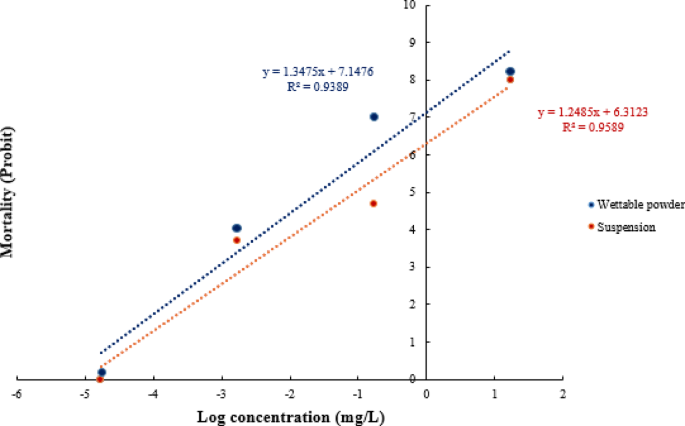
Dose-response tests showed the lethal concentrations (LCs) for wettable powder formulation of Bt in Ae. aegypti from Bandar Abbas, Iran. The LC50 and LC90 were 0.007 and 0.052 mg/l, respectively. Probit analysis of Bt revealed that the LC99 value was 0.256 mg/l. (Table 3; Fig. 1).
Dose-response tests showed the lethal concentrations (LCs) for suspension formulation of Bt in Ae. aegypti from Bandar Abbas, Iran. The LC50 and LC90 values were 0.160 and 5.623 mg/l, respectively. Probit analysis of Bt revealed that the LC99 value was 102.651 mg/l (95% CI: 14.185–4919.364 mg/L(. It is important to note that this estimate is based on extrapolation beyond the observed data and should be interpreted with caution. The LC99 estimate is provisional and reflects model assumptions over a broad extrapolated range rather than direct empirical observation. Therefore, it should not be used for comparative toxicity assessments or regulatory purposes due to its lack of reliability (Table 4; Fig. 1).

The mortality (probit) of Aedes aegypti late 3rd/early 4th instar larvae after 24 h of exposure to Bioflash® wettable powder and suspension formulations (concentrations 17, 0.17, 0.0017 and 0.000017 mg/L) with four replicates for each concentration, in Bandar Abbas, Iran, 2024.
Using dose-response regression lines, the diagnostic or discriminating concentration is determined, which is double of the estimated LC99.9 value52.
Phase II: Semi-field studies
After 24 h, larval mortality rates were 100% for dosages of 0.5 mg/L, 2.5 mg/L, and 12.5 mg/L. For the dosage of 0.1 mg/L, 100% mortality was achieved after 48 h. To evaluate the residual activity of the Bioflash® wettable powder formulation on Ae. aegypti larvae over a 20-day period following treatment, a probit model was applied for each dosage with reference to the post-treatment days. We identified the post-treatment days (and their 95% confidence intervals) when 80% and 90% mortality was observed for each dosage. During the semi-field phase, the wettable powder formulation demonstrated residual activity lasting 2 to 14 days. The residual activity of the 2.5 mg/L and 12.5 mg/L dosages was greater than that of the other Bt dosages tested (as depicted in Table 5; Fig. 2).
During the experiment, the average temperature in Bandar Abbas was 32.38 °C, with a relative humidity of 49.45%. The average temperature of the water in the container was 27.3 °C, and the pH level ranged from 7.6 to 7.8.

Expected larval mortality based on a probit model using four dosages of Bioflash® wettable powder formulation on stage III larvae of Aedes aegypti in 4 L water containers under semi-field conditions to evaluate the residual activity of the Bioflash® over 20 days following treatment, Bandar Abbas, Iran, 2024.
Discussion
Resistance to chemical insecticides is a significant challenge for vector control programs and the management of vector-borne diseases. This issue is increasingly widespread globally, limiting the effectiveness of control methods aimed at vector mosquitoes. The WHO has indicated that insecticide resistance is a major threat to the control and prevention of vector-borne diseases. Additionally, synthetic and chemical insecticides also affect non-target organisms and cause environmental contamination. As a result, there has been a growing interest in non-chemical and environmentally friendly methods for vector control in recent years54. Larvicides play an important role to manage and control larval stages of Ae. aegypti. It is crucial to implement vector control and surveillance strategies effectively and efficiently, while also addressing insecticide resistance and minimizing the negative effects of pesticides on both human health and the environment55. In areas where larvae of Ae. aegypti and Ae. albopictus have developed resistance to temephos56, biological agents such as Bt are being considered as alternatives. These agents selectively target mosquito larvae while sparing non-target organisms.
Recently, Asgarian et al.. (2025) reported resistance to temephos in Ae. aegypti in Bandar Abbas City, Hormozgan Province, in Iran16. If effective control measures are not implemented against Ae. aegypti, there is a risk of its spread to other regions of the country10.
Bacillus thuringiensis serotype M-H-14 is produced commercially in Iran under the trade name Bioflash®. This study compared the efficacy of Bioflash® granules, wettable powder, and suspension formulations on Ae. aegypti larvae in vitro. Additionally, the residual activity of the wettable powder formulation at four different dosages was evaluated under semi-field conditions in Bandar Abbas City, Hormozgan Province, Iran.
A variety of Bt-based products are in several formulations, including granules, powder, pellets, briquettes, and liquid. Not all Bt formulations have the same effect on target species and the environment. In some cases, the formulation type significantly influences effectiveness; in fact, it can affect both the persistence of Bt and its area of impact. In addition to the type of formulation, different concentrations of Bt can also have differing effects on the larvae of mosquitoes25,39,49. Highly concentrated liquid formulations are effective for controlling floodwater mosquitoes, while float formulations have been designed for use in fast-flowing or turbulent waters. For mosquitoes that feed near the bottom, formulations that settle and remain there are necessary. Granules that float on the surface of water are particularly effective against Anopheles spp25.
The ineffectiveness of the Bt granule formulation in controlling Ae. aegypti larvae in this study, is linked to the larvae’s feeding behavior. Our observations in the insectary showed that Ae. aegypti larvae primarily feed on the bottom of the containers. Souza et al. (2016) also noted that Ae. aegypti larvae mainly consume organic matter that is either diluted in water or settled at the bottom of their breeding containers57. Therefore, it is crucial for Bt particles to remain accessible for consumption by the larvae for an extended period.
Bioflash® granules float on the water’s surface, preventing them from being consumed by Ae. aegypti larvae. Previous studies in Iran have also shown that the Bioflash® granular formulation has low efficacy against Anopheles stephensi larvae, particularly when used at the manufacturer’s recommended dosage and under semi-field conditions36,58. Among mosquitoes, Bt has shown varying levels of toxicity to host species. In general, Culex and Aedes are highly susceptible to Bt, while Anopheles mosquitoes show less susceptibility. Moreover, even within the same genus, some species are more sensitive to Bt than others. Culex mosquitoes typically feed throughout all levels of the water column, while Aedes mosquitoes are primarily substrate feeders. This feeding behavior allows both to ingest settled Bt particles to varying extents. In contrast, Anopheles mosquitoes feed primarily at the water surface, where Bt remains for only a short time. As a result, Anopheles species are less susceptible to Bt than Culex or Aedes25,59. For almost all species, increasing larval age leads to a decrease in mosquito susceptibility to Bt. Since late fourth-instar larvae do not feed, it is necessary to apply Bt when the majority of larvae are in the third instar59.
The success of Bt in vector control depends on its persistence in the environment. Several factors influence the persistence of Bt, including the type of formulation used, the target host, and environmental conditions such as ultraviolet (UV) exposure, water quality, pH levels, temperature, and salinity. Additionally, the presence of pollutants, as well as organic and inorganic particles in the water, can significantly impact the effectiveness of Bt. There is a direct relationship between water pollutant containing organic materials and the dose of Bt required to kill mosquitoes. Excess organic material can lead to less ingestion of Bt by mosquitoes, which ultimately reduces its effectiveness25. Water temperature significantly affects the effectiveness of Bt. Low temperatures reduce the feeding rates of target larvae, which likely leads to decreased virulence of Bt60. Becker et al. (1992) reported that the mortality rate of larvae of Cx. pipiens and Ae. aegypti were lower at temperatures below 19o C and higher at temperatures above 33o C61. In field trials against Cx. tarsalis, all Bt formulations were less effective in water with a pH above 859. Sunlight reduces the persistence of Bt and causes its inactivation62.
In Colombia, under semi-field conditions, the highest dose of Bt-CECIF tablets tested against Ae. aegypti larvae demonstrated the greatest residual activity, lasting for 15 days, until larval mortality reached 80%63. The findings of the Columbia study align with those of the current study. Our studies demonstrated that the Bt wettable powder formulation was effective in controlling the immature stages of dengue-vector mosquitoes under semi-field conditions. The lethal effects of four different dosages were rapid, killing larvae within 24 to 48 h. The residual effect of these dosages lasted between 2 and 14 days, reaching 80% larval mortality.
In one study, the application of a 4.8% technical powder Bt tablet led to more than an 80% reduction in the pupal production of Ae. aegypti in 70-liter containers exposed to sunlight64. Both wettable powder and tablet Bt formulations were effective in controlling Ae. aegypti in tires, achieving an 80% reduction in larval populations for up to six months. In contrast, the granule formulation was effective for controlling larvae for up to 33 days65. In our study, the Bt wettable powder formulation demonstrated greater efficacy in controlling larvae compared to the suspension and granule formulations. Similarly, in Saudi Arabia, the Bt powder formulation proved to be more effective than the suspension in targeting larvae of Ae. aegypti. In the larval bioassay, the LC50 of the suspension was more than 20% higher than that of the powder formulation66. Field trials demonstrated that the use of 2 mg/L VectoBac water-dispersible granule formulation (WG) (6,000 ITU/L) controlled Ae. aegypti by over 90% for a duration of 35 to 40 days in various container types67. The susceptibility levels of several insectary-reared and field-collected strains of Ae. aegypti and Ae. albopictus from dengue-endemic areas to Bt at various storage ages were analyzed. The results indicated that susceptibility to Bt decreased as the duration of storage and rearing in the insectary increased. Specifically, the LC50 for Bt increased by 2–3 times after 2 years of storage compared to fresh samples that had been stored for 3–6 months. Despite this increase in LC50, Bt still demonstrated excellent efficacy against all susceptible insectary strains even after 2 years. Additionally, tests on wild-collected strains of Ae. aegypti and Ae. albopictus from a dengue-endemic area confirmed that Bt remained effective after 18–24 months of storage19.
Ritchie et al. (2010) reported that most endospores and crystals of the Bt WG formulation adhered to the sides and bottom of the containers, where they were ingested by the larvae of Ae. aegypti. They also demonstrated that VectoBac WG can serve as a reliable pretreatment for dry containers, providing larval control for up to eight weeks when the container is filled with water33. Between 2005 and 2011 in Cambodia, WG formulation of Bt applied at a single dosage of 8 g per 1000 L effectively suppressed Ae. aegypti mosquitoes for an uninterrupted period of 13 weeks, significantly disrupting dengue transmission68. In our study, the suspension formulation achieved 100% mortality on Ae. aegypti larvae at the highest concentration under laboratory conditions. In Brazil, Bt was evaluated in both laboratory and semi-field conditions against Ae. aegypti larvae. Consistent with our findings, concentrated suspensions of AEDESControl® and Biovech® caused 100% larval mortality in all replicates in the laboratory. Under semi-field conditions in shaded ovitraps, both Bt products showed complete larval mortality up to 12 weeks. In ovitraps exposed to sunlight for 2 to 4 h per day, Bt persisted for 10 weeks. However, DengueTech® (Mini tabletes) did not exhibit the same effectiveness69. Our study’s results indicate that as the dosage of Bt increases, its residual activity also increases. Ritchie et al. (2010) reported that the application of mega doses of the water-dispersible granule formulation of Bt effectively controlled larvae for several months, even during heavy rainfall. They noted that mega doses are particularly suitable for situations where discarded items such as empty containers, buckets, tires, and ornamental plant bowls and pots serve as significant sources of Ae. aegypti production33.
Although homes being the primary breeding sites for Ae. aegypti in endemic areas, the use of safe larvicides to prevent larval reproduction in these environments is limited. Effective management of potential Ae. aegypti breeding sites includes their removal, protection, or treatment by households. A study found that Ae. aegypti larvae exposed continuously to Bt remained susceptible, reinforcing the advantages of using this larvicide in native areas that require treatment over many years69.
Our study showed that the Bioflash® wettable powder formulation showed better efficacy in controlling Ae. aegypti larvae compared to the granule and suspension formulations. The wettable powder had lower lethal concentration values (LC50 and LC90) against Ae. aegypti larvae, indicating its higher potency. This means it can effectively kill larvae at lower doses66. In semi-field evaluation, the wettable powder maintained its residual efficacy for two weeks, making it practical for vector control programs targeting Ae. aegypti.
In addition to achieving higher larval mortality, the wettable powder formulation significantly impacted pupation and adult emergence. Reduced pupation rates and increased deformity in pupae and adults have been observed more with wettable powders compared to other formulations, highlighting their superior biological effect against mosquito development66.
The minimum tested dosage of the wettable powder formulation that showed maximum immediate and residual effect on larvae under semi-field conditions of this study should be selected as the optimal dosage for field application. This dosage needs to be confirmed through larger-scale field trials targeting natural populations of Ae. aegypti in their natural breeding habitats52. According to our study, applying 2.5 mg/L of the Bioflash® wettable powder formulation effectively controls Ae. aegypti larvae and maintains residual activity for 10 days. Therefore, it is recommended as an efficient and cost-effective method for controlling these larvae in water containers, both indoors and outdoors, following further examination in larger-scale field settings.
Conclusion
Suppressing Ae. aegypti is a practical strategy for controlling dengue fever. While many methods for managing Ae. aegypti have focused on source reduction; this approach has proven ineffective due to inadequate monitoring, which fails to sufficiently reduce vector populations and the associated disease burden. Therefore, there is an urgent need for new control measures that specifically target both indoor and outdoor mosquito breeding habitats. Given the observed insecticide resistance in Ae. aegypti in Iran, it is particularly important to explore alternatives to chemical insecticides, such as Bacillus thuringiensis (Bt), for managing the immature stages of the mosquito. In our study, Bt wettable powder formulation showed higher efficacy in controlling Ae. aegypti larvae due to higher larvicidal activity at lower doses, better water dispersal, and persistence compared to granule and suspension formulations. These characteristics make wettable powder a preferred choice for integrated mosquito management programs targeting dengue vectors.
Data availability
All data generated or analysed during this study are included in this published article.
References
-
WHO. UNICEF. Global vector control response 2017–2030. Published online 2017.
-
Mboera, L. E. et al. The risk of dengue virus transmission in Dar Es Salaam, Tanzania during an epidemic period of 2014. PLoS Negl. Trop. Dis. 10 (1), e0004313 (2016).
-
Kraemer, M. U. et al. The global distribution of the arbovirus vectors Aedes aegypti and Ae. albopictus. Elife 4, e08347 (2015).
-
WHO. Global strategy for dengue prevention and control 2012–2020. https://reliefweb.int/report/world/global-strategy-dengue-prevention-and-control-2012-2020?gad_source=1&gclid=CjwKCAjw1emzBhB8EiwAHwZZxVwd5lvsFgd2kIE4NYO5T3Jh0uwlYj6ifhCy4fFKQQ6Tmjq1Y6kYqRoC4PcQAvD_BwE (2012).
-
WHO. Regional plan of action 2019–2023 for implementation of the global vector control response 2017–2030. World Health Organization. Regional Office for the Eastern Mediterranean. Available from https://iris.who.int/handle/10665/325805 (2019).
-
Doosti, S. et al. Mosquito surveillance and the first record of the invasive mosquito species Aedes (Stegomyia) albopictus (Skuse) (Diptera: Culicidae) in Southern Iran. Iran. J. Public. Health. 45 (8), 1064 (2016).
-
Azari-Hamidian, S. et al. First record of a medically important vector, the Asian tiger mosquito Aedes albopictus (Skuse, 1895) (Diptera: Culicidae), using morphological and molecular data in Northern Iran. J. Insect Biodivers. Syst. 10 (4), 953–963 (2024).
-
Iran Center for Disease Control and Prevention (ICDC). Report of CDC on dengue fever. http://icdc.behdasht.gov.ir/XsR (2025).
-
Dorzaban, H. et al. Mosquito surveillance and the first record of morphological and molecular-based identification of invasive species Aedes (Stegomyia) aegypti (Diptera: Culicidae), Southern Iran. Exp. Parasitol. 236, 108235 (2022).
-
Sedaghat, M. M. Discover the status of invasive Aedes species and the challenges in dengue surveillance and control in Iran. New Microb. New. Infect 101559, 1–2 (2024).
-
Ranson, H., Burhani, J., Lumjuan, N. & Black, I. V. W. C. Insecticide resistance in dengue vectors. TropIKA Net [online] 1 (1), 1–12 (2010).
-
Moore, P. D., Yedjou, C. G. & Tchounwou, P. B. Malathion-induced oxidative stress, cytotoxicity, and genotoxicity in human liver carcinoma (HepG2) cells. Environ. Toxicol. 25 (3), 221–226 (2010).
-
Aktar, W., Sengupta, D. & Chowdhury, A. Impact of pesticides use in agriculture: their benefits and hazards. Interdiscip Toxicol. 2 (1), 1–12 (2009).
-
McGregor, B. L. & Connelly, C. R. A review of the control of Aedes aegypti (Diptera: Culicidae) in the continental united States. J. Med. Entomol. 58 (1), 10–25 (2021).
-
Enayati, A. et al. Kdr genotyping and the first report of V410L and V1016I Kdr mutations in voltage-gated sodium channel gene in Aedes aegypti (Diptera: Culicidae) from Iran. Parasite Vector. 17 (1), 34 (2024).
-
Asgarian, T. et al. Organophosphate and pyrethroid resistance status of invasive Aedes aegypti (Diptera: Culicidae) from Iran. J. Arthropod Borne Dis. 18 (4), 296–310 (2024).
-
Lacey, L. A. Bacillus thuringiensis serovariety israelensis and Bacillus sphaericus for mosquito control. J. Am. Mosq. Control Assoc. 133–163 (2007).
-
WHO. Bacillus thuringiensis israelensis (Bti) in drinking-water, Background document for development of WHO Guidelines for Drinking-water Quality. (Geneva, Switzerland, 2009).
-
Lee, Y. & Zairi, J. Susceptibility of laboratory and field-collected Aedes aegypti and Aedes albopictus to Bacillus Thuringiensis israelensis H-14. J. Am. Mosq. Control Assoc. 22 (1), 97–101 (2006).
-
Aldemir, A. Initial and residual activity of Vectobac® 12 AS, Vectobac® WDG, and Vectolex® WDG for control of mosquitoes in Ararat Valley, Turkey. J. Am. Mosq. Control Assoc. 25 (1), 113–116 (2009).
-
World Health Organization, International Programme on Chemical Safety. Microbial Pest Control Agent: Bacillus thuringiensis. https://iris.who.int/handle/10665/42242 (1999).
-
Lagadic, L., Roucaute, M. & Caquet, T. Bti sprays do not adversely affect non-target aquatic invertebrates in French Atlantic coastal wetlands. J. Appl. Ecol. 51 (1), 102–113 (2014).
-
Caquet, T., Roucaute, M., Le Goff, P. & Lagadic, L. Effects of repeated field applications of two formulations of Bacillus Thuringiensis var. Israelensis on non-target salt marsh invertebrates in Atlantic coastal wetlands. Ecotoxicol. Environ. Saf. 74 (5), 1122–1130 (2011).
-
Boisvert, M. (ed) Utilization of Bacillus thuringiensis var. israelensis (Bti)-based Formulations for the Biological Control of Mosquitoes in Canada. Proceedings of the 6th Pacific Rim. Conference on the biotechnology of Bacillus thuringiensis and its environmental impact, Victoria, BC, Canada, 30 October-3 November, 2005. National Sciences and Engineering Research Council of Canada (NSERC) (2007).
-
Glare, T. R. & O’Callaghan, M. Environmental and Health Impacts of Bacillus Thuringiensis Israelensis 57 (Report for the Ministry of Health, 1998).
-
Carvalho, K. et al. d. S. Long-term exposure of Aedes aegypti to Bacillus thuringiensis svar. israelensis did not involve altered susceptibility to this microbial larvicide or to other control agents. Parasite Vector. 11 (673) (2018).
-
Soberón, M., Fernández, L. E., Pérez, C., Gill, S. S. & Bravo, A. Mode of action of mosquitocidal Bacillus Thuringiensis toxins. Toxicon 49 (5), 597–600 (2007).
-
Pardo-López, L., Soberón, M. & Bravo, A. Bacillus Thuringiensis insecticidal three-domain cry toxins: mode of action, insect resistance and consequences for crop protection. FEMS Microbiol. Rev. 37 (1), 3−22 (2013).
-
Regis, L. N. et al. Sustained reduction of the dengue vector population resulting from an integrated control strategy applied in two Brazilian cities. PLoS One. 8 (7), e67682 (2013).
-
Flacio, E., Engeler, L., Tonolla, M., Lüthy, P. & Patocchi, N. Strategies of a thirteen year surveillance programme on Aedes albopictus (Stegomyia albopicta) in Southern Switzerland. Parasit. Vector. 8 (208), 1–18 (2015).
-
Williams, G. M. et al. Area-wide ground applications of Bacillus Thuringiensis var. Israelensis for the control of Aedes albopictus in residential neighborhoods: from optimization to operation. PLoS One. 9 (10), e110035 (2014).
-
Setha, T., Chantha, N., Benjamin, S. & Socheat, D. Bacterial larvicide, Bacillus Thuringiensis israelensis strain AM 65 – 52 water dispersible granule formulation impacts both dengue vector, Aedes aegypti (L.) population density and disease transmission in Cambodia. PLoS Negl. Trop. Dis. 10 (9), e0004973 (2016).
-
Ritchie, S. A., Rapley, L. P. & Benjamin, S. Bacillus Thuringiensis var. Israelensis (Bti) provides residual control of Aedes aegypti in small containers. Am. J. Trop. Med. Hyg. 82 (6), 1053 (2010).
-
Suwito, S., Purnama, S. & Kardiwinata, P. Efficacy Bacillus Thuringiensis var. Israelensis serotype H-14 (Bti H-14) for control Aedes spp. Density in Denpasar, Bali. Int. J. Community Med. Public. Health. 8 (9), 4197–4203 (2021).
-
Pruszynski, C. A., Hribar, L. J., Mickle, R. & Leal, A. L. A large scale biorational approach using Bacillus Thuringiensis israeliensis (strain AM65-52) for managing Aedes aegypti populations to prevent dengue, Chikungunya and Zika transmission. PloS One. 12 (2), e0170079 (2017).
-
Hosseinpour, A., Turki, H. & Soltani, A. Laboratory and semi-field evaluation of Bacillus Thuringiensis (Bioflash®) against Anopheles stephensi (Diptera: Culicidae) in an endemic malarious area of Iran. J. Kerman Univ. Med. Sci. (JKMU). 26 (2), 145–151 (2019).
-
Guidi, V., Patocchi, N., Lüthy, P. & Tonolla, M. Distribution of Bacillus Thuringiensis subsp. Israelensis in soil of a Swiss wetland reserve after 22 years of mosquito control. Appl. Environ. Microbiol. 77 (11), 3663–3668 (2011).
-
Becker, N., Ludwig, M. & Su, T. Lack of resistance in Aedes vexans field populations after 36 years of Bacillus Thuringiensis subsp. Israelensis applications in the upper rhine Valley, Germany. J. Am. Mosq. Control Assoc. 34 (2), 154–157 (2018).
-
Araújo, A. P. et al. The susceptibility of Aedes aegypti populations displaying temephos resistance to Bacillus Thuringiensis israelensis: a basis for management. Parasit. Vector. 6 (297), 1–9 (2013).
-
Suter, T. et al. Insecticide susceptibility of Aedes albopictus and Ae. aegypti from Brazil and the Swiss-Italian border region. Parasit. Vector. 10 (431), 1–11 (2017).
-
Marcombe, S. et al. Field efficacy of new larvicide products for control of multi-resistant Aedes aegypti populations in Martinique (French West Indies). Am. J. Trop. Med. Hyg. 84 (1), 118 (2011).
-
Schneider, S. et al. Do multi-year applications of Bacillus Thuringiensis subsp. Israelensis for control of mosquito larvae affect the abundance of B. cereus group populations in riparian wetland soils? Microb. Ecol. 74, 901–909 (2017).
-
Lacey, L. A. & Siegel, J. P. Safety and ecotoxicology of entomopathogenic bacteria. In Entomopathogenic Bacteria: from Laboratory To Field Application (eds Charles, J. F. et al.) (Springer, 2000). https://doi.org/10.1007/978-94-017-1429-7_14.
-
Derua, Y. A., Kweka, E. J., Kisinza, W. N., Githeko, A. K. & Mosha, F. W. Bacterial larvicides used for malaria vector control in sub-Saharan africa: review of their effectiveness and operational feasibility. Parasit. Vector. 12 (426), 1–18 (2019).
-
Tetreau, G., Stalinski, R., David, J. P. & Després, L. Monitoring resistance to Bacillus Thuringiensis subsp. Israelensis in the field by performing bioassays with each cry toxin separately. Mem. Inst. Oswaldo Cruz. 108, 894–900 (2013).
-
Stalinski, R., Laporte, F., Tetreau, G. & Després, L. Receptors are affected by selection with each Bacillus Thuringiensis israelensis cry toxin but not with the full Bti mixture in Aedes aegypti. Infect. Genet. Evol. 44, 218–227 (2016).
-
Paris, M. et al. Persistence of Bacillus Thuringiensis israelensis (Bti) in the environment induces resistance to multiple Bti toxins in mosquitoes. Pest Manag Sci. 67 (1), 122–128 (2011).
-
Georghiou, G. P. & Wirth, M. C. Influence of exposure to single versus multiple toxins of Bacillus Thuringiensis subsp. Israelensis on development of resistance in the mosquito Culex quinquefasciatus (Diptera: Culicidae). Appl. Environ. Microbiol. 63 (3), 1095–1101 (1997).
-
Marcombe, S., Chonephetsarath, S., Thammavong, P. & Brey, P. T. Alternative insecticides for larval control of the dengue vector Aedes aegypti in Lao PDR: insecticide resistance and semi-field trial study. Parasit. Vector. 11 (616), 1–8 (2018).
-
Azari-Hamidian, S. & Harbach, R. E. Keys to the adult females and fourth-instar larvae of the mosquitoes of Iran (Diptera: Culicidae). Zootaxa 2078 (1), 1–33 (2009).
-
Lau, S. M. et al. A new paradigm for Aedes spp. Surveillance using gravid ovipositing sticky trap and NS1 antigen test kit. Parasit. Vector. 10 (151), 1–9 (2017).
-
WHO. Guidelines for laboratory and field testing of mosquito larvicides. (2005).
-
Abbott, W. S. A method of computing the effectiveness of an insecticide. J. Econ. Entomol. 18 (2), 265–267 (1925).
-
WHO. Management of insecticide resistance in vectors of public health importance. Report of the ninth meeting of the Global Collaboration for Development of Pesticides for Public Health. (2014).
-
WHO. Global insecticide use for vector-borne disease control: a 10-year assessment (2010–2019). sixth edition ed. Geneva: World Health Organization. Licence: CC BY-NC-SA 3.0 IGO2021. (2021).
-
Asgarian, T. S., Vatandoost, H., Hanafi-Bojd, A. A. & Nikpoor, F. Worldwide status of insecticide resistance of Aedes aegypti and Ae. albopictus, vectors of arboviruses of Chikungunya, Dengue, Zika and yellow fever. J. Arthropod Borne Dis. 17 (1), 1–27 (2023).
-
Souza, R. S., Diaz-Albiter, H. M., Dillon, V. M., Dillon, R. J. & Genta, F. A. Digestion of yeasts and beta-1, 3-glucanases in mosquito larvae: physiological and biochemical considerations. PLoS One. 11 (3), e0151403 (2016).
-
Gezelbash, Z. et al. Laboratory and field evaluation of two formulations of Bacillus Thuringiensis MH-14 against mosquito larvae in the Islamic Republic of Iran, 2012. EMHJ-Eastern Mediterranean Health J. 20 (4), 229–235 (2014). 2014.
-
Mulla, M., Federici, B. & Darwazeh, H. Effectiveness of the bacterial pathogen Bacillus thuringiensis serotype H-14 against mosquito larvae. Proceedings and papers of the Forty-eighth Annual Conference of the California Mosquito and Vector Control Association, Inc. January 20–23, (Quality Inn, Anaheim, California, 1981).
-
Walker, E. D. Effect of low temperature on feeding rate of Aedes stimulans larvae and efficacy of Bacillus Thuringiensis var. Israelensis (H-14). J. Am. Mosq. Control Assoc. 11 (1), 107–110 (1995).
-
Becker, N., Zgomba, M., Ludwig, M., Petric, D. & Rettich, F. Factors influencing the activity of Bacillus Thuringiensis var. Israelensis treatments. J. Am. Mosq. Control Assoc. 8 (3), 285–289 (1992).
-
Becker, N. & Margalit, J. Use of Bacillus Thuringiensis israelensis against mosquitoes and blackflies. In Bacillus thuringiensis, an Environmental Biopesticide: Theory and Practice (eds Entwistle, P. F. et al.) 147–170 (Ludwigshafen, 1993).
-
Gómez-Vargas, W., Valencia-Jiménez, K., Correa-Londoño, G. & Jaramillo-Yepes, F. Novel larvicide tablets of Bacillus Thuringiensis var. israelensis: assessment of larvicidal effect on Aedes aegypti (Diptera: Culicidae) in Colombia. Biomed 38, 95–105 (2018).
-
Armengol, G., Hernandez, J., Velez, J. G. & Orduz, S. Long-lasting effects of a Bacillus Thuringiensis serovar israelensis experimental tablet formulation for Aedes aegypti (Diptera: Culicidae) control. J. Econ. Entomol. 99 (5), 1590–1595 (2006).
-
de Melo-Santos, M. A. V., de Araújo, A. P., Rios, E. M. M. & Regis, L. Long lasting persistence of Bacillus Thuringiensis serovar. Israelensis larvicidal activity in Aedes aegypti (Diptera: Culicidae) breeding places is associated with bacteria recycling. BioControl 49 (2), 186–191 (2009).
-
Mohammad, A. Biological control of Aedes aegypti mosquitoes using Bacillus Thuringiensis. Egypt. Acad. J. Biol. Sci. F Toxicol. Pest Control. 14 (2), 133–138 (2022).
-
Lee, Y. & Zairi, J. Field evaluation of Bacillus Thuringiensis H-14 against Aedes mosquitoes. Trop. Biomed. 23 (1), 37–44 (2006).
-
Setha, T., Chantha, N., Benjamin, S., Socheat, D. B. & Larvicide Bacillus Thuringiensis israelensis strain AM 65 – 52 water dispersible granule formulation impacts both dengue vector, Aedes aegypti (L.) population density and disease transmission in Cambodia. PLoS Negl. Trop. Dis. 10 (9), e0004973 (2016).
-
Nakazawa, M. M., Araújo, A. P., Melo-Santos, M. A. V., Oliveira, C. M. F. & Silva-Filha, M. H. N. L. Efficacy and persistence of Bacillus Thuringiensis svar. Israelensis (Bti) and pyriproxyfen-based products in artificial breeding sites colonized with susceptible or Bti-exposed Aedes aegypti larvae. BioControl 151, 104400 (2020).
Acknowledgements
This study was funded and supported by Tehran University of Medical Sciences (TUMS); Grant No. 1403-4-125-73132.We would like to express our gratitude to the staff of the Bandar Abbas Health Education and Research Station. We also extend our thanks to Dr. Mohammad Hassan Pouriayevali, head of the Department of the National Research and Reference Laboratory for Arboviruses and Viral Hemorrhagic Fevers at the Pasteur Institute of Iran, as well as to Nature Biotechnology Company (Bioran).
Funding
The project leading to this publication is from Tehran University of Medical Sciences (TUMS); Grant No. 1403-4-125-73132.
Ethics declarations
Competing interests
The authors declare no competing interests.
Ethical considerations
The authors declare the ethical approval code as No.: IR.TUMS.SPH.REC.1404.014.
Additional information
Publisher’s note
Springer Nature remains neutral with regard to jurisdictional claims in published maps and institutional affiliations.
Rights and permissions
Open Access This article is licensed under a Creative Commons Attribution-NonCommercial-NoDerivatives 4.0 International License, which permits any non-commercial use, sharing, distribution and reproduction in any medium or format, as long as you give appropriate credit to the original author(s) and the source, provide a link to the Creative Commons licence, and indicate if you modified the licensed material. You do not have permission under this licence to share adapted material derived from this article or parts of it. The images or other third party material in this article are included in the article’s Creative Commons licence, unless indicated otherwise in a credit line to the material. If material is not included in the article’s Creative Commons licence and your intended use is not permitted by statutory regulation or exceeds the permitted use, you will need to obtain permission directly from the copyright holder. To view a copy of this licence, visit http://creativecommons.org/licenses/by-nc-nd/4.0/.
About this article

Cite this article
Asgarian, T.S., Moosa-Kazemi, S.H. & Sedaghat, M.M. Evaluating the larvicidal effect of Bacillus Thuringiensis M-H-14 on Aedes aegypti larvae under laboratory and semi-field conditions in Southern Iran. Sci Rep 15, 43052 (2025). https://doi.org/10.1038/s41598-025-26966-2
-
Received:
-
Accepted:
-
Published:
-
Version of record:
-
DOI: https://doi.org/10.1038/s41598-025-26966-2