
Data availability
All data supporting the findings of this study are presented in the Article and its Supplementary Information. Bulk RNA-seq data are available via Gene Expression Omnibus under accession no. GSE305452. Source data are provided with this paper.
References
-
Wolf, J. et al. Effectiveness of interventions to improve drinking water, sanitation, and handwashing with soap on risk of diarrhoeal disease in children in low-income and middle-income settings: a systematic review and meta-analysis. Lancet 400, 48–59 (2022).
-
Mauter, M. S. et al. The role of nanotechnology in tackling global water challenges. Nat. Sustain. 1, 166–175 (2018).
-
Chu, C., Ryberg, E. C., Loeb, S. K., Suh, M. J. & Kim, J. H. Water disinfection in rural areas demands unconventional solar technologies. Acc. Chem. Res. 52, 1187–1195 (2019).
-
Tu, S. et al. Piezocatalysis and piezo-photocatalysis: catalysts classification and modification strategy, reaction mechanism, and practical application. Adv. Funct. Mater. 30, 2005158 (2020).
-
Huo, Z. Y., Lee, D. M., Wang, S., Kim, Y. J. & Kim, S. W. Emerging energy harvesting materials and devices for self-powered water disinfection. Small Methods 5, 2100093 (2021).
-
Wang, Y. et al. Ultrasonic activation of inert poly(tetrafluoroethylene) enables piezocatalytic generation of reactive oxygen species. Nat. Commun. 12, 3508 (2021).
-
Jin, Z. et al. Tribocatalytic sterilization of BN2/CN Z-type heterojunctions. Nano Energy 122, 109284 (2024).
-
Zhao, Y., Low, Z.-X., Pan, Y., Zhong, Z. & Gao, G. Universal water disinfection by piezoelectret aluminium oxide-based electroporation and generation of reactive oxygen species. Nano Energy 92, 106749 (2022).
-
Masimukku, S. et al. High efficient degradation of dye molecules by PDMS embedded abundant single-layer tungsten disulfide and their antibacterial performance. Nano Energy 46, 338–346 (2018).
-
WHO Guidelines for Drinking-Water Quality (World Health Organization, 2017).
-
Wang, Z., Dong, X., Tang, W. & Wang, Z. L. Contact-electro-catalysis (CEC). Chem. Soc. Rev. 53, 4349–4373 (2024).
-
Chen, B. et al. Water–solid contact electrification causes hydrogen peroxide production from hydroxyl radical recombination in sprayed microdroplets. Proc. Natl Acad. Sci. USA 119, e2209056119 (2022).
-
Lin, S., Xu, L., Wang, A. C. & Wang, Z. L. Quantifying electron-transfer in liquid–solid contact electrification and the formation of electric double-layer. Nat. Commun. 11, 399 (2020).
-
Wang, Z. et al. A contact-electro-catalysis process for producing reactive oxygen species by ball milling of triboelectric materials. Nat. Commun. 15, 757 (2024).
-
Chen, Z. et al. Recent progress of solid–liquid interface-mediated contact-electro-catalysis. Langmuir 40, 5557–5570 (2024).
-
Loh, Z. H. et al. Observation of the fastest chemical processes in the radiolysis of water. Science 367, 179–182 (2020).
-
Heindel, J. P., LaCour, R. A. & Head-Gordon, T. The role of charge in microdroplet redox chemistry. Nat. Commun. 15, 3670 (2024).
-
Ben-Amotz, D. Electric buzz in a glass of pure water. Science 376, 800–801 (2022).
-
Lin, S., Chen, X. & Wang, Z. L. Contact electrification at the liquid–solid interface. Chem. Rev. 122, 5209–5232 (2022).
-
Wang, B. et al. ROS-induced lipid peroxidation modulates cell death outcome: mechanisms behind apoptosis, autophagy, and ferroptosis. Arch. Toxicol. 97, 1439–1451 (2023).
-
Endale, H. T., Tesfaye, W. & Mengstie, T. A. ROS induced lipid peroxidation and their role in ferroptosis. Front. Cell Dev. Biol. 11, 1226044 (2023).
-
Ezraty, B., Gennaris, A., Barras, F. & Collet, J. F. Oxidative stress, protein damage and repair in bacteria. Nat. Rev. Microbiol. 15, 385–396 (2017).
-
Imlay, J. A. The molecular mechanisms and physiological consequences of oxidative stress: lessons from a model bacterium. Nat. Rev. Microbiol. 11, 443–454 (2013).
-
Liu, Q. et al. Piezo-photoelectronic coupling effect of BaTiO3@TiO2 nanowires for highly concentrated dye degradation. Nano Energy 92, 106702 (2022).
-
Liu, X. et al. Low frequency hydromechanics-driven generation of superoxide radicals via optimized piezotronic effect for water disinfection. Nano Energy 88, 106290 (2021).
-
Xu, S., Guo, L., Sun, Q. & Wang, Z. L. Piezotronic effect enhanced plasmonic photocatalysis by AuNPs/BaTiO3 heterostructures. Adv. Funct. Mater. 29, 1808737 (2019).
-
Zhang, X. et al. Building P-doped MoS2/g-C3N4 layered heterojunction with a dual-internal electric field for efficient photocatalytic sterilization. Chem. Eng. J. 429, 132588 (2022).
-
Liu, C. et al. Rapid water disinfection using vertically aligned MoS2 nanofilms and visible light. Nat. Nanotechnol. 11, 1098–1104 (2016).
-
Teng, Z. et al. Edge-functionalized g-C3N4 nanosheets as a highly efficient metal-free photocatalyst for safe drinking water. Chem 5, 664–680 (2019).
-
Wu, T. et al. Solar-driven efficient heterogeneous subminute water disinfection nanosystem assembled with fingerprint MoS2. Nat. Water 1, 462–470 (2023).
Acknowledgements
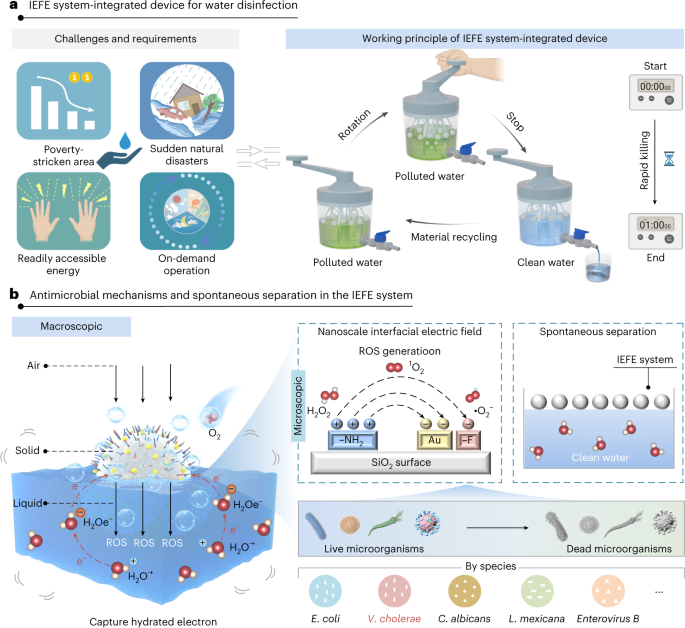
This work was supported by the Distinguished Young Scholars of China (grant no. 22325201 to X.D.), the National Natural Science Foundation of China (grant nos. 22302033 to Z.C., 22178233 to J.G., 82172299 to Y.L. and 52202214, 52573243 to T.W.), the National Excellent Young Scientists Fund (grant no. 00308054A1045 to J.G.) and the National Key R&D Program of China (grant no. 2022YFA0912800 to J.G.). Additional support was provided by the Talents Program of Sichuan Province, the Double First-Class University Plan of Sichuan University (to J.G.), the State Key Laboratory of Polymer Materials Engineering (grant no. SKLPME 2020-03-01 to J.G.), the Tianfu Emei Program of Sichuan Province (grant no. 2022-EC02-00073-CG to J.G.), the Fundamental Research Funds for the Central Universities (grant no. SCU2025D014 to J.G.), the Ministry of Education Key Laboratory of Leather Chemistry and Engineering, and the National Engineering Research Center of Clean Technology in Leather Industry (to J.G.), the Hubei Natural Science Fund for Distinguished Young Scholars (grant no. 2022CFA068 to Y.L.) and the Hubei Public Health Youth Talents Program (to Y.L.). We acknowledge the assistance of the staff at the Analytical and Testing Center of the University of Electronic Science and Technology of China, the College of Biomass Science and Engineering of Sichuan University and K. Cai, B. Hu and K. Zhou from Hubei Provincial Center for Disease Control and Prevention for their assistance. The numerical calculations in this Article were performed at the Computing Center in Xi’an. We thank Xiaqi Wang for the illustrations in Fig. 1a.
Ethics declarations
Competing interests
X.D. and Z.C. are inventors on a patent application (China, ZL 2023 1 0743387.9) relating to the IEFE system described in this work. The other authors declare no competing interests.
Peer review
Peer review information
Nature Nanotechnology thanks Kurt Kolasinski and the other, anonymous, reviewer(s) for their contribution to the peer review of this work.
Additional information
Publisher’s note Springer Nature remains neutral with regard to jurisdictional claims in published maps and institutional affiliations.
Extended data
Extended Data Fig. 1 Design and characterization of the IEFE system.
a, Design principle of the IEFE system. b, SEM images and corresponding 3D models showing pristine SiO2 and SiO2@NFAu particles (scale bars, 500 nm). c, TEM-EDS results and HRTEM images of SiO2@NFAu (scale bars, 200 nm; HRTEM scale bars, 10 nm and 2 nm). The yellow arrows in b and c indicate Au NPs. The blue arrows and lines in c indicate the lattice of the Au NPs.
Extended Data Fig. 2 Disinfection performance of the IEFE system at elevated temperature.
a, Comparison of the disinfection performance of the IEFE system at 20 °C and 50 °C, demonstrating that thermal energy independently drives the disinfection process. b, Disinfection performance of the IEFE system at 20 °C, 35 °C, and 50 °C under 2000 rpm agitation, showing the strong promoting effect of elevated temperature on catalytic disinfection. For a and b: n = 3 independent measurements, data presented as the means ± SD.
Extended Data Fig. 3 Long-lasting protection of the IEFE system.
a, Schematic diagram and b, Corresponding disinfection performance of SiO2@NFAu after recontamination of the solution (n = 3 independent measurements, data presented as the means ± SD). Panel a created with BioRender.com.
Supplementary information
Supplementary Information
Supplementary experimental methods, Figs. 1–35, Tables 1–3 and references.
Supplementary Video 1
Visual demonstration of the IEFE system performing simultaneous water disinfection and nanopowder separation. Hydrophobic particles spontaneously detach from the water surface post-treatment, without filtration or magnetic separation.
Supplementary Video 2
Demonstration of the IEFE device disinfecting real-world water within one minute using manual stirring. The system enables rapid bacterial inactivation and self-separation, allowing immediate collection of clean water.
Source data
Rights and permissions
Springer Nature or its licensor (e.g. a society or other partner) holds exclusive rights to this article under a publishing agreement with the author(s) or other rightsholder(s); author self-archiving of the accepted manuscript version of this article is solely governed by the terms of such publishing agreement and applicable law.
About this article

Cite this article
Chen, Z., Zhang, Y., Lv, P. et al. Hand-powered interfacial electric-field-enhanced water disinfection system. Nat. Nanotechnol. (2025). https://doi.org/10.1038/s41565-025-02033-9
-
Received:
-
Accepted:
-
Published:
-
DOI: https://doi.org/10.1038/s41565-025-02033-9