
van Dijk, M. et al. A meta-analysis of projected global food demand and population at risk of hunger for the period 2010–2050. Nat. Food 2, 494–501 (2021).
Hasegawa, T. et al. Extreme climate events increase risk of global food insecurity and adaptation needs. Nat. Food 2, 587–595 (2021).
Zhang, H. et al. A Gγ protein regulates alkaline sensitivity in crops. Science 379, eade8416 (2023).
Singh, B. K. et al. Climate change impacts on plant pathogens, food security and paths forward. Nat. Rev. Microbiol. 21, 640–656 (2023).
Potapov, P. et al. Global maps of cropland extent and change show accelerated cropland expansion in the twenty-first century. Nat. Food 3, 19–28 (2022).
Crow, J. F. 90 years ago: the beginning of hybrid maize. Genetics 148, 923–928 (1998).
Pingali, P. L. Green revolution: impacts, limits, and the path ahead. Proc Natl Acad. Sci. USA 109, 12302–12308 (2012).
Green, J. M. The benefits of herbicide-resistant crops. Pest. Manag. Sci. 68, 1323–1331 (2012).
Lu, Y. et al. Widespread adoption of Bt cotton and insecticide decrease promotes biocontrol services. Nature 487, 362–365 (2012).
Mascher, M. et al. Promises and challenges of crop translational genomics. Nature 636, 585–593 (2024).
Yu, X. et al. Single-cell and spatial multi-omics in the plant sciences: technical advances, applications, and perspectives. Plant Commun. 4, 100508 (2023).
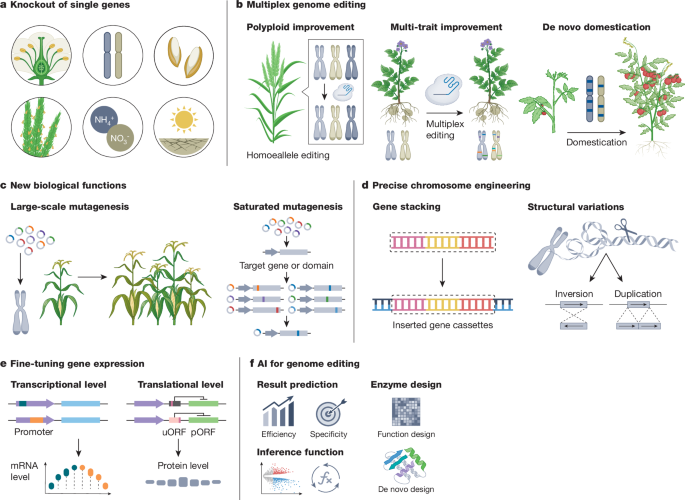
Yu, H. et al. A route to de novo domestication of wild allotetraploid rice. Cell 184, 1156–1170 (2021). This study demonstrates the rapid neo-domestication of wild rice relatives, a new paradigm in enriching crop genetic resources and accelerating crop improvement.
Li, T. et al. Domestication of wild tomato is accelerated by genome editing. Nat. Biotechnol. 36, 1160–1163 (2018).
Abramson, J. et al. Accurate structure prediction of biomolecular interactions with AlphaFold 3. Nature 630, 493–500 (2024).
Kortemme, T. De novo protein design—from new structures to programmable functions. Cell 187, 526–544 (2024).
Silver, D. et al. Mastering the game of Go with deep neural networks and tree search. Nature 529, 484–489 (2016).
Listov, D. et al. Opportunities and challenges in design and optimization of protein function. Nat. Rev. Mol. Cell Biol. 25, 639–653 (2024).
Yang, W. et al. Crop phenomics and high-throughput phenotyping: past decades, current challenges, and future perspectives. Mol. Plant 13, 187–214 (2020).
Shen, S. et al. Metabolomics-centered mining of plant metabolic diversity and function: Past decade and future perspectives. Mol. Plant 16, 43–63 (2023).
Li, B. et al. Targeted genome-modification tools and their advanced applications in crop breeding. Nat. Rev. Genet. 25, 603–622 (2024).
Scossa, F. et al. Integrating multi-omics data for crop improvement. J. Plant Physiol. 257, 153352 (2021).
Torres-Rodríguez, J. V. et al. Evolving best practices for transcriptome-wide association studies accelerate discovery of gene-phenotype links. Curr. Opin. Plant Biol. 83, 102670 (2025).
Goff, S. A. et al. A draft sequence of the rice genome (Oryza sativa L. ssp. japonica). Science 296, 92–100 (2002).
Li, H. & Durbin, R. Genome assembly in the telomere-to-telomere era. Nat. Rev. Genet. 25, 658–670 (2024).
Chen, J. et al. A complete telomere-to-telomere assembly of the maize genome. Nat. Genet. 55, 1221–1231 (2023).
Qin, P. et al. Pan-genome analysis of 33 genetically diverse rice accessions reveals hidden genomic variations. Cell 184, 3542–3558 (2021).
Tang, D. et al. Genome evolution and diversity of wild and cultivated potatoes. Nature 606, 535–541 (2022). Sequencing and analysis of genomes from wild and cultivated potatoes enables identification of candidate genes for many traits, including a transcription factor for tuber formation.
Liu, Y. et al. Pan-genome of wild and cultivated soybeans. Cell 182, 162–176 (2020).
Hufford, M. B. et al. De novo assembly, annotation, and comparative analysis of 26 diverse maize genomes. Science 373, 655–662 (2021).
Jayakodi, M. et al. Structural variation in the pangenome of wild and domesticated barley. Nature 636, 654–662 (2024).
Jiao, C. et al. Pan-genome bridges wheat structural variations with habitat and breeding. Nature 637, 384–393 (2024).
Sun, W. et al. Genetic modification of Gγ subunit AT1 enhances salt-alkali tolerance in main graminaceous crops. Natl Sci. Rev. 10, nwad075 (2023). This study demonstrates that elite alleles cloned from one crop can be rapidly translated into other crops, facilitated by crop genomics, mutant collections and genome editing.
Varshney, R. K. et al. A chickpea genetic variation map based on the sequencing of 3,366 genomes. Nature 599, 622–627 (2021). This study demonstrates some valuable breeding strategies from sequencing and analysis of cultivated and wild chickpea accessions.
Wei, X. et al. Genomic investigation of 18,421 lines reveals the genetic architecture of rice. Science 385, eadm8762 (2024).
Cheng, S. et al. Harnessing landrace diversity empowers wheat breeding. Nature 632, 823–831 (2024). This study provides a framework for fully utilizing genetic diversity in more than 1,000 wheat landraces and cultivars for wheat improvement through sequencing and in-depth field phenotyping.
Zhang, J. et al. Releasing a sugar brake generates sweeter tomato without yield penalty. Nature 635, 647–656 (2024).
Zhang, Y. et al. Structural variation reshapes population gene expression and trait variation in 2,105 Brassica napus accessions. Nat. Genet. 56, 2538–2550 (2024).
Wang, W. et al. Genomic variation in 3,010 diverse accessions of Asian cultivated rice. Nature 557, 43–49 (2018).
Yang, N. et al. Two teosintes made modern maize. Science 382, eadg8940 (2023).
Gu, Z. et al. Structure and function of rice hybrid genomes reveal genetic basis and optimal performance of heterosis. Nat. Genet. 55, 1745–1756 (2023).
Wu, Y. et al. Phylogenomic discovery of deleterious mutations facilitates hybrid potato breeding. Cell 186, 2313–2328 (2023).
Alemu, A. et al. Genomic selection in plant breeding: key factors shaping two decades of progress. Mol. Plant 17, 552–578 (2024).
Mueller, U. G. & Linksvayer, T. A. Microbiome breeding: conceptual and practical issues. Trends Microbiol. 30, 997–1011 (2022).
Schmitz, L. et al. Synthetic bacterial community derived from a desert rhizosphere confers salt stress resilience to tomato in the presence of a soil microbiome. ISME J. 16, 1907–1920 (2022).
Yue, H. et al. Host genotype-specific rhizosphere fungus enhances drought resistance in wheat. Microbiome 12, 44 (2024).
Kwak, M.-J. et al. Rhizosphere microbiome structure alters to enable wilt resistance in tomato. Nat. Biotechnol. 36, 1100–1109 (2018).
Zhang, L. et al. A highly conserved core bacterial microbiota with nitrogen-fixation capacity inhabits the xylem sap in maize plants. Nat. Commun. 13, 3361 (2022).
Huang, R. et al. Natural variation at OsCERK1 regulates arbuscular mycorrhizal symbiosis in rice. New Phytol. 225, 1762–1776 (2020).
Zhang, J. et al. NRT1.1B is associated with root microbiota composition and nitrogen use in field-grown rice. Nat. Biotechnol. 37, 676–684 (2019).
Su, P. et al. Microbiome homeostasis on rice leaves is regulated by a precursor molecule of lignin biosynthesis. Nat. Commun. 15, 23 (2024).
Weisberg, A. J. et al. Genomic approaches to plant-pathogen epidemiology and diagnostics. Annu. Rev. Phytopathol. 59, 311–332 (2021).
Thilliez, G. J. A. et al. Pathogen enrichment sequencing (PenSeq) enables population genomic studies in oomycetes. New Phytol. 221, 1634–1648 (2019).
Brooks, E. G. et al. Plant promoters and terminators for high-precision bioengineering. Biodes. Res. 5, 0013 (2023).
Gabriel, L. et al. BRAKER3: fully automated genome annotation using RNA-seq and protein evidence with GeneMark-ETP, AUGUSTUS, and TSEBRA. Genome Res. 34, 769–777 (2024).
Yang, C. et al. Rice metabolic regulatory network spanning the entire life cycle. Mol. Plant 15, 258–275 (2022).
Zhu, G. et al. Rewiring of the fruit metabolome in tomato breeding. Cell 172, 249–261 (2018). This study uses metabolomics to demonstrate how breeding has made tomato more edible.
Sreenivasulu, N. et al. Metabolic signatures from genebank collections: an underexploited resource for human health? Annu. Rev. Food Sci. Technol. 14, 183–202 (2023).
Bai, Y. et al. Natural history-guided omics reveals plant defensive chemistry against leafhopper pests. Science 375, eabm2948 (2022).
Sha, G. et al. Genome editing of a rice CDP-DAG synthase confers multipathogen resistance. Nature 618, 1017–1023 (2023). Saturated targeted mutagenesis enabled by multiplexed genome editing optimizes the RBL1 allele in balancing immunity and growth, making the unusable allele valuable in rice breeding.
Michaelis, A. C. et al. The social and structural architecture of the yeast protein interactome. Nature 624, 192–200 (2023).
Bilbao, A. et al. PeakDecoder enables machine learning-based metabolite annotation and accurate profiling in multidimensional mass spectrometry measurements. Nat. Commun. 14, 2461 (2023).
Alseekh, S. & Fernie, A. R. Metabolomics 20 years on: what have we learned and what hurdles remain? Plant J. 94, 933–942 (2018).
Marand, A. P. et al. A cis-regulatory atlas in maize at single-cell resolution. Cell 184, 3041–3055 (2021).
Swift, J. et al. Exaptation of ancestral cell-identity networks enables C4 photosynthesis. Nature 636, 143–150 (2024).
Ortiz-Ramírez, C. et al. Ground tissue circuitry regulates organ complexity in maize and Setaria. Science 374, 1247–1252 (2021).
Omary, M. et al. A conserved superlocus regulates above- and belowground root initiation. Science 375, eabf4368 (2022).
Zhang, T. Q. et al. Single-cell transcriptome atlas and chromatin accessibility landscape reveal differentiation trajectories in the rice root. Nat. Commun. 12, 2053 (2021).
Wang, Q. et al. Single-cell transcriptome atlas reveals developmental trajectories and a novel metabolic pathway of catechin esters in tea leaves. Plant Biotechnol. J. 20, 2089–2106 (2022).
Wang, H. et al. Molecular regulation of oil gland development and biosynthesis of essential oils in Citrus spp. Science 383, 659–666 (2024).
Li, C. et al. Single-cell multi-omics in the medicinal plant Catharanthus roseus. Nat. Chem. Biol. 19, 1031–1041 (2023).
Xu, X. et al. Single-cell RNA sequencing of developing maize ears facilitates functional analysis and trait candidate gene discovery. Dev. Cell 56, 557–568 (2021). This study integrates single-cell omics with GWASs in crops to identify genes associated with yield.
Nobori, T. et al. A rare PRIMER cell state in plant immunity. Nature 638, 197–205 (2025).
Serrano, K. et al. Spatial co-transcriptomics reveals discrete stages of the arbuscular mycorrhizal symbiosis. Nat. Plants 10, 673–688 (2024).
Liu, Z. et al. Single-nucleus transcriptomes reveal spatiotemporal symbiotic perception and early response in Medicago. Nat. Plants 9, 1734–1748 (2023).
Rhaman, M. S. et al. Opportunities and challenges in advancing plant research with single-cell omics. Genomics Proteomics Bioinformatics 22, qzae026 (2024).
Qin, Y. et al. Single-cell RNA-seq reveals fate determination control of an individual fibre cell initiation in cotton (Gossypium hirsutum). Plant Biotechnol. J. 20, 2372–2388 (2022).
Wang, Y. et al. A spatial transcriptome map of the developing maize ear. Nat. Plants 10, 815–827 (2024).
Chau, T. N. et al. Advancing plant single-cell genomics with foundation models. Curr. Opin. Plant Biol. 82, 102666 (2024).
Zhang, X. et al. A spatially resolved multi-omic single-cell atlas of soybean development. Cell 188, 550–567 (2024).
Tosches, M. A. & Lee, H. J. Cellular atlases of the entire mouse brain. Nature 624, 253–255 (2023).
Tuncel, A., Pan, C., Clem, J. S., Liu, D. & Qi, Y. CRISPR–Cas applications in agriculture and plant research. Nat. Rev. Mol. Cell Biol. 26, 419–441 (2025).
Liu, H. J. et al. High-throughput CRISPR/Cas9 mutagenesis streamlines trait gene identification in maize. Plant Cell 32, 1397–1413 (2020).
Bai, M. et al. Generation of a multiplex mutagenesis population via pooled CRISPR–Cas9 in soya bean. Plant Biotechnol. J. 18, 721–731 (2020).
Meng, X. et al. Construction of a genome-wide mutant library in rice using CRISPR/Cas9. Mol. Plant 10, 1238–1241 (2017).
Bi, M. et al. Construction of transcription factor mutagenesis population in tomato using a pooled CRISPR/Cas9 plasmid library. Plant Physiol. Biochem. 205, 108094 (2023).
He, J. et al. Genome-scale targeted mutagenesis in Brassica napus using a pooled CRISPR library. Genome Res. 33, 798–809 (2023).
Li, C. et al. Targeted, random mutagenesis of plant genes with dual cytosine and adenine base editors. Nat. Biotechnol. 38, 875–882 (2020).
Xu, R. et al. Identification of herbicide resistance OsACC1 mutations via in planta prime-editing-library screening in rice. Nat. Plants 7, 888–892 (2021).
Beying, N. et al. CRISPR–Cas9-mediated induction of heritable chromosomal translocations in Arabidopsis. Nat. Plants 6, 638–645 (2020).
Rönspies, M. et al. CRISPR–Cas-mediated chromosome engineering for crop improvement and synthetic biology. Nat. Plants 7, 566–573 (2021).
Sun, C. et al. Precise integration of large DNA sequences in plant genomes using PrimeRoot editors. Nat. Biotechnol. 42, 316–327 (2024).
Dong, O. X. et al. Marker-free carotenoid-enriched rice generated through targeted gene insertion using CRISPR-Cas9. Nat. Commun. 11, 1178 (2020).
Lu, Y. et al. A donor-DNA-free CRISPR/Cas-based approach to gene knock-up in rice. Nat. Plants 7, 1445–1452 (2021).
Li, S. et al. Genome-edited powdery mildew resistance in wheat without growth penalties. Nature 602, 455–460 (2022). This study demonstrates the ability to use multiplex genome editing to breed elite wheat germplasm with enhanced disease resistance and increased yields through altering chromatin structure.
Schwartz, C. et al. CRISPR–Cas9-mediated 75.5-Mb inversion in maize. Nat. Plants 6, 1427–1431 (2020).
Rönspies, M. et al. CRISPR/Cas-mediated chromosome engineering: opening up a new avenue for plant breeding. J. Exp. Bot. 72, 177–183 (2021).
Rodríguez-Leal, D. et al. Engineering quantitative trait variation for crop improvement by genome editing. Cell 171, 470–480 (2017). This study presents a new approach to regulate gene transcription and explore the biology of quantitative trait loci using CRISPR–Cas9.
Xue, C. et al. Tuning plant phenotypes by precise, graded downregulation of gene expression. Nat. Biotechnol. 41, 1758–1764 (2023). This study introduces a new strategy to downregulate protein translation and precisely modulate plant phenotypes by engineering uORFs.
Zhang, H. et al. Genome editing of upstream open reading frames enables translational control in plants. Nat. Biotechnol. 36, 894–898 (2018).
Xing, S. et al. Fine-tuning sugar content in strawberry. Genome Biol. 21, 230 (2020).
Song, X. et al. Targeting a gene regulatory element enhances rice grain yield by decoupling panicle number and size. Nat. Biotechnol. 40, 1403–1411 (2022).
Tian, J. et al. Engineering disease-resistant plants with alternative translation efficiency by switching uORF types through CRISPR. Sci. China Life Sci. 67, 1715–1726 (2024).
Kim, N. et al. Deep learning models to predict the editing efficiencies and outcomes of diverse base editors. Nat. Biotechnol. 42, 484–497 (2024).
Yu, G. et al. Prediction of efficiencies for diverse prime editing systems in multiple cell types. Cell 186, 2256–2272 (2023).
Replogle, J. M. et al. Mapping information-rich genotype-phenotype landscapes with genome-scale Perturb-seq. Cell 185, 2559–2575 (2022).
Jiang, K. et al. Rapid in silico directed evolution by a protein language model with EVOLVEpro. Science 387, eadr6006 (2024).
He, Y. et al. Protein language models-assisted optimization of a uracil-N-glycosylase variant enables programmable T-to-G and T-to-C base editing. Mol. Cell 84, 1257–1270 (2024).
Huang, J. et al. Discovery of deaminase functions by structure-based protein clustering. Cell 186, 3182–3195 (2023).
Pacesa, M. et al. Past, present, and future of CRISPR genome editing technologies. Cell 187, 1076–1100 (2024).
Wang, J. et al. Scaffolding protein functional sites using deep learning. Science 377, 387–394 (2022).
Qu, Y. et al. CRISPR-GPT: an LLM agent for automated design of gene-editing experiments. Preprint at bioRxiv https://doi.org/10.1101/2024.04.25.591003 (2024).
Huang, P. S. et al. The coming of age of de novo protein design. Nature 537, 320–327 (2016).
Bennett, N. R. et al. Atomically accurate de novo design of antibodies with RFdiffusion. Preprint at bioRxiv https://doi.org/10.1101/2024.03.14.585103 (2024). This research proposed a computational design algorithm that can design antibodies to bind user-specified epitopes.
Sesterhenn, F. et al. De novo protein design enables the precise induction of RSV-neutralizing antibodies. Science 368, eaay5051 (2020).
Notin, P. et al. Machine learning for functional protein design. Nat. Biotechnol. 42, 216–228 (2024).
Zambaldi, V. et al. De novo design of high-affinity protein binders with AlphaProteo. Preprint at https://doi.org/10.48550/arXiv.2409.08022 (2024).
Baker, D. & Church, G. Protein design meets biosecurity. Science 383, 349 (2024).
Yeh, A. H. et al. De novo design of luciferases using deep learning. Nature 614, 774–780 (2023).
Wang, J. et al. Protein design using structure-prediction networks: AlphaFold and RoseTTAFold as protein structure foundation models. Cold Spring Harbor Perspect. Biol. 16, a041472 (2024).
Cao, L. et al. Design of protein-binding proteins from the target structure alone. Nature 605, 551–560 (2022). This study provides a general approach to design protein binders.
Watson, J. L. et al. De novo design of protein structure and function with RFdiffusion. Nature 620, 1089–1100 (2023).
Wu, K. et al. Sequence-specific targeting of intrinsically disordered protein regions. Preprint at bioRxiv https://doi.org/10.1101/2024.07.15.603480 (2024).
Kourelis, J. et al. NLR immune receptor–nanobody fusions confer plant disease resistance. Science 379, 934–939 (2023).
Ortiz, D. et al. Recognition of the Magnaporthe oryzae effector AVR-Pia by the decoy domain of the rice NLR immune receptor RGA5. Plant Cell 29, 156–168 (2017).
Yang, J. et al. Enzymatic degradation of deoxynivalenol with the engineered detoxification enzyme Fhb7. JACS Au 4, 619–634 (2024).
Frank, C. et al. Scalable protein design using optimization in a relaxed sequence space. Science 386, 439–445 (2024).
Herud-Sikimić, O. et al. A biosensor for the direct visualization of auxin. Nature 592, 768–772 (2021).
Li, W. et al. Tissue-specific accumulation of pH-sensing phosphatidic acid determines plant stress tolerance. Nat. Plants 5, 1012–1021 (2019).
An, L. et al. Binding and sensing diverse small molecules using shape-complementary pseudocycles. Science 385, 276–282 (2024).
Krishna, R. et al. Generalized biomolecular modeling and design with RoseTTAFold All-Atom. Science 384, eadl2528 (2024). This study develops RoseTTAFold All-Atom and RoseTTAFold diffusion All-Atom, which allow researchers to predict protein–biomolecule complexes and design small molecule binders, respectively.
Lu, L. et al. De novo design of drug-binding proteins with predictable binding energy and specificity. Science 384, 106–112 (2024).
Horaruang, W. et al. Engineering a K+ channel ‘sensory antenna’ enhances stomatal kinetics, water use efficiency and photosynthesis. Nat. Plants 8, 1262–1274 (2022).
Wang, X. et al. Structural insights into ion selectivity and transport mechanisms of Oryza sativa HKT2;1 and HKT2;2/1 transporters. Nat. Plants 10, 633–644 (2024).
Xu, C. et al. Computational design of transmembrane pores. Nature 585, 129–134 (2020).
Scott, A. J. et al. Constructing ion channels from water-soluble α-helical barrels. Nat. Chem. 13, 643–650 (2021).
Bi, G. et al. The ZAR1 resistosome is a calcium-permeable channel triggering plant immune signaling. Cell 184, 3528–3541 (2021).
Wang, W. et al. WeiTsing, a pericycle-expressed ion channel, safeguards the stele to confer clubroot resistance. Cell 186, 2656–2671 (2023).
Förderer, A. et al. A wheat resistosome defines common principles of immune receptor channels. Nature 610, 532–539 (2022).
Liu, F. et al. Activation of the helper NRC4 immune receptor forms a hexameric resistosome. Cell 187, 4877–4889 (2024).
Berhanu, S. et al. Sculpting conducting nanopore size and shape through de novo protein design. Science 385, 282–288 (2024).
Liu, Y. et al. Bottom-up design of calcium channels from defined selectivity filter geometry. Preprint at bioRxiv https://doi.org/10.1101/2024.12.19.629320 (2024).
Zheng, K. et al. ESM All-Atom: multi-scale protein language model for unified molecular modeling. Preprint at https://doi.org/10.48550/arXiv.2403.12995 (2024).
Collins, A. S. P. et al. Parallel, continuous monitoring and quantification of programmed cell death in plant tissue. Adv. Sci. 11, 2400225 (2024).
Borowsky, A. T. & Bailey-Serres, J. Rewiring gene circuitry for plant improvement. Nat. Genet. 56, 1574–1582 (2024).
Oliva, R. et al. Broad-spectrum resistance to bacterial blight in rice using genome editing. Nat. Biotechnol. 37, 1344–1350 (2019).
Chen, Z. et al. De novo design of protein logic gates. Science 368, 78–84 (2020).
Rui, Z. et al. High-throughput proximal ground crop phenotyping systems—a comprehensive review. Comput. Electron. Agric. 224, 109108 (2024).
Li, G. et al. The sequences of 1504 mutants in the model rice variety Kitaake facilitate rapid functional genomic studies. Plant Cell 29, 1218–1231 (2017).
Lynch, J. P. Harnessing root architecture to address global challenges. Plant J. 109, 415–431 (2022).
Scharwies, J. D. et al. Moisture-responsive root-branching pathways identified in diverse maize breeding germplasm. Science 387, 666–673 (2025).
Shi, X. et al. Ultra-wideband microwave imaging system for root phenotyping. Sensors 22, 2031 (2022).
Nagel, K. A. et al. GROWSCREEN-Rhizo is a novel phenotyping robot enabling simultaneous measurements of root and shoot growth for plants grown in soil-filled rhizotrons. Funct. Plant Biol. 39, 891–904 (2012).
Yu, P. et al. Seedling root system adaptation to water availability during maize domestication and global expansion. Nat. Genet. 56, 1245–1256 (2024). This study reveals that reshaping maize root architecture by reducing the seed root number and increasing lateral root density enhances drought resilience.
Huang, X. et al. Genome-wide association studies of 14 agronomic traits in rice landraces. Nat. Genet. 42, 961–967 (2010).
Wu, X. et al. Using high-throughput multiple optical phenotyping to decipher the genetic architecture of maize drought tolerance. Genome Biol. 22, 185 (2021). This study utilized a HTP system to extract drought tolerance phenotypes in maize and employed genetic methods such as GWAS in the identification of genes controlling drought resistance in maize.
Al-Tamimi, N. et al. Salinity tolerance loci revealed in rice using high-throughput non-invasive phenotyping. Nat. Commun. 7, 13342 (2016). This work uses HTP and GWAS to study salt tolerance in rice, thereby gaining a deeper understanding of the early response of rice to salinity.
Gao, J. et al. Deciphering genetic basis of developmental and agronomic traits by integrating high-throughput optical phenotyping and genome-wide association studies in wheat. Plant Biotechnol. J. 21, 1966–1977 (2023).
Li, B. et al. Phenomics-based GWAS analysis reveals the genetic architecture for drought resistance in cotton. Plant Biotechnol. J. 18, 2533–2544 (2020).
Morton, M. et al. Deciphering salt stress responses in Solanum pimpinellifolium through high-throughput phenotyping. Plant J. 119, 2514–2537 (2024).
Wang, W. et al. Integration of high-throughput phenotyping, GWAS, and predictive models reveals the genetic architecture of plant height in maize. Mol. Plant 16, 354–373 (2023).
Crain, J. et al. Combining high-throughput phenotyping and genomic information to increase prediction and selection accuracy in wheat breeding. Plant Genome 11, 170043 (2018).
Lane, H. M. et al. Phenomic selection and prediction of maize grain yield from near-infrared reflectance spectroscopy of kernels. Plant Phenome J. 3, e20002 (2020).
Tross, M. C. et al. Data driven discovery and quantification of hyperspectral leaf reflectance phenotypes across a maize diversity panel. Plant Phenome J. 7, e20106 (2024).
Rincent, R. et al. Phenomic selection is a low-cost and high-throughput method based on indirect predictions: proof of concept on wheat and poplar. G3 8, 3961–3972 (2018).
Gibbs, J. A. et al. Active vision and surface reconstruction for 3D plant shoot modelling. IEEE/ACM Trans. Comput. Biol. Bioinformatics 17, 1907–1917 (2020).
Jin, S. et al. Lidar sheds new light on plant phenomics for plant breeding and management: recent advances and future prospects. ISPRS 171, 202–223 (2021).
Wagner, R. et al. Imagine all the plants: evaluation of a light-field camera for on-site crop growth monitoring. Remote Sens. 8, 823 (2016).
Chang, J. et al. EI-MVSNet: epipolar-guided multi-view stereo network with interval-aware label. IEEE Trans. Image Process. 33, 753–766 (2024).
Gu, Y. et al. Novel 3D photosynthetic traits derived from the fusion of UAV LiDAR point cloud and multispectral imagery in wheat. Remote Sens. Environ. 311, 114244 (2024).
Zhang, Y. et al. Dissecting the phenotypic components and genetic architecture of maize stem vascular bundles using high-throughput phenotypic analysis. Plant Biotechnol. J. 19, 35–50 (2021).
Zhang, Y. et al. Plant microphenotype: from innovative imaging to computational analysis. Plant Biotechnol. J. 22, 802–818 (2024).
Liu, Z. et al. Sustained deep-tissue voltage recording using a fast indicator evolved for two-photon microscopy. Cell 185, 3408–3425 (2022).
Ovečka, M. et al. Multiscale imaging of plant development by light-sheet fluorescence microscopy. Nat. Plants 4, 639–650 (2018). This work shows that light-sheet fluorescence microscopy methods collectively represent a major breakthrough in the development of bio-imaging of living multicellular organisms.
Payne, W. Z. & Kurouski, D. Raman spectroscopy enables phenotyping and assessment of nutrition values of plants: a review. Plant Methods 17, 78 (2021).
Gonçalves, M. T. V. et al. Near-infrared spectroscopy outperforms genomics for predicting sugarcane feedstock quality traits. PLoS ONE 16, e0236853 (2021).
Sineshchekov, V. A. Applications of fluorescence spectroscopy in the investigation of plant phytochrome invivo. Plant Physiol. Biochem. 208, 108434 (2024).
Barnes, M. et al. Fourier transform infrared spectroscopy as a non-destructive method for analysing herbarium specimens. Biol. Lett. 19, 20220546 (2023).
Hacisalihoglu, G. & Armstrong, P. Crop seed phenomics: focus on non-destructive functional trait phenotyping methods and applications. Plants 12, 1177 (2023).
Kou, T. et al. Terahertz spectroscopy for accurate identification of Panax quinquefolium basing on nonconjugated 24(R)-pseudoginsenoside F11. Plant Phenomics 2021, 6793457 (2021).
Horn, P. J. & Chapman, K. D. Imaging plant metabolism in situ. J. Exp. Bot. 75, 1654–1670 (2024).
Song, P. et al. High-throughput phenotyping: breaking through the bottleneck in future crop breeding. Crop J. 9, 633–645 (2021).
Wen, W. et al. Standard framework construction of technology and equipment for big data in crop phenomics. Engineering 42, 175–184 (2024).
Teng, Z. et al. Panicle-Cloud: an open and AI-powered cloud computing platform for quantifying rice panicles from drone-collected imagery to enable the classification of yield production in rice. Plant Phenomics 5, 0105 (2023).
Wei, X. et al. A quantitative genomics map of rice provides genetic insights and guides breeding. Nat. Genet. 53, 243–253 (2021).
Zhang, J. et al. Engineering rice genomes towards green super rice. Curr. Opin. Plant Biol. 82, 102664 (2024).
Moor, M. et al. Foundation models for generalist medical artificial intelligence. Nature 616, 259–265 (2023).
Zhang, K. et al. A generalist vision–language foundation model for diverse biomedical tasks. Nat. Med. 30, 3129–3141 (2024).
Zhu, W. et al. The CropGPT project: call for a global, coordinated effort in precision design breeding driven by AI using biological big data. Mol. Plant 17, 215–218 (2024).
Sharma, S. et al. DeepG2P: fusing multi-modal data to improve crop production. Preprint at https://doi.org/10.48550/arXiv.2211.05986 (2022).
Wang, H. et al. Horizontal gene transfer of Fhb7 from fungus underlies Fusarium head blight resistance in wheat. Science 368, eaba5435 (2020).
Zhang, C. et al. High-resolution satellite imagery applications in crop phenotyping: an overview. Comput. Electron. Agric. 175, 105584 (2020).
Jiang, Z. et al. Combining UAV-RGB high-throughput field phenotyping and genome-wide association study to reveal genetic variation of rice germplasms in dynamic response to drought stress. New Phytol. 232, 440–455 (2021).
Lu, S. et al. Natural variation at the soybean J locus improves adaptation to the tropics and enhances yield. Nat. Genet. 49, 773–779 (2017).
Qi, X. et al. Genome editing enables next-generation hybrid seed production technology. Mol. Plant 13, 1262–1269 (2020).
Wang, J. et al. A single transcription factor promotes both yield and immunity in rice. Science 361, 1026–1028 (2018).
Xu, K. et al. Sub1A is an ethylene-response-factor-like gene that confers submergence tolerance to rice. Nature 442, 705–708 (2006).
Ristaino, J. B. et al. The persistent threat of emerging plant disease pandemics to global food security. Proc. Natl Acad. Sci. USA 118, e2022239118 (2021).
Xia, K. et al. The single-cell stereo-seq reveals region-specific cell subtypes and transcriptome profiling in Arabidopsis leaves. Dev. Cell 57, 1299–1310 (2022).
Sun, G. et al. The maize single-nucleus transcriptome comprehensively describes signaling networks governing movement and development of grass stomata. Plant Cell 34, 1890–1911 (2022).
Ye, H. et al. A novel in vivo genome editing doubled haploid system for Zea mays L. Nat. Plants 10, 1493–1501 (2024).
Watson, A. et al. Speed breeding is a powerful tool to accelerate crop research and breeding. Nat. Plants 4, 23–29 (2018).


