- Comment
- Published:
Subjects
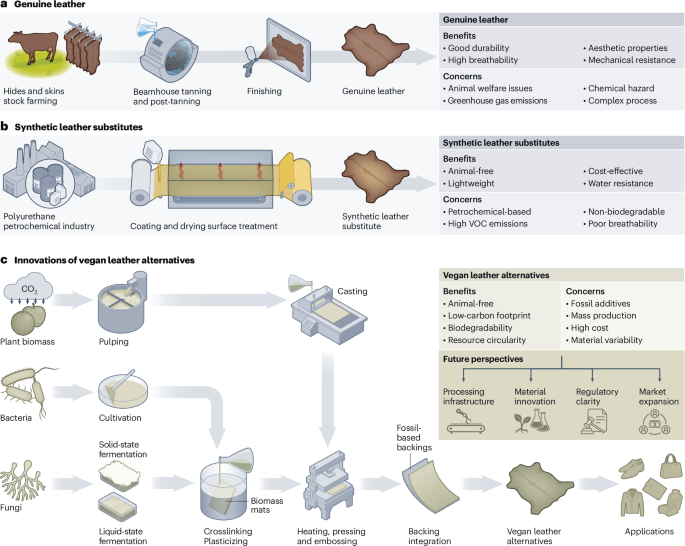
The leather industry is at a pivotal moment on its path towards sustainability. Although many bio-based leather alternatives can reduce environmental impact, we need clear definitions of such alternatives to guide materials innovations that truly bring them into the mainstream, sustainable market, as highlighted in a recent court ruling.
This is a preview of subscription content, access via your institution
Access options
Access Nature and 54 other Nature Portfolio journals
Get Nature+, our best-value online-access subscription
$32.99 / 30 days
cancel any time
Subscribe to this journal
Receive 12 digital issues and online access to articles
$119.00 per year
only $9.92 per issue
Buy this article
- Purchase on SpringerLink
- Instant access to the full article PDF.
USD 39.95
Prices may be subject to local taxes which are calculated during checkout

References
-
Jones, M., Gandia, A., John, S. & Bismarck, A. Nat. Sustain. 4, 9–16 (2021).
-
Zhang, F. et al. Carbohydr. Polym. 348, 122800 (2025).
-
Liu, X., Zhang, X., Wang, X., Yue, O. & Jiang, H. Trends Biotechnol. 43, 1104–1115 (2025).
-
Meyer, M., Dietrich, S., Schulz, H. & Mondschein, A. Coatings 11, 226 (2021).
-
Xia, Q. et al. Nat. Sustain. 4, 627–635 (2021).
-
Melton, L. Nat. Biotechnol. 40, 1163 (2022).
-
Walker, K. T. et al. Nat. Biotechnol. 43, 345–354 (2025).
-
Elsacker, E. et al. Adv. Mater. https://doi.org/10.1002/adma.202502728 (2025).
-
Hao, Y., Wang, H., Tian, D., Zhang, W. & Shi, B. Ind. Crops Prod. 226, 120632 (2025).
-
Gantenbein, S. et al. Nat. Mater. 22, 128–134 (2023).
-
Waltz, E. Nat. Biotechnol. 40, 287–289 (2022).
-
Pauliuk, S. Nat. Sustain. 3, 2–4 (2020).
-
Covington, A. D. & Wise, W. R. J. Leather Sci. Eng. 2, 28 (2020).
Acknowledgements
We acknowledge the National Natural Science Foundation of China (22478264) and the International Science and Technology Innovation Cooperation project of Sichuan Province (25GJHZ0078). This work was performed in part at Key Laboratory of Leather Chemistry and Engineering of Ministry of Education of Sichuan University, which is partially supported by the Fundamental Research Funds for the Central Universities (SCU2025D014).
Ethics declarations
Competing interests
The authors declare no competing interests.
Rights and permissions
About this article

Cite this article
Zhang, F., Zhou, J., Xu, H. et al. Integrating materials innovation and policy challenges for leather alternatives. Nat Sustain (2026). https://doi.org/10.1038/s41893-025-01759-7
-
Published:
-
Version of record:
-
DOI: https://doi.org/10.1038/s41893-025-01759-7