
Introduction
Yield potential is defined as the yield of a well-adapted cultivar when grown without water and nutrient limitations and with weeds, diseases, and insect pests effectively controlled1,2. Under these conditions, yield potential is determined by solar radiation, temperature, and atmospheric carbon dioxide concentration. In the case of rainfed crops, water supply and soil water storage impose another limit to yield potential3. Hence, in absence of climatic trends, changes in yield potential over time can be attributed to genetic traits influencing light interception and conversion to biomass as governed by photosynthesis, respiration, water-use efficiency, and biomass partitioning to grain4,5. Continuous gains in yield potential through genetic improvement is crucial to avoid yield plateaus and reduce land requirements for adequate crop production6,7,8,9.
Field studies quantifying genetic yield improvement often rely on side-by-side comparison of sets of historical cultivars in today’s environment10,11,12,13,14,15,16,17,18,19. In these studies, the slope of the linear regression between measured grain yields versus each cultivar’s year of release is assumed to represent the annual rate of yield potential gain due to genetic improvement. Other approaches to quantify genetic yield improvement consist of comparison of new cultivars against check cultivars during several years20 or analysis of large long-term variety multi-environment trials (MET) using mixed linear models21,22. A common assumption of the first two approaches (i.e., side-by-side testing of historical series and comparison between new and check cultivars) is that the yield of the check cultivars does not erode over time or that the yield erosion can be fully avoided with check replacement and/or management so that the measured genetic gain can be fully attributable to higher yield potential in newer cultivars23,24,25. This assumption can be criticized because it ignores the yield decline that occurs over time when cultivars lose adaptation to the evolving climate, atmospheric composition, soil properties, crop management practices, pest and disease pressure, hereafter referred to as a ‘yield erosion’7,26,27,28,29,30,31. Retrospective analysis of MET datasets allows counteracting this drawback as each cultivar was tested at their peak of use31.
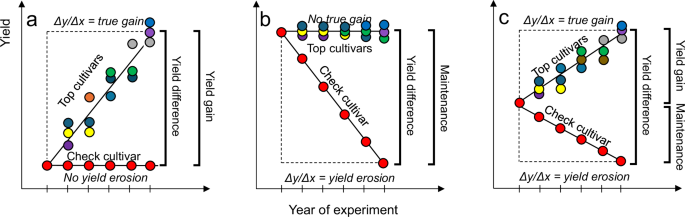
Consequently, observed yield differences between new and old cultivars at any point in time can be associated with (i) higher genetically determined yield potential in new cultivars, (ii) yield erosion of old cultivars, or (iii) a combination of both (Fig. 1). Both breeding to counteract yield erosion by maintaining cultivars adapted to the changing abiotic and biotic environments (maintenance breeding) or improving yield potential in new cultivars are useful and needed. However, many studies of this kind on major food crops have assumed that yield differences between old and new cultivars are solely due to genetic gain in yield potential without assessing the contribution from maintenance breeding.

Scheme showing how yield differences between new and old cultivars can be attributed to genetic improvement in yield potential (a), yield erosion in older cultivars (b), or both (c). This scheme assumes no changes in yield due to climate or agronomic practices.
Continued yield gains are essential to ensure adequate food supply while substantially reducing land conversion and greenhouse gas emissions due to expansion of crop production area6,32,33,34. Clarity on the factors with greatest contribution to yield advance in recent decades is essential for effective prioritization of future research to improve yields. In the world’s most productive cropping systems, increase in yield potential via genetic improvement is the trait that is most widely credited with greatest impact on yield trends in farmer’s fields35,36,37. But what if existing estimations of genetic gains in yield potential are wrong? Here, we distinguish maintenance breeding from gains in yield potential using wheat as a case study, which is the most widely grown staple food crop worldwide, with a global harvested area of 217 million hectares, which accounts for about one quarter of global cereal production and ca. 20% of human calories and protein38.
Results
Yield trends over time
We assembled a database (post-2000) that consisted of multi-environmental trials (METs) in Argentina, United States (US), United Kingdom (UK), and France (Supplementary Fig. 1) evaluating 849 cultivars across 17 locations, and including 10 check cultivars that were released no more than five years prior to being included in a trial (to avoid missing any early and quick yield decay) and were tested thereafter against more recently released cultivars for a minimum of 10 years to capture any measurable yield decay over time. In addition, because high-yielding wheat stands have lush leaf canopies that are conducive to development of fungal diseases39,40, yield loss from these diseases was minimized by prophylactic, in-season applications of foliar fungicide across all cultivars in every trial. Most trials included separate treatments with and without fungicide across all cultivars (Supplementary Tables 1 and 2). Overall, our database included 13,003 cultivar × site × fungicide combinations x year combinations.
Average yield of top yielding cultivars and check cultivars oscillated over time due to inter-annual variation in weather conditions (Fig. 2). However, we could not detect any long-term climatic trend based on trends in simulated yields using process-based crop models and local measured weather (Supplementary Fig. 2). On the other hand, two distinct features were apparent from the observed trends in measured yields (Figs. 2 and 3). First, the yield difference between top yielding cultivars and check cultivars was negligible at the beginning of the time series (141 kg ha−1), indicating that the check cultivars chosen in our study were among the top yielding cultivars at the beginning of the trials. Second, the yield difference between the top yielding cultivars and check cultivars, based on fungicide-treated crops, increased over time at an overall rate of +73 kg ha−1 y−1, highlighting the contribution of breeding to crop yield improvement.

Symbols represent the best linear unbiased estimators (BLUEs; see Methods) calculated for fungicide-treated top cultivars (empty upward triangles) and treated and untreated check cultivars (blue circles and red downward triangles). The name of the reference check cultivar is indicated within each panel. Baguette 10 (a), Baguette P11 (b), and Klein Proteo (c), Buck SY 200 (d) in Argentina (AR); Claire (e), Cordiale (f), and Grafton (g) in United Kingdom (UK); Apache (h) in France (FR), and Endurance (i) and Duster (j) in the United States (US). Slopes (kg ha−1 y−1) and significance of regression analyses are indicated within each panel (P < 0.1x; P < 0.05*; P < 0.01**; P < 0.001***). Vertical lines in check cultivars indicate the ± one standard error from the BLUEs. Source data are provided as a Source Data file.

Symbols represent the average change overtime in best linear unbiased estimators (BLUEs; see Methods) calculated for fungicide-treated top cultivars (empty upward triangles) and treated and untreated check cultivars (blue circles and red downward triangles). The overall yield difference between treated top cultivars and treated check yields is also shown (green diamonds). Trends (slopes) are indicated next to the fitted regression lines (kg ha−1 y−1). All trends differed significantly from zero (two-tailed t-test; P < 0.001). Source data are provided as a Source Data file.
Distinguishing gains in yield potential versus maintenance breeding
At question is how much of the overall yield difference can be attributed to increase in yield potential versus maintenance breeding aiming to keep cultivars adapted to the evolving environment. To distinguish between these two components, we evaluated the overall yield trends of top cultivars and check cultivars in crops treated with foliar fungicide (Figs. 2 and 3). We found that maintenance breeding and yield potential gain have contributed similarly, given the observed rates of -33 kg ha−1 y−1 for checks and +40 kg ha−1 y−1 in top cultivars. Thus, ignoring the contribution of maintenance breeding, as done in previous studies, can lead to a substantial overestimation in yield potential gain. Additionally, untreated check cultivars showed larger yield reductions (-64 kg ha−1 y−1) than treated ones over time, suggesting an increased susceptibility to foliar diseases over time and, thus, a larger yet masked yield erosion.
We further investigated yield trends using the entire database (13,003 yield entries combining site, cultivar, year, and fungicide application) with a mixed-effects model analysis (Table 1). There was a substantial effect of fungicide in all four countries, with an average yield response of +1285 kg ha−1, which is equivalent to 20% of the yield of the untreated cro. Thus, we evaluated yield trends for treated and untreated crops separately and found that genetic gains in treated crops ranged from +32 to 62 kg ha−1 y−1 (0.5–0.9% y−1) across countries. On the other hand, a negative non-genetic trend, which is associated with yield erosion and counteracted by maintenance breeding, was apparent in all cases, except for fungicide-treated crops in UK, ranging from -33 kg ha−1 y−1 (US) to -137 kg ha−1 y−1 (France) in treated crops and from -72 kg ha−1 y−1 (US) to -229 kg ha−1 y−1 (UK) in untreated crops. These results were consistent with the trends shown in Figs. 2 and 3.
Discussion
Genetic improvement contributes to on-farm yield gains through farmer adoption of new cultivars that have been selected for increased yielding ability, grain quality, disease resistance, winter hardiness, etc. across a wide range of relevant environments13,41. In that process, new cultivars typically have improved resistance and adaptation to evolving pest populations, management practices, soil properties, and climate, thus avoiding the yield erosion that would occur over time in absence of cultivar replacement28,31,42. Genetic improvement can also contribute to on-farm yield gain through commercial release and farmer adoption of new cultivars with higher yield potential due to improvements in carbon assimilation and partitioning to grain. These changes have been apparent in wheat and rice cultivars released since the onset of Green Revolution in the 1960s, as well as in hybrid maize cultivars over the same time frame43,44,45,46. At issue is how to estimate the relative contributions of maintenance breeding to compensate for yield erosion of old cultivars28 versus improvement in yield potential. This distinction is crucial as overestimation of yield potential gains could lead to optimistic yield projections and production capacity on existing cropland8.
Our study shows that comparing yields of new versus old cultivars in today’s environment does not provide a reliable estimate of genetic improvement in yield potential of wheat (Fig. 3, Table 1). The historical side-by-side cultivar yield trial approach carries the risk of inflating the estimated return on investment in yield potential increase through genetic improvement because such comparisons are biased against the old cultivars when there is a progressive loss of adaptation to the evolving biophysical environment. This bias could be more pronounced when only a handful of cultivars are meant to represent several decades of breeding10,11,12,15,17,47. Other studies using multi-year observations of the same check cultivars in variety trials have documented yield declines in untreated checks22,23,24,25,48. However, they admittedly relied on the assumption that the yield erosion can be fully offset via improved agronomic management, which does not seem to be the case as our study shows. Indeed, yield erosion is well known by breeders, who purposely replace check cultivars after a few years of inclusion in trials25. Interestingly, the magnitude of yield erosion found in our study was diverse across cultivars and regions (Fig. 2, Table 1, Supplementary Fig. 2). We conclude that, with few exceptions29,49, the extensive literature on yield potential improvement has overestimated gains in yield potential. While this conclusion is sobering, it also highlights the importance of robust breeding programs that, while seeking for higher yield potential, also combat yield erosion by continuously releasing new cultivars better adapted to the changing biophysical environments and management of intensive crop production systems26,27.
If yield potential gain is slower than previously thought, as it seems to be the case for wheat based on the present study and for maize and rice as reported elsewhere27,50, future yield gains will increasingly depend on closing the existing gap between on-farm yield and yield potential via improvements in agronomic management and adoption of top performing cultivars. Unfortunately, studies that explicitly seek to measure yield erosion in cultivars of other major upland crops such as maize or soybean have not yet been conducted. It would be surprising if there were no yield declines in widely grown cultivars in these other major crops. To better estimate future food production capacity at national to global scale will require improved estimates of expected crop yield gains due to improvements in agronomic management and genetic gain.
Our study is subject to several uncertainties and limitations. First, our analysis relied on the assumption that the average yield of top ten performing cultivars in each site-year can be taken as a proxy of the yield potential. However, a positive component of genotype by year interaction shown by top yielding cultivars in an individual year could lead to an overestimation of the yield potential and associated genetic gains. Second, yield limiting and reducing factors are likely to persist even under experimental conditions, causing the average yield of the top ten performing cultivars to fall below the yield potential. For example, in the case of wheat in US, management tends to be conservative due to climate risk and not really optimized to avoid yield limiting and reducing factors, leading to large yield gaps between simulated and measured yields (Supplementary Fig. 2)51. This finding highlights the need for evaluating cultivars under near-optimal conditions so that changes in yield in top cultivars can reliably be taken as gains in yield potential. Finally, our analysis is sensitive to the choice and number of check cultivars against which the highest-yielding cultivars are being compared. In our study, we used check cultivars that were widely grown soon after their time of release. Still, we recognize that a limited number of check cultivars were available per country. However, mixed linear model analysis including the 849 cultivars of the entire database showed consistent results. Overall, these uncertainties and limitations are not likely to influence our results so that the conclusions of our analysis can be considered robust.
Methods
Data from variety trials
We retrieved yield data from four METs in Argentina, France, UK, and US (Supplementary Fig. 1, Supplementary Tables 1 and 2). These trials assess the agronomic value of crops, including yield and diseases resistance in different environmental conditions. Collectively, the four countries where METs were located include 30 M ha and produce 129 M tons of wheat, accounting for 14% and 17% of wheat global area and production, respectively (average from 2019–2021)38. We only included trials that complied with the following criteria: (i) replicated field trials including at least 10 years of data, (ii) conducted after 2000 and including semi-dwarf cultivars, (iii) located within main wheat producing regions in each country/region, (iv) included widely sown cultivars and (v) included ‘check’ cultivars that remained in the trials over a longer period of time compared with others ( > 10 years) and were incorporated to the trials within three years after their commercial release.
Following the above criteria, we compiled data from 17 replicated trial locations (Supplementary Fig. 1, Supplementary Table 1 and 2). All trials were rainfed and most of them have a treatment without fungicide and another that received at least one in-season foliar fungicide application. Inclusion of fungicide-treated and untreated crops allowed us to assess changes in crop susceptibility to diseases over time. There was a total of ten check cultivars across the 17 trial locations, which corresponded to cultivars that were widely grown across millions of hectares globally soon after their time of release. Overall, our database included 13,003 cultivar × site × fungicide x year combinations across four countries. On average, 31 cultivars were tested every year in each trial, ranging from 16 to 55 across trial-year observations. Our database size is reasonable and comparable to previous studies assessing genetic gains22,23,24,25,48.
Seed was regenerated every year for the check cultivars. Plot size ranged between 7 and 15 m2 (Argentina: 1.5 × 5 m; US: 1.5 × 10 m; UK: 1.65 × 9 m; France: 7–10 m2), which is a common size for variety trials. Crops received recommended management practices regarding sowing date, seeding rate, fertilization, and weed and pest management at each site every year. As a result, high yields were obtained in these experiments, which were, on average, 18% (US), 29% (Europe) and 45% (Argentina) higher than average farmer yields during the same period38. Likewise, except for US, average yields of the top performers were ±15% of the simulated yield potential in each region.
Data analysis
We excluded cultivar-year combinations with suspicious values (e.g., CV > 30% among replicates) and specific years with near crop failure due to drought, severe lodging, and/or frost as reported by local experts. A total of 1% cultivar-year observations were eliminated following our quality control. Subsequently, we calculated the average yield of the 10 top-yielding cultivars for each trial-year combination, excluding the checks. Such an approach helped us discard experimental and/or underperforming cultivars. We assumed that the average yield of the 10 top yielding cultivars in each year represented the yield potential and then evaluated yield trends of these highest yielders over time as a measure of changes in yield potential.
We assessed the influence of weather on the yield trends of both the top yielding and check cultivars. To do this, we retrieved the simulated water-limited yield potential associated to the closest location to each trial available at the Global Yield Gap Atlas (www.yieldgap.org). Water-limited yield potential is determined by solar radiation, temperature, CO2 concentration, precipitation, and soil properties influencing the water balance1. Briefly, the water-limited yield potential was estimated using process-based crop models including CERES-Wheat (Argentina), SSM (US), and WOFOST (France and UK)52,53,54 that were specifically validated to be used in the target sites55,56,57,58. These previous studies have shown good agreement between simulated and measured yields in experiments conducted across wide range of biophysical environments where nutrient limitations and yield-reducing factors were effectively removed. The water-limited yield potential was simulated based on local measured weather, soil, and management practices and assumed no nutrient limitation and complete absence of yield-reducing factors such as weeds, pathogens, and insect pests. For each specific trial, we assessed changes in simulated water-limited yield potential over time for a fixed cultivar and set of management practices so that trends in simulated yield are solely attributable to weather variation during the specific timeframe of each experiment (Supplementary Fig. 2). Since there were no statistically significant long-term trends in simulated yield potential (P > 0.363), we analyzed the yield data without any normalization by weather or simulated yields.
Available phenotypic yield data for the statistical analysis consisted of either variety means (UK dataset and 11 out of 130 trial-location-year combinations in Argentina) or raw data per plot (datasets from France and US and 119 out of 130 trials location-year combinations in Argentina) per individual trial. For trials for which raw data were available, weighted variety means were calculated using best linear unbiased estimates (BLUEs) derived from linear mixed models:
$${y}_{in}=mu+{G}{scriptstyle{i}}+{underline{R}}{scriptstyle{n}}+{underline{varepsilon }}{scriptstyle{in}}$$
(1)
where yin is the phenotypic observation of genotype i in replicate n; µ is the trial mean; Gi is the fixed additive effect of the genotype i; ({underline{R}}{scriptstyle{n}}) is the random effect of the replicate n and is ~N(0, σ2r); and ({underline{varepsilon }}{scriptstyle{in}}) is a random residual term attributable to the effect of the within-trial experimental error and is µ~N(0, σ2e). Models were fitted using REML59, as implemented in the “asreml” package60 for R61. Four datasets consisting of either variety means per trial (UK), variety BLUEs per trial (France and US), or both (Argentina), were used to (i) test the effect of the fungicide treatment on grain yield; (ii) estimate overall, genetic, and non-genetic linear trends for grain yield over the years covered by the trials; and (iii) compute the BLUEs of the individual variety effects per calendar year for fungicide-treated and untreated crops. We used the following linear mixed models to analyze the effect of fungicide in the four METs:
$${y}{scriptstyle{ijkm}}=mu+{F}!{scriptstyle{j}}+{underline{Y}}{scriptstyle{k}}+{underline{E}}{scriptstyle{km}}+{underline{G}}{scriptstyle{i}}+{underline{(GY)}}{scriptstyle{ik}}+{underline{varepsilon }}{scriptstyle{ijkm}}$$
(2)
where yijkm is the phenotypic observation of genotype i in trial m, conducted in year k under the fungicide treatment j; µ is the overall mean; Fj is the fixed additive effect of the fungicide treatment j; ({underline{Y}}!{scriptstyle{k}}) is the random additive effect of the year k and is ~N(0, σ2y); ({underline{E}}{scriptstyle{km}}) is the random effect of the trial m nested within year k and is ~N(0, σ2e); ({underline{G}}{scriptstyle{i}}) is the random additive effect of the genotype i and is ~N(0, σ2g); ({underline{(GY)}}{scriptstyle{ik}}) is the random effect of the interaction between genotype i and year k and is ~N(0, σ2gy); and ({underline{varepsilon }}{scriptstyle{ijkm}}) is a random residual term attributable to the combined effect of the within-trial experimental error and the genotype × trial (nested within year) interaction and is ~N(0, σ2e). The BLUEs of fungicide effects were computed from this analysis.
With the aim of estimating unbiased genetic and non-genetic progresses for grain yield23,24 over the years comprised by the MET datasets, our model incorporated a fixed genetic trend (β) with respect to the year of first testing of genotype i (ri) and a fixed non-genetic trend (γ) respect to the trial year k (({{t}}{scriptstyle{k}})) scaled to the first year (2002 in Argentina; 2004 in UK, 2000 in US; and 2001 in France) as follows:
$${y}{scriptstyle{ikm}}=mu+gamma {t}{scriptstyle{k}}+{underline{Y}}{scriptstyle{k}}+{underline{E}}{scriptstyle{km}}+beta {r}{scriptstyle{i}}+{underline{G}}{scriptstyle{i}}+{underline{varepsilon }}{scriptstyle{ikm}}$$
(3)
where ({underline{Y}}!{scriptstyle{k}}) and ({underline{E}}!{scriptstyle{km}}) are the random environmental deviations from the non-genetic trend due to the effects of the year and trial nested within year, respectively; ({underline{G}}{scriptstyle{i}}) is the random genotypic deviation from the genetic trend, and ({underline{varepsilon }}{scriptstyle{ijkm}}) is a random residual term attributable to the combined effect of the within-trial experimental error and the genotype × year and genotype × trial (nested within year) interactions. All random terms in model (3) were assumed to follow a normal distribution. This linear mixed model was used to analyze breakouts from the MET datasets, stratified by the presence or absence of fungicide treatments. In a complementary analysis, the term βri was removed from the model to estimate the overall, i.e., genetic + non-genetic, yield trend for the undivided MET dataset. Finally, we computed the BLUEs of the individual variety effects per trial-year. To do so, we used the following linear mixed model for the analysis of the fungicide-treated and untreated crops in the four MET datasets:
$${y}_{scriptstyle{ikm}}=mu+{G}{scriptstyle{i}}+{underline{Y}}!{scriptstyle{k}}+{underline{E}}{scriptstyle{km}}+{underline{(GY)}}{scriptstyle{ik}}+{underline{varepsilon }}{scriptstyle{ikm}}$$
(4)
The BLUEs of the variety × year effects were computed from this analysis.
Reporting summary
Further information on research design is available in the Nature Portfolio Reporting Summary linked to this article.
Data availability
The processed raw data from cultivar trials are available at Zenodo [https://zenodo.org/records/18521687]. Experimental trial data are also publicly available via the links provided in the Supplementary Table 1. Data on simulated yield potential are publicly available via the Global Yield Gap Atlas website [www.yieldgap.org]. Source data are provided with this paper.
Code availability
The code used for the analysis is available at Zenodo [https://zenodo.org/records/18521687].
References
-
Evans, L. T. Crop Evolution, Adaptation, and Yield. Cambridge University Press (1993).
-
van Ittersum, M. K. & Rabbinge, R. Concepts in production ecology for analysis and quantification of agricultural input-output combinations. Field Crops Res. 52, 197–208 (1997).
-
van Ittersum, M. K. et al. Yield gap analysis with local to global relevance-a review. Field Crops Res. 143, 4–17 (2013).
-
Berghuijs, H. N. et al. Catching-up with genetic progress: Simulation of potential production for modern wheat cultivars in the Netherlands. Field Crops Res. 296, 108891 (2023).
-
Fischer, R. A. Number of kernels in wheat crops and the influence of solar radiation and temperature. J. Agric. Sci. 105, 447–461 (1985).
-
Cassman, K. G. Ecological intensification of cereal production systems: yield potential, soil quality, and precision agriculture. Proc. Natl. Acad. Sci. USA. 96, 5952–5959 (1999).
-
Cassman, K. G., Dobermann, A., Walters, D. T. & Yang, H. Meeting cereal demand while protecting natural resources and improving environmental quality. Annu. Rev. Environ. Resour. 28, 315–358 (2003).
-
Grassini, P., Eskridge, K. M. & Cassman, K. G. Distinguishing between yield advances and yield plateaus in historical crop production trends. Nat. Commun. 4, 2918 (2013).
-
Cassman, K. G. & Grassini, P. A global perspective on sustainable intensification research. Nat. Sustain. 3, 262–268 (2020).
-
Brancourt-Hulmel, M. et al. Genetic improvement of agronomic traits of winter wheat cultivars released in France from 1946 to 1992. Crop Sci. 43, 37–45 (2003).
-
Calderini, D. & Slafer, G. A. Changes in yield and yield stability in wheat during the 20th century. Field Crops Res. 57, 335–347 (1998).
-
Curin, F., Otegui, M. E. & Gonzalez, F. G. Wheat yield progress and stability during the last five decades in Argentina. Field Crops Res. 269, 108183 (2021).
-
Duvick, D. N. & Cassman, K. G. Post-green revolution trends in yield potential of temperate maize in the North-Central United States. Crop Sci. 39, 1622–1630 (1999).
-
Di Matteo, J. A., Ferreyra, J. M., Cerrudo, A. A., Echarte, L. & Andrade, F. H. Yield potential and yield stability of Argentine maize hybrids over 45 years of breeding. Field Crops Res. 197, 107–116 (2016).
-
Maeoka, R. E. et al. Changes in the phenotype of winter wheat varieties released between 1920 and 2016 in response to in-furrow fertilizer: biomass allocation, yield, and grain protein concentration. Front. Plant Sci. 10, 1786 (2020).
-
Rogers, J. et al. Agronomic performance and genetic progress of selected historical soybean varieties in the southern USA. Plant Breed. 134, 85–93 (2015).
-
Lo Valvo, P. J., Miralles, D. J. & Serrago, R. A. Genetic progress in Argentine bread wheat varieties released between 1918 and 2011: Changes in physiological and numerical yield components. Field Crops Res. 221, 314–321 (2018).
-
Fischer, T. et al. Sixty years of irrigated wheat yield increase in the Yaqui Valley of Mexico: Past drivers, prospects and sustainability. Field Crops Res. 283, 108528 (2022).
-
Amás, J. I., Curin, F., D’andrea, K. E., Luque, S. F. & Otegui, M. E. Maize breeding effects on grain yield genetic progress and its contribution to global yield gain in Argentina. Field Crops Res. 316, 109520 (2024).
-
Fischer, T. Advances in the Potential Yield of Grain Crops. Population, agriculture, and biodiversity: problems and prospects. Univ of Missouri Press, Columbia, Missouri, USA, pp 149-180 (2020).
-
Rutkoski, J. E. A practical guide to genetic gain. Adv. Agron. 157, 217–249 (2019).
-
Laidig, F. et al. Breeding progress of disease resistance and impact of disease severity under natural infections in winter wheat variety trials. Theor. Appl. Genet. 134, 1281–1302 (2021).
-
Mackay, I. et al. Reanalyses of the historical series of UK variety trials to quantify the contributions of genetic and environmental factors to trends and variability in yield over time. Theor. Appl. Genet. 122, 225–238 (2011).
-
Piepho, H. P., Laidig, F., Drobek, T. & Meyer, U. Dissecting genetic and non-genetic sources of long-term yield trend in German official variety trials. Theor. Appl. Genet. 127, 1009–1018 (2014).
-
Raymond, J. et al. Continuing genetic improvement and biases in genetic gain estimates revealed in historical UK variety trials data. Field Crops Res. 302, 109086 (2023).
-
Laidig, F. et al. Long-term breeding progress of yield, yield-related, and disease resistance traits in five cereal crops of German variety trials. Theor. Appl. Genet. 134, 3805–3827 (2021).
-
Peng, S., Cassman, K. G., Virmani, S. S., Sheehy, J. & Khush, G. S. Yield potential trends of tropical rice since the release of IR8 and the challenge of increasing rice yield potential. Crop Sci. 39, 1552–1559 (1999).
-
Peng, S. et al. The importance of maintenance breeding: A case study of the first miracle rice variety-IR8. Field Crops Res. 119, 342–347 (2010).
-
Espe, M. B. et al. Rice yield improvements through plant breeding are offset by inherent yield declines over time. Field Crops Res. 222, 59–65 (2018).
-
van Etten, J. et al. Crop variety management for climate adaptation supported by citizen science. Proc. Natl. Acad. Sci. USA. 116, 4194–4199 (2019).
-
de la Vega, A. J., De Lacy, I. H. & Chapman, S. C. Progress over 20 years of sunflower breeding in central Argentina. Field Crops Res. 100, 61–72 (2007).
-
Marin, F. R. et al. Protecting the Amazon forest and reducing global warming via agricultural intensification. Nat. Sustain. 5, 1018–1026 (2022).
-
Linquist, B., Van Groenigen, K. J., Adviento-Borbe, M. A., Pittelkow, C. & Van Kessel, C. An agronomic assessment of greenhouse gas emissions from major cereal crops. Glob. Chang. Biol. 18, 194–209 (2012).
-
Burney, J. A., Davis, S. J. & Lobell, D. B. Greenhouse gas mitigation by agricultural intensification. Proc. Natl. Acad. Sci. USA. 107, 12052–12057 (2010).
-
Smith, J. S. C., Carver, B., Diers, B. W. & Specht J. E., Yield Gains in Major US Field Crops: Contributing Factors and Future Prospects. CSSA Special Publication #33, ASA-CSSA-SSSA, Madison, WI (2015).
-
Fischer, R. A. & Edmeades, G. O. Breeding and cereal yield progress. Crop Sci. 50, S-85 (2010).
-
Nelson, G. C. et al. Food Security, Farming, and Climate Change to 2050. IFPRI: Washington, DC, (2010).
-
FAO. FAOSTAT production data. Available at www.fao.org/faostat/en/#data. Deposited 15 August 2022.
-
Serrago, R. A., Carretero, R., Bancal, M. O. & Miralles, D. J. Foliar diseases affect the eco-physiological attributes linked with yield and biomass in wheat (Triticum aestivum L.). Eur. J. Agron. 31, 195–203 (2009).
-
Figueroa, M., Hammond-Kosack, K. E. & Solomon, P. S. A review of wheat diseases-a field perspective. Mol. Plant Pathol. 19, 1523–1536 (2018).
-
Hall, A. J. & Richards, R. A. Prognosis for genetic improvement of yield potential and water-limited yield of major grain crops. Field Crops Res. 143, 18–33 (2013).
-
Oury, F. X. et al. A study of genetic progress due to selection reveals a negative effect of climate change on bread wheat yield in France. Eur. J. Agron. 40, 28–38 (2012).
-
Khush, G. S. Green revolution: the way forward. Nat. Rev. Genet. 2, 815–822 (2001).
-
Evenson, R. E. & Gollin, D. Assessing the impact of the Green Revolution, 1960 to 2000. Science 300, 758–762 (2003).
-
Hedden, P. The genes of the Green Revolution. Trends Genet. 19, 5–9 (2003).
-
Duvick, D. N. The contribution of breeding to yield advances in maize (Zea mays L.). Adv. Agron. 86, 83–145 (2005).
-
Ruiz, A. et al. Harvest index has increased over the last 50 years of maize breeding. Field Crops Res. 300, 108991 (2023).
-
Seck, F., Covarrubias-Pazaran, G., Gueye, T. & Bartholomé, J. Realized genetic gain in rice: Achievements from breeding programs. Rice 16, 61 (2023).
-
Graybosch, R. A. & Peterson, C. J. Genetic improvement in winter wheat yields in the Great Plains of North America, 1959–2008. Crop Sci. 50, 1882–1890 (2010).
-
Rizzo, G. et al. Climate and agronomy, not genetics, underpin recent maize yield gains in favorable environments. Proc. Natl. Acad. Sci. USA. 119, e2113629119 (2022).
-
de Oliveira Silva, A., Slafer, G. A., Fritz, A. K. & Lollato, R. P. Physiological basis of genotypic response to management in dryland wheat. Front. Plant Sci. 10, 1644 (2020).
-
Otter, S., Ritchie, J. T. Validation of the CERES-wheat model in diverse environments. In Wheat growth and modelling Boston, MA: Springer USA, pp. 307-310 (1985).
-
Soltani, A. & Sinclair, T. R. Modeling physiology of crop development, growth and yield. CAB International, Cambridge, MA, USA (2012).
-
Van Diepen, C. V., Wolf, J. V., Van Keulen, H. & Rappoldt, C. WOFOST: A simulation model of crop production. Soil Use Manag. 5, 16–24 (1989).
-
Aramburu Merlos, F. et al. Potential for crop production increase in Argentina through closure of existing yield gaps. Field Crops Res. 184, 145–154 (2015).
-
Lollato, R. P., Edwards, J. T. & Ochsner, T. E. Meteorological limits to winter wheat productivity in the US southern Great Plains. Field Crops Res. 203, 212–226 (2017).
-
Lollato, R. P. et al. Agronomic practices for reducing wheat yield gaps: A quantitative appraisal of progressive producers. Crop Sci. 59, 333–350 (2019).
-
Wolf, J. et al. Modeling winter wheat production over Europe with WOFOST – the effect of two new zonations and two newly calibrated model parameter sets. Methods of Introducing System Models into Agricultural Research. Advances in Agricultural Systems Modeling 2: Trans-disciplinary Research, Synthesis, and Applications, eds L. R. Ahuja, L. Ma (ASA-CSSA-SSSA, Madison, WI), pp. 297–326 (2011).
-
Patterson, H. D., Thompson, R. Maximum likelihood estimation of components of variance. In: Proceedings of the 8th International Biometrics Conference, pp. 197-207 (1975).
-
Butler, D. G., Cullis, B. R., Gilmour, A. R., Gogel, B. G., Thompson, R. ASReml-R Reference Manual Version 4.2. VSN International Ltd., Hemel Hempstead, HP2 4TP, UK, 2023.
-
R Core Team, 2024. R: A Language and Environment for Statistical Computing. R Foundation for Statistical Computing, Vienna, Austria. https://www.R-project.org/, 2024.
Acknowledgements
We thank Drs Jacques Le Gouis (INRAE), Andy Macdonald (Rothamsted Research), and Susannah Bolton (AHDB) for helping retrieve data from trials in France and United Kingdom.
Ethics declarations
Competing interests
The authors declare no competing interests.
Peer review
Peer review information
Nature Communications thanks the anonymous reviewers for their contribution to the peer review of this work. A peer review file is available.
Additional information
Publisher’s note Springer Nature remains neutral with regard to jurisdictional claims in published maps and institutional affiliations.
Supplementary information
Source data
Rights and permissions
Open Access This article is licensed under a Creative Commons Attribution-NonCommercial-NoDerivatives 4.0 International License, which permits any non-commercial use, sharing, distribution and reproduction in any medium or format, as long as you give appropriate credit to the original author(s) and the source, provide a link to the Creative Commons licence, and indicate if you modified the licensed material. You do not have permission under this licence to share adapted material derived from this article or parts of it. The images or other third party material in this article are included in the article’s Creative Commons licence, unless indicated otherwise in a credit line to the material. If material is not included in the article’s Creative Commons licence and your intended use is not permitted by statutory regulation or exceeds the permitted use, you will need to obtain permission directly from the copyright holder. To view a copy of this licence, visit http://creativecommons.org/licenses/by-nc-nd/4.0/.
About this article

Cite this article
Andrade, J.F., Man, J., Monzon, J.P. et al. Maintenance breeding and breeding for yield potential both contribute to genetic improvement in wheat yield. Nat Commun 17, 2078 (2026). https://doi.org/10.1038/s41467-026-69936-6
-
Received:
-
Accepted:
-
Published:
-
Version of record:
-
DOI: https://doi.org/10.1038/s41467-026-69936-6