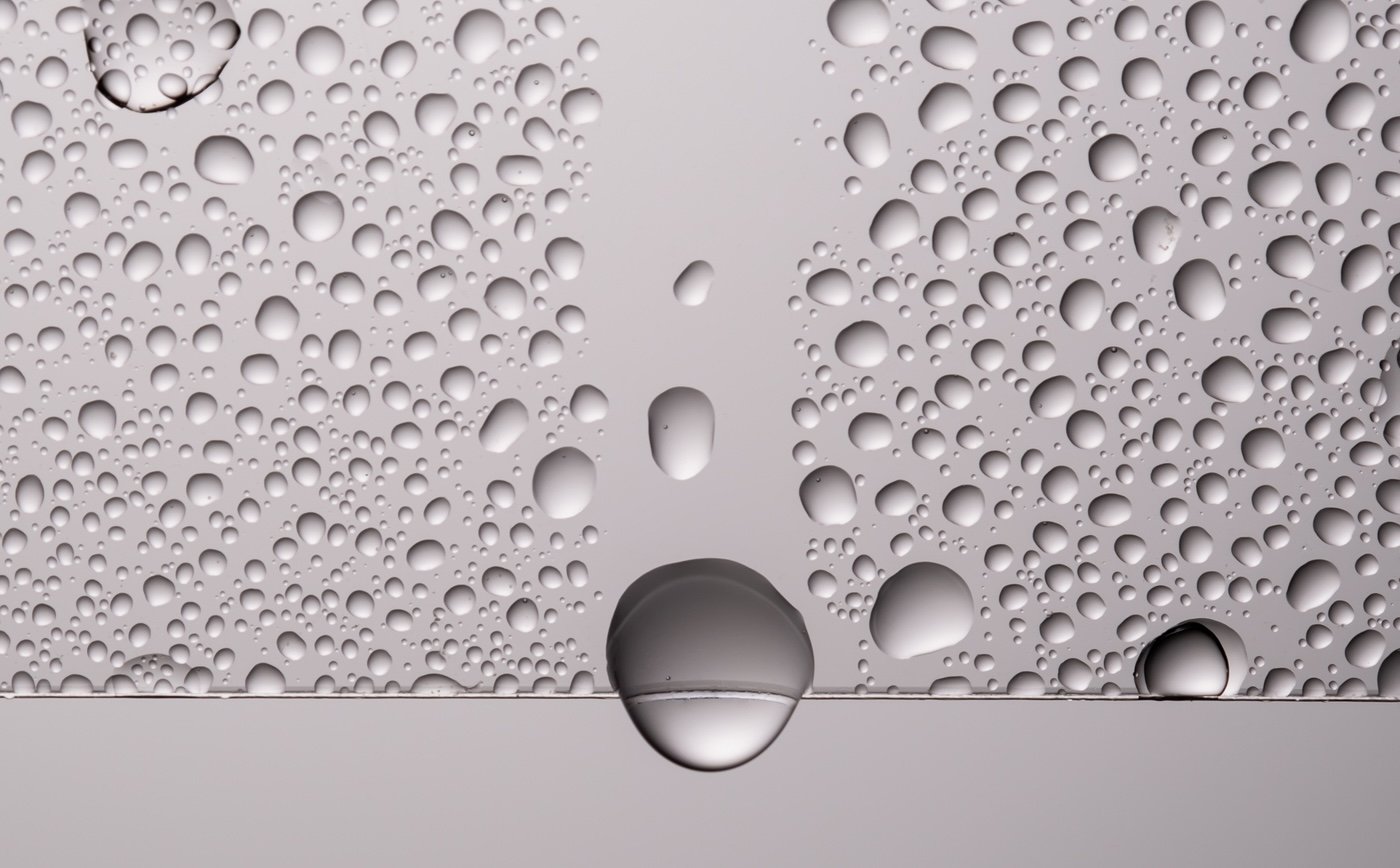
The fluid-handling bioprocessing surfaces that successfully repel microliter droplets aren’t as effective for nano- and picoliter droplets. Because those smaller droplets are more sensitive to chemical and topological differences in the substrate, they are more likely to stick to the surfaces they contact, which poses a challenge as bioprocesses move to ever-smaller quantities of liquids.
One potential solution is to coat surfaces with low-surface-energy particles.
Researchers Mizuki Tenjimbayashi, PhD, Shunto Arai, PhD, Hiroshi Mizoguchi, PhD, and Satoshi Ishii, PhD, all from the Research Center for Materials Nanoarchitectonics, National Institute for Materials Science (NIMS) in Japan, report that a “dynamic particle coating of ultrasonic-sprayed droplets enables the formation of highly spherical, isolated, particle-coated picoliter droplets…that changes the solid-liquid interfacial fraction to solid-solid interfacial fraction and reduces the force required to move the droplet to the subnanonewton range. Consequently, picoliter droplets slide off a tilted substrate without sticking.”
A new type of cell culturing
With this technique, “I think a new type of cell culturing is possible,” Tenjimbayashi tells GEN, noting that “we previously succeeded in encapsulating a cell inside the microdroplet.”
“For biopharmaceutical manufacturers, this advance may enhance droplet transport and enable precise manipulation using open platforms and thus improve automation. Because this method maintains the particles’ spherical shapes and allows reconfiguration, this method may find uses in precise, particle-coated droplet formulation for controlled release formulations. Additional potential applications include cell positioning and sorting, as well as real-time monitoring using lab-on-a-chip devices. Ultimately, it may also allow the development of ever-smaller microfluidic devices.”
Tenjimbayashi and colleagues note that particle-coated droplets slipped off the substrate much more easily than did non-coated particles on a coated substrate. That’s because of differences between the droplet-particle interactions and particle-substrate interactions, they explained.
The team produced the picoliter droplets of ionic liquid using an ultrasonic spray and a vibrating, superomniphobic particle powder bed, but they suggest other methods, such as commercial mist diffusers or heating the liquids, may also be feasible. Because the surface tension of the particles was much less than that of the droplets, the particles remained on their surface. The low wettability of the particles also contributed.
Notably, the commercial hydrocarbon-modified fumed titania particles used to coat microliter-sized droplets were not effective at creating coated picoliter droplets.
Tenjimbayashi and colleagues say their technique is a broadly applicable way to prepare isolated, highly spherical particle-coated picoliter droplets and to manipulate them in ways that include their “arrangement, transport, switchable sticking, and shape configuration.” The particles it produced did not stick or coalesce and were stable “for at least 30 days in a sealed glass bottle.”
The post Manipulating Microliter Droplets Without Sticking by Particle Coating appeared first on GEN – Genetic Engineering and Biotechnology News.