- News & Views
- Published:
Neural organoids
Nature Protocols (2025)Cite this article
-
289 Accesses
-
18 Altmetric
Subjects
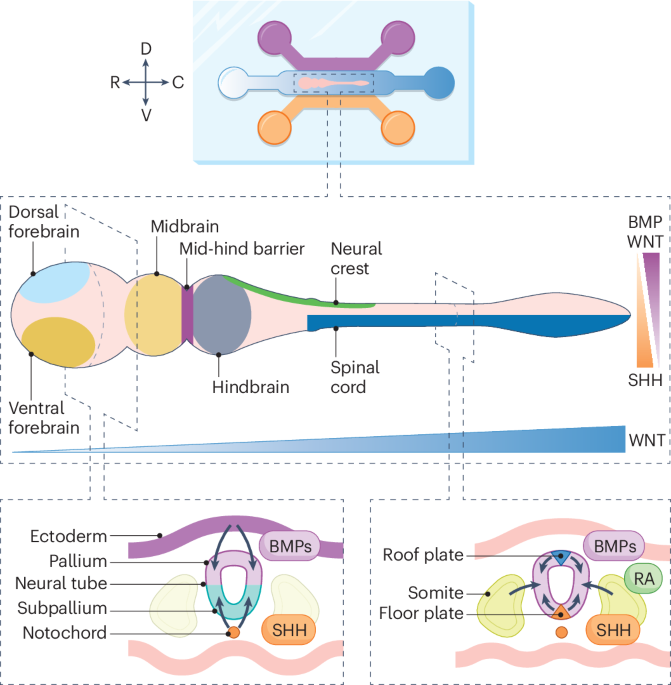
The complex spatiotemporal signaling of human neural tube development is successfully engineered in a device using microfluidic gradients, creating a high-fidelity model of the developing human central nervous system.
This is a preview of subscription content, access via your institution
Access options
Access Nature and 54 other Nature Portfolio journals
Get Nature+, our best-value online-access subscription
$32.99 / 30 days
cancel any time
Subscribe to this journal
Receive 12 print issues and online access
$259.00 per year
only $21.58 per issue
Buy this article
- Purchase on SpringerLink
- Instant access to full article PDF
Prices may be subject to local taxes which are calculated during checkout

References
-
Birtele, M., Lancaster, M. & Quadrato, G. Nat. Rev. Mol. Cell Biol. 26, 389–412 (2024).
-
Xue, X. et al. Nat. Protoc. https://doi.org/10.1038/s41596-025-01266-1 (2025).
-
Xue, X. et al. Nature 628, 391–399 (2024).
-
Urenda, J. P., Del Dosso, A., Birtele, M. & Quadrato, G. Biol. Psychiatry 93, 606–615 (2023).
-
Rifes, P. et al. Nat. Biotechnol. 38, 1265–1273 (2020).
-
Karzbrun, E. et al. Nature 599, 268–272 (2021).
-
Bagley, J. A., Reumann, D., Bian, S., Lévi-Strauss, J. & Knoblich, J. A. Nat. Methods 14, 743–751 (2017).
-
Birey, F. et al. Nature 545, 54–59 (2017).
Ethics declarations
Competing interests
The authors declare no competing interests.
Rights and permissions
About this article

Cite this article
Serles, P., Quadrato, G. Microfluidic gradients create a stem cell model of the human central nervous system. Nat Protoc (2025). https://doi.org/10.1038/s41596-025-01269-y
-
Published:
-
DOI: https://doi.org/10.1038/s41596-025-01269-y