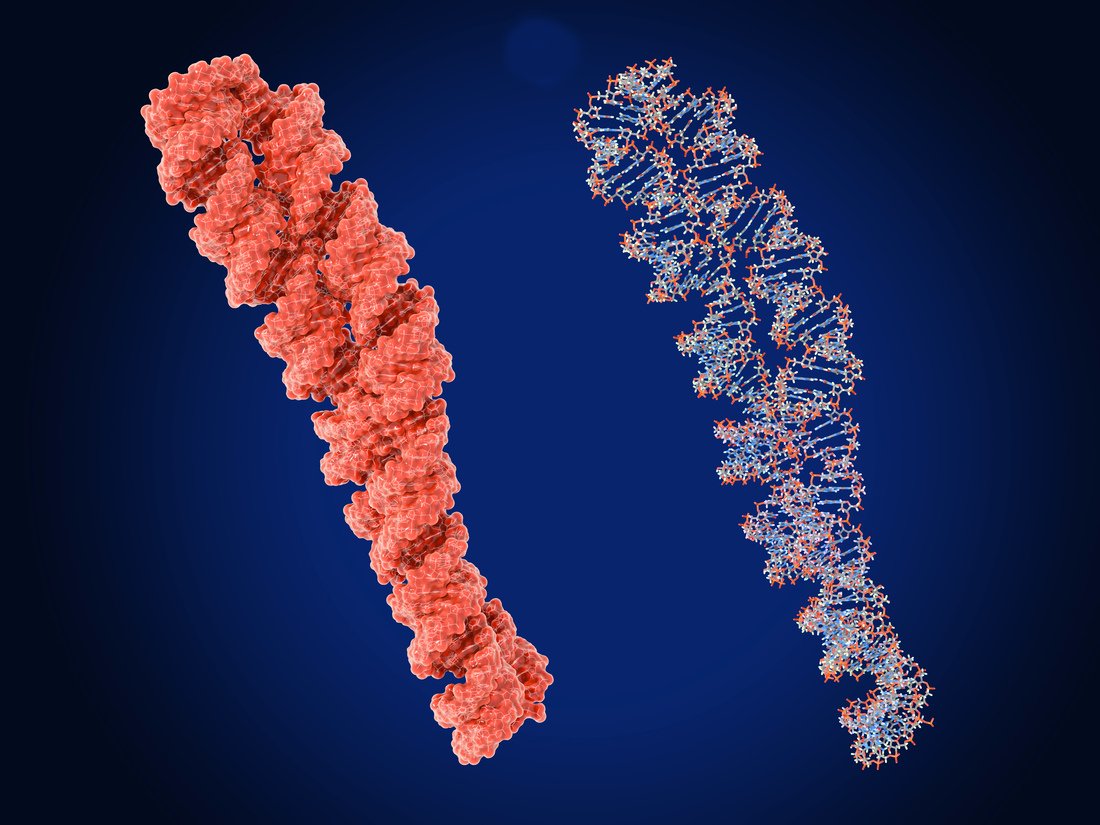
Double-stranded RNA (dsRNA) is a critical immunostimulatory impurity in mRNA production and poses a problem for the downstream purification methods vital to manufacturing mRNA vaccines and therapeutics. Scientists at Sartorius BIA Separations in Slovenia and Johannes Gutenberg University in Mainz, Germany, have a novel solution: pH denaturation of dsRNA.
Writing in a recent paper, first author Jasmina Puc, PhD, mRNA/pDNA application area manager, and senior author Rok Sekirnik, PhD, head of process development for mRNA/pDNA, both of Sartorius, note that “pH [levels] lower than 3.5 denatures the dsRNA present in mRNA within seconds…while preserving the mRNA’s integrity.”
When coupling it to chromatographic purification, their approach reduces dsRNA to less than 0.1% while recovering more than 90% of the mRNA and increasing the expression of purified mRNA or saRNA five- to six-fold in A549 cells. The process also reduces type I interferon signaling that otherwise would weaken the effectiveness of the vaccine or therapeutic.
Threshold: pH 3.5
The scientists developed this approach in response to the rapid evolution of the mRNA field. “This method features high recovery in aqueous conditions and was developed as a response to the need to move away from cellulose purification, which returns low yields, and reverse-phase, which uses organic solvents,” Sekirnik tells GEN.
The team applied this method to mRNA/saRNA constructs from 1 to 10 kb and assessed pH ranges from 3 to 6. For all the RNA constructs, the J2 immunoblot signal—a marker for dsRNA strands—decreased with decreasing pH and disappeared after five seconds. This was true for glycine, as well as for phosphate, citrate, and formate buffers.
Hydrogen bonds between canonical base pairs link RNA chains to form dsRNA. At pH 3.5, the bonds linking adenosine and cytosine are disrupted, effectively breaking the double-stranded RNA chains within mRNA so they can be removed downstream.
In evaluating multiple mRNA constructs (eGFP, FLuc, mCHIK, and Cas9), Puc, Sekirnik, and colleagues noted that only minor variations in the pH levels were required for full dsRNA denaturation. Cas9 mRNA constructions, for example, fully denatured at pH 4.5, while the other constructs required levels of pH 3.5 or less for full denaturation.
Downstream purification caveat
“Acidic dsRNA denaturation is partially reversible,” they cautioned. Adding kosmotropic salts such as sodium chloride at concentrations used in classical oligo dT chromatography “fully reversed the effects of low pH.”
This means biomanufacturers must consider the presence of salts when choosing downstream purification methods. The caveat for oligo dT chromatography is that salt is necessary for mRNA binding but also causes dsRNA to reform. The solution, so far, seems to be performing acidic sample pre-treatment in-line before loading the samples onto the affinity Oligo dT chromatography column. This prompted the formation of heteroduplex dT-polyA rather than dsRNA, thus allowing mRNA to bind to the oligo dT while removing dsRNA.
This method is inexpensive, nonhazardous, and scalable. It repurposes Oligo dT affinity chromatography, a clinically validated purification tool in mRNA manufacturing, for dsRNA removal. “The method works best with in-line dilution to shorten the hold times. This is a technical solution that classical chromatography skids support, but may need getting used to by manufacturers,” Sekirnik says.
“We are delighted by the positive response of the mRNA industry to this method and are working with mRNA developers and CDMOs on industrial implementation,” he continues. “Our next quest is to get hold of a gram of mRNA to showcase the approach at clinical production scale—mRNA is expensive.”
The post pH Denaturation of dsRNA for mRNA Purification appeared first on GEN – Genetic Engineering and Biotechnology News.