
References
-
Havelaar, A. H. et al. World Health Organization global estimates and regional comparisons of the burden of foodborne disease in 2010. PLoS Med. 12, e1001923 (2015).
-
Van Kessel, J. S., Karns, J. S., Gorski, L., McCluskey, B. J. & Perdue, M. L. Prevalence of salmonellae, listeria monocytogenes, and fecal coliforms in bulk tank milk on US Dairies. J. Dairy Sci. 87, 2822–2830 (2004).
-
Luna-Guevara, J. J., Arenas-Hernandez, M. M. P., Martínez De La Peña, C., Silva, J. L. & Luna-Guevara, M. L. The role of pathogenic E. coli in fresh vegetables: behavior, contamination factors, and preventive measures. Int. J. Microbiol. 2019, 1–10 (2019).
-
Zarei, O., Shokoohizadeh, L., Hossainpour, H. & Alikhani, M. Y. The prevalence of Shiga Toxin-producing escherichia coli and enteropathogenic escherichia coli isolated from raw chicken meat samples. Int. J. Microbiol. 2021, 1–5 (2021).
-
Martínez-Chávez, L. et al. Quantitative distribution of Salmonella spp. and Escherichia coli on beef carcasses and raw beef at retail establishments. Int. J. Food Microbiol. 210, 149–155 (2015).
-
Law, J. W.-F., Ab Mutalib, N.-S., Chan, K.-G. & Lee, L.-H. Rapid methods for the detection of foodborne bacterial pathogens: principles, applications, advantages and limitations. Front. Microbiol. 5, 770 (2015).
-
Amiri, M., Bezaatpour, A., Jafari, H., Boukherroub, R. & Szunerits, S. Electrochemical methodologies for the detection of pathogens. ACS Sens 3, 1069–1086 (2018).
-
Nnachi, R. C. et al. Biosensors for rapid detection of bacterial pathogens in water, food and environment. Environ. Int. 166, 107357 (2022).
-
Vaisocherová-Lísalová, H. et al. Low-fouling surface plasmon resonance biosensor for multi-step detection of foodborne bacterial pathogens in complex food samples. Biosens. Bioelectron. 80, 84–90 (2016).
-
Wang, L., Jia, K., Qu, X., Li, Y. & Lin, J. Progress in separation and detection of foodborne bacteria for food safety. Curr. Opin. Food Sci. 62, 101266 (2025).
-
Lee, J. & You, Y. An integrated system combining filter-assisted sample preparation and colorimetric biosensing for rapid pathogen detection in complex food matrices. Foods 14, 2986 (2025).
-
Jangid, H. et al. Nanoparticle-based detection of foodborne pathogens: addressing matrix challenges, advances, and future perspectives in food safety. Food Chem. X 29, 102696 (2025).
-
Zhou, Y. et al. DNAzyme biosensor as an emerging food safety indicator: history and fundamental mechanism to future prospects. TrAC Trends Anal. Chem. 194, 118516 (2026).
-
Xiao, F., Li, W. & Xu, H. Advances in magnetic nanoparticles for the separation of foodborne pathogens: recognition, separation strategy, and application. Compr. Rev. Food Sci. Food Saf. 21, 4478–4504 (2022).
-
Younes, N. et al. A review of rapid food safety testing: using lateral flow assay platform to detect foodborne pathogens. Crit. Rev. Food Sci. Nutr. 64, 9910–9932 (2024).
-
Trinh, T. N. D. & Nam, N. N. Isothermal amplification-based microfluidic devices for detecting foodborne pathogens: a review. Anal. Methods 16, 1150–1157 (2024).
-
Mazur, F., Han, Z., Tjandra, A. D. & Chandrawati, R. Digitalization of colorimetric sensor technologies for food safety. Adv. Mater. 36, 2404274 (2024).
-
Holliday, E. G. & Zhang, B. Machine learning-enabled colorimetric sensors for foodborne pathogen detection. in Advances in Food and Nutrition Research vol. 111 179–213 (Elsevier, 2024).
-
Park, S.-H. & You, Y. Gold nanoparticle-based colorimetric biosensing for foodborne pathogen detection. Foods 13, 95 (2023).
-
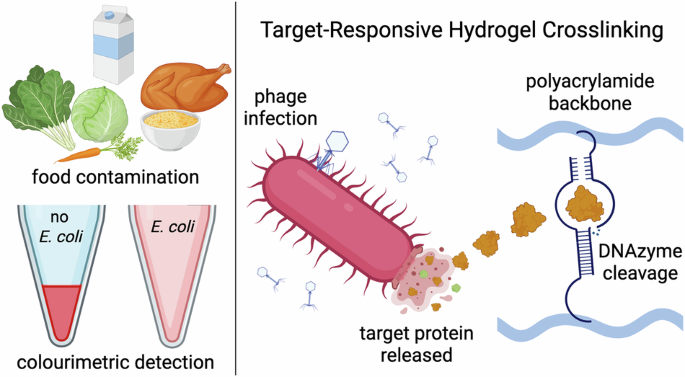
Mann, H. et al. Bacteriophage-activated DNAzyme hydrogels combined with machine learning enable point-of-use colorimetric detection of Escherichia coli. Adv. Mater. 37, 2411173 (2025).
-
Nutiu, R. & Li, Y. Structure-switching signaling aptamers. J. Am. Chem. Soc. 125, 4771–4778 (2003).
-
Yousefi, H., Ali, M. M., Su, H.-M., Filipe, C. D. M. & Didar, T. F. Sentinel wraps: real-time monitoring of food contamination by printing DNAzyme Probes on Food Packaging. ACS Nano 12, 3287–3294 (2018).
-
Ali, M. M., Aguirre, S. D., Lazim, H. & Li, Y. Fluorogenic DNAzyme Probes as Bacterial Indicators. Angew. Chem. Int. Ed. 50, 3751–3754 (2011).
-
Zhang, W., Feng, Q., Chang, D., Tram, K. & Li, Y. In vitro selection of RNA-cleaving DNAzymes for bacterial detection. Methods 106, 66–75 (2016).
-
Prasad, A. et al. Bacteriophage-loaded microneedle patches for targeted and minimally disruptive foodborne pathogen decontamination. Sci. Adv. 11, eadx6918 (2025).
-
Studier, F. W. The genetics and physiology of bacteriophage T7. Virology 39, 562–574 (1969).
-
Coulombe, G., Catford, A., Martinez-Perez, A. & Buenaventura, E. Outbreaks of Escherichia coli O157:H7 infections linked to romaine lettuce in Canada from 2008 to 2018: an analysis of food safety context. J. Food Prot. 83, 1444–1462 (2020).
-
Chen, C. et al. Studies on simultaneous enrichment and detection of Escherichia coli O157:H7 during sample shipment. Foods 11, 3653 (2022).
-
Solomon, E. B., Pang, H.-J. & Matthews, K. R. Persistence of Escherichia coli O157:H7 on lettuce plants following spray irrigation with contaminated water. J. Food Prot. 66, 2198–2202 (2003).
-
Machado-Moreira, B., Richards, K., Brennan, F., Abram, F. & Burgess, C. M. Microbial contamination of fresh produce: what, where, and how? Compr. Rev. Food Sci. Food Saf. 18, 1727–1750 (2019).
-
Mor-Mur, M. & Yuste, J. Emerging bacterial pathogens in meat and poultry: an overview. Food Bioprocess Technol. 3, 24–35 (2010).
-
U. S. FDA. Outbreak investigation of E. coli O121:H19: organic carrots (November 2024). (FDA, 2024).
-
Kintz, E. et al. Outbreaks of Shiga Toxin–Producing Escherichia coli linked to sprouted seeds, salad, and leafy greens: a systematic review. J. Food Prot. 82, 1950–1958 (2019).
-
Prasad, A. et al. Advancing in situ food monitoring through a smart lab-in-a-package system demonstrated by the detection of Salmonella in whole chicken. Adv. Mater. 35, 2302641 (2023).
-
Park, J. Y. et al. Detection of E. coli O157:H7 in food using automated immunomagnetic separation combined with real-time PCR. Processes 8, 908 (2020).
-
Bhunia, A. K. One day to one hour: how quickly can foodborne pathogens be detected? Future Microbiol 9, 935–946 (2014).
-
Priyanka, B., Patil, R. K. & Dwarakanath, S. A review on detection methods used for foodborne pathogens. Indian J. Med. Res. 144, 327–338 (2016).
-
Khan, S. et al. Material breakthroughs in smart food monitoring: intelligent packaging and on-site testing technologies for spoilage and contamination detection. Adv. Mater. 36, 2300875 (2024).