Introduction
Growing environmental pollution, such as yellow and fine dust, has heightened public concern for overall and skin health, driving demand for natural cosmetic products1. Consequently, research has focused on developing functional cosmetics using natural ingredients with antioxidant, whitening, and anti-inflammatory properties2.
Wheat (Triticum aestivum L.) is a major staple crop rich in bioactive compounds, including β-glucan, tocopherols, flavonoids, and dietary fiber, which contribute to antioxidant activity and metabolic health benefits3,4. Furthermore, wheat-derived phytosterols and ceramides exhibit antioxidant and moisturizing properties, making wheat a promising source for functional food and cosmetic applications⁵. Recently, Han et al.⁶ demonstrated the emulsifying stability and tyrosinase inhibitory activity of wheat germ-derived lipids, further supporting their potential as cosmetic ingredients. However, these studies largely focused on compositional analysis and preliminary bioactivities, without addressing the challenge of wheat’s inherently low lipid content and the need for efficient extraction and bioactivity enhancement technologies. The present study aims to fill this gap by applying plasma treatment to improve both lipid yield and functional properties.
Plasma comprises photons, ions, free electrons, and atoms in their ground or excited states, which together maintain an overall neutral charge. Among plasma techniques, dielectric barrier discharge (DBD) is widely studied due to its safety, versatility in utilizing atmospheric air for discharge generation, and low energy requirements7. In recent years, reactive air plasma (ReAP) has been extensively applied across fields such as medicine, agriculture, and the food industry8. ReAP generates reactive oxygen and nitrogen species (RONS), ozone, and other radicals that can interact with biological and food matrices, inducing chemical modifications and functional enhancements. Previous studies have examined the effects of ReAP on the quality of various foods under different operational conditions, including fruits, vegetables, wheat flour, and peanuts8,9,10. Bahrami et al.9 found that ReAP alters the chemical composition of wheat flour through radical-induced and ozone-propagated oxidation, subsequently modifying its functionality. ReAP has also been employed to enhance the functionality of natural phenolic compounds in foods such as naringin, quercetin, and phlorotannin11,12,13. Moreover, Heydari et al.14 demonstrated that several factors influence the extraction yield of plant components, including cell wall disruption, ReAP process parameters, plant species, and the material’s surface characteristics. Overall, these studies highlight the potential of ReAP not only as a physical processing tool but also as a means to improve the functional properties of biological and food materials, which underpins its growing application in various industries.
Despite these findings, few studies have specifically examined the lipid-related components and functionality of wheat lipids treated with ReAP. Therefore, this study (1) assessed the impact of ReAP treatment using a DBD plasma system on wheat lipid extraction yield and (2) investigated the effects of wheat lipids, quantified by GC–MS, on skin anti-aging properties.
Materials and methods
Samples
The wheat cultivar “Saegeumgang” was cultivated at the National Institute of Crop Science, Rural Development Administration, Wanju, Korea. It was harvested in 2022 and stored at 4 °C for subsequent analysis. This cultivar was selected because it is the most widely cultivated wheat in Republic of Korea, ensuring practical relevance and a reliable raw material supply for potential industrial applications.
Experimental setup for reap
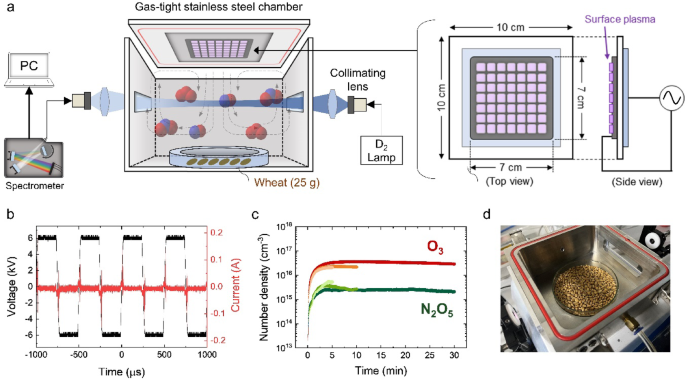
Figure 1a depicts our experimental apparatus, comprising a plasma reactor and the relevant facilities. The batch-type plasma reactor had a surface DBD (sDBD) source mounted on the lid. The reactor was cuboid-shaped with outer dimensions of 15 × 15 × 10 cm3 and an inner volume of 815 cm3. The sDBD source comprised a plane electrode and a patterned grid electrode placed on opposite sides of a dielectric plate, designed to generate an array of air discharge on the opened surfaces. The plane electrode was connected to a power system consisting of a high-voltage amplifier (Model 10/40A-HS, TREK, USA) and waveform generator (33512 B, Keysight Technologies, USA) while the grid electrode was grounded. This experimental configuration is inherently scalable and enables sample processing while maintaining no direct contact between the plasma and the target.

(a) Plasma treatment setup and in-situ measurement. (a) Schematic of the plasma reactor and sDBD source (details in the main text). (b) Measured voltage (black) and current (red) waveforms of sDBD. (c) Time evolution of O₃ and N₂O₅ number densities during plasma discharge at different treatment times. (d) Photograph of the plasma reactor used for wheat treatment.
Wheat samples weighing approximately 25 g were evenly distributed in a Petri dish placed at the center of the bottom of the reactor. Treatment times were set at 5, 10, and 30 min for the plasma exposure of wheat samples. ReAP treatment durations of 5, 10, and 30 min were selected based on preliminary tests, which indicated that these exposure times resulted in measurable changes in lipid yield and bioactivity while avoiding excessive thermal effects. The distance between the plasma source and the sample surface was approximately 8 cm. The concentration of the reactive species within the plasma reactor was monitored in real time using in situ optical absorption spectroscopy. This system included a deuterium lamp (DH-2000-BAL, Ocean Optics, USA) and a spectrometer (Maya 2000 Pro, Ocean Insight, USA). The lamp was coupled to an optical fiber (QP400-2-SR, Ocean Optics, USA), and the other end of the fiber was connected to a collimating lens assembly (74-UV, Ocean Optics, USA), which was employed to collimate and direct light into the chamber and spectrometer. All spectral data were recorded automatically using a computer, and the absolute number densities of the chemicals were calculated using the Beer-Lambert law. Representative deconvolution results of the absorption spectra at 5 and 30 min are provided in Supplementary Fig. S1, confirming the accuracy of the spectral fitting and the reliability of the calculated concentrations. A detailed description of the spectral data analysis can be found in our previous paper15.
A square waveform of voltage with a 12-kV amplitude at a 2-kHz frequency was applied to the sDBD (Fig. 1b). The voltage and current waveforms of the sDBD were obtained using a high-voltage probe (P6015A, Tektronix, USA) and current probe (Model 4936, Pearson Electronics, USA) in conjunction with a 200-MHz bandwidth oscilloscope (MDO34, Tektronix, USA). In addition, a charge-voltage (Q–V) Lissajous curve (not shown here) was obtained to estimate the power dissipation to the plasma. The charge Q was calculated from the voltage across a 100-nF capacitor that was serially connected between the electrode and ground. The electric power dissipated by sDBD was 14 W.
Figure 1c presents the time evolution of the key chemical species produced within the plasma reactor; O3 and N2O5 were the dominant species. In all cases, during the first 5 min, both species spontaneously increased and became saturated. Notably, in the absence of the samples, the time-dependent formation of O3 and N2O5 was stable and reproducible. However, during the experiments, the saturation levels of their concentrations showed slight variations, although not significantly. This difference is likely due to the presence of the samples, which could affect the discharge and subsequent chemical production within the plasma reactor. The data in Fig. 1c were identified based on the treatment time. Figure 1d shows a photograph of the actual experimental apparatus used for wheat treatment. This image complements the schematic diagram and clearly illustrates the reactor configuration and sample placement during ReAP treatment.
All the experiments conducted in this study were performed using the same devices without any replacement, ensuring that there was no aging effect on the sDBD source throughout the experimental procedures.
Lipid extraction
Prior to lipid extraction, the wheat treated with plasma was ground using a blender and passed through a sieve (100 mesh) to obtain a fine powder with uniformly-sized particles. The lipids from the ground wheat were then extracted using the Folch method16. Briefly, 10 g of wheat was placed in a flask containing 50 mL Folch solution (chloroform: methanol = 2:1). The flask was then sealed and shaken at 25 °C for 24 h. After shaking, the mixture was filtered through a filter paper, and 15 mL of 0.88% sodium chloride solution was added. The 0.88% NaCl solution was added to promote clear phase separation, allowing water-soluble impurities (proteins, carbohydrates) to move into the aqueous phase while retaining lipids in the chloroform layer, thereby improving extraction efficiency. After vigorous shaking, the lower phase was collected and evaporated in a nitrogen atmosphere. The lipid extraction yield was determined by weighing the evaporated samples.
Field-emission scanning electron microscopy (FESEM)
Three types of wheat samples were prepared for testing morphological changes: untreated (control), plasma-affected, and heat-affected samples. For heat-affected samples, the plasma reactor lid containing the sDBD source was inverted so that the plasma was generated at the outer surface, isolating plasma from the reactor. This simple way allowed the reactor to be thermally affected by the operation of the sDBD while protecting the samples from plasma-generated chemical species and UV radiation.
FESEM (Magellan400, FEI Company, Oregon, USA) was used to observe surface changes in the wheat samples after plasma treatment. The samples were mounted on stubs using carbon tape and sputter-coated with a platinum target using an ion sputter coater (SPT-20, COXEM, JNY SOLUTION, Korea) to ensure conductivity. Imaging was performed using an FESEM system at an acceleration voltage of 5 kV and a beam current of 50 pA. The surface changes observed in the seed coat of wheat were compared to those in the untreated control samples, with the microscope set to a magnification of 500× and a scale of 100 μm.
Fatty acid contents
To investigate changes in the fatty acid content of wheat lipids after ReAP, a modified method based on Moigradean et al.17 was employed. After alkaline hydrolysis, the samples were subjected to methyl esterification using the BF3 methanol method. Specifically, 20 mg of sample was combined with 2 mL of 0.5 M NaOH methanol solution and heated at 80 °C for 10 min. After cooling, 2 mL of 14% BF3-methanol reagent was added, the container was sealed, and the mixture was heated to 100 °C for 5 min. After cooling, 2 mL isooctane and 7 mL saturated NaCl solution were added, and the mixture was thoroughly shaken. The solution was then centrifuged (2,500 rpm, 3 min), and the supernatant was collected and filtered through a Pasteur pipette filled with anhydrous sodium sulfate. The resulting filtrate was further filtered using a 0.22 μm PTFE syringe filter, concentrated under nitrogen gas, and re-dissolved in 1 mL of hexane for subsequent analysis.
Fatty acid methyl esters (FAME) were analyzed using gas chromatography coupled with a mass-selective detector (GC/MS QP 2010, Shimadzu, Kyoto, Japan). Separation was carried out on a DB-FFAP capillary column (30 m×0.25 mm ID, 0.25 μm film thickness, Agilent Technologies, Santa Clara, CA, USA). Helium was used as the carrier gas at a 3 mL/min flow rate and a 1:50 split ratio. The injector temperature was maintained at 250 °C. The oven temperature program was initiated at 120 °C and increased to 245 °C at a rate of 3 °C/min, with a final hold time of 3 min. MS spectra were recorded over a mass range of m/z 35–500, with the interface temperature set at 230 °C and the ion source temperature at 200 °C. Additional settings included a solvent cut time of 3 min, an event time of 0.30, and a scan speed of 1666. The FAME peaks were identified by comparing their retention times and equivalent chain lengths with those of standard FAMEs. The standards were obtained from Supelco Inc. (Bellefonte, PA, USA) (Supelco 37 Component FAME Mix), and other reagents were sourced from Merck, Germany. The fatty acid content was calculated based on the peak area and the sample weight. All measurements were performed in triplicate.
Enzyme Inhibition activity
The inhibitory activities of tyrosinase and elastase were evaluated using the enzymatic methods described by Han et al.6. For tyrosinase inhibition, a dopachrome assay was performed using L-3,4-dihydroxyphenylalanine L-DOPA as the substrate. Elastase inhibitory activity was determined by measuring the release of p-nitroaniline from N-succinyl-Ala-Ala-Ala-Ala-p-nitroanilide. Kojic acid and elastin were positive controls in the tyrosinase and elastase inhibition assays, respectively. The samples were tested at concentrations of 1 mg/mL for tyrosinase inhibitory activity and 0.1 mg/mL for elastase inhibitory activity.
Moisturizing activity
The Human keratinocyte cell line HaCaT (American Type Culture Collection, VA, USA) was cultured in DMEM supplemented with 10% fetal bovine serum (FBS; Gibco, MA, USA) and 1% penicillin-streptomycin (Sigma-Aldrich, MO, USA) at 37 °C in a humidified atmosphere of 5% CO2. The cells were detached using trypsin-EDTA (Welgene, Daegu, Republic of Korea) and sub-cultured every 2–3 days. For the experiments, cells were seeded in 96-well plates at a density of 1 × 10⁵ cells/mL and allowed to adhere for 15 h. The cells were treated with the various samples for 24 h. After treatment, cells were washed with phosphate-buffered saline to remove debris, and cell viability was assessed using the MTS assay (CellTiter 96® AQueous One Solution Cell Proliferation Assay, Promega, WI, USA). Specifically, 10 µL of MTS reagent was added to each well, and the reaction time was adjusted to ensure the absorbance difference between the blank and the negative control group (DMSO-treated group) was between 1.2 and 1.5. The absorbance was measured at 490 nm using an EnVision XCite 2105 Multimode Plate Reader (CT, USA).
Based on the cytotoxicity analysis results, the amount of hyaluronic acid produced was measured to assess the moisturizing activity of lipids extracted from plasma-treated wheat. The cells were seeded in a 96-well plate at a density of 2 × 10⁴ cells/well. After an overnight incubation, the medium was replaced with serum-free DMEM. To eliminate the effect of FBS, the cells were serum-starved for 24 h before treatment with the samples at the specified concentrations. After 24 h of treatment, the culture supernatants were collected, and HA levels were measured using the Hyaluronan Quantikine ELISA kit (R&D Systems, Minneapolis, MN, USA), which was conducted in triplicate according to the manufacturer’s instructions. HA levels were quantified using a standard curve.
Statistical analyses
All data are expressed as the mean ± standard deviation of three replicates (n = 3). Statistical comparisons among treatments were conducted using Duncan’s multiple range test with a significance threshold of p < 0.05, using the SPSS statistical software (version 18.0; SPSS, Inc., Chicago, IL, USA).
Results and discussion
Lipid extraction yields
Cold treatment induces cavitation and microstreaming, which fragments particles into smaller sizes, promotes cell swelling and hydration, and enhances the release of proteins into the extraction solvent18. However, no reported studies exist on the enhancement of wheat lipid extraction yields using ReAP. Figure 2 presents the lipid extraction yield from wheat after ReAP treatment in this study. The untreated sample yielded 1.78% lipids, which increased with ReAP treatment, peaking at 2.97% in the sample treated for 10 min (p < 0.05). The observed increase in lipid content after ReAP treatment may be attributed to the disruption of the wheat cell structure caused by grinding and plasma exposure, which enhanced lipid release. Furthermore, the Folch method, employing a chloroform–methanol (2:1) mixture, is highly effective for total lipid extraction, potentially contributing to the higher extraction yield compared with untreated samples16,19.

Lipid extraction yields of wheat lby treated with cold reactive air plasma. Different letters indicate significant differences according to Duncan’s multiple range test at p < 0.05.
The wheat endocarp consists of two cell layers: cross cells and tube cells. Cross cells, which have thicker walls than tube cells, contain lipid components20. It is hypothesized that ReAP treatment affects the cross cells by thinning their walls, thereby enhancing lipid extraction yields. Specifically, O3 generated during ReAP is a strong oxidant that induces oxidative stress. Consequently, cell-wall proteins and polysaccharides in the cross-cell layer undergo oxidative degradation, loosening the wall matrix and improving lipid extraction. In addition, N2O5 generated simultaneously may create localized acidic microenvironments through hydrolysis to HNO3, potentially contributing to additional stress on the cell-wall matrix21,22,23,24. ReAP can also induce changes in the physical properties of the plant surface, such as the formation of cracks and depressions, which facilitate the release of compounds of interest, thereby increasing extraction efficiency14. Similar enhancements in the extraction yields of functional components, such as sugars and proteins, have been observed in natural products treated with ReAP. For instance, Rashid et al.25 highlighted the role of ReAP in improving galactomannan extraction by generating reactive species in the extraction solvent and modifying the seed’s surface microstructure. Likewise, Kim et al.26 reported that the protein extraction yield from soybeans increased when the beans were crushed and treated with plasma under NOx conditions.
Given that the wheat endocarp contains cross cells with thicker walls, which house the lipid components, the efficiency of functional component extraction can vary based on several factors, including the sample’s condition, the choice of extraction solvents, and the types of radicals produced during ReAP treatment.
FESEM
To investigate the effects of ReAP on the wheat surface, a detailed examination was conducted using FESEM (Fig. 3). The control sample exhibited distinct rectangular subdomains on the wheat surface (Fig. 3a). However, after ReAP treatment, these defined boundaries disappeared, resulting in a smoother surface structure (Fig. 3b–d). The surface coat of the wheat was removed, and surface roughness was reduced due to the plasma treatment. Notably, after 30 min of ReAP treatment, cracks appeared on the wheat surface, likely caused by increased chamber temperature and moisture evaporation. This phenomenon was attributed to the humidity within the chamber and the generation of highly oxidative reactive species27.

FESEM images of wheat surfaces treated with cold reactive air plasma. (a) Control (untreated). (b–d) Surfaces after 5, 10, and 30 min plasma treatment; cracks in the seed coat (green dashed lines) are visible at 30 min. (e–g) Surfaces after heat exposure (plasma without reactive species) for 5, 10, and 30 min.
The effects of ReAP on wheat surface morphology may vary depending on the wheat type. Wheat is generally classified as hard, soft, or intermediate based on hardness. Misra et al.28 used DBD-induced cold plasma to modify the structural and functional properties of both hard and soft wheat flours. In this study, the “Saegeumgang” cultivar was used and is classified as intermediate. Further research is necessary to explore the effects of ReAP on both soft and hard wheat cultivars.
Various factors influence plasma-affected samples, including the chemical species, ultraviolet (UV) radiation, and heat generated within the reactor. To determine whether the observed surface changes were caused by heat, heat-affected samples were analyzed, excluding the effects of chemical species and UV radiation. The analysis showed that increased temperature and moisture evaporation alone did not contribute to the surface changes (Fig. 3e–g).
In conclusion, ReAP treatment enhances the permeability of the wheat seed coat to oxygen or water29 by weakening the physical barrier on the surface. This, in turn, facilitates solvent penetration30 and improves lipid interactions.
Fatty acid contents
After lipids were extracted from wheat and their fatty acid profiles analyzed, palmitic, stearic, oleic, linoleic, and α-linolenic acids were detected (Table 1). Following 10 min of ReAP treatment, the palmitic acid content increased significantly, from 22.70 mg/100 g to 120.15 mg/100 g, representing a 5.29-fold increase (p < 0.05). Similarly, the linoleic acid content rose from 29.20 mg/100 g to 243.49 mg/100 g, an 8.34-fold increase (p < 0.05). However, the contents of stearic acid, oleic acid, and α-linolenic acid decreased after ReAP treatment. These findings align with those of previous studies that reported increases in specific fatty acids, such as palmitic and α-linolenic acids, in wheat flours exposed to oxygen and helium plasma discharges31. Additionally, Bahrami et al.9 demonstrated that ReAP treatment significantly impacted the free fatty acid and phospholipid content in wheat flour. The remarkable increase in palmitic and linoleic acid concentrations observed after ReAP treatment may be attributed to enhanced cell wall disruption caused by plasma exposure combined with fine grinding, which facilitated the release of intracellular lipids. Furthermore, the use of the Folch extraction method, which is highly efficient for total lipid recovery, might have contributed to the increased yield. Nevertheless, further studies using other cereal grains with varying lipid contents are needed to determine whether similar increases in fatty acid concentrations can be consistently observed following plasma treatment.
ReAP treatment also markedly altered the fatty acid composition of wheat lipids, resulting in significant increases in palmitic acid (C16:0) and linolenic acid (C18:3), whereas some other fatty acids decreased. These compositional shifts can be attributed to several factors. First, dielectric barrier discharge plasma disrupts cellular membranes and surface structures, as confirmed by microscopic observations, thereby enhancing the release of fatty acids bound in phospholipids or neutral lipids. Second, plasma-generated reactive oxygen and nitrogen species (RONS) induce selective oxidation and cleavage of more oxidation-susceptible polyunsaturated fatty acids, enriching relatively stable fatty acids such as palmitic acid. In addition, the observed increase in linolenic acid may partly result from a relative enrichment effect caused by the preferential degradation of other unsaturated fatty acids, as reported in similar studies32,33,34. Overall, these results suggest that ReAP treatment not only improves lipid yield but also modulates fatty acid composition through a combination of physical disruption and selective oxidative reactions.
Various processing methods, including ReAP and electron beam irradiation, have been employed to increase the levels of functional components in crops, such as polyphenols and proteins. However, few studies have investigated the effects of ReAP on lipids in food products, likely because ReAP treatments tend to promote lipid oxidation. Notably, the ReAP treatment duration and the plasma gas type are critical factors influencing lipid oxidation. For example, Gao et al.35 found that oxygen plasma caused greater reductions in unsaturated, monounsaturated, and polyunsaturated fatty acids in wheat flour compared to helium plasma. Despite this, the production of specific fatty acids can enhance their value as functional ingredients. Linoleic acid, for instance, inhibits melanin production, underscoring its potential to prevent UV-induced skin hyperpigmentation36.
Enzyme Inhibition and moisturizing activities
To investigate the anti-aging properties of wheat lipids, their enzyme inhibitory activities against tyrosinase and elastase were evaluated. Tyrosinase catalyzes the hydroxylation of L-tyrosine to L-3,4-dihydroxyphenylalanine (L-DOPA) and the subsequent oxidation of L-DOPA to dopaquinone, both of which are essential steps in the melanin biosynthesis pathway31. While melanin plays a protective role in shielding the skin from UV radiation, excessive melanin production can lead to hyperpigmentation disorders, such as melasma, freckles, and age spots37. Thus, developing tyrosinase inhibitors is critical for controlling melanin overproduction and for skin-whitening applications in cosmetics. After 10 min of ReAP treatment, the tyrosinase inhibitory activity of wheat lipid extract (1 mg/mL) increased from 61.79% to 72.76% (p < 0.05). Elastin, a key protein in skin elasticity, strength, and resilience, is broken down by elastase. Elastase activation reduces skin elasticity, wrinkle formation, and overall skin aging31. The elastase inhibitory activity of the wheat lipid extract (0.1 mg/mL) increased from 24.64% to 34.67% after 10 min of ReAP treatment (p < 0.05), but it decreased by approximately 10% following 30 min of treatment (Table 2). Similar to tyrosinase inhibition, the most significant elastase inhibition was observed after 10 min of ReAP treatment.
The enhanced tyrosinase and elastase inhibition activities observed after ReAP treatment may be associated with the increased availability of lipid-soluble bioactive compounds. Previous studies have shown that nonpolar fractions rich in lipids can exert stronger elastase inhibition compared with polar fractions, suggesting a role for lipid-derived bioactive in these effects38,39.
To assess the moisturizing activity of wheat lipid extracts treated with ReAP, the viability of HaCaT cells was evaluated. When exposed to wheat lipid extract at concentrations of 200 µg/mL or lower, HaCaT cells maintained a high survival rate of 95.83% or greater (p < 0.05) (Fig. 4a). Moisturizing activity was determined by measuring hyaluronic acid (HA) production in HaCaT cells. All assays were performed at concentrations verified to be non-cytotoxic in preliminary tests. The moisturizing effect of untreated wheat lipid extract increased concentration-dependently. Notably, the extract demonstrated the highest moisturizing activity when the cells were treated with 200 µg/mL of wheat lipid extract and then subjected to 10 min of ReAP treatment, surpassing even the positive control, which had a moisturizing activity comparable to that of a 5 mg/mL solution (p < 0.05) (Fig. 4b). The relatively low or absent cytotoxicity of the lipid extracts within this range further supports their potential applicability as safe bioactive ingredients.

Cell viability and moisturizing activity of wheat lipids treated with cold reactive air plasma.
The skin-aging-related enzyme inhibition and moisturizing effects of ReAP-treated wheat lipid extracts are likely attributed to functional lipid components, such as ceramides and linolenic acid. Ando et al.36 demonstrated that certain lipid components help inhibit melanin biosynthesis. Intercellular lipids, especially ceramides, are essential for maintaining the skin’s barrier function and the water-holding capacity of the stratum corneum40. Guillou et al.5 also explored the moisturizing effects of ceramide components in wheat, highlighting their potential use in cosmetic formulations. However, studies on the bioactivity of wheat lipids as cosmetic ingredients remain limited.
Further research is required to explore the mechanisms behind the enzyme inhibitory and moisturizing activities of ReAP-treated wheat lipids, as well as to conduct correlation analyses between specific lipid components and these bioactivities. Given the growing interest among cosmetic companies in natural substances with whitening, anti-wrinkle, and moisturizing properties, our findings hold significant commercial potential. Applying ReAP to wheat could yield valuable materials for use in the cosmetic industry.
Based on the enzyme inhibition and moisturizing activity results, it is hypothesized that ReAP treatment increased the levels of specific fatty acids, such as palmitic and linoleic acids, in wheat, likely enhancing enzyme inhibition related to skin aging and improving moisturizing activity. To further explore the potential of wheat lipids as cosmetic ingredients, follow-up studies involving animal experiments or clinical trials are required. In addition, for industrial applications, verification of the bioactivity using a scaled-up plasma system should be conducted to confirm reproducibility and practical feasibility. These findings highlight the potential of wheat lipids for development into natural skin care products.
Conclusion
ReAP has the potential to transform wheat into a valuable lipid source. A 10-min ReAP treatment enhanced the lipid extraction yield and improved the functional properties of wheat lipids, particularly in wrinkle reduction and moisturizing efficacy. Thus, a 10-min ReAP treatment is an efficient and promising method for preparing wheat lipids for industrial applications.
Data availability
The datasets used and/or analyzed during the current study available from the corresponding author on reasonable request.
References
-
Lee, T. B., So, Y. K., Kim, S. Y. & Hwang, J. Y. Biological activities of cosmetic material from ten kinds of flower ethanol extracts. Korean J. Med. Crop Sci. 28 (4), 260–275. https://doi.org/10.7783/KJMCS.2020.28.4.260 (2020).
-
Han, N. et al. Application of emulsion containing wheat-bran-derived lipids as a functional cosmetic Raw material. Korean J. Food Sci. Technol. 55 (3), 278–281. https://doi.org/10.9721/KJFST.2023.55.3.278 (2023).
-
Kim, S. et al. Comparison of lipid-related compounds in wheat cultivars and their physiological activities. J. Korean Soc. Food Sci. Nutr. 51 (8), 789–796. https://doi.org/10.3746/jkfn.2022.51.8.789 (2022).
-
Ziegler, J. U., Schweiggert, R. M., Würschum, T., Longin, C. F. H. & Carle, R. Lipophilic antioxidants in wheat (Triticum spp.): A target for breeding new varieties for future functional cereal products. J. Func Foods. 20, 594–605. https://doi.org/10.1016/j.jff.2015.11.022 (2016).
-
Guillou, S. et al. The moisturizing effect of a wheat extract food supplement on women’s skin: A randomized, double-blind placebo-controlled trial. Int. J. Cosmet. Sci. 33 (2), 138–143. https://doi.org/10.1111/j.1468-2494.2010.00600.x (2011).
-
Han, N. et al. Effect of atmospheric-pressure plasma on functional compounds and physiological activities in peanut shells. Antioxidants 11, 2214. https://doi.org/10.3390/antiox11112214 (2022).
-
Sarangapani, C. et al. Pesticide degradation in water using atmospheric air cold plasma. J. Water Process. Eng. 9, 225–232. https://doi.org/10.1016/j.jwpe.2016.01.003 (2016).
-
Domonkos, M., Tichá, P., Trejbal, J. & Demo, P. Applications of cold atmospheric pressure plasma technology in medicine, agriculture and food industry. Appl. Sci. 11, 4809. https://doi.org/10.3390/app11114809 (2021).
-
Bahrami, N. et al. Cold plasma: A new technology to modify wheat flour functionality. Food Chem. 202, 247–253. https://doi.org/10.1016/j.foodchem.2016.01.113 (2016).
-
Gebremical, G. G., Emire, S. A. & Berhanu, T. Effects of multihollow surface dielectric barrier discharge plasma on chemical and antioxidant properties of peanut. J. Food Qual. 2019, 1–10. https://doi.org/10.1155/2019/3702649 (2019).
-
Kim, T. H., Lee, J., Kim, H. J. & Jo, C. Plasma-induced degradation of Quercetin associated with the enhancement of biological activities. J. Agric. Food Chem. 65 (32), 6929–6935. https://doi.org/10.1021/acs.jafc.7b00987 (2017).
-
Kim, H. J. et al. Effect of atmospheric pressure dielectric barrier discharge plasma on the biological activity of naringin. Food Chem. 160, 241–245. https://doi.org/10.1016/j.foodchem.2014.03.101 (2014).
-
Kim, H. J. et al. Plasma-polymerized phlorotannins and their enhanced biological activities. J. Agric. Food Chem. 68 (8), 2357–2365. https://doi.org/10.1021/acs.jafc.9b07077 (2020).
-
Heydari, M. et al. Cold plasma-assisted extraction of phytochemicals: A review. Foods 12 (17), 3181. https://doi.org/10.3390/foods12173181 (2023).
-
Kim, J. et al. Competitive formation of NO, NO2, and O3 in an air-flowing plasma reactor: A central role of the flow rate. Chem. Eng. J. 468, 143636. https://doi.org/10.1016/j.cej.2023.143636 (2023).
-
Folch, J., Lees, M. & Sloane Stanley, G. H. A simple method for the isolation and purification of total lipids from animal tissues. J. Biol. Chem. 226 (1), 497–509. https://doi.org/10.1016/S0021-9258(18)64849-5 (1957).
-
Moigradean, D., Poiana, M. A., Alda, L. M. & Gogoasa, I. Quantitative identification of fatty acids from walnut and coconut oils using GC-MS method. J. Agroaliment Processes Technol. 19, 459–463 (2013).
-
Rahman, M. M. & Lamsal, B. P. Ultrasound-assisted extraction and modification of plant-based proteins: impact on physicochemical, functional, and nutritional properties. Compr. Rev. Food Sci. 20 (2), 1457–1480. https://doi.org/10.1111/1541-4337.12709 (2021).
-
Omar, A. M. & Zhang, Q. Evaluation of lipid extraction protocols for untargeted analysis of mouse tissue lipidome. Metabolites 13, 1002 (2023).
-
Legland, D., Le, T. D. Q., Alvarado, C., Girousse, C. & Chateigner-Boutin, A. L. New growth-related features of wheat grain pericarp reveled by synchrotron-based X-ray micro-tomography and 3D reconstruction. Plants 12(5), 1038. https://doi.org/10.3390/plants12051038 (2023).
-
Gall, H. L. et al. Cell wall metabolism in response to abiotic stress. Plant 4, 112–166. https://doi.org/10.3390/plants4010112 (2015).
-
Wiese, C. B. & Pell, E. J. Oxidative modification of the cell wall in tomato plants exposed to Ozone. Plant. Physiol. Biochem. 41, 375–382. https://doi.org/10.1016/S0981-9428(03)00033-0 (2003).
-
Wu, Z. et al. Dielectric barrier discharge plasma delayed the textural hardening of bamboo shoots by regulating cell wall metabolism. Sci. Hortic. 321, 112322. https://doi.org/10.1017/j.scienta.2023.112322 (2023).
-
Shu, J. et al. Synergistic generation of N2O5 by needle-ring electrode and gliding Arc discharge air plasmas for enhanced bacterial inactivation. AIP Adv. 15, 075140. https://doi.org/10.1063/5.0280729 (2025).
-
Rashid, F., Bao, Y., Ahmed, Z. & Huang, J. Y. Effect of high voltage atmospheric cold plasma on extraction of Fenugreek Galactomannan and its physicochemical properties. Food Res. Int. 138, 109776. https://doi.org/10.1016/j.foodres.2020.109776 (2020).
-
Kim, H. J. et al. Structural and functional changes in soybean protein via remote plasma treatments. Molecules 28 (9), 3882. https://doi.org/10.3390/molecules28093882 (2023).
-
Janić Hajnal, E., Vukić, M., Pezo, L., Orčić, D. & Puač, N. Šoronja Simović, D. Effect of atmospheric cold plasma treatments on reduction of Alternaria toxins content in wheat flour. Toxins 11 (12), 704. https://doi.org/10.3390/toxins11120704 (2019).
-
Misra, N. N. et al. Atmospheric pressure cold plasma (ACP) treatment of wheat flour. Food Hydrocoll. 44, 115–121. https://doi.org/10.1016/j.foodhyd.2014.08.019 (2015).
-
Bormashenko, E., Grynyov, R., Bormashenko, Y. & Drori, E. Cold radiofrequency plasma treatment modifies wettability and germination speed of plant seeds. Sci. Rep. 2, 741. https://doi.org/10.1038/srep00741 (2012).
-
Guo, Q. et al. Improvement of wheat seed vitality by dielectric barrier discharge plasma treatment. Bioelectromagnetics 39 (2), 120–131. https://doi.org/10.1002/bem.22088 (2018).
-
Mechqoq, H. et al. El Aouad, N. Molecular docking, tyrosinase, collagenase, and elastase Inhibition activities of Argan by-products. Cosmetics 9 (1), 24. https://doi.org/10.3390/cosmetics9010024 (2022).
-
Bayati, M., Lund, M. N., Tiwari, B. K. & Poojary, M. M. Chemical and physical changes induced by cold plasma treatment of foods: A critical review. Compr. Rev. Food Sci. Food Saf. 23, e13376. https://doi.org/10.1111/1541-4337.13376 (2024).
-
Upadhyay, R., Thirumdas, R., Deshmukh, R. R., Annapure, U. & Misra, N. N. An exploration of the effects of low-pressure plasma discharge on the physicochemical properties of Chia (Salvia Hispanica L.) flour. J. Eng. Process. Manag. 11 (2), 73–80. https://doi.org/10.7251/JEPM19020730 (2019).
-
Wang, Y. et al. LC-MS-based lipidomics analyses revealed changes in lipid profiles in Asian sea bass (Lates calcarifer) with dielectric barrier discharge (DBD) atmospheric plasma treatment. Food Chem. 439, 138098. https://doi.org/10.1016/j.foodchem.2023.138098 (2024).
-
Gao, G., Wu, J., Wei, Z. & Li, X. Effects of low-pressure radio-frequency cold plasma on the biochemical parameters and fatty acid profile of wheat flours. Cereal Chem. 100 (2), 393–413. https://doi.org/10.1002/cche.10618 (2023).
-
Ando, H., Ryu, A., Hashimoto, A., Oka, M. & Ichihashi, M. Linoleic acid and α-linolenic acid lightens ultraviolet-induced hyperpigmentation of the skin. Arch. Derm. Res. 290(7), 375–381. https://doi.org/10.1007/s004030050320 (1998).
-
Bose, B., Choudhury, H., Tandon, P. & Kumaria, S. Studies on secondary metabolite profiling, anti-inflammatory potential, in vitro photoprotective and skin-aging related enzyme inhibitory activities of Malaxis acuminata, a threatened Orchid of nutraceutical importance. J. Photochem. Photobiol B: Biol. 173, 686–695. https://doi.org/10.1016/j.jphotobiol.2017.07.010 (2017).
-
Ambarwati, N. S. S. et al. In vitro studies on the cytotoxicity, elastase, and tyrosinase inhibitory activities of tomato (Solanum lycopersicum Mill.) extract. J. Adv. Pharm. Technol. Res. 13, 182–186. https://doi.org/10.4103/japtr.japtr_49_22 (2022).
-
Alam, A. F., Song, M. B., Lee, S. H. & B. R., & Activities of optimized unripe Ajwa date pulp (Phoenix dactylifera) extract by response surface methodology. Int. J. Mol. Sci. 24 (4), 3396. https://doi.org/10.3390/ijms24043396 (2023).
-
Bizot-Foulon, V. et al. Inhibition of human neutrophil elastase by wheat ceramides. Int. J. Cosmet. Sci. 17 (6), 255–264. https://doi.org/10.1111/j.1467-2494.1995.tb00130.x (1995).
Acknowledgements
This study was funded by the Cooperative Research Program for Agriculture Science and Technology Development (grant number PJ016086012023) of the Rural Development Administration of the Republic of Korea.
Ethics declarations
Competing interests
The authors declare no competing interests.
Additional information
Publisher’s note
Springer Nature remains neutral with regard to jurisdictional claims in published maps and institutional affiliations.
Supplementary Information
Rights and permissions
Open Access This article is licensed under a Creative Commons Attribution-NonCommercial-NoDerivatives 4.0 International License, which permits any non-commercial use, sharing, distribution and reproduction in any medium or format, as long as you give appropriate credit to the original author(s) and the source, provide a link to the Creative Commons licence, and indicate if you modified the licensed material. You do not have permission under this licence to share adapted material derived from this article or parts of it. The images or other third party material in this article are included in the article’s Creative Commons licence, unless indicated otherwise in a credit line to the material. If material is not included in the article’s Creative Commons licence and your intended use is not permitted by statutory regulation or exceeds the permitted use, you will need to obtain permission directly from the copyright holder. To view a copy of this licence, visit http://creativecommons.org/licenses/by-nc-nd/4.0/.
About this article

Cite this article
Kim, HJ., Han, N., Bae, J.H. et al. Reactive air plasma treatment enhances extraction yield and bioactive anti-aging properties of wheat lipids. Sci Rep 15, 44925 (2025). https://doi.org/10.1038/s41598-025-29355-x
-
Received:
-
Accepted:
-
Published:
-
Version of record:
-
DOI: https://doi.org/10.1038/s41598-025-29355-x