Data availability
The raw data associated with Figs. 7 and 8 have been deposited to the European Genome Phenome archive under the dataset ID EGAD50000001589.
Code availability
The described computational pipeline for processing SUM-seq sequencing data is available at GitHub via https://git.embl.de/grp-zaugg/SUMseq.
References
-
Baysoy, A., Bai, Z., Satija, R. & Fan, R. The technological landscape and applications of single-cell multi-omics. Nat. Rev. Mol. Cell Biol. 24, 695–713 (2023).
-
Badia-i-Mompel, P. et al. Gene regulatory network inference in the era of single-cell multi-omics. Nat. Rev. Genet. 24, 739–754 (2023).
-
Claringbould, A. & Zaugg, J. B. Enhancers in disease: molecular basis and emerging treatment strategies. Trends Mol. Med. 27, 1060–1073 (2021).
-
Xu, W. et al. ISSAAC-seq enables sensitive and flexible multimodal profiling of chromatin accessibility and gene expression in single cells. Nat. Methods 19, 1243–1249 (2022).
-
Ma, S. et al. Chromatin potential identified by shared single-cell profiling of RNA and chromatin. Cell 183, 1103–1116.e20 (2020).
-
Zhu, C. et al. An ultra high-throughput method for single-cell joint analysis of open chromatin and transcriptome. Nat. Struct. Mol. Biol. 26, 1063–1070 (2019).
-
Lareau, C. A. et al. Droplet-based combinatorial indexing for massive-scale single-cell chromatin accessibility. Nat. Biotechnol. 37, 916–924 (2019).
-
Lobato-Moreno, S. et al. Single-cell ultra-high-throughput multiplexed chromatin and RNA profiling reveals gene regulatory dynamics. Nat. Methods 22, 1213–1225 (2025).
-
Datlinger, P. et al. Ultra-high-throughput single-cell RNA sequencing and perturbation screening with combinatorial fluidic indexing. Nat. Methods 18, 635–642 (2021).
-
Di, L. et al. RNA sequencing by direct tagmentation of RNA/DNA hybrids. Proc. Natl Acad. Sci. USA 117, 2886–2893 (2020).
-
Zhang, H. et al. txci-ATAC-seq: a massive-scale single-cell technique to profile chromatin accessibility. Genome Biol. 25, 78 (2024).
-
Bartosovic, M., Kabbe, M. & Castelo-Branco, G. Single-cell CUT&Tag profiles histone modifications and transcription factors in complex tissues. Nat. Biotechnol. 39, 825–835 (2021).
-
Stoeckius, M. et al. Simultaneous epitope and transcriptome measurement in single cells. Nat. Methods 14, 865–868 (2017).
-
Otoničar, J. et al. HIPSD&R-seq enables scalable genomic copy number and transcriptome profiling. Genome Biol. 25, 316 (2024).
-
Clark, I. C. et al. Microfluidics-free single-cell genomics with templated emulsification. Nat. Biotechnol. 41, 1557–1566 (2023).
-
Picelli, S. et al. Tn5 transposase and tagmentation procedures for massively scaled sequencing projects. Genome Res. 24, 2033–2040 (2014).
-
Hennig, B. P. et al. Large-scale low-cost NGS library preparation using a robust Tn5 purification and tagmentation protocol. G3 Genes Genomes Genet. 8, 79–89 (2018).
-
Kaminow, B., Yunusov, D. & Dobin, A. STARsolo: accurate, fast and versatile mapping/quantification of single-cell and single-nucleus RNA-seq data. Preprint at bioRxiv https://doi.org/10.1101/2021.05.05.442755 (2021).
-
Lun, A. T. L. et al. EmptyDrops: distinguishing cells from empty droplets in droplet-based single-cell RNA sequencing data. Genome Biol. 20, 63 (2019).
-
Zhang, H. et al. Fast alignment and preprocessing of chromatin profiles with Chromap. Nat. Commun. 12, 6566 (2021).
-
Stuart, T. et al. Comprehensive integration of single-cell data. Cell 177, 1888–1902.e21 (2019).
-
Wolf, F. A., Angerer, P. & Theis, F. J. SCANPY: large-scale single-cell gene expression data analysis. Genome Biol. 19, 15 (2018).
-
Granja, J. M. et al. ArchR is a scalable software package for integrative single-cell chromatin accessibility analysis. Nat. Genet. 53, 403–411 (2021).
-
Stuart, T., Srivastava, A., Madad, S., Lareau, C. A. & Satija, R. Single-cell chromatin state analysis with Signac. Nat. Methods 18, 1333–1341 (2021).
-
User Guide Chromium Next GEM Single Cell ATAC Reagent Kits v2. 10x Genomics Manual CG000496-Rev C (10x Genomics, 2024).
-
Heumos, L. et al. Best practices for single-cell analysis across modalities. Nat. Rev. Genet. 24, 550–572 (2023).
-
Ashuach, T. et al. MultiVI: deep generative model for the integration of multimodal data. Nat. Methods 20, 1222–1231 (2023).
-
Argelaguet, R. et al. MOFA+: a statistical framework for comprehensive integration of multi-modal single-cell data. Genome Biol. 21, 111 (2020).
-
Piran, Z., Cohen, N., Hoshen, Y. & Nitzan, M. Disentanglement of single-cell data with biolord. Nat. Biotechnol. 42, 1678–1683 (2024).
-
Nuclei Isolation for Single Cell Multiome ATAC + Gene Expression Sequencing. 10x Genomics Manual CG000365-Rev C (10x Genomics, 2025).
-
Nuclei Isolation from Complex Tissues for Single Cell Multiome ATAC + Gene Expression Sequencing. 10x Genomics Manual CG000375-Rev C (10x Genomics, 2022).
-
Nadelmann, E. R. et al. Isolation of nuclei from mammalian cells and tissues for single-nucleus molecular profiling. Curr. Protoc. 1, e132 (2021).
-
Slyper, M. et al. A single-cell and single-nucleus RNA-seq toolbox for fresh and frozen human tumors. Nat. Med. 26, 792–802 (2020).
-
Cusanovich, D. A. et al. The cis-regulatory dynamics of embryonic development at single-cell resolution. Nature 555, 538–542 (2018).
-
Han, M., Wei, G., McManus, C. E., Hillier, L. W. & Reinke, V. Isolated C. elegans germ nuclei exhibit distinct genomic profiles of histone modification and gene expression. BMC Genom. 20, 500 (2019).
-
Steiner, F. A., Talbert, P. B., Kasinathan, S., Deal, R. B. & Henikoff, S. Cell-type-specific nuclei purification from whole animals for genome-wide expression and chromatin profiling. Genome Res. 22, 766–777 (2012).
-
Durham, T. J. et al. Comprehensive characterization of tissue-specific chromatin accessibility in L2 Caenorhabditis elegans nematodes. Genome Res. 31, 1952–1969 (2021).
-
Thibivilliers, S. B., Anderson, D. K. & Libault, M. Y. Isolation of plant nuclei compatible with microfluidic single-nucleus ATAC-sequencing. Bio Protoc. 11, e4240 (2021).
-
Östlund, C. et al. Dynamics and molecular interactions of linker of nucleoskeleton and cytoskeleton (LINC) complex proteins. J. Cell Sci. 122, 4099–4108 (2009).
-
Santinha, A. J. et al. Transcriptional linkage analysis with in vivo AAV-Perturb-seq. Nature 622, 367–375 (2023).
-
Deal, R. B. & Henikoff, S. The INTACT method for cell type–specific gene expression and chromatin profiling in Arabidopsis thaliana. Nat. Protoc. 6, 56–68 (2011).
Acknowledgements
We thank the EMBL Genomic Core facility for help with sequencing, Protein Purification Core facility for Tn5 production, M. Snyder for providing hiPS cells and EMBL IT for access to the high-performance computing cluster used for all analyses. We further thank members of the Zaugg and the Noh group for extensive discussions during the development of the protocol. This work was supported by: the Cariplo foundation grant, the GSK basic research fund, the EMBL research fund, and the Novo Nordisk Foundation’s Research Leader Programme (to K.M.N.); The European Research Council (ERC, epiNicheAML, 101044873) and Deutsche Forschungsgemeinschaft (DFG, German Research Foundation) – SFB 1709/1 2025 – 533056198 (to J.B.Z.); The Research council of Finland (347543), Sigrid Jusélius foundation, and Instrumentarium Science foundation (to M.M.). Views and opinions expressed are however those of the authors only and do not necessarily reflect those of the European Union or the European Research Council. Neither the European Union nor the granting authority can be held responsible for them.
Ethics declarations
Competing interests
The authors declare no competing interests.
Peer review
Peer review information
Nature Protocols thanks Marek Bartosovic, Pascal Hunold and the other, anonymous, reviewer(s) for their contribution to the peer review of this work.
Additional information
Publisher’s note Springer Nature remains neutral with regard to jurisdictional claims in published maps and institutional affiliations.
Key reference
Lobato-Moreno, S. et al. Nat. Methods 22, 1213–1225 (2025): https://doi.org/10.1038/s41592-025-02700-8
Extended data
Extended Data Fig. 1 Comparison of multimodal methods for profiling of chromatin accessibility and gene expression from the same nucleus.
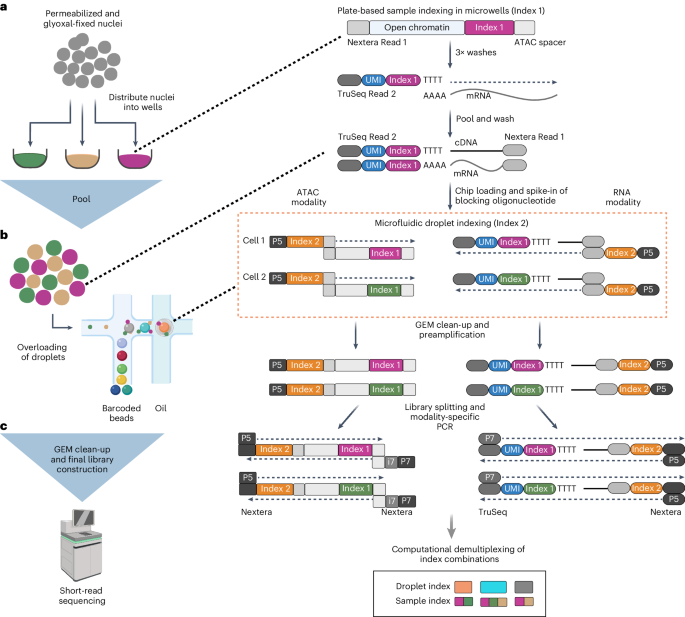
A common step in all strategies is the dissociation of the tissue/sample to obtain a single cell suspension, and the tagmentation of open chromatin following nuclei isolation (1). The commercial 10x Epi multiome workflow continues with the encapsulation of single nuclei into individual droplets, and barcoding of open chromatin and nuclear mRNA, omitting the possibility to pool multiple samples and limiting the throughput (a). While ligation-based combinatorial indexing strategies (b) offer higher throughput and, in principle, allow multiplexing, the capability is constrained by the number of first barcodes utilized. Moreover, multiplexing is experimentally challenging, as barcodes are appended after the in situ chromatin tagmentation and reverse transcription steps. Lastly, the ligation-based barcoding compromises the data complexity and quality. Combinatorial microfluidic indexing, as used in SUM-seq (c) enables a one-step multiplexing option, resulting in increased throughput and high data complexity. Created with BioRender.com.
Supplementary information
Supplementary Information
Supplementary Protocol 1–5, Supplementary Figs. 1–6 and Supplementary Note.
Reporting Summary
Supplementary Tables
Preindexing oligonucleotides for SUM-ATAC-seq. Preindexing oligonucleotides for SUM-RNA-seq. General oligonucleotides required for SUM-seq library preparation. Summary of optimization steps during the development of the SUM-seq protocol. Comparison between SUM-seq and other ATAC + RNA single-cell methods.
Rights and permissions
Springer Nature or its licensor (e.g. a society or other partner) holds exclusive rights to this article under a publishing agreement with the author(s) or other rightsholder(s); author self-archiving of the accepted manuscript version of this article is solely governed by the terms of such publishing agreement and applicable law.
About this article

Cite this article
Yildiz, U., Lobato-Moreno, S., Claringbould, A. et al. Single-cell ultra-high-throughput multiplexed chromatin accessibility and gene expression sequencing (SUM-seq). Nat Protoc (2026). https://doi.org/10.1038/s41596-025-01310-0
-
Received:
-
Accepted:
-
Published:
-
Version of record:
-
DOI: https://doi.org/10.1038/s41596-025-01310-0