
References
-
Xie, M. & Fussenegger, M. Designing cell function: assembly of synthetic gene circuits for cell biology applications. Nat. Rev. Mol. Cell Biol. 19, 507–525 (2018).
-
Lim, W. A. The emerging era of cell engineering: harnessing the modularity of cells to program complex biological function. Science 378, 848–852 (2022).
-
Saxena, P. et al. A programmable synthetic lineage-control network that differentiates human IPSCs into glucose-sensitive insulin-secreting beta-like cells. Nat. Commun. 7, 11247 (2016).
-
Courbet, A., Endy, D., Renard, E., Molina, F. & Bonnet, J. Detection of pathological biomarkers in human clinical samples via amplifying genetic switches and logic gates. Sci. Transl. Med. 7, 289ra83 (2015).
-
Weber, W. et al. A synthetic mammalian gene circuit reveals antituberculosis compounds. Proc. Natl Acad. Sci. 105, 9994–9998 (2008).
-
Nissim, L. et al. Synthetic RNA-based immunomodulatory gene circuits for cancer immunotherapy. Cell 171, 1138–1150.e15 (2017).
-
Peng, L., Sferruzza, G., Yang, L., Zhou, L. & Chen, S. CAR-T and CAR-NK as cellular cancer immunotherapy for solid tumors. Cell. Mol. Immunol. 21, 1089–1108 (2024).
-
Garreta, E. et al. Fine tuning the extracellular environment accelerates the derivation of kidney organoids from human pluripotent stem cells. Nat. Mater. 18, 397–405 (2019).
-
Barriga, E. H., Franze, K., Charras, G. & Mayor, R. Tissue stiffening coordinates morphogenesis by triggering collective cell migration in vivo. Nature 554, 523–527 (2018).
-
Barnes, J. M., Przybyla, L. & Weaver, V. M. Tissue mechanics regulate brain development, homeostasis and disease. J. Cell Sci. 130, 71–82 (2017).
-
Tschumperlin, D. J., Ligresti, G., Hilscher, M. B. & Shah, V. H. Mechanosensing and fibrosis. J. Clin. Invest. 128, 74–84 (2018).
-
Chatterjee, S. Endothelial mechanotransduction, redox signaling and the regulation of vascular inflammatory pathways. Front. Physiol. 9, 524 (2018).
-
Nia, H. T., Munn, L. L. & Jain, R. K. Physical traits of cancer. Science 370, eaaz0868 (2020).
-
Lampi, M. C. & Reinhart-King, C. A. Targeting extracellular matrix stiffness to attenuate disease: from molecular mechanisms to clinical trials. Sci. Transl. Med. 10, eaao0475 (2018).
-
Paszek, M. J. et al. Tensional homeostasis and the malignant phenotype. Cancer Cell 8, 241–254 (2005).
-
Gaggioli, C. et al. Fibroblast-led collective invasion of carcinoma cells with differing roles for RhoGTPases in leading and following cells. Nat. Cell Biol. 9, 1392–1400 (2007).
-
Gomez, E. W., Chen, Q. K., Gjorevski, N. & Nelson, C. M. Tissue geometry patterns epithelial–mesenchymal transition via intercellular mechanotransduction. J. Cell Biochem. 110, 44–51 (2010).
-
Kechagia, J. Z., Ivaska, J. & Roca-Cusachs, P. Integrins as biomechanical sensors of the microenvironment. Nat. Rev. Mol. Cell Biol. 20, 457–473 (2019).
-
Kirby, T. J. & Lammerding, J. Emerging views of the nucleus as a cellular mechanosensor. Nat. Cell Biol. 20, 373–381 (2018).
-
Kefauver, J. M., Ward, A. B. & Patapoutian, A. Discoveries in structure and physiology of mechanically activated ion channels. Nature 587, 567–576 (2020).
-
Faure, L. M., Venturini, V. & Roca-Cusachs, P. Cell compression — relevance, mechanotransduction mechanisms and tools. J. Cell Sci. 138, jcs263704 (2025).
-
Chen, W., Lou, J. & Zhu, C. Forcing switch from short- to intermediate- and long-lived states of the alphaA domain generates LFA-1/ICAM-1 catch bonds. J. Biol. Chem. 285, 35967–35978 (2010).
-
Kong, F., García, A. J., Mould, A. P., Humphries, M. J. & Zhu, C. Demonstration of catch bonds between an integrin and its ligand. J. Cell Biol. 185, 1275–1284 (2009).
-
del Rio, A. et al. Stretching single talin rod molecules activates vinculin binding. Science 323, 638–641 (2009).
-
Yao, M. et al. Mechanical activation of vinculin binding to talin locks talin in an unfolded conformation. Sci. Rep. 4, 4610 (2014).
-
Elosegui-Artola, A. et al. Mechanical regulation of a molecular clutch defines force transmission and transduction in response to matrix rigidity. Nat. Cell Biol.18, 540–548 (2016).
-
Oria, R. et al. Force loading explains spatial sensing of ligands by cells. Nature 552, 219–224 (2017).
-
Rakshit, S., Zhang, Y., Manibog, K., Shafraz, O. & Sivasankar, S. Ideal, catch, and slip bonds in cadherin adhesion. Proc. Natl Acad. Sci. USA 109, 18815–18820 (2012).
-
Desprat, N., Supatto, W., Pouille, P. A., Beaurepaire, E. & Farge, E. Tissue deformation modulates twist expression to determine anterior midgut differentiation in Drosophila embryos. Dev. Cell 15, 470–477 (2008).
-
Röper, J.-C. et al. The major β-catenin/E-cadherin junctional binding site is a primary molecular mechano-transductor of differentiation in vivo. eLife 7, e33381 (2018).
-
Zhou, B. et al. Notch signaling pathway: architecture, disease, and therapeutics. Signal. Transduct. Target. Ther. 7, 95 (2022).
-
Gordon, W. R. et al. Mechanical allostery: evidence for a force requirement in the proteolytic activation of Notch. Dev. Cell 33, 729–736 (2015).
-
Langridge, P. D. & Struhl, G. Epsin-dependent ligand endocytosis activates notch by force. Cell 171, 1383–1396.e12 (2017).
-
Khamaisi, B., Luca, V. C., Blacklow, S. C. & Sprinzak, D. Functional comparison between endogenous and synthetic Notch systems. ACS Synth. Biol. 11, 3343–3353 (2022).
-
Coste, B. et al. Piezo1 and Piezo2 are essential components of distinct mechanically activated cation channels. Science 330, 55–60 (2010).
-
Servin-Vences, M. R., Moroni, M., Lewin, G. R. & Poole, K. Direct measurement of TRPV4 and Piezo1 activity reveals multiple mechanotransduction pathways in chondrocytes. eLife 6, e21074 (2017).
-
O’Conor, C. J., Leddy, H. A., Benefield, H. C., Liedtke, W. B. & Guilak, F. TRPV4-mediated mechanotransduction regulates the metabolic response of chondrocytes to dynamic loading. Proc. Natl Acad. Sci. USA 111, 1316–1321 (2014).
-
Huang, M. & Chalfie, M. Gene interactions affecting mechanosensory transduction in Caenorhabditis elegans. Nature 367, 467–470 (1994).
-
Xiao, B. Mechanisms of mechanotransduction and physiological roles of PIEZO channels. Nat. Rev. Mol. Cell Biol. 25, 886–903 (2024).
-
Sinha, B. et al. Cells respond to mechanical stress by rapid disassembly of caveolae. Cell 144, 402–413 (2011).
-
Quiroga, X. et al. A mechanosensing mechanism controls plasma membrane shape homeostasis at the nanoscale. eLife 12, e72316 (2023).
-
Diz-Muñoz, A. et al. Membrane tension acts through PLD2 and mTORC2 to limit actin network assembly during neutrophil migration. PLoS Biol. 14, 1–30 (2016).
-
Roux, A.-L. L. e, Quiroga, X., Walani, N., Arroyo, M. & Roca-Cusachs, P. The plasma membrane as a mechanochemical transducer. Phil. Trans. R. Soc. B 374, 20180221 (2019).
-
Chachisvilis, M., Zhang, Y. L. & Frangos, J. A. G protein-coupled receptors sense fluid shear stress in endothelial cells. Proc. Natl Acad. Sci. USA 103, 15463–15468 (2006).
-
Denais, C. M. et al. Nuclear envelope rupture and repair during cancer cell migration. Science 352, 353–358 (2016).
-
Elosegui-Artola, A. et al. Force triggers YAP nuclear entry by regulating transport across nuclear pores. Cell 171, 1397–1410.e14 (2017).
-
Lombardi, M. L. et al. The interaction between nesprins and SUN proteins at the nuclear envelope is critical for force transmission between the nucleus and cytoskeleton. J. Biol. Chem. 286, 26743–26753 (2011).
-
Niethammer, P. Components and mechanisms of nuclear mechanotransduction. Annu. Rev. Cell Dev. Biol. 37, 233–256 (2021).
-
Enyedi, B., Jelcic, M. & Niethammer, P. The cell nucleus serves as a mechanotransducer of tissue damage-induced inflammation. Cell 165, 1160–1170 (2016).
-
Venturini, V. et al. The nucleus measures shape changes for cellular proprioception to control dynamic cell behavior. Science 370, eaba2644 (2020).
-
Lomakin, A. J. et al. The nucleus acts as a ruler tailoring cell responses to spatial constraints. Science 370, eaba2894 (2020).
-
Tajik, A. et al. Transcription upregulation via force-induced direct stretching of chromatin. Nat. Mater. 15, 1287–1296 (2016).
-
Zimmerli, C. E. et al. Nuclear pores dilate and constrict in cellulo. Science 374, eabd9776 (2021).
-
Aureille, J. et al. Nuclear envelope deformation controls cell cycle progression in response to mechanical force. EMBO Rep. 20, e48084 (2019).
-
Andreu, I. et al. Mechanical force application to the nucleus regulates nucleocytoplasmic transport. Nat. Cell Biol. 24, 896–905 (2022).
-
Dupont, S. et al. Role of YAP/TAZ in mechanotransduction. Nature 474, 179–183 (2011).
-
Luciano, M. et al. Cell monolayers sense curvature by exploiting active mechanics and nuclear mechanoadaptation. Nat. Phys. 17, 1382–1390 (2021).
-
Koushki, N., Ghagre, A., Srivastava, L. K., Molter, C. & Ehrlicher, A. J. Nuclear compression regulates YAP spatiotemporal fluctuations in living cells. Proc. Natl Acad. Sci. USA 120, e2301285120 (2023).
-
Tharp, K. M. et al. Adhesion-mediated mechanosignaling forces mitohormesis. Cell Metab. 33, 1322–1341.e13 (2021).
-
Phuyal, S. et al. Mechanical strain stimulates COPII-dependent secretory trafficking via Rac1. EMBO J. 41, e110596 (2022).
-
Ucar, H. et al. Mechanical actions of dendritic-spine enlargement on presynaptic exocytosis. Nature 600, 686–689 (2021).
-
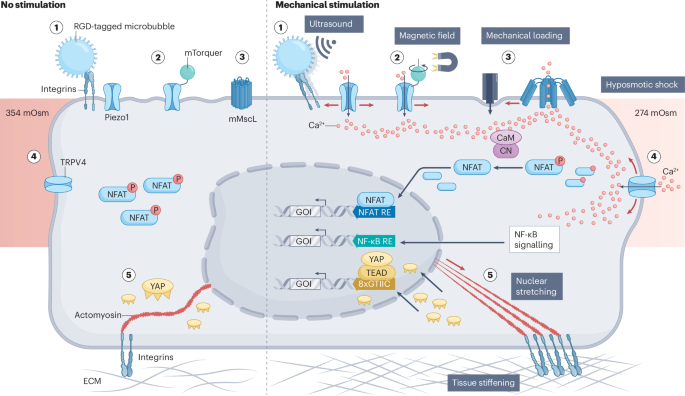
Liu, L. et al. Mechanoresponsive stem cells to target cancer metastases through biophysical cues. Sci. Transl. Med. 9, eaan2966 (2017). This paper describes synthetic mechanotransduction triggered by tissue mechanical properties, based on the mechanosensor YAP.
-
Pan, Y. et al. Mechanogenetics for the remote and noninvasive control of cancer immunotherapy. Proc. Natl Acad. Sci. USA 115, 992–997 (2018).
-
Woo Yoon, C. et al. Tumor priming by ultrasound mechanogenetics for with SynNotch CAR T therapy. Preprint at bioRxiv https://doi.org/10.1101/2024.10.01.615989 (2024). This paper describes synthetic mechanotransduction triggered by ultrasound, providing both mechanical and chemical control, based on the mechanosensor Piezo1.
-
Lee, J. U. et al. Non-contact long-range magnetic stimulation of mechanosensitive ion channels in freely moving animals. Nat. Mater. 20, 1029–1036 (2021).
-
Shin, W. et al. Magnetogenetics with Piezo1 mechanosensitive ion channel for CRISPR gene editing. Nano Lett. 22, 7415–7422 (2022). This paper describes synthetic mechanotransduction triggered by magnetic fields resulting in gene editing, based on the mechanosensor Piezo1.
-
Nims, R. J. et al. A synthetic mechanogenetic gene circuit for autonomous drug delivery in engineered tissues. Sci. Adv. 7, 9858–9885 (2021).
-
Yang, X., Zeng, H., Wang, L., Luo, S. & Zhou, Y. Activation of Piezo1 downregulates renin in juxtaglomerular cells and contributes to blood pressure homeostasis. Cell Biosci. 12, 197 (2022).
-
Kim, Y. S., Steward, N., Kim, A., Fehle, I. & Guilak, F. Tuning the response of synthetic mechanogenetic gene circuits using mutations in TRPV4. Tissue Eng. A 31, 174–183 (2025).
-
Heureaux, J., Chen, D., Murray, V. L., Deng, C. X. & Liu, A. P. Activation of a bacterial mechanosensitive channel in mammalian cells by cytoskeletal stress. Cell Mol. Bioeng. 7, 307–319 (2014).
-
Soloperto, A. et al. Mechano-sensitization of mammalian neuronal networks through expression of the bacterial large-conductance mechanosensitive ion channel. J. Cell Sci. 131, jcs210393 (2018).
-
Yoshimura, K., Batiza, A., Schroeder, M., Blount, P. & Kung, C. Hydrophilicity of a single residue within MscL correlates with increased channel mechanosensitivity. Biophys. J. 77, 1960–1972 (1999).
-
Iscla, I. & Blount, P. Sensing and responding to membrane tension: the bacterial MscL channel as a model system. Biophys. J. 103, 169–174 (2012).
-
Zhao, H. et al. Tuning of cellular insulin release by music for real-time diabetes control. Lancet Diabetes Endocrinol. 11, 637–640 (2023).
-
Liu, Y. et al. Robotic actuation-mediated quantitative mechanogenetics for noninvasive and on-demand cancer therapy. Adv. Sci. 11, 2401611 (2024).
-
Pocaterra, A., Romani, P. & Dupont, S. YAP/TAZ functions and their regulation at a glance. J. Cell Sci. 133, jcs230425 (2020).
-
Luan, S. & Wang, C. Calcium signaling mechanisms across kingdoms. Annu. Rev. Cell Dev. Biol. 37, 311–340 (2021).
-
Kis, Z. et al. Development of a synthetic gene network to modulate gene expression by mechanical forces. Sci. Rep. 6, 29643 (2016).
-
Barnea, G. et al. The genetic design of signaling cascades to record receptor activation. Proc. Natl Acad. Sci. USA 105, 64–69 (2008).
-
Morsut, L. et al. Engineering customized cell sensing and response behaviors using synthetic notch receptors. Cell 164, 780–791 (2016).
-
Meloty-Kapella, L., Shergill, B., Kuon, J., Botvinick, E. & Weinmaster, G. Notch ligand endocytosis generates mechanical pulling force dependent on dynamin, epsins, and actin. Dev. Cell 22, 1299–1312 (2012).
-
McMillan, B. J. et al. A tail of two sites: a bipartite mechanism for recognition of Notch ligands by mind bomb E3 ligases. Mol. Cell 57, 912–924 (2015).
-
Garibyan, M. et al. Engineering programmable material-to-cell pathways via synthetic Notch receptors to spatially control differentiation in multicellular constructs. Nat. Commun. 15, 5891 (2024).
-
Handa, H., Idesako, N. & Itoh, M. Immobilized DLL4-induced Notch signaling is mediated by dynamics of the actin cytoskeleton. Biochem. Biophys. Res. Commun. 602, 179–185 (2022). This paper describes engineering of synthetic cell receptors is based on Notch, with customizable extra- and intracellular ligands.
-
Sloas, D. C., Tran, J. C., Marzilli, A. M. & Ngo, J. T. Tension-tuned receptors for synthetic mechanotransduction and intercellular force detection. Nat. Biotechnol. 41, 1287–1295 (2023). Using the synthetic Notch developed by Handa et al., this paper describes engineering of synthetic Notch receptors sensitive to specific ranges of applied force.
-
Yang, S. et al. DNA-functionalized artificial mechanoreceptor for de novo force-responsive signaling. Nat. Chem. Biol. 20, 1066–1077 (2024). This paper describes a DNA-based synthetic mechanosensor.
-
Simmel, F. C., Yurke, B. & Singh, H. R. Principles and applications of nucleic acid strand displacement reactions. Chem. Rev. 119, 6326–6369 (2019).
-
Walbrun, A. et al. Single-molecule force spectroscopy of toehold-mediated strand displacement. Nat. Commun. 15, 7564 (2024).
-
Hsu, Y. Y., Resto Irizarry, A. M., Fu, J. & Liu, A. P. Mechanosensitive channel-based optical membrane tension reporter. ACS Sens. 8, 12–18 (2023).
-
Granero-Moya, I. et al. Nucleocytoplasmic transport senses mechanical forces independently of cell density in cell monolayers. J. Cell Sci. 137, jcs262363 (2024).
-
Oakes, P. W., Banerjee, S., Marchetti, M. C. & Gardel, M. L. Geometry regulates traction stresses in adherent cells. Biophys. J. 107, 825–833 (2014).
-
Faure, L. M. et al. 3D micropatterned traction force microscopy: a technique to control 3D cell shape while measuring cell-substrate force transmission. Adv. Sci. 11, 2406932 (2024).
-
Elosegui-Artola, A. et al. Rigidity sensing and adaptation through regulation of integrin types. Nat. Mater. 13, 631–637 (2014).
-
Chan, C. E. & Odde, D. J. Traction dynamics of filopodia on compliant substrates. Science 322, 1687–1691 (2008).
-
Elosegui-Artola, A., Trepat, X. & Roca-Cusachs, P. Control of mechanotransduction by molecular clutch dynamics. Trends Cell Biol. 28, 356–367 (2018).
-
Krishnan, R. et al. Reinforcement versus fluidization in cytoskeletal mechanoresponsiveness. PLoS ONE 4, e5486 (2009).
-
Andreu, I. et al. The force loading rate drives cell mechanosensing through both reinforcement and cytoskeletal softening. Nat. Commun. 12, 4229 (2021).
-
Asano, T., Ishizua, T. & Yawo, H. Optically controlled contraction of photosensitive skeletal muscle cells. Biotechnol. Bioeng. 109, 199–204 (2012).
-
Sakar, M. S. et al. Formation and optogenetic control of engineered 3D skeletal muscle bioactuators. Lab. Chip 12, 4976–4985 (2012).
-
Raman, R. et al. Optogenetic skeletal muscle-powered adaptive biological machines. Proc. Natl Acad. Sci. USA 113, 3497–3502 (2016).
-
Raman, R. Biofabrication of living actuators. Annu. Rev. Biomed. Eng. 26, 223–245 (2024).
-
Lee, K. Y. et al. An autonomously swimming biohybrid fish designed with human cardiac biophysics. Science 375, 639–647 (2022).
-
Izquierdo, E., Quinkler, T. & De Renzis, S. Guided morphogenesis through optogenetic activation of Rho signalling during early Drosophila embryogenesis. Nat. Commun. 9, 2366 (2018).
-
Valon, L., Marín-Llauradó, A., Wyatt, T., Charras, G. & Trepat, X. Optogenetic control of cellular forces and mechanotransduction. Nat. Commun. 8, 14396 (2017). This paper describes a molecular system that triggers cell force generation with light.
-
Wagner, E. & Glotzer, M. Local RhoA activation induces cytokinetic furrows independent of spindle position and cell cycle stage. J. Cell Biol. 213, 641–649 (2016).
-
Oakes, P. W. et al. Optogenetic control of RhoA reveals zyxin-mediated elasticity of stress fibres. Nat. Commun. 8, 15817 (2017).
-
Kennedy, M. J. et al. Rapid blue-light-mediated induction of protein interactions in living cells. Nat. Methods 7, 973–975 (2010).
-
Ruppel, A. et al. Force propagation between epithelial cells depends on active coupling and mechano-structural polarization. eLife 12, e83588 (2023).
-
Cavanaugh, K. E., Staddon, M. F., Munro, E., Banerjee, S. & Gardel, M. L. RhoA mediates epithelial cell shape changes via mechanosensitive endocytosis. Dev. Cell 52, 152–166.e5 (2020).
-
Yamamoto, K. et al. Optogenetic relaxation of actomyosin contractility uncovers mechanistic roles of cortical tension during cytokinesis. Nat. Commun. 12, 7145 (2021).
-
Herrera-Perez, R. M., Cupo, C., Allan, C., Lin, A. & Kasza, K. E. Using optogenetics to link myosin patterns to contractile cell behaviors during convergent extension. Biophys. J. 120, 4214–4229 (2021).
-
MacHacek, M. et al. Coordination of Rho GTPase activities during cell protrusion. Nature 461, 99–103 (2009).
-
Valon, L. et al. Predictive spatiotemporal manipulation of signaling perturbations using optogenetics. Biophys. J. 109, 1785–1797 (2015).
-
O’Neill, P. R., Kalyanaraman, V. & Gautam, N. Subcellular optogenetic activation of Cdc42 controls local and distal signaling to drive immune cell migration. Mol. Biol. Cell 27, 1442–1450 (2016).
-
Valon, L. et al. Quantitative subcellular control of Cdc42, Rac1 and RhoA GTPases using the Cry2/CIBN optogenetic dimerizer. Biophys. J. 106, 244a (2014).
-
Rossetti, L. et al. Optogenetic generation of leader cells reveals a force–velocity relation for collective cell migration. Nat. Phys. 20, 1659–1669 (2024).
-
Rao, M. V., Chu, P. H., Hahn, K. M. & Zaidel-Bar, R. An optogenetic tool for the activation of endogenous diaphanous-related formins induces thickening of stress fibers without an increase in contractility. Cytoskeleton 70, 394–407 (2013).
-
Wu, Y. I. et al. A genetically encoded photoactivatable Rac controls the motility of living cells. Nature 461, 104–108 (2009).
-
Wang, X., He, L., Wu, Y. I., Hahn, K. M. & Montell, D. J. Light-mediated activation reveals a key role for Rac in collective guidance of cell movement in vivo. Nat. Cell Biol. 12, 591–597 (2010).
-
Martin, A. C. & Goldstein, B. Apical constriction: themes and variations on a cellular mechanism driving morphogenesis. Development 141, 1987–1998 (2014).
-
Martínez-Ara, G. et al. Optogenetic control of apical constriction induces synthetic morphogenesis in mammalian tissues. Nat. Commun. 13, 5400 (2022). This paper describes a molecular system that induces differential cell forces on the apical and basal sides of cells, thus controlling tissue morphogenesis.
-
Zhang, W. et al. Optogenetic control with a photocleavable protein, PhoCl. Nat. Methods 14, 391–394 (2017).
-
Endo, M., Iwawaki, T., Yoshimura, H. & Ozawa, T. Photocleavable cadherin inhibits cell-to-cell mechanotransduction by light. ACS Chem. Biol. 14, 2206–2214 (2019).
-
Ollech, D. et al. An optochemical tool for light-induced dissociation of adherens junctions to control mechanical coupling between cells. Nat. Commun. 11, 472 (2020). This paper describes control of cell–cell adhesion with light.
-
Nzigou Mombo, B. et al. Reversible photoregulation of cell-cell adhesions with opto-E-cadherin. Nat. Commun. 14, 6292 (2023).
-
Liao, Z. & Shattil, S. J. Talin, a Rap1 effector for integrin activation at the plasma membrane, also promotes Rap1 activity by disrupting sequestration of Rap1 by SHANK3. J. Cell Sci. 138, JCS263595 (2025).
-
Liao, Z., Kasirer-Friede, A. & Shattil, S. J. Optogenetic interrogation of integrin αVβ3 function in endothelial cells. J. Cell Sci. 130, 3532–3541 (2017).
-
Baaske, J. et al. Optogenetic control of integrin–matrix interaction. Commun. Biol. 2, 15 (2019).
-
Petersen, S. et al. Phototriggering of cell adhesion by caged cyclic RGD peptides. Angew. Chem. 120, 3236–3239 (2008).
-
Lee, T. T. et al. Light-triggered in vivo activation of adhesive peptides regulates cell adhesion, inflammation and vascularization of biomaterials. Nat. Mater. 14, 352–360 (2014). This paper describes the control of cell–matrix adhesion with light in vivo.
-
Wang, X. & Ha, T. Defining single molecular forces required to activate integrin and Notch signaling. Science 340, 991–994 (2013).
-
Zhang, Y., Ge, C., Zhu, C. & Salaita, K. DNA-based digital tension probes reveal integrin forces during early cell adhesion. Nat. Commun. 5, 5167 (2014).
-
Jo, M. H. et al. Determination of single-molecule loading rate during mechanotransduction in cell adhesion. Science 383, 1374–1379 (2024).
-
Combs, J. D. et al. Measuring integrin force loading rates using a two-step DNA tension sensor. J. Am. Chem. Soc. 146, 23034–23043 (2024).
-
Schoenit, A. et al. Tuning epithelial cell–cell adhesion and collective dynamics with functional DNA-E-cadherin hybrid linkers. Nano Lett. 22, 302–310 (2022).
-
Stevens, A. J. et al. Programming multicellular assembly with synthetic cell adhesion molecules. Nature 614, 144–152 (2023).
-
Baba, H., Fujita, T., Mizuno, K., Tambo, M. & Toda, S. Programming spatial cell sorting by engineering cadherin intracellular activity. ACS Synth. Biol. 13, 1705–1715 (2024).
-
Bijonowski, B. M. et al. Intercellular adhesion boots collective cell migration through elevated membrane tension. Nat. Commun. 16, 1588 (2025).
-
Heinisch, J. J. et al. Atomic force microscopy — looking at mechanosensors on the cell surface. J. Cell Sci. 125, 4189–4195 (2012).
-
Wang, C. & Yadavalli, V. K. Investigating biomolecular recognition at the cell surface using atomic force microscopy. Micron 60, 5–17 (2014).
-
Liu, J. et al. Tension gauge tethers as tension threshold and duration sensors. ACS Sens. 8, 704–711 (2023).
-
Chaudhuri, O., Cooper-White, J., Janmey, P. A., Mooney, D. J. & Shenoy, V. B. Effects of extracellular matrix viscoelasticity on cellular behaviour. Nature 584, 535–546 (2020).
-
Joseph, J. G. & Liu, A. P. Mechanical regulation of endocytosis: new insights and recent advances. Adv. Biosyst. 4, 1900278 (2020).
-
Boulant, S., Kural, C., Zeeh, J. C., Ubelmann, F. & Kirchhausen, T. Actin dynamics counteract membrane tension during clathrin-mediated endocytosis. Nat. Cell Biol. 13, 1124–1131 (2011).
-
Baschieri, F. et al. Frustrated endocytosis controls contractility-independent mechanotransduction at clathrin-coated structures. Nat. Commun. 9, 3825 (2018).
-
Zhao, W. et al. Nanoscale manipulation of membrane curvature for probing endocytosis in live cells. Nat. Nanotechnol. 12, 750–756 (2017).
-
Kaksonen, M. & Roux, A. Mechanisms of clathrin-mediated endocytosis. Nat. Rev. Mol. Cell Biol. 19, 313–326 (2018).
-
Lovett, D. B., Shekhar, N., Nickerson, J. A., Roux, K. J. & Lele, T. P. Modulation of nuclear shape by substrate rigidity. Cell Mol. Bioeng. 6, 230–238 (2013).
-
Swift, J. et al. Nuclear lamin-A scales with tissue stiffness and enhances matrix-directed differentiation. Science 341, 1240104 (2013).
-
Guilak, F. Compression-induced changes in the shape and volume of the chondrocyte nucleus. J. Biomech. 28, 1529–1541 (1995).
-
Lemière, J., Real-Calderon, P., Holt, L. J., Fai, T. G. & Chang, F. Control of nuclear size by osmotic forces in Schizosaccharomyces pombe. eLife 11, e76075 (2022).
-
Finan, J. D., Chalut, K. J., Wax, A. & Guilak, F. Nonlinear osmotic properties of the cell nucleus. Ann. Biomed. Eng. 37, 477–491 (2009).
-
Versaevel, M., Grevesse, T. & Gabriele, S. Spatial coordination between cell and nuclear shape within micropatterned endothelial cells. Nat. Commun. 3, 671 (2012).
-
Wu, J. et al. Actomyosin pulls to advance the nucleus in a migrating tissue cell. Biophys. J. 106, 7–15 (2014).
-
Kalukula, Y., Stephens, A. D., Lammerding, J. & Gabriele, S. Mechanics and functional consequences of nuclear deformations. Nat. Rev. Mol. Cell Biol. 23, 583–602 (2022).
-
Malashicheva, A. & Perepelina, K. Diversity of nuclear lamin A/C action as a key to tissue-specific regulation of cellular identity in health and disease. Front. Cell Dev. Biol. 9, 761469 (2021).
-
Furusawa, T. et al. Chromatin decompaction by the nucleosomal binding protein HMGN5 impairs nuclear sturdiness. Nat. Commun. 6, 6138 (2015).
-
Stephens, A. D. et al. Chromatin histone modifications and rigidity affect nuclear morphology independent of lamins. Mol. Biol. Cell 29, 220–233 (2018).
-
Kosmalska, A. J. et al. Physical principles of membrane remodelling during cell mechanoadaptation. Nat. Commun. 6, 7292 (2015).
-
Kechagia, Z. et al. The laminin–keratin link shields the nucleus from mechanical deformation and signalling. Nat. Mater. 22, 1409–1420 (2023).
-
Beedle, A. E. M. et al. Fibrillar adhesion dynamics govern the timescales of nuclear mechano-response via the vimentin cytoskeleton. Preprint at bioRxiv https://doi.org/10.1101/2023.11.08.566191 (2023).
-
Nava, M. M. et al. Heterochromatin-driven nuclear softening protects the genome against mechanical stress-induced damage. Cell 181, 800–817.e22 (2020).
-
Santorelli, M. et al. Control of spatio-temporal patterning via cell growth in a multicellular synthetic gene circuit. Nat. Commun. 15, 9867 (2024).
-
Roca-Cusachs, P., Conte, V. & Trepat, X. Quantifying forces in cell biology. Nat. Cell Biol. 19, 742–751 (2017).
-
Villeneuve, C., McCreery, K. P. & Wickström, S. A. Measuring and manipulating mechanical forces during development. Nat. Cell Biol. 27, 575–590 (2025).
-
Brophy, J. A. N. & Voigt, C. A. Principles of genetic circuit design. Nat. Methods 11, 508–520 (2014).
-
Kohn, J. C. et al. Cooperative effects of matrix stiffness and fluid shear stress on endothelial cell behavior. Biophys. J. 108, 471–478 (2015).
-
Zieman, S. J., Melenovsky, V. & Kass, D. A. Mechanisms, pathophysiology, and therapy of arterial stiffness. Arterioscler. Thromb. Vasc. Biol. 25, 932–943 (2005).
-
O’Rourke, M. F. & Nichols, W. W. Aortic diameter, aortic stiffness, and wave reflection increase with age and isolated systolic hypertension. Hypertension 45, 652–658 (2005).
-
Gossen, M. & Bujard, H. Tight control of gene expression in mammalian cells by tetracycline-responsive promoters. Proc. Natl Acad. Sci. USA 89, 5547–5551 (1992).
-
Chassin, H. et al. A modular degron library for synthetic circuits in mammalian cells. Nat. Commun. 10, 2013 (2019).
-
Simsek, H. & Klotzsch, E. The solid tumor microenvironment — breaking the barrier for T cells. BioEssays 44, 2100285 (2022).
-
Chitty, J. L. et al. A first-in-class pan-lysyl oxidase inhibitor impairs stromal remodeling and enhances gemcitabine response and survival in pancreatic cancer. Nat. Cancer 4, 1326–1344 (2023).
-
Nakanishi, H. & Kato, Y. Protein-based systems for translational regulation of synthetic mRNAs in mammalian cells. Life 11, 1192 (2021).
-
Yang, X. et al. Engineering synthetic phosphorylation signaling networks in human cells. Science 387, 74–81 (2025).
-
Nielsen, A. A. K. et al. Genetic circuit design automation. Science 352, aac7341 (2016).
-
Jones, T. S., Oliveira, S. M. D., Myers, C. J., Voigt, C. A. & Densmore, D. Genetic circuit design automation with Cello 2.0. Nat. Protoc. 17, 1097–1113 (2022).
-
Gala, M. & Žoldák, G. Classifying residues in mechanically stable and unstable substructures based on a protein sequence: the case study of the DnaK Hsp70 chaperone. Nanomaterials 11, 2198 (2021).
-
Asgharzadeh, P. et al. A NanoFE simulation-based surrogate machine learning model to predict mechanical functionality of protein networks from live confocal imaging. Comput. Struct. Biotechnol. J. 18, 2774–2788 (2020).
-
Kulkarni, J. A. et al. The current landscape of nucleic acid therapeutics. Nat. Nanotechnol. 16, 630–643 (2021).
-
Procko, C. et al. Mutational analysis of mechanosensitive ion channels in the carnivorous Venus flytrap plant. Curr. Biol. 33, 3257–3264.e4 (2023).
-
Garamella, J., Majumder, S., Liu, A. P. & Noireaux, V. An adaptive synthetic cell based on mechanosensing, biosensing, and inducible gene circuits. ACS Synth. Biol. 8, 1913–1920 (2019).
-
Jahnke, K. et al. DNA origami signaling units transduce chemical and mechanical signals in synthetic cells. Adv. Funct. Mater. 34, 2301176 (2024).

