
- Comment
- Published:
Subjects
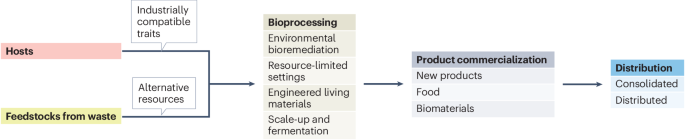
Engineered biology has long been touted as a sustainable avenue for producing the world’s energy, chemicals and food. However, substantial challenges in scalability, economic competitiveness and resource use have hindered its industrial translatability. This Comment discusses emerging strategies to increase the competitiveness of this technology by rethinking the microbial host, feedstock, product landscapes and applications.
This is a preview of subscription content, access via your institution
Access options
Subscribe to this journal
Receive 12 digital issues and online access to articles
$119.00 per year
only $9.92 per issue
Buy this article
- Purchase on SpringerLink
- Instant access to full article PDF
Prices may be subject to local taxes which are calculated during checkout

References
-
Jawed, K., Yazdani, S. & Koffas, M. Metab. Eng. Commun. 9, e00095 (2019).
-
Numberger, D. et al. Sci. Rep. 9, 9673 (2019).
-
Ruiz, C. et al. J. Biotechnol. 306, 9–15 (2019).
-
Goveas, L. C. et al. J. Pure Appl. Microbiol. 14, 473–484 (2020).
-
Bazina, N. et al. J. Biotechnol. 374, 17–30 (2023).
-
Liew, F. E. et al. Nat. Biotechnol. 40, 335–344 (2022).
-
Patel, R. N. et al. Biomolecules 3, 741–777 (2013).
-
Pauli, S. et al. Metab. Eng. 77, 100–117 (2023).
-
Reed, K. B. et al. Nat. Commun. 15, 3188 (2024).
-
Shankar, S. & Hoyt, M. A. Expression Constructs and Methods of Genetically Engineering Methylotrophic Yeast (ed. USPTO) (Impossible Foods, 2020).
-
Xu, Y. et al. Trends Food Sci. Technol. 129, 512–527 (2022).
-
Choi, Y. & Lee, S. Y. Nat. Rev. Chem. 4, 638–656 (2020).
-
Wen, A. et al. ACS Synth. Biol. 10, 3264–3277 (2021).
-
Ali, N. et al. Sci. Rep. 10, 1116 (2020).
-
Conde-Pueyo, N. et al. Life 10, 14 (2020).
Acknowledgements
This work was partially supported by the National Science Foundation (NSF) under award numbers CBET- 2133661 and EFMA-2029249. S.G.L. was supported by an NSF Graduate Research Fellowship Program.
Ethics declarations
Competing interests
The authors declare no competing interests.
Peer review
Peer review information
Nature Chemical Engineering thanks Joshua Yuan and the other, anonymous, reviewer(s) for their contribution to the peer review of this work.
Rights and permissions
About this article

Cite this article
Lee, S.G., Alper, H.S. Toward a more effective engineered biology. Nat Chem Eng (2025). https://doi.org/10.1038/s44286-025-00263-1
-
Published:
-
DOI: https://doi.org/10.1038/s44286-025-00263-1